

When You’re Sliding Into First and You Feel You’re Gonna Burst, Read This Story
What you need to know about the cyclospora outbreak.

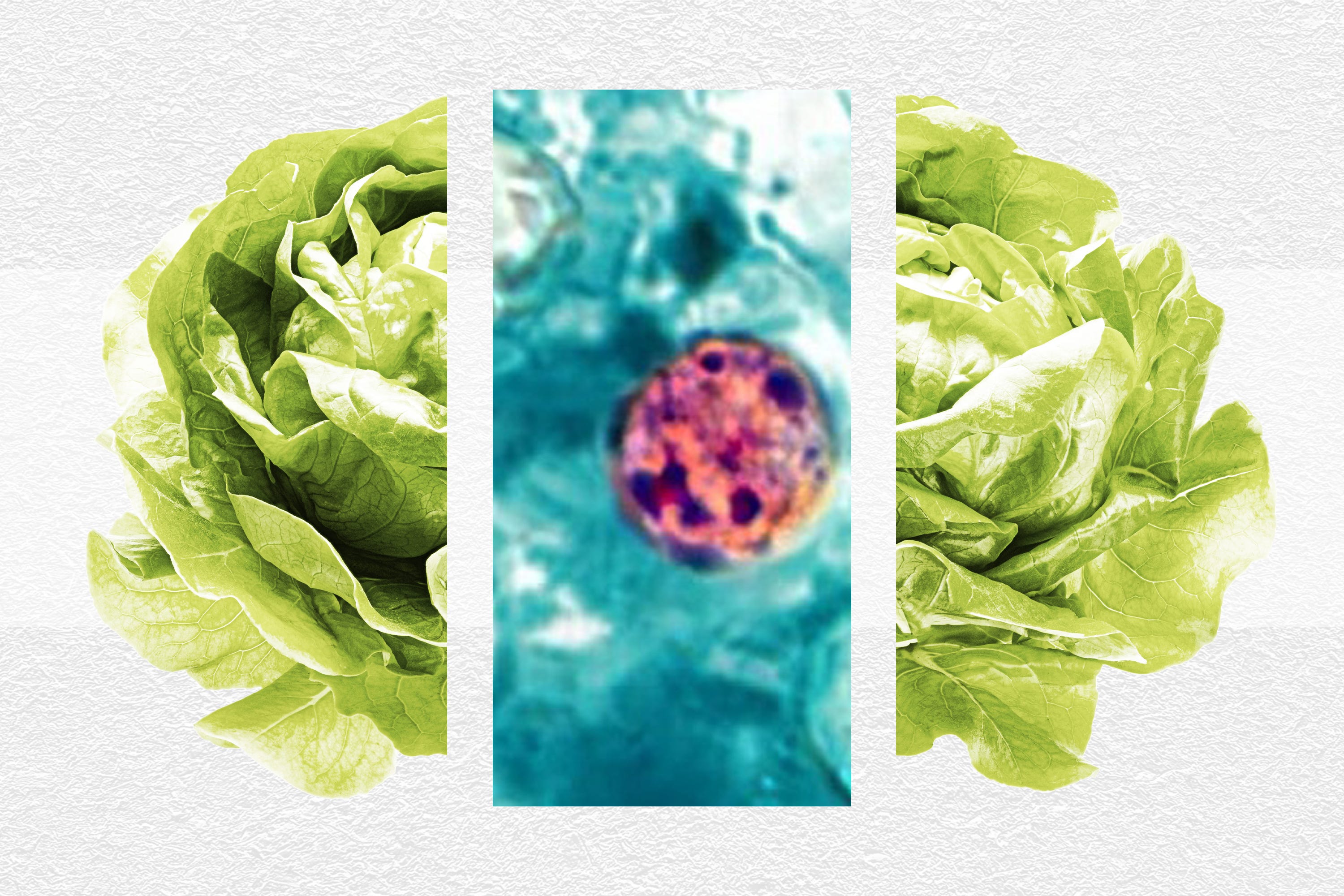
“EXPLOSIVE DIARRHEA” IS NOT A PHRASE YOU WANT to be hearing in your household, let alone on the national news. But it is happening a lot these days, thanks to an outbreak of a parasitic infection called cyclospora that has already sickened thousands of people across the country.
So far the largest number is in Michigan, my home state. But it’s not simply a Michigan problem: More than thirty states have recorded cases. And although officials have said they think contaminated lettuce might be the culprit, or one of the culprits, as of Wednesday morning they still were not sure.
That last part has raised a lot of questions about how federal public health agencies are handling the outbreak, given their weakened condition following all of the funding cuts, layoffs, and leadership purges by the Trump administration.
But those aren’t the only questions on people’s minds. There are practical questions too: What is this disease? How do you get it? What can you do to not get it? And what should you do if you get it?
To answer those sorts of questions—including some submitted by readers of The Bulwark—I turned to Katelyn Jetelina, an epidemiologist and data scientist who consults with organizations like the CDC but is probably best known as the founder and writer of the Your Local Epidemiologist newsletter.
Jetelina knows the relevant science. She is also gifted at explaining it to non-scientists. That is no small thing, especially in a time when government agencies have lost their veteran leaders and the public’s trust.
A lightly edited transcript of our conversation follows.
JONATHAN COHN: Katelyn, thanks for joining us. Don’t take this the wrong way, but as soon as I heard the phrase “explosive diarrhea,” you were the first name that came to mind.
KATELYN JETELINA: What an honor. What an honor. Yeah, you guys just keep calling me with these random bug things that keep happening at really high rates nowadays, huh?
COHN: Yes, it is not always the best thing to see you on our camera. But all joking aside, let’s start with the basics. What is cyclospora? How does it make you sick and what does it do to your body?
JETELINA: Cyclospora is a microscopic, really, small single-celled parasite. And the interesting thing about this parasite is humans are the only known host. So every contamination event traces back to—and I know this is disgusting—human waste or fecal matter, somewhere along the train, and usually in water.
There are two ways a food source gets contaminated. One is at the farm level, from poor field sanitation. It could be workers without adequate bathroom access, or contaminated irrigation water. Or contamination can happen during processing, usually through contaminated water at the packing or washing stage.
We don’t know which one it is yet. I hope we get answers soon. But it does trace back to human fecal matter hitting our produce, and then us eating it and making us sick.
COHN: And when you get sick, what happens?
JETELINA: So it’s watery, explosive diarrhea. It is not fun. And partly it’s not fun because you get cramping and bloating and fatigue, and appetite loss and sometimes low fever.
But this bugger can drag out for weeks. There was this poor soul in a Nepal outbreak, they went 107 days with these symptoms. It comes and goes, you feel like you’re getting better and then it’ll come back for a few days.
Thankfully it’s rarely fatal. There are no deaths reported with this outbreak. The real danger is dehydration from weeks of diarrhea. And it’s usually hardest hit for the most vulnerable—we’re talking pregnant women, kids, older adults, immunocompromised.
With really severe cases among high-risk groups, it can be treated with antibiotics. But that is usually the last move. Usually you just wait it out.
COHN: This gets to one of our reader questions who said their son was having watery diarrhea for a couple of days and wanted to know, at what point do you seek help for this?
JETELINA: Dehydration is the biggest concern. And so a few days should be okay as long as they can suck on ice cubes. But always check with your clinical care team. They’ll tell you when to come in.
We usually know it’s cyclospora compared to another disease that causes diarrhea because it lasts so long. And so if you’re high risk, don’t tough it out. If you’re pregnant, immunocompromised, go to the doctor, call them.
All of us that are healthy can probably last it out for a few days. But it’s always great to connect with the care team.
COHN: We’re going to talk in a minute about what the government should be doing to detect and prevent the disease, but I want to stay on the individual level for right now. People listening to this, they’ll be thinking, I don’t want to get sick. What is some general advice for how we should be conducting ourselves, to try to avoid this?
JETELINA: Unfortunately we don’t know the source yet. It’s delayed. I don’t know why we don’t know the source. I wish we had more answers, but we don’t.
What we know from past outbreaks in the United States is that cyclospora is usually on produce with lots of grooves and bumps and folds, because the parasite finds those folds and hides in the nooks and crannies. And so it’s typically on lettuce. So right now I’m avoiding bagged or boxed salads…
COHN: You mean like the bags you get in the store?
JETELINA: Yes, those pre-made ones that make my life easier at dinner. I’m not buying those, because that’s usually a big culprit. Whole heads of lettuce that you can wash and cut yourself are probably a safer bet.
COHN: I read somewhere that raspberries are a good one to avoid, which broke my heart because I love raspberries this time of year. Is that right?
JETELINA: That’s right. If you think about raspberries, they have tons of those grooves and the parasite can just stick in there.
Things you can peel are usually good. Oranges or bananas are great. Or things that you can really wash thoroughly, like a cucumber. Or definitely anything you can cook.
Support our coverage of health and policy—even the gross stuff. Join Bulwark+.
COHN: So this gets to a couple of reader questions. I’m gonna throw them at you real quick and you know you can give me some answers. So Natalie said, does it matter if I’m washing them in hot water? Should I be using soap to wash my produce?
JETELINA: That’s a good question. Washing helps, but it won’t fully remove the parasite because—again—it clings and hides in these nooks and crannies.
Cooking is the better bet. And in order to cook it, you have to cook the spinach leaf or whatever to hit a temperature of 158 degrees [Fahrenheit]. Once you hit that, it completely kills the parasite and so you’re good.
Freezing doesn’t really work as well. Microwaves also don’t work as well because the temperature is so inconsistent. What you see in studies is at least 45 seconds [in the microwave], but even 45 seconds doesn’t kill [it] all.
So really the best bet is putting it on your stove. I know you can’t put your bagged salad on a stove. That doesn’t sound very great. So for me at least that means just avoiding it.
COHN: One question we got from a lot of readers, including Martha and Connie, was about buying produce from a local farm stand rather than a store? Is that safer? Can you trust that?
JETELINA: I’m seeing that question a lot too. I think it’s a great question. The problem is that cyclospora lives in the soil or contaminated water sources. So local produce could be contaminated as well. We just don’t know how this started.
If this started at a processing plant, sure, those local farms are much more safe. But if it actually started at a source of farm water contamination, it could still be infected. . . .
COHN: This is now considered the largest outbreak [of cyclospora] in recent history. Is there any reason to think the disease is a worse outbreak for some reason? Do we know? Do we think we’re maybe detecting it?
JETELINA: We have spikes every year around this time. Every year we have about 3,000 to 4,000 cases in total. Right now we have about more than 3,000 cases for this particular outbreak. So this is definitely a big outbreak. It is not something we really expected.
The question of why is a really good question. And I’ll be honest, I don’t think we know yet.
It could be that it was just spreading undetected for a long time, and now we’re catching a lot of cases. And we’re going to get more cases the more that people are asking questions, and the knowledge base is increasing. More people are gonna be testing, more physicians are gonna be willing to use the test, and the numbers are going to balloon.
Unfortunately, the only way to really stop an outbreak like this is to take the source out from distribution. And we can only do that over time—that certain lettuce from that farm just stops getting circulated, or we do find a specific thing that’s then pulled from the market.
COHN: Alright, let’s talk about policy. You have written—we both have written—about cuts to the public health infrastructure of this country under the Trump administration. That includes a scaling back of some of the data tracking for cyclospora, as I understand it. Now, you’ve written about this and you seemed skeptical that it was actually part of the story here. Could you talk about that for a second?
JETELINA: A lot of people are pointing their fingers to this program that was cut called FoodNet, that was cut last September. The reason I’m very skeptical about that is that FoodNet was never used for outbreak detection or response. It was used more to detect trends in the background that researchers use for studying this parasite—or other other bugs—over time.
There was an impact in cutting that, don’t get me wrong. But I don’t think that there’s a direct link to this outbreak.
What I do think is happening is not rocket science. If you cut public health funding, you cut our force. You have a lack of transparency. You have no centralized communication efforts. . . .
We have siloed health systems, and these teams are chronically underfunded, especially parasite teams. And you know, this work is very laborious.
And local public health departments are being pulled in a billion directions right now. We have the highest number of measles cases in thirty years. We’re dealing with Ebola and people traveling from places with Ebola. We have a really high whooping cough rate. We have the World Cup. We have so much going on.
I think the bottom line is that, if the American public wants a public health system and one that works, then the United States has to pay for it and support it. And what we’ve seen over the past eighteen months is the decimation of it instead.
COHN: You do epidemiology, you’ve been part of these efforts. A lot of this damage has been done. When you lose people, when you lay off people, you can’t just snap your fingers and flip a switch. How long do you think it’s going to take us to rebuild this kind of infrastructure just to get back to where we were before these cuts?
JETELINA: You’re not going to like my answer. I think it’s gonna be at least ten to twenty years. I think we are going to go backwards. We are going to go backwards before we go forward again. I think the biggest question is how backwards do we go? And what sense of urgency is met with it.
These systems have been destroyed and it’s not like the status quo was great before. We have lost a lot of historical knowledge. We’re losing a lot of scientific research and funding right now.
And it’s not like a subscription where you can turn on and turn off. We need these pipelines of brilliant scientists. We need these surveillance systems. We also need to reimagine how these systems work, so we can all do better in the future as well. So it’s going to take a while.
Which means you may be calling me more to join The Bulwark during outbreaks. But this is what those of us in public health expected would happen. I am not surprised this is the state of affairs now.
The needless undermining of public health initiatives seems to be primarily about eugenics: authoritarians who genuinely want to believe in their own physical/mental superiority and are happy to put it to the test, thinking that they'll be immune because of "superior genes" or "better life choices," or that others will be hurt more than they were. The dark irony of this is that horrible diseases don't often play by those rules (the Spanish Flu was the most lethal to healthy young people), and avoiding getting sick in yesteryear was often simply a matter of either not being exposed or being exposed in a situation where the circumstances wouldn't take someone's life in the process. That and the only reason why authoritarians can delude themselves is because of public health initiatives (mass vaccinations, public sanitation, etc.) minimized and/or eliminated those diseases in the first place.
Best of luck, health wellness influencers and MAGA bros. Try not to squirt all over the toilet and bathroom floor.
I cackled at this headline