Defiance in a Time of Cowardice
She sang the national anthem in Spanish as deportation forces assaulted L.A. Now she’s headed to Sundance.

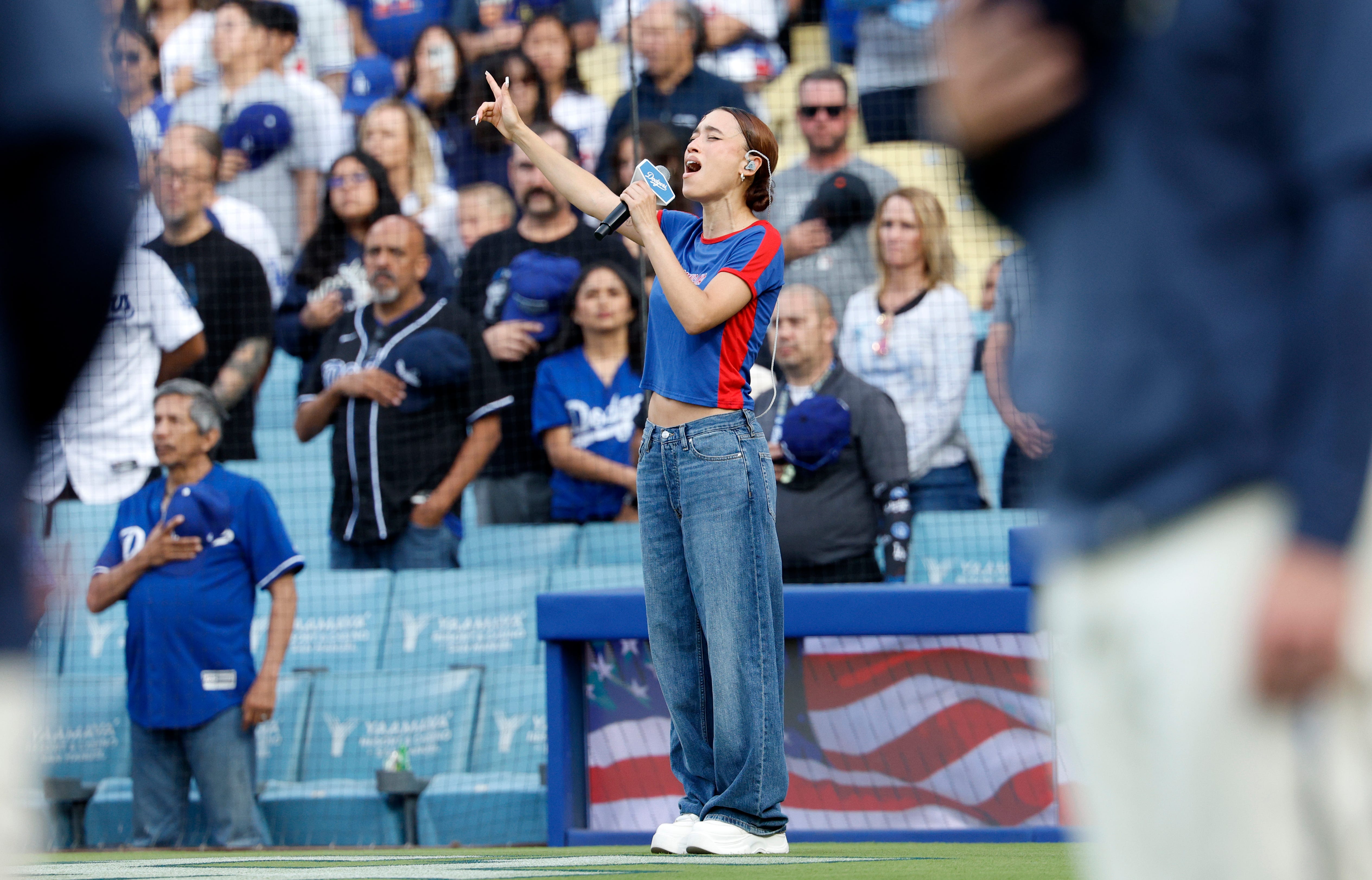
THERE WERE PLENTY OF INDELIBLE MOMENTS for the Los Angeles Dodgers this past season, in which the franchise won its second consecutive World Series in dramatic Game 7 fashion.
But the one that will stick with me the most—the video that still gives me chills—came during an otherwise unremarkable baseball day early in the summer. It was June 14, and the pop artist Nezza was getting ready to sing the national anthem at Dodger Stadium. A week earlier, ICE and DHS agents had descended en masse on Los Angeles work sites, grabbing immigrants and U.S. citizens alike. In solidarity, Nezza’s crew informed the Dodgers that she wanted to sing the official Spanish-language version of the anthem, “El Pendón Estrellado,” which had been commissioned by President Franklin D. Roosevelt in 1945. In response, she told me, the team said she had ninety seconds to sing, but didn’t specify what language she had to sing in.
That was the day before she was set to perform. On the day of the performance, a Dodgers employee made clear to her that the team did not want her to sing in Spanish. “We are going to do the song in English today, so I’m not sure if that wasn’t transferred or if that wasn’t relayed,” the employee said to Nezza. A video of the exchange, which Nezza posted on Instagram, captured her bright expression immediately dimming as she crossed her arms.
Nezza, whose given name is Vanessa Hernández, told me in an interview that immediately after that video was shot, she cried in the bathroom for 45 minutes. As she walked onto the field, she saw Latino families cheering her on. Even seconds before the first note, she hadn’t decided what to do. She says she felt like God was holding her hand. She breathed in, and Spanish came out. According to Nezza, her manager received a phone call from the Dodgers afterwards informing them that Nezza—and the manager’s other clients—were no longer welcome at Dodger Stadium. (The team denied doing so, and a spokesperson told the press that the franchise had “no hard feelings” toward Nezza and would be “happy to have her back.”)
The backlash to Nezza singing the official Spanish-language version of the Star-Spangled Banner wasn’t nearly as overwrought as the reaction a few months later to the announcement that Bad Bunny will be performing next year’s Super Bowl halftime show, although the singer said she received death threats. And ultimately, the incident has proved a boon to her career. Nezza is suddenly everywhere. She was a guest on Jimmy Kimmel Live!. The Los Angeles City Council honored her and had her sing the anthem in Spanish. Shakira invited her to be a guest at her concert.
And now the latest break for Nezza: A short film focusing on the incident, La Tierra del Valor (The Home of the Brave), will be screened among ten short documentaries at the 2026 Sundance Film Festival in late January.
THE ENTIRE SAGA made me think about the nature of defiance in this second Trump term—how the pains and pressure points the Trump administration has placed on certain communities have led to acts of bravery, not just from celebrated artists but from everyday laborers too.
Nezza certainly didn’t feel like a badass superhero the moment she grabbed the microphone. In fact, she was filled with fear and uncertainty.
“It came out of a place of pure heartbreak,” she told me by phone after the Sundance news broke. “I don’t think I’ve been that heartbroken in my life. I took it personally. And heartbreak leads you to do something you wouldn’t normally do.”
What compelled her to sing in Spanish that day, she explained, was the simple act of looking out into the crowd and seeing people who, she felt, needed solidarity. ICE raids had racked some of their community and upended their lives. The act of showing up to a baseball game would have normally transported them back to a sense of normalcy. But even in the most soothing of U.S. sporting events—where teams compete with no clock, and fans relax to the rhythms of the game and the comfort of an ice-cold beer—there was tension.
“I just wanted people to know I was with them. I wanted people who aren’t Spanish-speaking to see we’re a part of this nation’s history. We wouldn’t be where we are without us, we are part of that story,” she said. “I never meant it as disrespect. . . . Two things can be true: You can be a proud American and want better for your country.”
Look, if you don’t believe in fate, that’s fine. But there are certain elements of Nezza’s story that make you wonder.
The day she sang the anthem was No Kings Day. When, a few days later, she appeared on Jimmy Kimmel Live!, Kimmel was out on vacation and Diego Luna was filling in that week as guest host.
And that’s how Cristina Constantini met Nezza. Constantini, a director who has taken on such varied documentary subjects as Sally Ride, the first American woman astronaut; Walter Mercado, the popular astrologer; and Latin superstar Karol G, happened to be visiting Kimmel’s show because she loves Luna.
After the singer and the director took a photo together backstage at Kimmel’s show, they quickly decided to make a short film detailing Nezza’s moment of noncompliance—and that’s what led to La Tierra del Valor.
“We live during a time where all the institutions and corporations I worked for—or leaders I looked up to—they caved or remained silent, so we are now finding hope in everyday people,” Constantini told me, stressing that what has become one of the best moments of Nezza’s career could easily have been a moment that stalled it. “This young woman at an inflection point in her career, who has a lot going on, broke with what the corporation or institution was asking for in that moment. It’s the kind of bravery we need to embody in the coming years as we fight fascism, authoritarianism, and the powers that be.”
Constantini was drawn to Nezza’s story precisely because she used the American national anthem as a springboard for taking a stand for Spanish speakers. But upon talking to Nezza, she learned another critical lesson about what defiance looks like.
“She articulates it well, bravery often feels like fear in the moment,” Constantini told me. “After the fact everyone says, ‘She’s so strong, she’s so courageous.’”
In our conversation Nezza talked about how odd it felt to be portrayed as a defiant figure. Those who know her, including Constantini, say she is the last person anyone would expect to break the rules, especially in such a spectacular fashion.
“I never put myself in a position to get in trouble. I talk to my therapist—I don’t know what it is but it makes my body freeze, I can’t even cut in line,” Nezza half-joked.
But one of the few silver linings that have come from this harsh year of deportations and ICE raids is that it has clarified which people and institutions will use their voices to push back and which will choose accommodation. Many powerful organizations and individuals found themselves swiftly moving to the latter camp. Nezza proved she belonged to the former.
“I’m finding a lot of hope in figures like Nezza right now,” Constantini said. “That’s what you do during dark times: You look to the people that are fighting.”
“Two things can be true: You can be a proud American and want better for your country.” That part right there is what this community is all about.
Thank you for sharing this. I had no idea this had happened.