Does DHS Flack Tricia McLaughlin Believe Her Own Lies?
She knows what her real audience wants to hear from her.

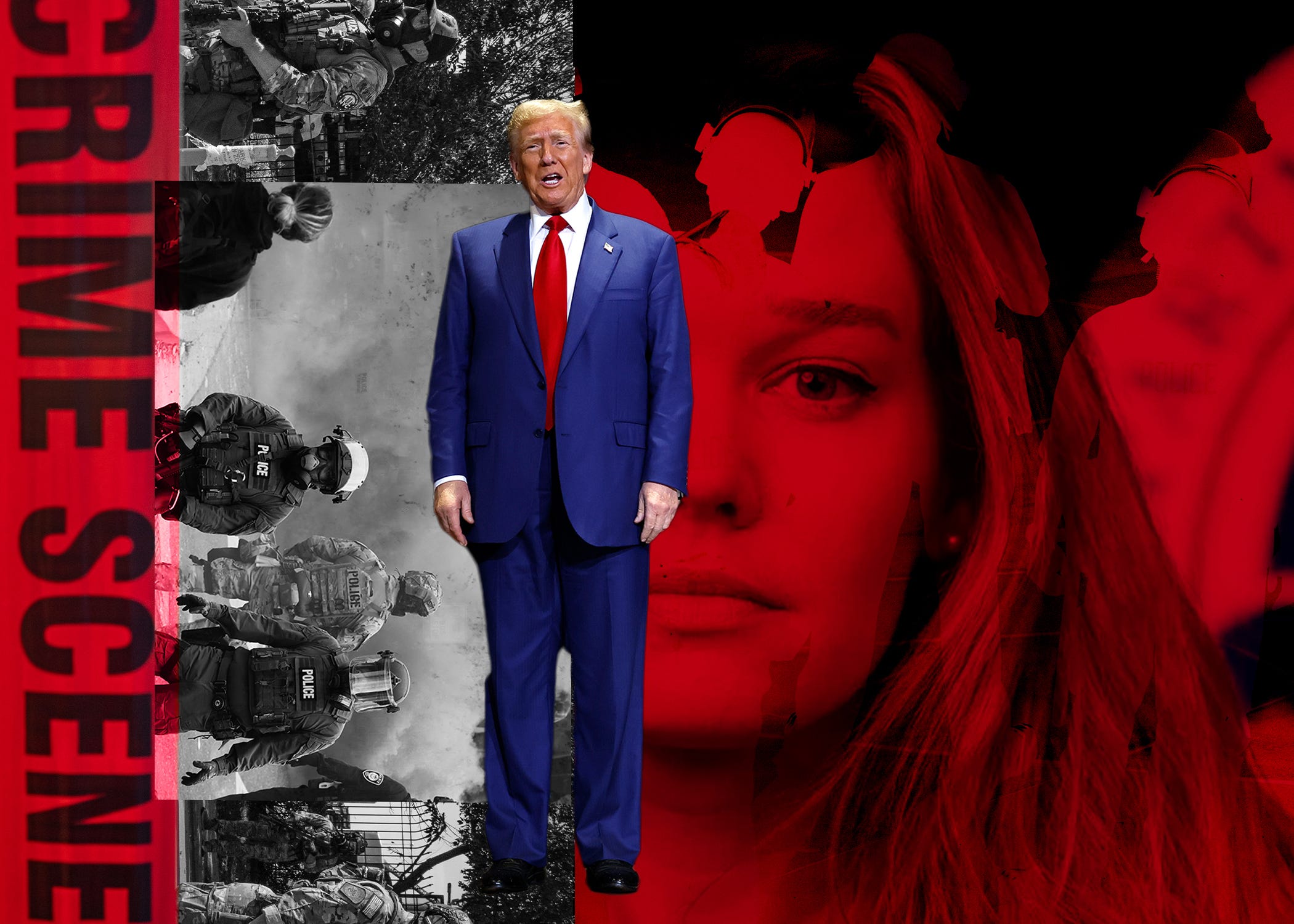
WHENEVER VIDEOS GO VIRAL showing masked federal agents brutalizing migrants, killing U.S. citizens, or gassing six-month-old children, cable-news viewers will see the same face pop up again and again to justify, reframe, and recharacterize what those videos show: Department of Homeland Security spokesperson Tricia McLaughlin.
Like other individuals tasked with explaining the arguments and worldview of President Donald Trump and his administration, McLaughlin doesn’t give the impression of caring especially about the truth; she doesn’t even pay homage to the truth by crafting lies that seem plausible. Her deceptions are so apparent and ill conceived they don’t even appear designed to persuade at all.
Why does she say things that are so plainly contradicted by facts and often even video evidence? For example, she tweeted in late November that “~ 70% of illegal aliens arrested have active criminal charges or criminal convictions.” But that’s exactly backwards: According to an analysis published several days before her tweet, and another analysis published in response to her tweet, over 70 percent of those arrested by DHS up to that point had never been convicted of or charged with a crime. In another instance McLaughlin insisted there was “documentation” that a grieving mother was lying about not receiving proper medical care and suffering through horrible conditions prior to her ultimate miscarriage and stillbirth; in fact, no such documentation has been produced. Or take McLaughlin’s claim that ICE agents are not featured in a video documenting their abuses—despite legible body gear identifying the personnel as ICE in the recording. If McLaughlin’s goal is not to win over skeptics by offering plausible interpretations of agreed-upon facts, then what exactly is she trying to accomplish?
The answer is not that she is confused or distracted; it is that she is offering a demonstration.
Full disclosure: I come to this subject with firsthand, interpersonal experience. During the 2024 election cycle, I frequently debated McLaughlin on cable news shows. Back then, she was a Republican surrogate fresh off the Vivek Ramaswamy campaign and I was making the rounds as a Democratic pundit and presidential delegate for then–Vice President Kamala Harris. McLaughlin struck me as easily flustered and poorly prepared, and—more concerning—her claims were often inaccurate in ways that required no specialized knowledge to identify.
For example, she often cited statistics that did not align with the actual data and she made bald assertions that were contradicted by readily available evidence, as when she casually claimed in October 2024 that “real wages are down.” When I’d correct her false claims on air—in that instance, sitting next to her, I pointed out that “real wages have outpaced inflation, month over month, for fifteen months”—she did not attempt to defend them, revise them to better accommodate the facts, or meaningfully engage the substance of my rebuttal.
Instead, she would smile. And often she would double down on the lie.
The contrast between this combative and cynical on-air persona and her off-screen personality was striking. After segments, Tricia and I would chat while waiting for rides. I found her to be friendly, normal, and disarmingly pleasant. When I saw she had taken a role in the Trump administration, I sent a brief congratulatory message; she responded graciously. Our interactions like that made her on air-performance more puzzling to me. I had a hard time accepting that someone who seemed so nice and normal would lie in both premeditated and reflexive ways. I even started to wonder whether she actually knew she was lying at all. Could it be that she genuinely believed what she was saying?
But I’ve come around to thinking that was the wrong question. During one of our cable segments, I noticed something extraneous to the discussion: McLaughlin was doing the hit from a beautiful Manhattan apartment. I teased her the next time we were in studio together about the swanky digs, and she explained that it belonged to her boyfriend—a Republican operative named Benjamin Yoho who had worked with her on the Ramaswamy campaign. McLaughlin and Yoho have since married, and one can only imagine that their place has gotten even nicer. After Noem was appointed to head DHS, she awarded a no-bid contract worth over $200 million to multiple companies to run a domestic and international ad campaign focusing on immigration policy. According to reporting by ProPublica, one of the contract recipients then subcontracted some of the ad production work to The Strategy Group, where Yoho serves as CEO. (It is not clear how much his company was paid for this work.) Amid scrutiny regarding Yoho’s involvement in the ad campaign, McLaughlin, the department’s assistant secretary for public affairs, claimed to have “fully recused” herself from considering her husband’s company for DHS contracts, and to not “have visibility into why they were chosen.” A lawyer representing Yoho told The Bulwark after this story was published that “[neither] Mr. Yoho nor any of his companies have ever bid for work at DHS nor have they ever worked directly for DHS.”1
HERE’S MY THEORY of the case. The reason McLaughlin and other people who speak on behalf of the administration say things on television that are demonstrably false is not to try to convince ambivalent people of the merits of Trump’s policy decisions. Persuasion is not their objective. Their objective is instead to offer a demonstration of loyalty to the president and his political project—costly loyalty: The price is their own credibility. The more indefensible a claim, the clearer the signal.
When a spokesperson insists on a version of recent events that is directly contradicted by video footage—as McLaughlin recently did in saying Alex Pretti “violently resisted” Border Patrol agents before they shot him to death—two things are happening at once. First, the speaker is showing the audience, and especially the “audience of one” in the White House, that when it comes to defending the administration, there is no limiting principle: no contrary fact, no unfavorable evidence, no threshold of personal embarrassment or shame that will cause dissent. I will defend Trump at all costs, is the message we’d see if we put on the propaganda-revealing glasses from They Live. It’s certainly the message Trump himself is meant to receive.
The performance is also instructional—a modeling of behavior. Viewers who support Trump are being presented with a method they can use to approach similar conversations: Calmly assert a lie and wall yourself off from any facts or evidence that would undermine that lie. In this way, it is possible to create the reality you want to see in the world—a reality shaped primarily by the requirements of loyalty to Trump rather than by a set of commonly agreed-upon facts.
What McLaughlin does requires more obedience than skill. Her television appearances showed that she understood her real task, which is not to argue convincingly in support of a misguided but sincerely held position but to hold the party line no matter the resulting contradictions. And that is a craft she continues to ply today as the spokesperson for an agency engaged in the wrongful detention of American citizens, in family separation, and in causing death, both to people in custody and people in our streets.
With its both-sides bias and limited capacity for real-time fact-checking, cable news offers the perfect stage for this type of performance. During the October 2024 appearance mentioned above, I grew frustrated with the host for refusing to acknowledge that McLaughlin was passing off false information as true. “This is a news program though, so let’s say the truth,” I begged. “And Tricia says it’s not true,” the anchor retorted, encouraging the audience to follow us both on social media. “It’s facts versus feelings. Fact-check it. Fact-check it next,” I suggested. They didn’t, of course. Tricia grinned through the whole exchange. Once again, she was getting away with it.
That absence of consequences is part of the lesson. If a government spokesperson can deny what viewers have just seen with their own eyes and suffer no penalty for doing so, then viewers learn something powerful about where authority actually resides: beyond reality.
McLaughlin’s role in the larger media ecosystem reveals a dark truth about our fraught political moment. Republican lying at this stage is about signaling allegiance to Trump and counseling imitation among his base. It’s the InfoWars idea writ large: Reality is a preferred thesis, not something external to the thesis that might constrain it. As Hannah Arendt put it in the last public interview she gave, “If everybody always lies to you, the consequence is not that you believe the lies, but rather that nobody believes anything any longer. . . . With such a people you can then do what you please.”
Once this basic orientation is understood, it becomes clearer how familiar critiques and tactics miss the point. Fact-checking does not fail because it is too weak; rather, it fails because it is aimed at persuasion on individual points of fact—a tactic the opponent has already abandoned. What MAGA is trying to do instead is build a culture of submission to an unaccountable authority.
The lies are no longer meant to be believed; they are simply meant to impress the big boss. The solution is not to tick through arguments on the terms of liars. It is to offer the public a reality to believe in that is more compelling than the litany of lies.
Correction (February 13, 2026, 2:20 a.m. EST): As originally published, this paragraph stated that Homeland Security Secretary Kristi Noem directly awarded a company established by Benjamin Yoho part of a contract for a major ad campaign. A lawyer representing Yoho reached out to clarify the situation: “The DHS award you are referring to went to Safe America Media (SAM) or possibly People Who Think (PWT). Mr. Yoho is the CEO of The Strategy Group. . . . TSG has done some subcontracting work for Safe America Media. However, it has been limited to production only. TSG has done no work for People Who Think. [Neither] Mr. Yoho nor any of his companies have ever bid for work at DHS nor have they ever worked directly for DHS.” We have updated the story to clarify that Yoho’s company did not directly bid for or receive a contract directly from DHS. We have also removed a line stating that Yoho’s company was “only just set up”; while, according to ProPublica, “the main recipient listed on the contracts . . . was created days before the deal was finalized,” Yoho’s lawyer tells us that he “has been the CEO of [TSG] for many years.” Finally, the article’s original description of the ad campaign as an “aggressive self-deportation–focused ad campaign across the Southwest” has been modified to better reflect its scope and intended audience.
 | A guest post by
|