
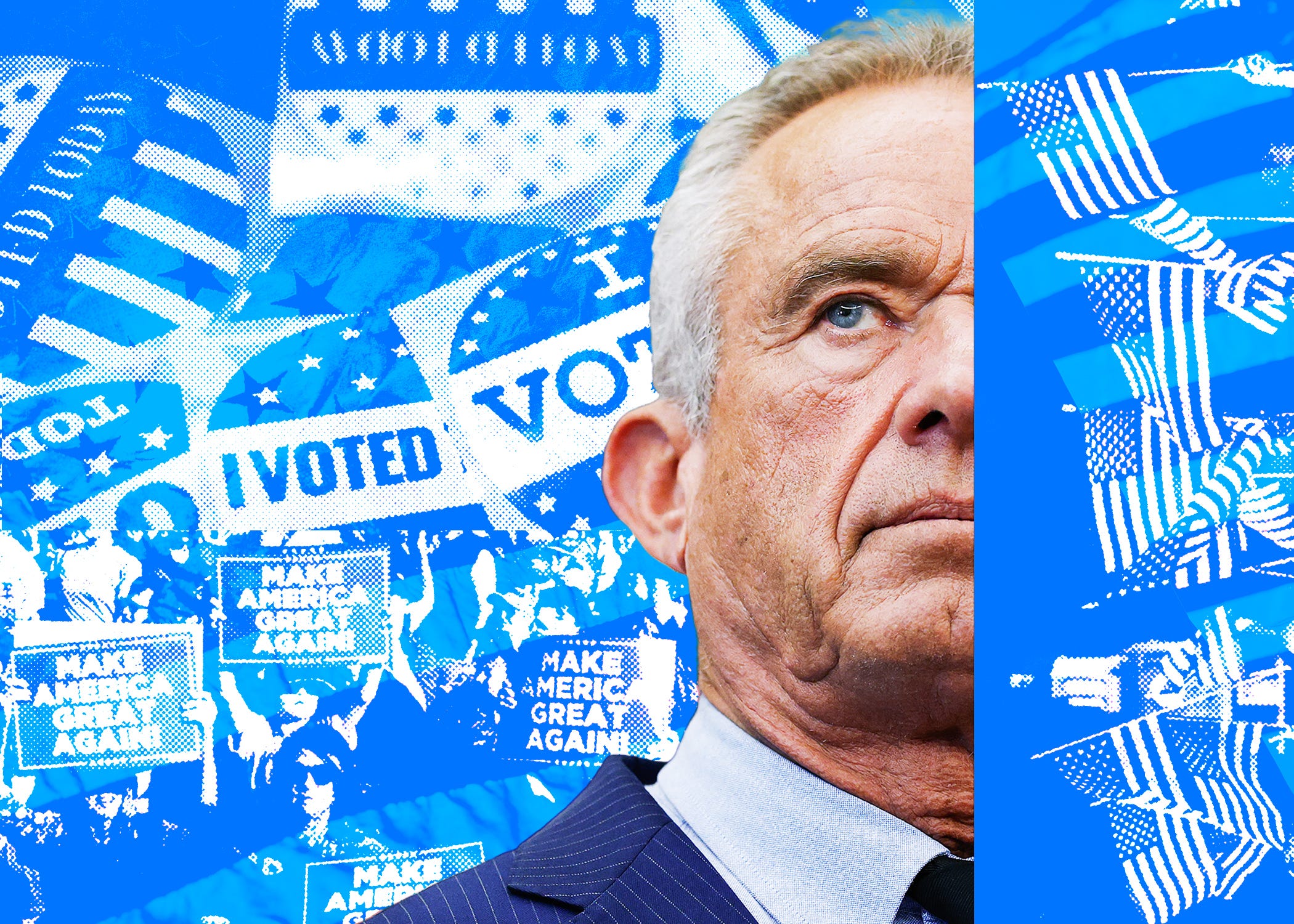
EVEN BEFORE ROBERT F. KENNEDY JR. was sworn in as secretary of health and human services, Democrats made no secret of their animus toward him. They called him a “lunatic” and a “charlatan,” warned that his anti-vaccine crusade would lead to suffering and death, and insisted he had no business being the federal government’s top health official. Many Democrats have called for his resignation; some have taken moves to impeach him.
What they have not done—at least so far—is make him a main antagonist in the upcoming 2026 midterm campaigns.
That’s because, currently, there is a divide among party officials over how much a Kennedy-as-bad-guy narrative will resonate with voters.
Some strategists see the Trump administration’s embrace of the anti-vax movement and unfounded claims that Tylenol is linked to autism as a promising way to activate the “rage mom” vote that Democrats have relied on in the past few election cycles. They believe that the party could gain a lot if it can tap into the frustration parents have with the confusing and often dangerous health guidance coming from the Trump administration. Others go further, arguing that making RFK Jr.’s policy agenda a fixture of the campaign isn’t just politically prudent but a moral imperative.
“I think we have to [talk about it more]. And when I look at the makeup of the leadership of our party, this, to me, felt like a massive miss, because, frankly, there aren’t that many young moms who are in office, especially at the federal level,” Michigan State Sen. Mallory McMorrow, who is running in the Democratic Senate primary, told me in an interview. McMorrow, who was pregnant during COVID, said that the rise of MAHA wasn’t a surprise to anyone who was spending time on parent Facebook groups or scrolling Instagram.
“I hope Democrats will look at it and say in the same way that Donald Trump validated a lot of people’s fears and angers, the solutions are wrong, and the solutions are not making us any healthier, they are making us less healthy. They are putting us in danger,” McMorrow said. “And we have to offer another way forward.”
But not every Democrat is convinced that making Kennedy a chief villain in the midterms is a smart play. They fear that the party still faces a deficit of trust with a critical slice of the electorate that soured on it and the medical establishment during the pandemic. And they argue that Democrats should be careful not to recycle COVID-era talking points—like “believe in science”—that helped lay the groundwork for Kennedy to thrive in the first place. Anger towards Trump’s attacks on public health might be real, but they believe Democrats have to activate that frustration without reminding voters of unpopular pandemic-era mandates or sacrificing other topics.
“People haven’t agreed with [Kennedy], but he has sown confusion. And you want to campaign, in general, on issues that voters are not confused about,” said Democratic pollster Celinda Lake. “You also want to talk about something that is a more common experience. Most people right now aren’t pregnant. Everybody is facing rising premiums. So I think that limits the conversation,” Lake added. “We don’t get as much mileage as we would have thought for these people having crazy ideas and doing crazy actions.”
The largely private debate among Democrats over whether or not (and how effectively) to campaign against Kennedy has come at a time when, publicly, the party has made no secret about where they stand on the man.
In just eight months since his confirmation, Kennedy has managed to anger virtually every D.C. Democrat. He has done so by taking a sledgehammer to public health agencies, dismissing top scientists, and creating an enormous amount of confusion and fear for Americans, particularly for parents and pregnant women. Parents have been showing up at their doctor’s office asking if they could, or should, rush to get their newborns vaccinated, fearing that they can no longer rely on routine immunizations to be accessible under Kennedy’s leadership. A quick scan of social media sites like Reddit and Facebook will turn up a number of posts from women furious that President Donald Trump and Kennedy would create so much uncertainty around the use of Tylenol.
Kennedy’s promotion of—and association with—vaccine skepticism also presents some political vulnerabilities. Polling consistently shows that the vast majority of parents want current vaccines to remain widely available. Even Trump’s own pollsters circulated a memo to Republicans lawmakers over the summer showing that a majority of the president’s own voters support vaccines. And when Gov. Ron DeSantis called for ending Florida’s school vaccine mandates, prominent Republicans like Sen. Rick Scott (R-Fla.) and Sen. Bill Cassidy (R-La.), joined Democrats in pushing back on him. Donald Trump himself expressed skepticism.
For those reasons, several party operatives have argued that Democrats should lean more forcefully into making vaccines a campaign issue. Amanda Litman, the cofounder of Run for Something, a progressive group that recruits and trains first-time candidates, told me that Democrats could have been more creative in making Republicans answer for the fact that measles cases are the highest they’ve been since the United States eliminated the disease in 2000—such as introducing a bill around vaccine education named after one of the children who died in the Texas measles outbreak, similar to how Republicans pushed the Laken Riley Act, named after the nursing student who was attacked and murdered by an illegal immigrant.
“The MAHA movement in general should be owned by Democrats because I think Democrats support policies that, for the most part, that movement agrees with,” said Rep. Kelly Morrison (D-Minn.), who is part of the newly formed Democratic Congressional Doctors Caucus. Morrison also predicted that there would be a backlash against Kennedy as his agenda made the country less healthy and as parents only grew more confused about conflicting health guidance for their kids. “There’s a lot of opportunity to engage with those people and welcome them. We’ve got to be not scolding anyone. I don’t care who you voted for in the last election, come into the big tent.”
But as is often the case around these topics, there is concern among party officials that these tactics could end up backfiring—or being more trouble than they’re worth. Democratic strategists told me that it’s been hard to organize around Kennedy’s extreme positions. Initial conversations among a handful of Democratic-aligned healthcare advocacy groups about launching an anti-Kennedy messaging campaign stalled earlier this year after there was little support from the larger party apparatus for the effort.
“Democrats are anxious about not necessarily having a finger on the pulse of where the public is, and that’s why you haven’t seen people be quite as defiant on it,” said a progressive Democratic strategist, arguing that a lot of Democratic leaders were caught off guard by the backlash to some COVID policies and were shocked that the MAHA movement was able to get a foothold in mainstream politics. “There may be a little bit of learned obedience, feeling like you’re bracing for impact on something that you don’t know intuitively. I just don’t think Democrats know how people feel.”
🫏 Donkey Business:
— Some updates on the redistricting wars since the last edition of this newsletter: Democratic Maryland Senate President Bill Ferguson sent a letter to his colleagues Tuesday rejecting the state’s push to redraw congressional maps before the 2026 midterms, writing that the state Senate would not move forward with the plan. Ferguson has been a thorn in the side of the national Democratic party for weeks, and the letter was met with deep frustration among his colleagues in the General Assembly whom I spoke with today, who say much of the rest of the party is on board and ready to take action. Usually with these types of letters, lawmakers try to get as many colleagues as they can to sign on to indicate that there’s a robust opposition. So it was notable that no one else signed on to the letter with Ferguson.
Meanwhile, pressure continues to ramp up on Illinois state lawmakers to take action. The Illinois congressional delegation released a statement on Tuesday making clear that they “firmly support advancing a new congressional map” in order to “protect the people of Illinois from the extremism that the Trump administration has relentlessly unleashed.” The statement came a day after House Minority Leader Hakeem Jeffries made stops in Chicago and Springfield in an effort to convince local lawmakers to redraw their maps.
And Elias Law Group, the Democratic-aligned firm that has been leading much of the party’s redistricting litigation, filed a lawsuit in New York on Monday arguing that the 11th Congressional District—which is represented by Nicole Malliotakis, the only Republican House member in New York City—unfairly dilutes black and Latino voters. It’s a Hail Mary attempt at gaining a seat in New York, given that Democrats’ options are limited since the state uses an independent commission to draw maps.
My open tabs:
— Chris Murphy needs blue America to wake up
— In Fight Against Trump, Democrats Are Already Running for Proposed House Seats
Democrats, just say what you believe. If you think RFK Jr and MAHA are terrible for Americans' health (they are), go out there and say so.
I can't stand this multi-dimensional chess.
Just tell the truth. He is unqualified to serve in the position he is in and it has a direct (negative) impact on the health of citizens. The word “vaccine” doesn’t even have to be used.