DOGE Targeting Nuclear Safety Brings Back Memories of Three Mile Island
I was a reporter on the ground during the 1979 nuclear crisis—and news of DOGEbros messing with nuclear regulation is setting off familiar klaxons in my mind.

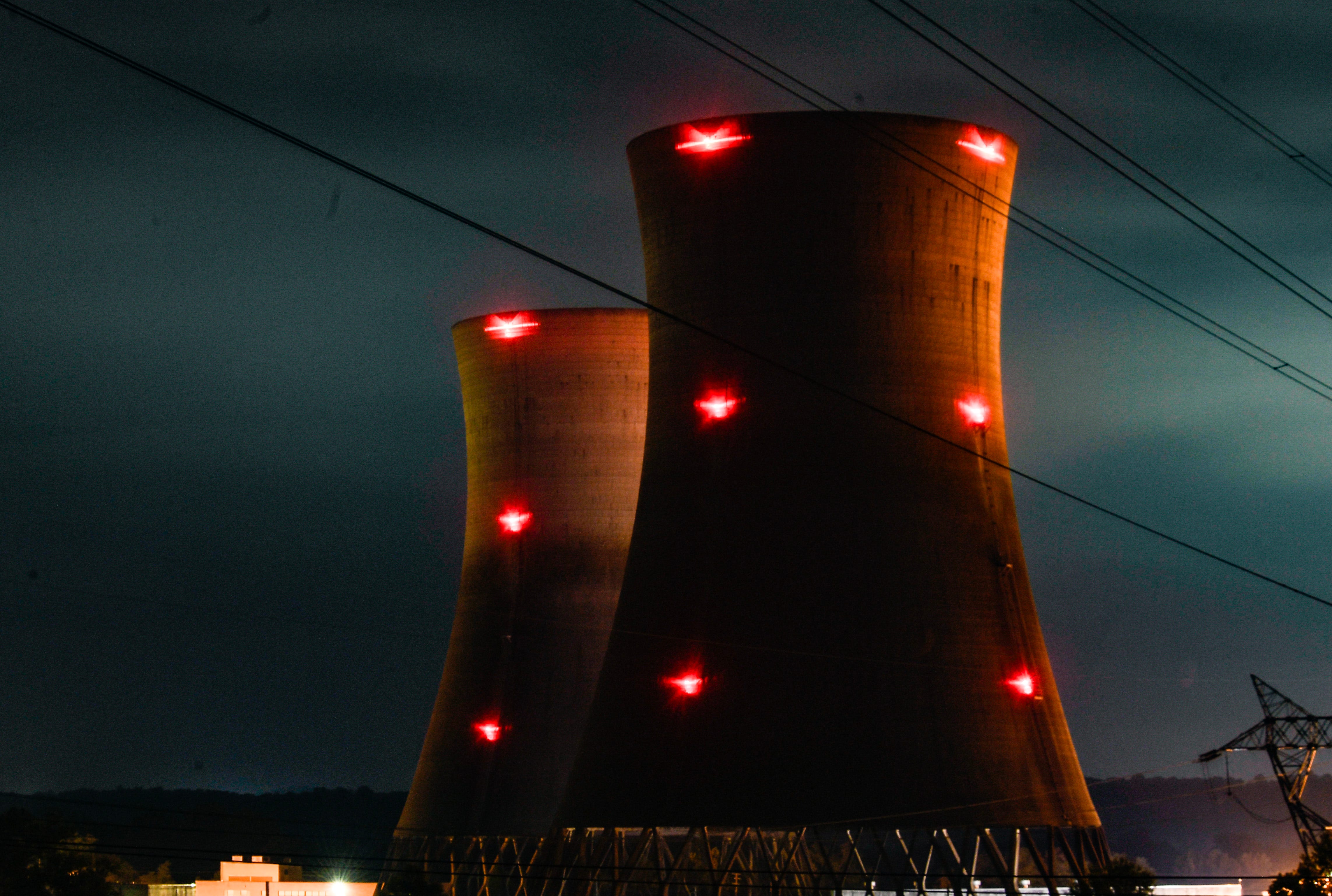
I WAS ASKED A FEW YEARS AGO to name the biggest story I’d ever covered as a journalist. “You’d think Three Mile Island would have been the major story of my career, but history has just kept happening,” I replied.
Yet even after the deadlocked 2000 election, the inauguration of the first black U.S. president, the rise of Donald Trump, and so many other huge stories, that nuclear power plant accident on March 28, 1979, is still in the running for number one. And as I periodically rediscover, it still has the power to haunt.
That’s what happened last week, when ProPublica published an article by Avi Asher-Schapiro headlined “DOGE Goes Nuclear: How Trump Invited Silicon Valley Into America’s Nuclear Power Regulator.” The gist: Young, unqualified, and deeply unserious DOGEbros are “forcing a ‘move fast and break things’ Silicon Valley ethos on one of the country’s most important regulators.”
“The safety culture is under threat,” Allison Macfarlane, a former chair of that regulator, the Nuclear Regulatory Commission, told ProPublica. That was admirably restrained. This is a chilling investigatory account of corruption, cronyism, and lack of care.
So what else is new, you might wonder; it sounds like business as usual in the Trump era. Still, if you are a TMI “survivor,” you can’t look away from a chart that shows over 400 people who worked on nuclear reactors and safety have left the government since Trump took office, and only 60 people have been hired.
The ProPublica report comes during a period of bipartisan consensus on the growing role of nuclear power in a cleaner U.S. energy future. The ADVANCE Act, signed by President Joe Biden in 2024, passed with broad congressional support. Among other things, the law requires more timely and predictable reviews of license applications for new reactors.
Todd Abrajano, president and CEO of the U.S. Nuclear Industry Council, the trade association for the nuclear energy industry, told me in a statement that many of the changes occurring now stem from the new law and its modernization provisions. “The United States needs a regulatory system that can evaluate next-generation nuclear technologies efficiently while maintaining the rigorous safety standards that have long made the NRC the global gold standard for nuclear oversight,” he said.
That’s reassuring up to a point, but doesn’t stem my flashbacks to the fears and turmoil that consumed all of us—residents, reporters, national and local political leaders, science and tech experts inside and outside government—in the tense week and confusing aftermath of the TMI accident. WNEP-TV in Scranton-Wilkes-Barre (a hundred miles away from the Middletown plant) captured it in a March 30 segment on the third day of the crisis.
The news tonight is not encouraging. An unexpected release of more radiation from the Three Mile Island nuclear power plant has led to a series of consequences. Certain people have been advised to evacuate, others have been urged to remain indoors. Telephone lines in the Harrisburg area are jammed, and the immediate highways are, too, as more people decide to leave.
Plant officials say that they do not have a meltdown on their hands. The nuclear core is under control. But plant officials do admit some uranium oxide pellets that power the reactor have melted. That is causing heat and steam pressure and the need to vent into the atmosphere. Plant officials say it will go on for five more days. The air is being monitored for radiation. There is none here. Safeway announced it will not buy milk from southern Pennsylvania.
And on and on, with dispatches from correspondents at the scene, for over seven more minutes.
Radiation suits and an airlift plan
A NEWS CONFERENCE CLIP of then-Gov. Dick Thornburgh features anxious reporters throwing out questions about whose radiation readings they should trust, and what dangers various readings posed. “We’re getting conflicting reports, too,” Thornburgh replied. “There are hundreds of people out there with survey meters,” added Tom Gerusky, the state’s radiation protection director.
Exactly. “For days the people in authority had little idea of what was happening, and less of what would happen next,” reporters Peter M. Sandman and Mary Paden, assigned to cover the coverage, wrote later that year in Columbia Journalism Review. “They fixed the reactor the way a mechanic fixes a car—they tinkered. When it was all over they tried to figure out what they had done right. With two months’ hindsight, we now know what the big story at T.M.I. really was: no one knew enough to guarantee that the genie would stay in the bottle. Call this criminal incompetence or call it the human condition. Either way it was the story.”
I had arrived in Harrisburg about six weeks before TMI, the only woman in a five-person Associated Press bureau covering the state capitol, and this was by far the most momentous story of my two-year professional journalism career. The China Syndrome had just opened in theaters and everyone suddenly knew the word “meltdown.” What we didn’t know was whether there had been one at TMI.
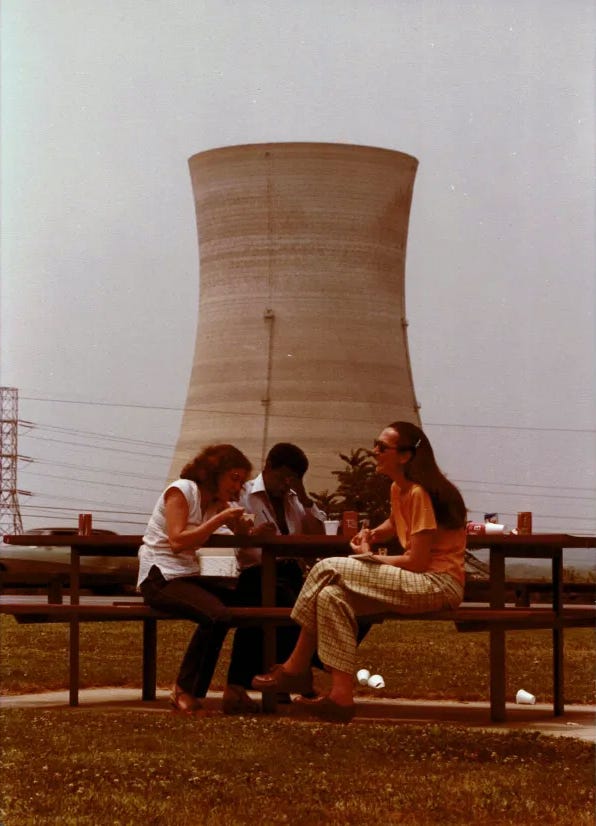
Three decades later, when the Obama administration announced $8.3 billion in loan guarantees for two reactors in Georgia, I wrote a “not so fast” column for AOL’s Politics Daily about that experience.
Some of the first foreign journalists to arrive were from Japan, evoking the spectacularly un-reassuring memory of the A-bomb and rampant radiation sickness. But then, nothing at the time was reassuring. The AP sent in radiation suits and drew up a helicopter evacuation plan. I was to be on the first flight out; the hope was to preserve my ability to bear children.
It never came to that (and a few years later I had two sons). Still, there were surreal and heart-pounding moments that remain vivid today. I remember driving through Middletown in unseasonably warm weather a day or two after the episode began, my car window wide open. Suddenly a radio announcer barked an emergency warning: Bursts of radiation coming from the plant! Close your windows! Stay indoors! I closed the window and tried not to panic.
Fourteen months later, in May 1980, I was back at Unit 2 for what promised to be high drama: human entry into the containment dome housing the partially melted core for the first time since the accident. Two young engineers wearing heavy protective gear would go in, take pictures, measure radiation, and leave after fifteen minutes.
As we waited for news, I participated in a fraught competition among reporters for the two landline phones available to us—“I’m the network!” “I’m the wire!” In the end, nobody got much of a story. The doors were jammed and the engineers couldn’t get in.
Backsliding on trust
FOR ME, THE STORY KEPT ON GOING. In Harrisburg until late 1982, tracking plant damage, radiation levels and cancer cases; who would pay for repairs and higher electric bills; how much liability the utility bore, and when or if Unit 2 would ever reopen. And then for nearly four years as AP’s Pennsylvania regional reporter in Washington, following the NRC and its TMI activities.
Much later, as climate change grew ever more obvious and ominous, I began to revise my views. The 2010 loan guarantees, and then-president Barack Obama’s explicit intent to include nuclear power in a carbon-free energy mix, did bring back bad memories, as I wrote. But I concluded with this: “I’m getting there on the trust thing. The feds could close the deal with me by launching a Manhattan Project on nuclear waste disposal, deadline any time before those new Georgia reactors come online.”
By 2019, I was saying that I wanted more nuclear energy. That same year, the USA Today editorial board—which included me—called it “an important part of the puzzle in weaning the nation’s power grid off fossil fuels.”
There have been two terrible nuclear accidents at commercial reactors since TMI, in 1986 at Chernobyl in what was then Soviet Ukraine, attributed to poor reactor design and poorly trained workers; and at Japan’s six-reactor Fukushima plant in 2011, amid an earthquake and tsunami.
Here at home, the U.S. government has not solved the nuclear waste disposal problem. In fact, Macfarlane and other energy experts released a bipartisan report this year that chides America for “accomplishing virtually nothing” over the last fifteen years. (The proposed solution that had advanced the farthest and been studied the longest, a repository planned for Yucca Mountain in Nevada, was killed off by the Obama administration.)
At the same time, U.S. reactors have become increasingly safe in the decades since TMI. So I really was getting there on the trust thing.
Until DOGE entered the picture and rampaged through the federal government on a search-and-destroy mission.
Abrajano notes that the Nuclear Regulatory Commission is still “led by respected professionals with deep experience in nuclear regulation. Chairman Ho Nieh is widely regarded across the nuclear policy community as a serious expert committed to the integrity of the commission,” supported even by Democratic Sen. Sheldon Whitehouse of Rhode Island, “who has raised concerns about protecting NRC independence.”
It will be up to those professionals to stick around and hold the line amid a shrinking safety staff and, as ProPublica reports, new arrivals who say things like “Assume the NRC is going to do whatever we tell the NRC to do.” NRC leaders, staff, and responsible nuclear companies themselves will need to keep a close watch as “thousands of pages of regulations are being rewritten at a sprint” and new energy companies flush with both cash and connections “wield increasing influence over policy.”
If there are setbacks, I’m hoping they’re the kind that can be reversed—and that we can all avoid catastrophe despite the chaos unleashed by Trump and the DOGE bros.
 | A guest post by
|