Don’t Eyeroll: Dems Have Mississippi in Their Sights
On the campaign trail with Senate candidate Scott Colom.

Jackson, Mississippi
THE MERE SUGGESTION that Democrats could win the Mississippi Senate race this cycle can produce dismissive eyerolls. (Trust me, I’ve seen it often enough from my editor.)
But as I’ve been talking with party officials and operatives over the past few months, no race is as regularly mentioned, or elicits as much excitement, as this one. They argue that circumstances are converging to flip a state that Donald Trump won by a 23-point margin: There is a charismatic Democrat at the top of the ticket, the state’s large black population is being mobilized, and there is a generationally weak Republican incumbent. As longtime Democratic strategist James Carville, who lives part-time along Mississippi’s Gulf Coast, put it to me: “It would take a unique set of circumstances, but we just might be operating under a unique set of circumstances.”
Eventually, enough quotes like this piled up in my notebook from enough influential Democrats that I was able to turn my editor’s eyerolls into a signoff to check out how real the hype is. So last weekend I made the trek down I-55—a stretch of highway that runs parallel to the Mississippi River, passing over bayous dotted with cypress trees—to spend a day on the campaign trail with Scott Colom, the Democratic candidate for Senate.
Colom is a 43-year-old district attorney, a devout Mississippi State sports fan, and father of two young girls. He was raised in a political household: His mom was an elected judge and his father ran for office as a Republican in the 1980s before eventually becoming a Democrat. In 2022, President Joe Biden nominated him to be a federal judge. But after getting approval from the state’s senior senator, Roger Wicker, Colom’s nomination was blocked by Sen. Cindy Hyde-Smith—the very Republican whom Colom is now trying to unseat.
Colom and I chatted in the back seats of his pickup truck on a recent Saturday morning with pickleball equipment and footballs strewn about our feet as his staff drove us to the first campaign event of the day. With a giant to-go cup of hot coffee in his hand (something that he seemed to have perpetually refilled throughout the day), Colom stressed that his campaign wasn’t about getting revenge on Hyde-Smith.
“As a Christian, I really had to forgive people,” he said.
And yet, there is something about Hyde-Smith that drove him to run. Democrats involved in the race believe she is a uniquely vulnerable candidate and that Colom would not have run if Wicker were the one up for re-election. Hyde-Smith, who was appointed to the Senate in 2018 to replace Thad Cochran, rarely if ever holds town halls or attends community events. And in a state that regularly ranks as the poorest in the nation, Colom argued that Mississippians are yearning for a senator who delivers.
That’s a common refrain for any challenger trying to unseat an incumbent. But in Colom’s case, there is fodder to work with. Whereas Cochran ended his four decades in the Senate as the chairman of the powerful Appropriations Committee—a post that helped him secure federal goodies for Mississippi—Hyde-Smith doesn’t have a comparable record of delivering for the state. She has taken votes that have placed rural hospitals at risk of closing. She has backed Donald Trump’s tariff agenda, even though it has hurt the state’s soybean farmers. And she voted against the 2021 infrastructure bill—which brought billions of federal dollars to the state—while even her fellow Republican Wicker supported it.
“The number-one rule of politics: Bring home resources for your state, look out for Mississippi,” said Colom. “You got to do that because we’re not a state that can afford to have partisan warriors.”
“You got to show up, you got to listen. You got to show that you’re running a different type of campaign, rooted in listening to people. And that’s what it’s going to take to win Mississippi,” Colom added. “I’m about to do more in one day than [Hyde-Smith] has done in six years, as far as interfacing with the public.”
That’s all well and good and makes for a buzzy campaign talking point. But this is still a state Trump won by double-digits. Plus, this isn’t the first time Democrats have talked up their opportunities in Mississippi only to go on to lose the election. Sen. Chuck Schumer has been publicly arguing since 2021 that the state could be in play. So what makes this year any different?
COLOM AND HIS TEAM came prepared with data about why their race should be viewed as just as competitive as those in, say, Iowa or Texas. They argued that Mississippi Democrats had been making consistent progress over the past few cycles: Mike Espy lost his Senate race to Hyde-Smith in 2018 by 7.8 points, then in 2019 the Democratic gubernatorial candidate, Jim Hood, lost by 5.5 points, while in 2023 Brandon Presely lost his bid for governor by just 3.2 points. Last year, Democrats broke the GOP’s supermajority in the state senate. And 158,196 voters participated in the Republican Senate primary in March compared to 150,641 in the Democratic primary—which Democratic pollsters told me was unusually high turnout and, they believe, a sign of a narrowing enthusiasm gap.
“This has the beginnings and makings of another race that could be in the single digits. I truly believe that,” said Democratic pollster Kevin Akins, who recently conducted a survey that found Hyde-Smith leading among likely voters with 42 percent of the vote compared to Colom’s 39 percent.
Any poll showing two leading candidates hovering right above or below 40 percent has to be regarded skeptically—if for nothing more than it shows the race hasn’t gelled yet. But part of the reason Democrats view Mississippi as one of the few places in the Deep South where they can compete is due to its large population of black voters, who’ve traditionally supported Democrats. Black people make up 38 percent of Mississippi’s population, the largest percentage of any state in the country. Colom’s team and allied Democrats believe that in order to win, they have to turn out as much of the black population as possible while earning above 20 percent of the white vote. (For comparison, Espy received 24 percent of the white vote when he ran against Hyde-Smith in 2020.)
Akins told me that Colom doesn’t start off with that kind of support from white voters, which means he’ll have to focus on making up ground over the next six months. But there’s also an independent candidate in the race—Ty Pinkins, a former Democrat who left the party in 2025—who could chip away at Hyde-Smith’s advantage.
“One of the key findings in the poll is that a majority of the third-party candidate supporters are Republicans or are Trump supporters,” said Akins. “There’s a set of Republicans who are just looking for an alternative to the senator. It might not be that all of them can get all the way to voting Democrat—but can some of them either sit the election out or support a third-party candidate?”
Aside from winning over some white and Republican voters, one of Colom’s biggest hurdles is raising enough money. Talking to Colom, it’s obvious that he gets frustrated watching candidates like James Talarico in Texas rake in $27 million in one fundraising quarter compared to the $600,000 he raised over the same period of time.
“People have been conditioned to think of Mississippi as not mattering, and that’s the biggest obstacle,” he told me. Colom tries to convince donors that their money can go a lot further in a race like his where it’s less expensive to buy TV ads. He thinks he needs to raise just around $15 million to win.
“I need to have enough money where, when [Hyde-Smith] starts lying about me, I can respond and I can tell the voters what I care about,” Colom said. “I’m not trying to out-TV her because I think that really is just diminishing returns at a certain point. But I can’t be like too many of our candidates, unable to communicate at all.”
One of the big unknowns is just how involved powerful party committees will get in the race on behalf of Colom. Right now, the national party appears Colom-curious, but increasingly intrigued. Last October, the Democratic National Committee transferred $100,000 to the Mississippi Democratic Party ahead of the state’s legislative races. The DNC has also invested additional money in the state party as part of its effort to build party infrastructure in red states around the country. And the campaign committees of Sens. Elizabeth Warren and Mark Kelly have given to the state party as well.
Meanwhile, super PACs associated with a number of prominent Senate Democrats—including Kelly, Elissa Slotkin, and Chris Murphy—have given directly to Colom’s campaign. And while the Senate Majority PAC—Democrats’ main Senate super PAC, which is heavily influenced by Schumer—has yet to spend on the race, spokesperson Lauren French told me “We’re looking at it very seriously and definitely not counting it out as a place that we could eventually end up spending this cycle.”

The gang returns to California for two live shows in May. Join Sarah, Tim, and Sam in San Diego on May 20 or in L.A. on May 21 for a night of politics and laughs, and a community built on good faith. Bulwark Live: California is sure to sell out—don’t delay.
IF COLOM IS TO WIN THE RACE, it won’t be because he outraises Hyde-Smith or skyrockets to TikTok fame like some of the other buzzy Democratic Senate candidates this cycle. Rather, it will be because of a relentless focus on retail politics. And, as it happens, it’s something he’s good at.
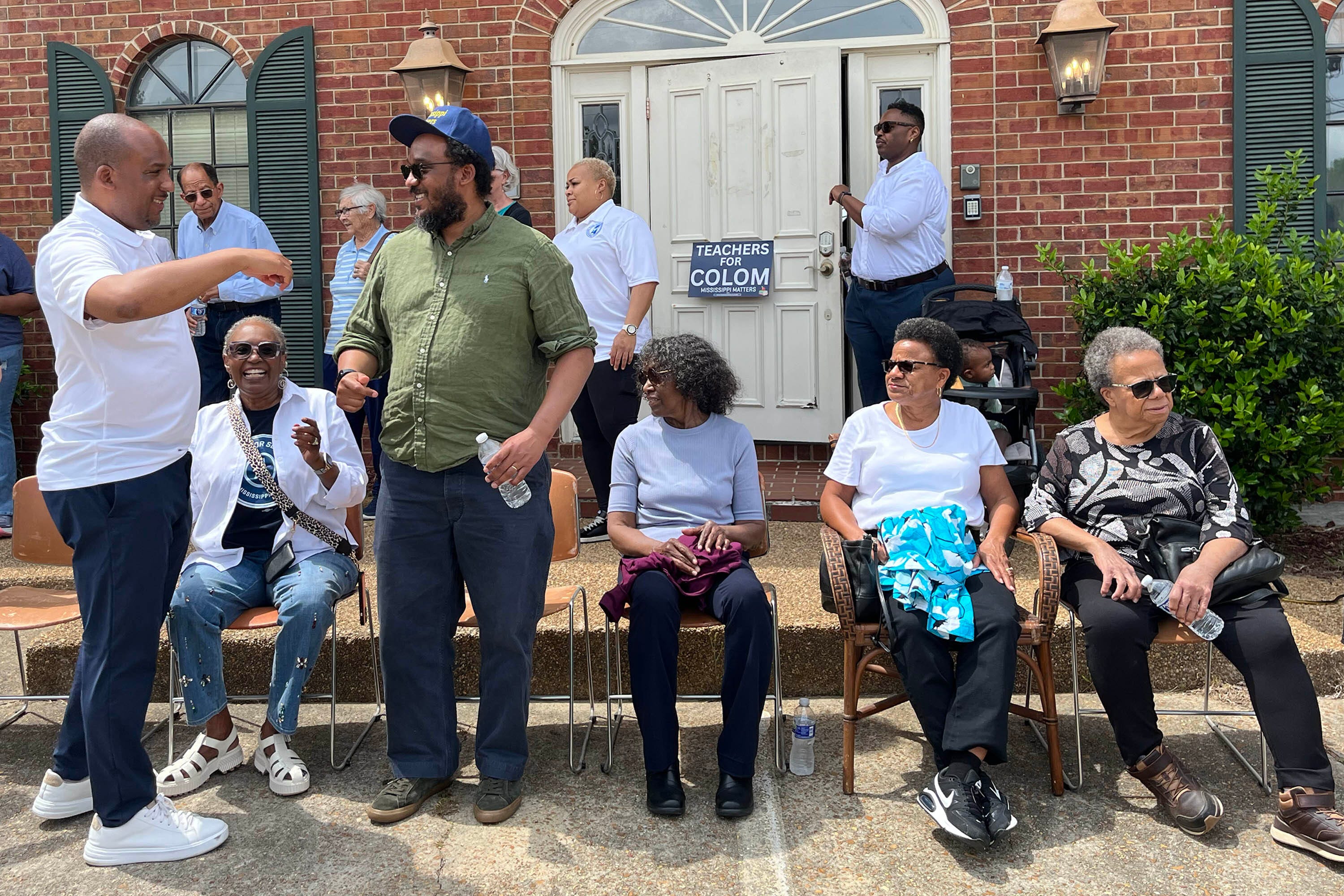
We started our day in the rural town of Vicksburg, where Colom attended a community clean-up event before hopping back in the pickup to drive to the annual South Jackson Festival. At the festival, Colom made his way down rows of food trucks that were selling lemon pepper wings, pickled pigs’ feet, and fried chicken. He shook hands, took pictures, and listened to stories about how one woman’s prescription drugs recently increased from $100 to $600 a month—making them unaffordable.
At one point, Colom stopped to tell me that life in Mississippi revolves around “faith, family, and football” and that candidates for office have to show up in these spaces—from local festivals, to college tailgates, to the church pews. “There’s one thing we can all agree on: Fuck Lane Kiffin,” he told me as we left the festival, referencing the Ole Miss coach who made a dramatic late-season departure to LSU.
These are the types of asides that will win Colom applause. What he needs, though, are votes. And for those, he believes there is a different calculus that Mississippians are making. Colom stressed that the most frequent thing he hears from voters is that they want to send someone to Washington whom they believe will follow through on the promises of the campaign trail.
“I’m not asking you to send me to D.C. to be the Democratic senator. I’m asking you to send me to D.C. to be the Mississippi Senator,” is a phrase Colom often repeated in his conversations with voters.
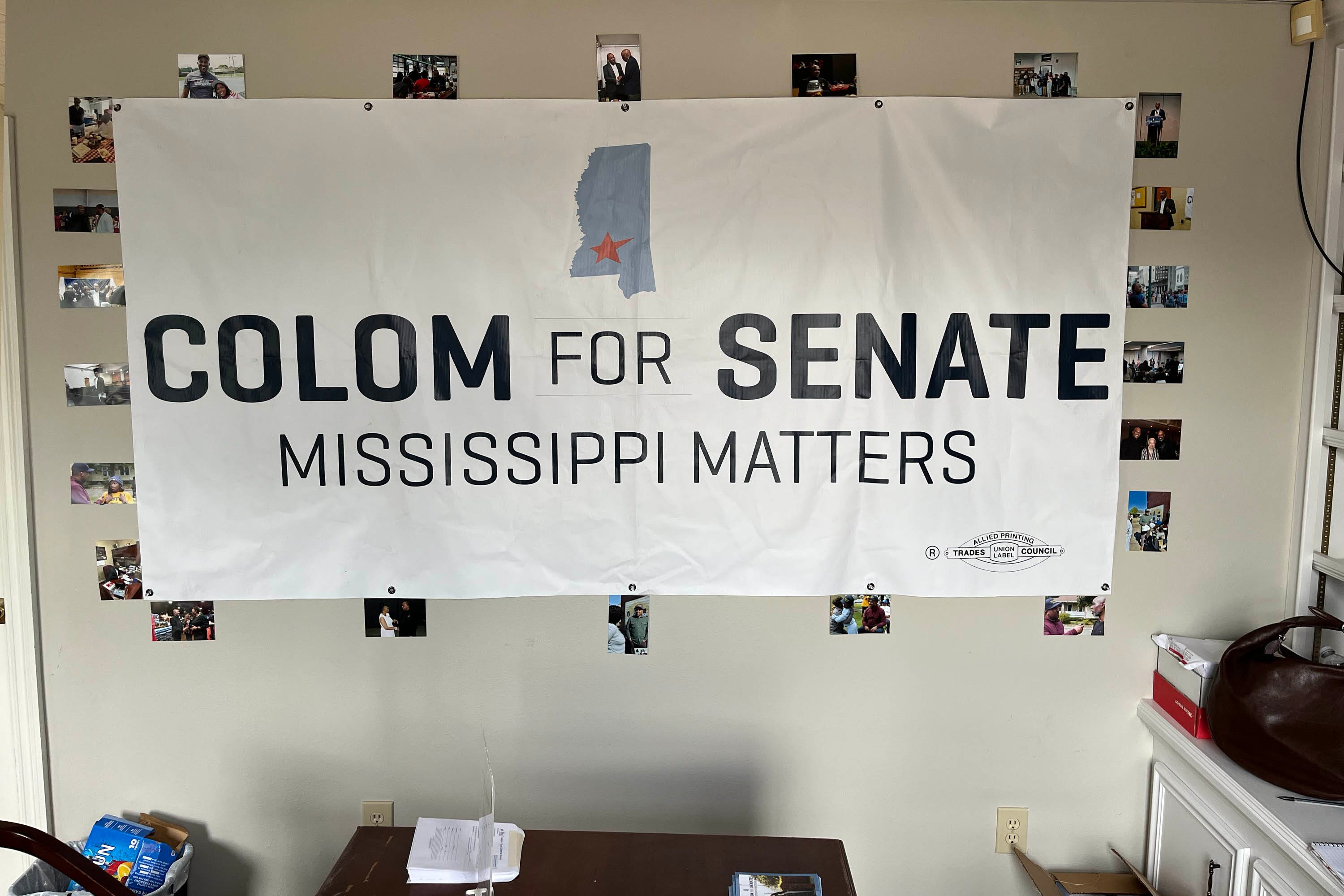
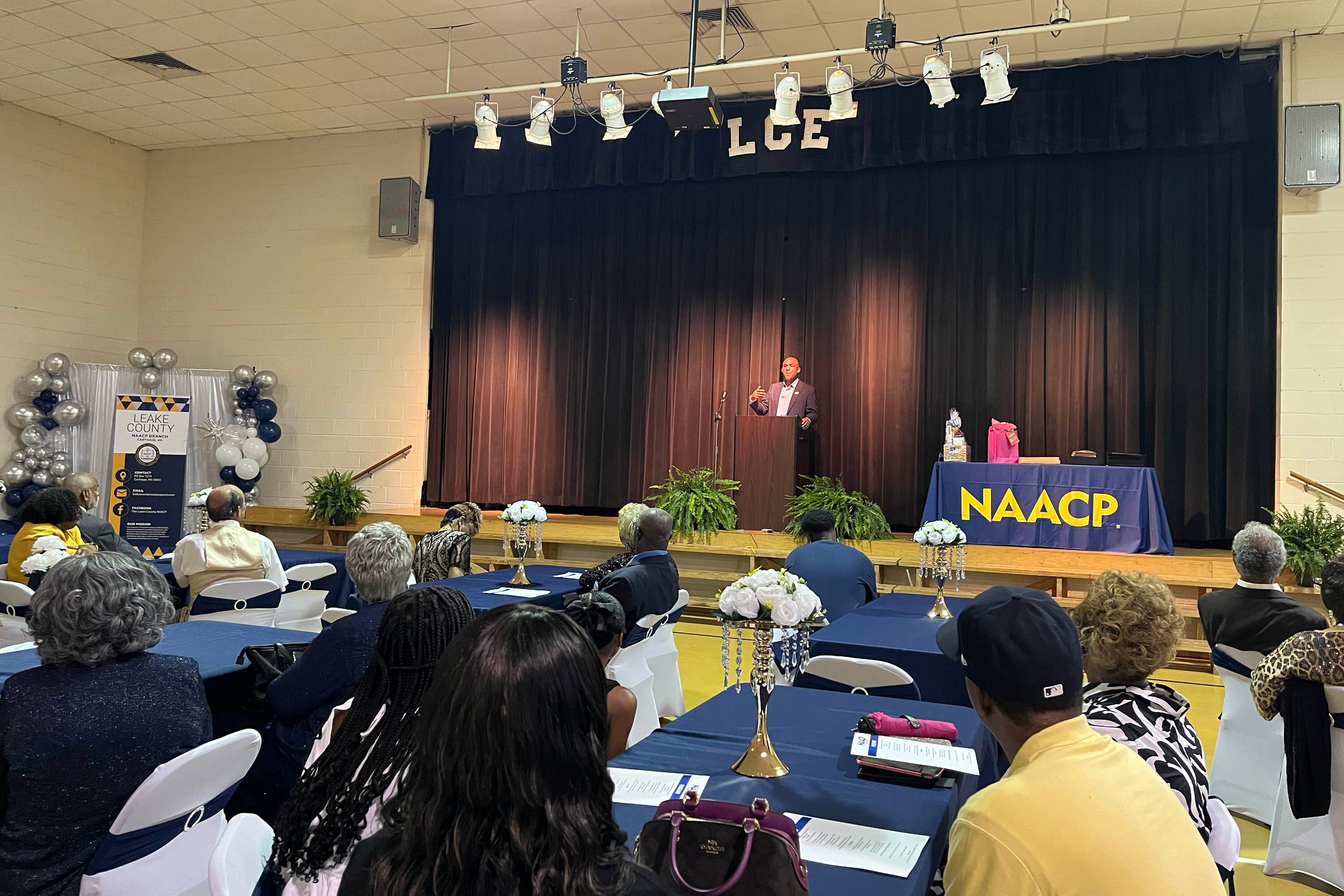
He was still in campaign mode when we stopped for lunch at IHOP. Colom gave the waitress a campaign pamphlet before he finished scarfing down a stack of pancakes. (Retail campaigning is hungry work.) At a campaign office opening later that day, he stayed for hours talking to volunteers and passing out paper trays of ribs and baked beans. And he ended the day at the Leake County annual NAACP dinner, where he worked the room of mostly older black voters.
When I asked Hyde-Smith’s team about Colom’s critiques that she wasn’t present enough in the state, they hit back with culture-war attacks. “The ‘Transgender Defender,’ Scott Colom, was handpicked by Chuck Schumer and the D.C. liberal elite. His previous campaigns were bankrolled by out-of-state billionaire George Soros,” said Jake Monssen, Hyde-Smith’s campaign manager. “He’s soft on crime, and he pushed for radical sex changes for children and protections for the doctors who perform them. Colom’s claims are purely politics from a struggling campaign that can’t defend his own extremist record.”
Maybe this type of broadside will be enough to carry Hyde-Smith in a conservative state. It was the playbook she used when she moved to block Colom’s federal judicial nomination. And it’s one that Republicans have used ad nauseam in the Deep South to retain a grip on power. Although Colom takes care to distance himself somewhat from the national party—he declined my invitation to offer advice on how it can fix its brand—Democrats are often seen in these parts as woefully out of touch with the voters they want to represent.
But there is another element of Mississippi culture that Colom and his allies believe is underappreciated and worth emphasizing in the context of a campaign. To drive through Mississippi is to reckon with the state’s violent past. Poor rural black communities serve as constant reminders that Mississippi’s brutal history of slavery and segregation wasn’t all that long ago. Throughout the day, Colom referenced this Mississippi legacy—from blues legends like B.B. King born in the Delta to literary legends like William Faulkner from the hill country. It was art, Colom said, that grew out of the state’s history of pain and suffering.
White and black Mississippians often haven’t agreed on how to address the state’s history. Historical markers remembering Emmett Till’s death have been shot up and vandalized. And even Hyde-Smith’s campaign is a reminder of this tension. In 2018, Hyde-Smith was criticized after a photo surfaced of her posing in a replica Confederate soldier’s hat and holding a rifle at the home of Confederate President Jefferson Davis, with the caption: “Mississippi history at its best!”
“A photo is worth a thousand words. Sometimes it’s worth the complete works of William Shakespeare,” said Carville, pointing to that photo when I asked why he thought Hyde-Smith was an especially weak candidate.
Colom is betting that this type of politics will catch up to Hyde-Smith and that Mississippians no longer have an appetite for GOP-themed culture-war politics when faced with mounting economic concerns. He’s banking on his belief that you cannot win by ignoring your voters. He’s betting on voters like John Byrd, a retiree who grew up in the Delta and now helps organize local events like the South Jackson Festival, who told me that he never sees Hyde-Smith in the community.
“They won’t come out here,” he said, referring to white Republican candidates. “It’s still plantation politics here until they start showing up.”
I was at that same event in Jackson on the 18th, met Scott and his mother and I have to tell you--as a 5th generation, white Mississippian, he's got more than just a shot. I believe he'll beat the tar out of Ol' Cindy, Liar and Miss No-Show when it comes to Mississippi's real needs. Like Scott and I discussed, this is *the* year and he is *the* candidate.
See you around the precincts!
Great profile. I love Talerico, but the disparity in resources is striking, and in what may well be a wave election, it just makes sense to invest in a few candidates who may be facing uphill fights, but have a chance, and in states where the money goes infinitely farther.
Wouldn't hurt to get some Mississippi football legends to campaign with him or for him.
Paul Loeb, author Soul of a Citizen and The Impossible Will Take a Little While