The Trumpist Legacy of Ed Feulner and the Heritage Foundation
Ideological entrepreneur, architect of ruin.

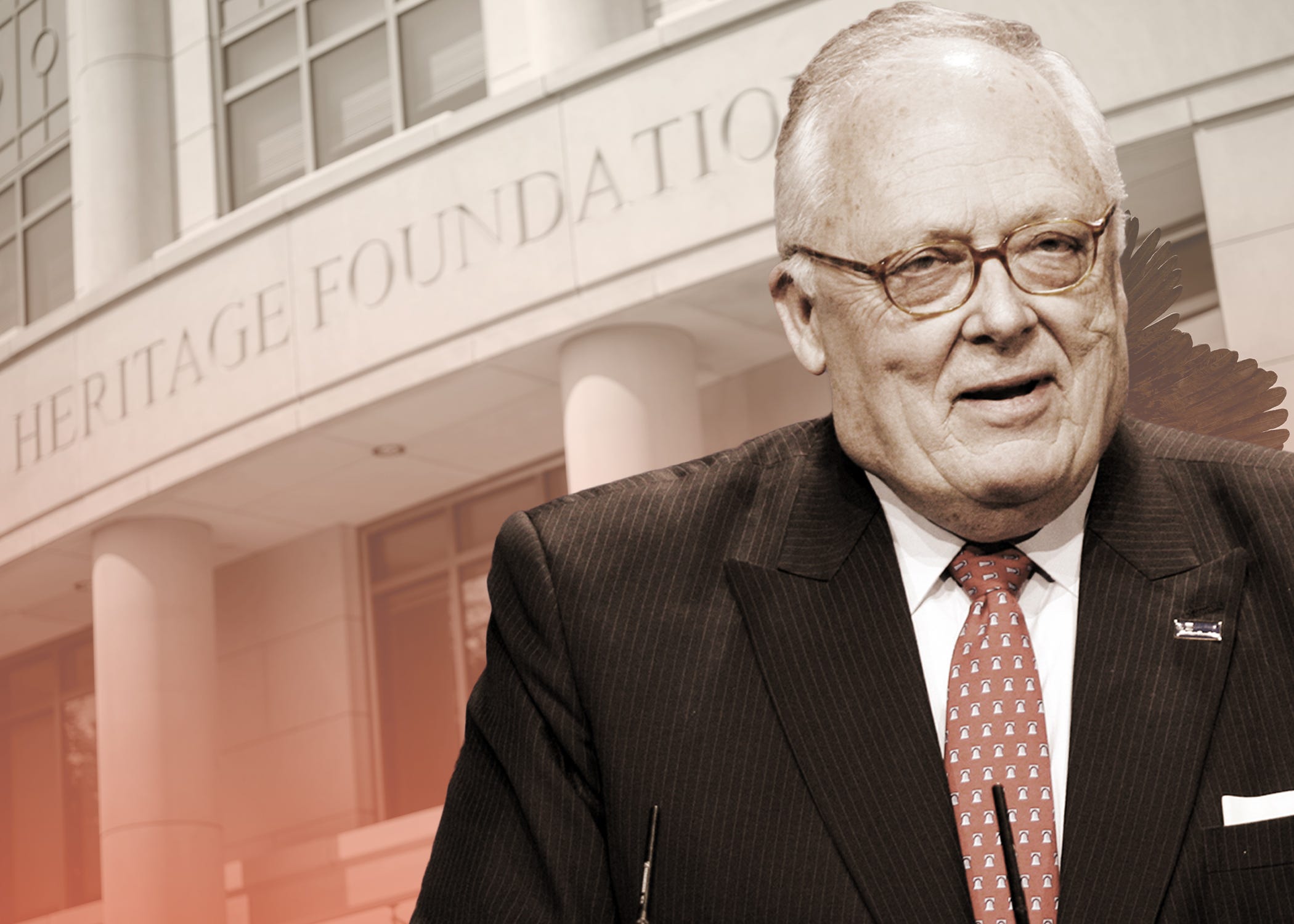
THE TWENTIETH-CENTURY CONSERVATIVE MOVEMENT had its own pantheon of heroes. At the top of this Olympus were the symbols: Reagan, Buckley, Goldwater—people whose memory became sacrosanct, regardless of historical reality. The next echelon down were the intellectuals. The writers and editors who “started it all” by seeing through liberal hegemony: Chambers, Meyer, Kirk, Burnham, Kendall, Rand—the list goes on. Then you have the activists and politicians, who ran the campaigns and marshaled the troops. And finally, more out of obligation than reverence, the donors, the “Funding Fathers,” whose deep pockets paid for it all.
Nestled amid this cast is a half-category. Not quite intellectuals but more than administrators, the “ideological entrepreneurs” who built the right’s battery of counter-institutions. Folks like book publisher Henry Regnery, Fox News Channel’s Roger Ailes, or the American Enterprise Institute’s William Baroody Sr. One of these ideological entrepreneurs, Ed Feulner, died last week, aged 83. The policy program of the second Trump administration is part of his legacy.
Feulner’s entire career was made possible by the conservative movement that he in turn shaped. Born into a Catholic family in 1941 and educated through midcentury Catholic educational institutions, Feulner was precisely the sort of young person drawn into the movement. He read Russell Kirk’s The Conservative Mind and Erik von Kuehnelt-Leddihn’s Liberty or Equality and became a conservative. From there, he subscribed to National Review and joined the Intercollegiate Studies Institute, the conservative student organization. Conservative grants paid for part of his graduate education before he worked at the Hoover Institution. Feulner went to Washington as an aide to the head of the House Republican Conference and then for New Right hopeful Rep. Phil Crane. Like many of the conservative movement’s second generation, Feulner believed in it all, fully and uncomplicatedly.
In Washington, Feulner and the New Right operative Paul Weyrich in 1973 cofounded the Heritage Foundation—Feulner’s principal legacy. Conservatives desperately craved right-wing counterweights to liberal strength in academia and the mainstream press. In their view, liberal ideas dominated due to a closed circuit of influence. Liberal professors dreamed up progressive ideas, which liberal journalists promoted. Liberal politicians read the papers and watched the news, and taking their cues, voted these programs into law, often providing more funding for liberal academics or managers. Conservative activists concluded that think tanks, among other things, could break this circuit. Feulner and Weyrich wanted a think tank for the hardcore conservative activists: one that would collapse the distance between political elites and the anti-liberal base.
Under Feulner, the Heritage Foundation became, as the conservative court historian Lee Edwards put it, a “Washington powerhouse.” The smashmouth think tank eschewed scholarly norms, prioritizing impact and purity over nuance, and often defining itself against other right-leaning think tanks. Heritage changed Washington, and as a result, the country.
AS IS OFTEN THE CASE WITH THE CONSERVATIVE MOVEMENT, myths abound about the Heritage Foundation’s genesis. One story goes that, as congressional aides, Feulner and Weyrich had lost a close legislative fight in spring 1971. A couple of days later, they received in the mail a report from the American Enterprise Institute on the very issue that had been at stake. AEI’s Baroody, according to this story, hadn’t wanted to influence the outcome of the vote by publishing earlier. Too little, too late, Feulner and Weyrich thought, and began the process of founding an explicitly political think tank that wouldn’t miss opportunities to shape the political landscape. Jason Stahl, a historian of conservative think tanks, calls the story an exaggeration. The timing doesn’t work: Baroody was already moving AEI in a more ideological direction and Feulner and Weyrich were already seeking funds for a think tank. Still, the fact that this is the story generations of conservative activists have believed reveals something about how they understand Heritage and how Heritage understands itself.
How Feulner and Weyrich got the money is another piece of folklore. One day, Weyrich, the press secretary for Colorado’s Senator Gordon Allott, was on mail duty. The aide normally responsible—a certain George F. Will—was away. He received a letter from the office of Joseph Coors, the Colorado brewing magnate. Coors had just read the Powell Memorandum and wanted to do something. Weyrich had just the thing. The narrative has been streamlined in the telling here, too. Coors must have had something in mind. He had already sounded out funding AEI. But Weyrich took him to meet a conservative aide in the Nixon White House who shouted, “AEI? AEI? I’ll tell you about AEI.” He took a book off his shelf and blew dust off it. “Their stuff is good for libraries.” Feulner and Weyrich got Coors’s money (and much more cash besides).
Feulner took over the Heritage leadership in 1977, doubling its operational budget by 1979. As the group’s president for nearly four decades, Feulner grew Heritage from a midsized operation to an organization with 300 employees and a $90 million annual budget.
Heritage did not create new scholarship. Feulner and Heritage put ideology, not ideas, first. Heritage “was a secondhand dealer in ideas,” Feulner said. It took conservative gospel and translated it into “policy concepts.” In doing so, Stahl argues, Heritage contributed to a decline in standards and rigor in policymaking.
Instead, the key to the “Heritage model” was relevance and aggression. “We don’t just stress credibility,” Feulner once said. “We stress timeliness. We stress an efficient, effective delivery system. Production is one side; marketing is equally important.” Perhaps the logical endpoint for defenders of free markets was to treat ideas as a consumer product. Heritage focused on brief reports that reached politicians and aides. Feulner turned Heritage into a massive provider of right-wing information for time-poor Washingtonians, with an exhaustive network of experts, contacts, and media products. Conservatives imagined a grand left-wing conspiracy to turn ideas into legislation. Feulner built a real one for the right.
Feulner’s most ambitious gambit along these lines was 1980’s Mandate for Leadership—a 3,000-page tome that aimed to define the policy agenda for the Reagan administration. Although the Reagan White House was occasionally ambivalent toward it, Mandate for Leadership provided a blueprint for conservative governance and—due to the major media coverage—serious cachet for Heritage. Heritage claims Reagan enacted two-thirds of Mandate for Leadership’s recommendations. Project 2025 is the ninth iteration of the series.
Since the 1980s, Heritage has presented itself as the premier conservative think tank. Its hardline conservatism set it apart from the likes of the libertarian Cato Institute or the more moderate AEI. Heritage, for example, issued report cards on politicians’ conservative purity. Reagan once scored 62 percent.
Feulner really was a true believer. Under his stewardship, Heritage shifted away from Weyrich’s Christian right social conservatism and toward a bigger-tent conservatism. The think tank had something for the social conservatives, but also something for defense hawks, something for neoconservatives, and something for supply-siders.
Feulner saw himself, too, as bridging the gulf between the founders of the conservative movement—men he deeply admired—and the halls of power. He brought the aging romantic conservative Russell Kirk on at Heritage as a distinguished scholar in the 1980s. Feulner wanted Kirk to bring soul as ballast to policy. Neither man recognized that the policy proposals Heritage pushed were accelerating the decline of the type of traditional localist life Kirk celebrated.
Politically, Heritage pushed free-market fundamentalism and deregulation. Heritage backed supply-side economics, NAFTA, and welfare reform. When George H.W. Bush took tentative steps away from the exaggerated Reaganism Heritage favored and toward traditional Republican policies, Feulner fulminated, “Conservatives supported George Bush and they got Michael Dukakis.” During the Obama years, Feulner formed a pressure group, Heritage Action, to attack Obamacare. Whatever ideas were au courant on the right, Heritage advanced.
Just as importantly, under Feulner, Heritage became a finishing school and personnel bank for Republican politicians and presidential administrations. “People are policy,” went one of Feulner’s mantras. Fourteen people involved with Mandate for Leadership worked on Ronald Reagan’s transition team. Others involved included William Bennett, eventually the secretary of education, and Samuel Francis, the Mephistophelean New Right writer. In 2001, Feulner bragged he’d “passed on 1,200 to 1,300 names and résumés” to the Bush White House.
Heritage became the right’s battering ram in Washington. It supplied ideas and policy briefs. It pressured politicians, issued purity tests, and supplied cadres of right-wing smart alecks. “Party considerations are secondary,” Feulner once said. What mattered was conservatism. But not all touched by Heritage were as beholden to the conservative movement’s founding myths as Feulner.
SINCE HIS RETIREMENTS from the Heritage presidency—first in 2013 and then again in 2018 after he was brought back to succeed his successor—Feulner the arch-Reaganite watched the conservative movement and the think tank he built transmogrify into vehicles for Trumpism. Kevin Roberts, the Heritage president since 2021, has openly driven the organization in an illiberal direction and explicitly talked about “institutionalizing Trumpism.” Trump’s director of the Office of Management and Budget, Russell Vought, and border czar, Tom Homan, are both Heritage creatures. Feulner, meanwhile, endorsed not Trump but Mike Pence for president in 2024.
Feulner’s Heritage Foundation sought to bring the impulses of the activist base into policymaking. It lowered scholarly barriers to focus on timeliness and policy impact above all. It demonized liberals and mainstream academia, and relied on right-wing donors to build its empire. Feulner always positioned Heritage hard on the right and criticized conservatives and Republicans when they failed to match his intensity. We should not be surprised, then, that the think tank he spent his career building in his image rapidly came to reflect the new Trumpist core of the American right.
 | A guest post by
|