Inside the Plan to Stop/Melt ICE at the Polls
The Trump administration says immigration agents won’t show up at voting locations. Activists, lawyers, and allied groups are preparing anyway.

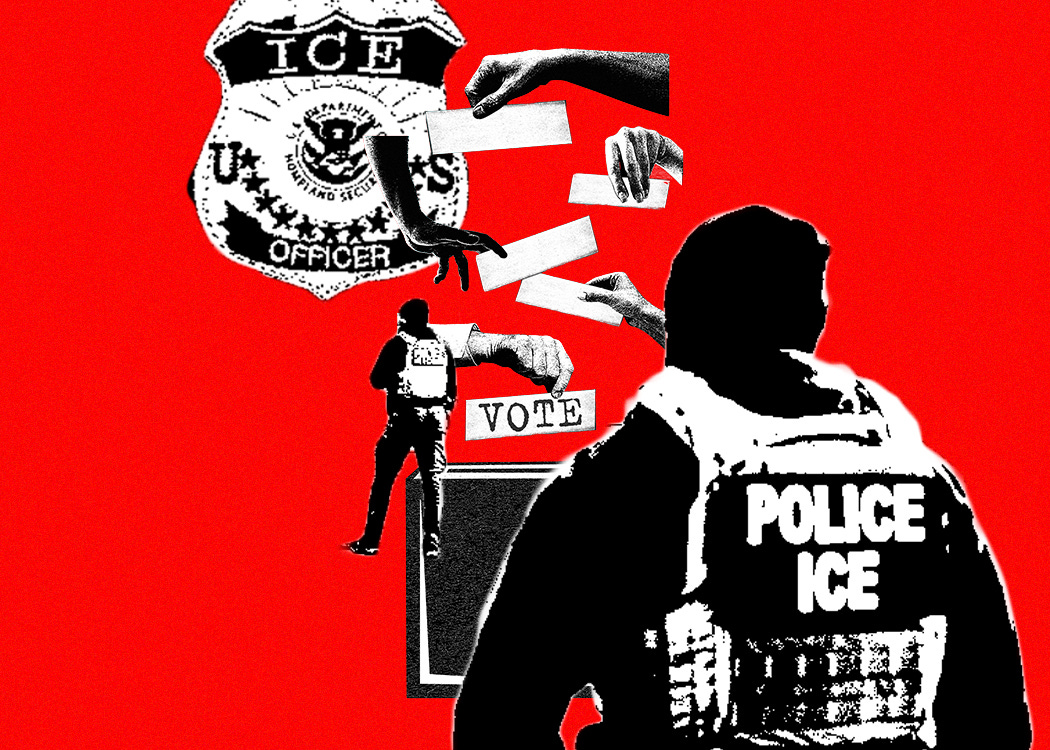
DURING A PRIVATE CALL last Wednesday, Department of Homeland Security official Heather Honey vowed to election officials around the country that ICE would not be at the polls in November, calling the idea “disinformation.”
“There will be no ICE presence at polling locations,” she said, according to Politico.
But others who dialed in to the conversation didn’t leave convinced. Arizona Secretary of State Adrian Fontes, who was on the line, waved away Honey’s promises as empty on account of her past efforts pushing the Big Lie that the 2020 election was stolen from Trump.
“I can’t depend on an election denier like that for the truth under any circumstances,” he told Politico. Honey—who serves in a newly created role at DHS, deputy assistant secretary for election integrity—was an activist in Pennsylvania whose research Trump attempted to use to overturn the 2020 election.
Fontes’s skepticism is justified. Trump has already called to “nationalize” elections—and Republicans in the House passed the SAVE America Act, which stipulates national voter ID requirements—to stem voting by “illegal aliens,” as the president alleged is happening in his State of the Union speech. Others on the call expressed sentiments similar to Fontes’s.
“I did not walk away from this meeting reassured that the federal government wouldn’t try to interfere in state sovereignty over the election,” Maine Secretary of State Shenna Bellows told NBC News.
Concerns over what Trump may do to influence the 2026 elections are serious enough that Democratic-run states are already taking steps to mitigate the threat. Even before the Wednesday call, advocacy groups, lawyers, and organizers were preparing for ICE to try to come to the polls. In particular, they are bracing for the Trump administration to engage in acts of voter intimidation and voter suppression, especially in areas with voters of color. The result could be a huge swath of voters either being prevented from exercising their democratic right or being made to feel too nervous to even try to exercise it. All of it done in an attempt to keep Republicans in power.
A clear example of proactive, preventive work at the state level can be seen in Arizona, where earlier this month Republican lawmakers tried to pass a law basically “inviting ICE to the polls,” as my colleague Andrew Egger put it. It ultimately was pulled, with residents standing in line for hours to testify against the measure.
LUCHA Arizona, a political organizing group that has been at the forefront of Arizona’s turn from red to purple (the state went for Biden in 2020 and Trump in 2024, and it now has two Democratic senators and a Democratic governor), was among those that saw the legislation as an important early bout in the national fight against ICE showing up at the polls.
Alejandra Gomez, the executive director of LUCHA AZ, said hearing ICE could be at the polls was a “chilling factor” for her two thousand-strong membership. But even though the legislation was pulled, there are many challenges ahead. For one, the bill can be resurrected at any moment. There is also the possibility that rebellious county recorders or other officials could ignore the law and allow ICE at the polls. In anticipation of such a scenario, she said, her group is preparing for legal challenges and an organizing fight.
Gomez said that LUCHA and the coalition it’s a part of, Activate 48, are prepared to “hold the line for democracy,” as Arizona groups have already done once with the recent legislative fight against ICE at the polls. They will also be active in the governor’s race and in working to flip the state legislature. Their goal is to knock on close to one million doors.
“This is a direct attack on immigrant and Latino communities, but right now it is having an effect on all communities,” Gomez told me. “What people witnessed with Renee Good and Alex Pretti is that ICE is a rogue force that uses violence to oppress and to scare people, and in Arizona, people are worried about violence when ICE is deployed.”
THAT FEAR IS REAL AND TANGIBLE. ICE may not show up at the polls in November, but just the prospect of Latinos, immigrants, and brown people getting detained by masked federal agents simply for deciding to exercise their right to vote could prove chilling.
Charles Kuck, a Georgia-based lawyer who often sues the Trump administration—he’s gone after them in response to their $100,000 fee gambit for H-1Bs and defended international students whom the administration tried to strip of legal status—said that while he believed the courts would rule against ICE being allowed to have a presence at the polls, the fear that the agency might try and show up poses a major problem.
“I don’t understand what legal basis they would have to have ICE at the polls,” he told me. “I think lawsuits would be filed that morning, and ICE would be forced to leave the polls. But the mere threat that it might happen would intimidate people from going to the polls, which is why voting early and absentee is so important.”
Mi Familia Vota, a national group that works to mobilize Latino voters in the eight states of Arizona, California, Colorado, Florida, Georgia, Nevada, North Carolina, and Texas, is working on voter education efforts to let prospective voters know their rights and ICE’s limitations.
They recently partnered with Mundial Media, an ad firm that works to reach Latinos digitally, to create more community comfort with elections. The groups showed advertisements of Latinos who have worked to make local elections safe, such as poll watchers. Those ads, an official said, helped increase strong voter intent 3 to 4 percentage points among English and Spanish respondents and lowered intimidation fears by 6 percentage points.
Mi Familia Vota’s national director of campaigns and programs, Angelica Razo, said that in addition to the digital work, the group plans a $10 million national campaign of voter engagement and education. It would involve old-fashioned, on-the-ground, direct work with voters to answer their questions and assuage their fears so they feel empowered to cast their ballots.
This kind of work involves group members showing up at polling locations—libraries, schools, courthouses, places “where we have already seen ICE target people,” Razo said—to offer support.
Mondale Robinson, the founder of the Black Male Voter Project, a national group that has done voter mobilization work in Georgia, said new fears around ICE are a natural progression of previous kinds of election interference.
“ICE is new, but it isn’t new,” he told me. “What’s the difference between ICE and massive investment in sheriff departments among southern rural populations where black people and brown people are overrepresented? ICE is everybody with a badge.”
Voter education also includes rapid-response messaging if there are threats and intimidation when voting begins. But reducing fear is also about presenting voters with options, like early voting, which can increase turnout without voters going directly to polling places.
“On the proactive side, we’re making sure people early vote and vote by mail,” Razo told me. “As an organization that works across various states on vote-by-mail campaign strategy, our work is around ‘How do we bolster that?’”
Robinson put it more plainly: “Our people are already counting on the fact that ICE and armed people are coming to the polls; we’re already prepared for that because Trump can only hold power without respect for constitutional norms.” He says that his main message to black voters is simple: “Assholes are working to try to create fear at the polls, but they can’t stop you. Do your shit and get out.”
This type of work could make a profound difference in overcoming potential efforts to suppress the vote. But it’s also grunt work—the kind of necessary but not flashy labor that doesn’t always garner national attention or the support of big-moneyed donors. They have, so far, been reluctant to give.
Razo’s group, like others that exist at the crossroads of Latino voting and immigration, still need financial support to help fund their work. When I wrote about the topic last year, I found that immigration groups were yelling from the rooftops that democracy-defense initiatives intersected with the urgent immigration work. It was also clear that progressive donors were gun-shy about publicly challenging Trump on immigration (his strong suit at the time) out of fear of drawing the administration’s wrath.
Razo and others are still waiting for those donors to get off the sidelines—since ICE itself is clearly ready to engage.
“Investing in our communities is investing in democracy for the long run,” she said. “Latino issues are everyone’s issues.”
Thanks as usual, Adrian. And thanks twice for highlighting the madness in AZ, where not only is the R controlled legislature wanting to “invite ICE” to the polls, they also have an election denier ‘County Recorder’ in Maricopa CO - one of the biggest, most populace counties in the USA, who wont reveal his plans to support elections, is being sued, subpoenaed, questioned and suspected of seeking to screw up elections to the point where no one knows the outcome! It’s ridiculous, It’s sublime, It’s AZ, but it may be even worse than it appears. Love your work and can’t say thanks often enough.
Even if actual ICE agents aren't at polling sites, I can certainly envision militias and other groups wearing masks, body armor, civilian or military-style clothes, and carrying weapons showing up near polling stations to intimidate and harass people of color trying to vote. That's one of the dangers of federal law enforcement agencies dressing and acting as they have in the past year.