Europe Is a Platform, Not a Burden
The Trump administration is hurting American alliances and trust because they can’t understand why our forces in Europe matter.

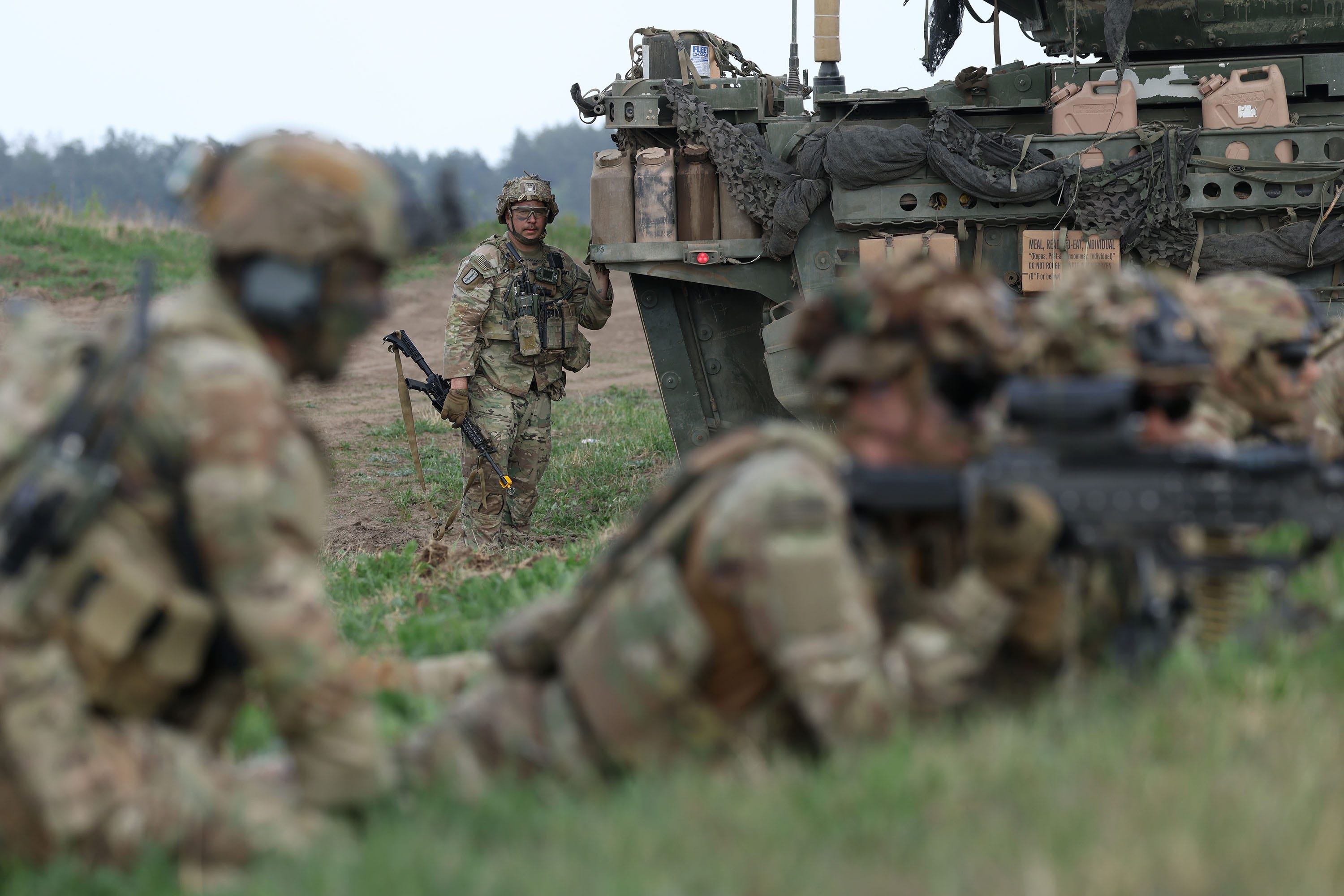
THE ABRUPT DECISION by Secretary of Defense Pete Hegseth to halt the planned deployment of roughly 4,000 American troops to Poland—and the broader announcement of withdrawing another 5,000 troops from Europe—has rattled allies across the continent. According to a recent report in Politico, even Pentagon officials were caught off guard. “We had no idea this was coming,” one U.S. official reportedly said, as European and American leaders spent the next twenty-four hours trying to determine whether additional surprises from head office were on the way. Russia surely welcomed the move.
None of that should reassure anyone.
I spent years helping redesign America’s military posture in Europe, including serving as commander of U.S. Army Europe as the command completed the previous major restructuring of forces on the continent in 2011. My biggest concern about this latest decision is not the force reduction itself. Military posture decisions come and go; every administration has the right to review deployments. What concerns me is the apparent lack of strategic coherence surrounding this one—and a growing misunderstanding in Washington about what American forces in Europe are actually there to do.
Military posture decisions are more than moving men and women around a map. They are strategic signals. And when commanders are surprised, allies are stunned, and adversaries are encouraged, the signal is backwards.
This is especially true in Poland, one of NATO’s strongest and most reliable allies. Poland spends heavily on defense—it has been modernizing its armed forces at an extraordinary pace since 2004, incorporating Abrams tanks, PATRIOT air defense systems, and F-16 fighter jets into its military organizations. It has also consistently aligned itself with U.S. strategic objectives and hosts American troops willingly. It’s the only country in Europe that has come close to meeting the goal 5 percent of GDP while also subsidizing American forces that serve on its soil.
Poland is hardly alone. Romania, Bulgaria, Croatia, and the Baltic nations have also spent the last decade building increasingly capable militaries with American support, equipment, advising, and training. Those partnerships were not accidental. They were the result of sustained American engagement designed to strengthen NATO’s eastern flank after Russia’s aggression in Crimea and eastern Ukraine. That was part of the long-term strategic plan when I was the commander, and it was exceedingly successful.
But now, Warsaw is scrambling for answers, and, really, every ally in Europe is also beginning to ask the same question: What exactly is America’s strategy?
THE TRUMP ADMINISTRATION’S PUTATIVE explanation only deepens the uncertainty. The force reduction discussion seems linked to to frustration with European opposition to President Trump’s Iran operation. Germany, among others, expressed concern or hesitation about supporting U.S. actions in the Middle East, President Trump became upset, and then suddenly troop reductions followed close behind. Managing alliances this way is extraordinarily dangerous. These actions aren’t part of thought-out process; they seem to be policy on a whim.
The leaders of our allies make decisions based on their own national security requirements, constitutional processes, coalition politics, and the support of their populations—just as American leaders should. Our allies are partners; they do not function as automatic extensions of the White House. Democracies debate military action. Democracies weigh risks differently. Democracies sometimes disagree, even among close allies. That is not a flaw in our alliances; it is how sovereign nations operate and engage with other allies.
The way Trump treats deployments as political rewards and punishments based on whether allied governments publicly support a particular American operation is strategically shortsighted. Worse, it misunderstands who actually benefits most from America’s military posture in Europe. The fact—and the strategy—is that the force structure in Europe today exists primarily for the strategic benefit of the United States.
Too many Americans still view U.S. forces in Europe through a Cold War lens. They imagine huge garrisons sitting idle on old bases, detached from modern security realities. Any caricature of American troops in Europe sitting around drinking beer and eating schnitzel while taxpayers foot the bill is profoundly wrong.
After the close of the Cold War and then in the aftermath of September 11th, the United States purposefully redesigned our force posture in Europe. Far from “occupation,” our European stationing provides America with forward positioning, operational reach, and alliance access. It is critical for logistics infrastructure, intelligence integration, and our rapid response capability across multiple theaters. Europe is a launching platform for American global operations.
Our bases in Germany, Italy, Spain, Poland, Romania, and elsewhere support U.S. missions far beyond Europe itself. Those installations provide access to the Middle East, North Africa, the Arctic, the Balkans, and Eastern Europe. They support air mobility, missile defense, intelligence operations, cyber activities, medical care, prepositioned equipment, naval operations, and command-and-control functions that would be extraordinarily difficult to replicate from the continental United States.
Europe is not a strategic burden. It is one of America’s greatest strategic advantages. And that advantage is built not just on bases or equipment, but on relationships.
These relationships extend far beyond the words in a treaty or the polite choreography of a high-level tête-à-tête. One of the least understood missions of American forces in Europe is theater security cooperation. TSC is a constant process of training, planning, exercising, coordinating, and building interoperability with allied and partner nations. U.S. forces in Europe routinely work with forty-nine European countries, many of the friendly nations among the fifty-four countries that make up Africa, and dozens of partners in the Middle East. Those relationships are not symbolic diplomatic exercises. They are designed to create strategic and operational capability, making America’s military—and those of our allies—stronger.
American service members are constantly engaged with partner nations. These might be during multinational exercises, logistics rehearsals, intelligence coordination, missile defense integration, aviation operations, cyber collaboration, medical planning, and joint leader development. Whatever the specifics, these interactions build familiarity, access, confidence, and trust with partners who may someday fight alongside American forces—or provide critical access during a crisis somewhere in the world. Once lost, trust in the United States cannot simply be re-won—or worse, demanded—at the last minute. And we certainly cannot deploy trust like we deploy forces.
WE HAVE ALREADY SEEN WHAT HAPPENS when America reduces its engagement in parts of Africa and other developing regions. Nations like China have aggressively moved in to fill the vacuum—offering infrastructure projects, military cooperation, economic investment, and political influence where American presence and leadership once carried enormous weight. Those relationships matter strategically, not only today, but for decades into the future. Influence abandoned rarely remains unclaimed.
Another misunderstanding behind this latest decision is the assumption that U.S. forces in Europe conduct standalone operations, as though American capabilities exist apart from the broader alliance structure. That is not how NATO works. The alliance is a complementary, interconnected system. American forces are one critical piece of a much larger operational puzzle that includes an awesome array of varied allied capabilities and sustainment networks spread across dozens of nations. NATO training exercises are designed specifically to integrate those capabilities so that multinational forces can operate together effectively in crisis or combat.
The sudden removal of a major American combat element from that structure, doesn’t just reduce one nation’s troop numbers. It weakens the collective capability of the alliance itself—both operationally and psychologically. Training plans are disrupted. Readiness cycles are affected. Interoperability suffers. Deterrence weakens because the visible integration of allied combat power is part of what makes NATO credible in the first place.
All of these issues are especially true when it comes to armored forces.
When I commanded in Europe, a major debate involved whether the United States should retain a permanently stationed armored brigade on the continent. I argued strongly that we should, to complement the wheeled Stryker Brigade we had in Grafenwöhr, Germany, and the rapidly deployable Airborne Brigade located in Vicenza, Italy. Others believed the risk of moving the Armored Brigade could be managed and the capability could be retained with a rotational model that reduced our permanent footprint and infrastructure costs. Ultimately, the permanently stationed armored brigade in Vilseck, Germany—a base we had significantly upgraded—was replaced with a rotational armored brigade combat team. In 2010, those rotational brigades were included in our operational plans and long-term strategy for the continent.
An armored brigade combat team is not a token force. It consists of heavy tanks, Bradley Fighting Vehicles, large artillery systems, engineers, logistics units, maintenance formations, and thousands of soldiers trained to conduct high-intensity combat operations. These are precisely the kinds of capabilities being used every day in Ukraine today.
By supplying a yearly rotational model, American armored forces were able to partner with NATO allies who still maintained significant tank formations. It also showed Russia that we still retained an armor punch continuously on the continent. The approach created flexibility and broadened interoperability across the alliance. But it only worked if the rotations remained predictable, continuous, and credible. As the commander at the time, I was promised by the Department of Defense and the Obama administration that this rotation would be sacrosanct.
Now, even that compromise is unraveling due to the petulance of the secretary of defense.
The brigade that was scheduled to deploy to Poland had already spent months preparing to replace the outgoing unit. Troops and equipment were already beginning to move when the mission was abruptly halted. That is not simply a matter of changing numbers on a briefing slide. It disrupts our military, our allies, and our serving families simultaneously—all while undercutting our deterrence messaging. This is precisely the kind of uncertainty that adversaries exploit.
Europe is a forward operating platform that gives the United States enormous military, diplomatic, and strategic advantages. During my years in Europe, we often described America’s relatively small forward presence as allowing us to “fight above our weight class.” Reducing that posture without a clearly articulated strategy is not a demonstration of strength. It is admitting short-sightedness.
You cannot casually remove pieces from a system like that without consequences. Especially not impulsively. Especially not without consultation. And especially not while allies scramble for explanations and Russia celebrates the outcome.
It is a warning sign of strategic confusion.