Courts Keep Smacking Down Trump’s Lawless Attempt to End Birthright Citizenship
But he keeps plugging away—believing his allies on the Supreme Court will ultimately side with him.

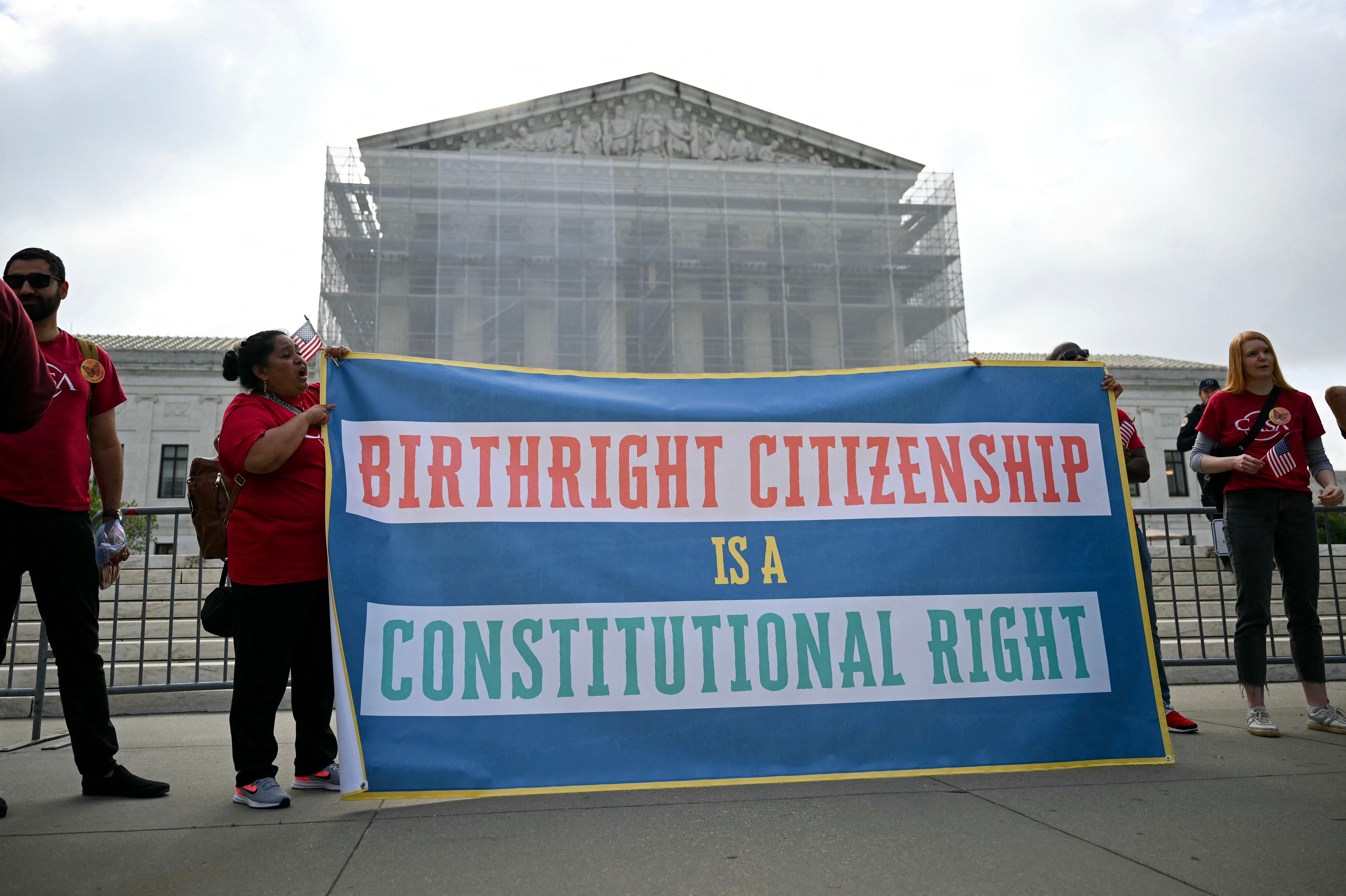
ON FRIDAY, A SECOND FEDERAL APPEALS COURT declared unconstitutional Donald Trump’s attempt to undo the plain language of Section 1 of the Fourteenth Amendment. That provision states that “all persons born . . . in the United States, and subject to the jurisdiction thereof, are citizens of the United States” (emphasis added). Numerous trial courts, as well as the U.S. Court of Appeals for the Ninth Circuit, have already ruled that “all” means “all.” It shouldn’t take a written opinion from one federal court, let alone multiple opinions from multiple federal courts, to know that nobody—not even a president—can unilaterally suspend the Constitution.
And when it comes to birthright citizenship, the language of the Constitution is clear. The courts have no job to do here other than read the plain language of the Constitution, which Congress went so far as to later memorialize in a statute. Anyone with access to the English language can simply read those laws to ascertain for themselves whether Donald Trump can lawfully deny birthright citizenship to certain individuals based on their parents’ citizenship status, which he attempted to do in an executive order signed his first day in office. He cannot. That would require a full-blown amendment to the Constitution, which in turn can only be accomplished through ratification by supermajorities in both the U.S. Congress and state legislatures. His executive order is illegal and unconstitutional.
Chief Judge David J. Barron explained as much in Friday’s hundred-page decision for a unanimous three-judge panel of the U.S. Court of Appeals for the First Circuit, which sits in Boston. He opened the opinion by making a point of underscoring that this is not a hard legal question:
The length of our analysis should not be mistaken for a sign that the fundamental question that these cases raise about the scope of birthright citizenship is a difficult one. It is not, which may explain why it has been more than a century since a branch of our government has made as concerted an effort as the Executive Branch now makes to deny Americans their birthright.
So why are the courts having to slog through so much federal litigation over Trump’s executive order? Because the far-right majority on the U.S. Supreme Court has refused to shut it down.
When given its first opportunity, the justices in the majority decided to pivot off-course, making a legally dubious ruling that so-called “universal injunctions” by district court judges are bad. A number of those judges had issued injunctions barring the Trump administration from enforcing its unconstitutional executive order on birthright citizenship. The majority’s cynical maneuver of ruling instead on universal injunctions did significant damage because it gave a fig leaf of legitimacy to Trump’s executive order. It also made it much harder for lower federal courts to stop other unconstitutional actions by Donald Trump. They now have to guess whether they’ve properly narrowed their injunctions in a way that would please the majority or otherwise certify a class action—both of which could be rejected by the Court down the road.
Trump recently appealed other birthright citizenship cases to his pals on the Supreme Court. Given their unconscionable record of handing Trump “emergency” wins in 21 of 23 cases filed since January, there’s no guarantee that the Constitution will prevail if the Court takes up this one, either. Yet there is no legitimate legal rationale not to uphold the actual Constitution.
After all, the so-called conservatives on the Court are supposedly “textualists.” A textualist purportedly adheres to the plain text of the Constitution or a statute on the theory that to do otherwise would be subscribing to “judicial activism,” which the more progressive justices have long been accused by the right of doing in making decisions like recognizing constitutional rights to abortion or same-sex marriage.
Because Trump cannot get around the actual text of Section 1, his bid to bypass the text fastens on a related tool of “conservative” judicial interpretation: originalism. Originalists claim to confine their interpretation of the Constitution to the “original meaning” at the time the text was written, or the “original understanding” of the text’s framers—in this instance, the people who voted to ratify the Fourteenth Amendment in 1861. (This strain of constitutional interpretation has a number of logical flaws, including that it’s impossible to definitively identify who all of the relevant people even are, let alone what they understood the text to mean in 1861.)
Under an originalist lens, the Trump administration claims that the Fourteenth Amendment’s phrase “subject to the jurisdiction thereof” means that a person in the United States must owe their “primary allegiance” to America, which they cannot do if their parents aren’t here lawfully in the first place. The trouble is, the Supreme Court already rejected this very argument back in 1898 in a case called United States v. Wong Kim Ark.
The Trump administration’s other argument is that the original purpose of the birthright citizenship clause (which was part of the trio of post-Civil War Amendments to the Constitution) was to recognize the citizenship of formerly enslaved individuals, putting to rest the Supreme Court’s shameful decision Dred Scott v. Sandford, which held in 1857 that enslaved people were not citizens. Judge Barron swiftly dispensed with that argument, too. In Wong King Ark, he noted, the Supreme Court emphasized that “the opening words, ‘All persons born,’ are general, not to say universal, restricted only by place and jurisdiction.”
All means all.
 | A guest post by
|