The Founders Would Abhor Trump’s Domestic Deployments
And the notion that courts can’t review his National Guard decisions is baseless.

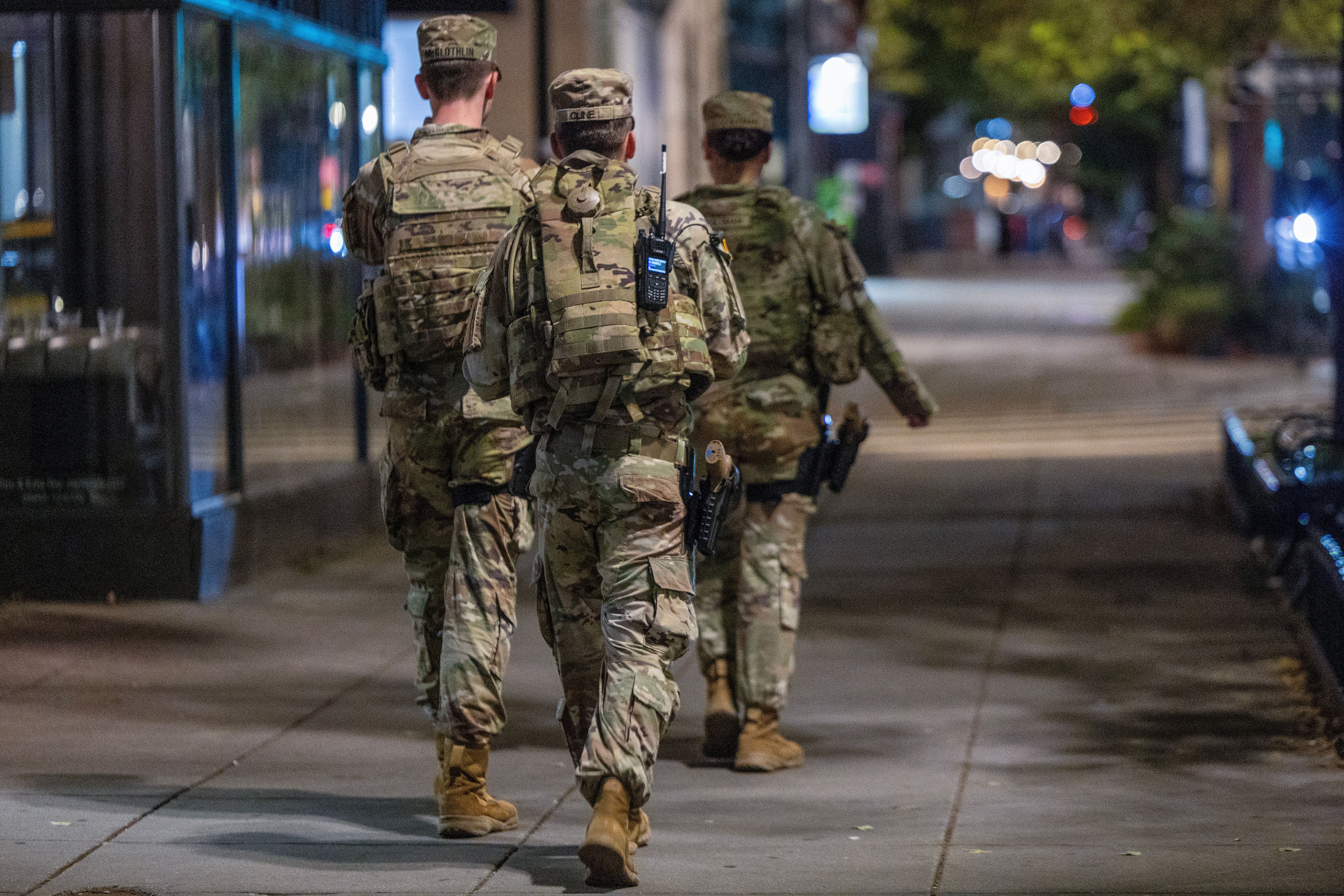
STARTING IN THE SPRING and then escalating over the summer, President Donald Trump sent federal troops or “called up” National Guard units to Los Angeles, Washington, D.C., Memphis, Portland, and Chicago. He did this supposedly to aid in law enforcement, and over the objection of the governors and mayors involved. And last week brought the news that he is creating a “quick reaction force” of over 20,000 National Guardsmen, drawn from every state, that he can deploy at his will wherever he wants.
The Founders would be appalled. They fought a revolution against a king who sent his troops against them to enforce his laws. That experience was fresh in their minds when they adopted a Constitution that says that Congress alone has the power “to provide for calling forth the Militia to execute the Laws of the Union, suppress Insurrections and repel Invasions.”
The president argues that it is appropriate for him to use the military “to execute the laws.” He also contends that the courts have no authority even to consider the legitimacy of his decision to summon National Guard troops and send them into American cities for what he deems law enforcement.
Neither position has constitutional support.
The Supreme Court declined to rule immediately on Trump’s position, ordering further briefing later this month. Any faithful resort to our constitutional history and adherence to the Court’s own precedents should lead the Court to reject the president’s claims overwhelmingly.
In their opinions for the Supreme Court in the two Second Amendment gun-control cases, District of Columbia v. Heller and New York State Rifle & Pistol Association v. Bruen, two of the Court’s most conservative justices, Antonin Scalia and Clarence Thomas, emphasized that the meaning of words in the Constitution must be determined by looking at the historical context in which they were used.
Protests were the spark that ignited our revolution and resulted in a new nation founded by patriots who were committed to establishing a government where the people would reign and military force would not be used against them. They no doubt recognized that when peaceful people assemble to protest injustice, it is not unlikely that a few malcontents will engage in disruptive acts. However, they trusted the governments of the states to protect the safety of their people and would never agree that a few violent incidents would provide a basis for the national government to set about “calling forth the militia.”
Federal judge April M. Perry respected this constitutional history when she issued an injunction last month against the use of National Guard troops in Chicago, as another judge had done in rejecting the use of troops in Portland. Perry’s opinion carefully detailed the history of the “calling forth” clause, which demonstrates that the drafters of the Constitution did not authorize sending militia into the states to harass their citizens because of some limited illegal conduct in connection with otherwise peaceful demonstrations.
Judge Perry’s ruling is consistent with a range of cases over the years in which the Supreme Court has made clear that martial law and military enforcement may only be invoked when there is an extreme danger to the existing order in one of the states, even in times of actual war.
For example, in Ex parte Milligan, a Civil War case, the Supreme Court reviewed the history that led the drafters of the Constitution to limit the use of military force against civilians. The Court concluded that “martial rule can never exist where the courts are open and in the proper and unobstructed exercise of their jurisdiction.”
Even after the attack on Pearl Harbor, the Supreme Court was unwilling to allow the use of military authority to arrest civilians in Hawaii, when the local government was operating and the civil courts were functioning. In a 1946 ruling, the Court examined the historical use of the militia shortly after the Constitution was adopted, noting that, even in the three prior occasions when the militia was called out to help deal with violent interference with the courts, the presidents had assured that the troops were responsible to the states’ governors.
The executive and military officials who later found it necessary to utilize the armed forces to keep order in a young and turbulent nation did not lose sight of the philosophy embodied in the Petition of Right and the Declaration of Independence that existing civilian government, and especially the courts, were not to be interfered with by the exercise of military power.
The reasons for the reluctance of the Founders to countenance the use of the military in times other than those of true national emergency were noted in Milligan:
This nation . . . has no right to expect that it will always have wise and humane rulers sincerely attached to the principles of the Constitution. Wicked men, ambitious of power, with hatred of liberty and contempt of law, may fill the place once occupied by Washington and Lincoln, and if this right is conceded, and the calamities of war again befall us, the dangers to human liberty are frightful to contemplate.
Most basically, the Supreme Court has not shied away from determining whether the president’s efforts to use military authority, including the armed forces or the National Guard, within the United States satisfies constitutional norms.
IN ADDITION TO THE DECISIONS already mentioned, one can look to the various decisions determining whether the president’s military orders to exclude or intern persons of Japanese descent at the outset of World War II were constitutional. History and the Supreme Court itself would later repudiate some of the Court’s rulings; the key point is that the courts independently decided whether the president had such authority.
In addition, in the midst of the Korean War, the Court struck down President Harry Truman’s seizure of American steel mills in order to continue generating war materiel for the troops. The Court declared that “the order cannot properly be sustained as an exercise of the President’s military power as Commander in Chief of the Armed Forces.” In his much-celebrated concurring opinion, Justice Robert H. Jackson rejected the proposition that the president’s role as commander-in-chief “vests power to do anything, anywhere, that can be done with an army or navy.”
Jackson explained: “No penance would ever expiate the sin against free government of holding that a President can escape control of executive powers by law through assuming his military role.”
Then, drawing on his experience as the chief war crimes prosecutor at Nuremberg, Jackson explained the importance of having the Court constrain an overly assertive president:
With all its defects, delays and inconveniences, men have discovered no technique for long preserving free government except that the Executive be under the law, and that the law be made by parliamentary deliberations. Such institutions may be destined to pass away. But it is the duty of the Court to be last, not first, to give them up.
The present Court, headed by Chief Justice John Roberts, should heed these words and assert the Court’s constitutional duty to review and repudiate President Trump’s efforts to militarize local law enforcement.
 | A guest post by
|