
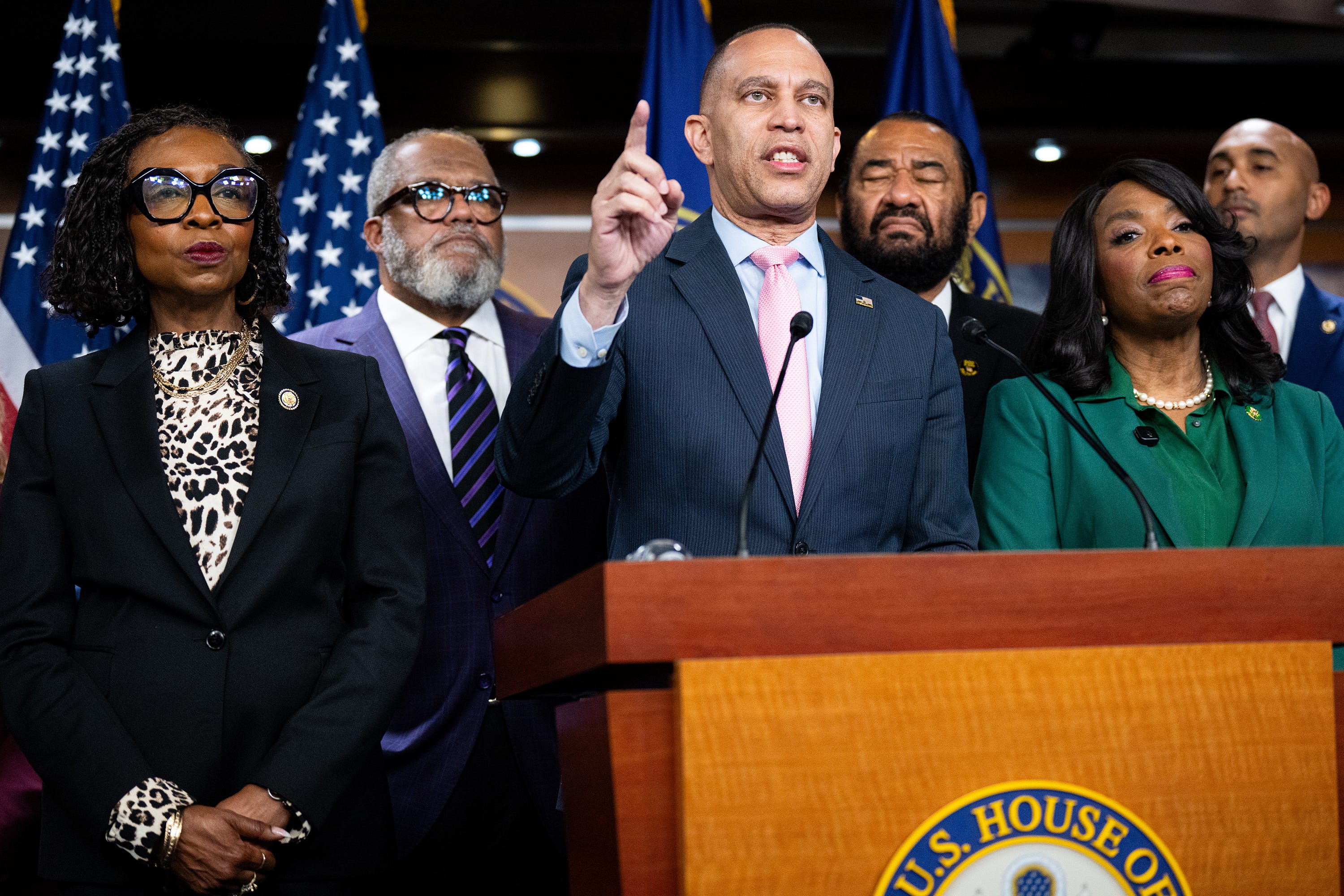
WHEN THE SUPREME COURT ISSUED a ruling last week gutting Section 2 of the Voting Rights Act, it didn’t surprise Democratic leaders, many of whom have come to view the John Roberts–led body as an increasingly partisan institution.
Still, the ruling sent a chill through the party, as Democrats realized that an entire generation of black leadership in the South—where a majority of the United States’ black population lives—could be pushed out of office.
That was the first reaction. The second reaction was a search—and thirst—for retaliation.
Party leaders are already plotting how to counteract the gerrymanders that Republicans are expected to undertake in Tennessee, Alabama, South Carolina, and Louisiana. House Minority Leader Hakeem Jeffries has pointed to New York, Illinois, Maryland, and Colorado as states where Democrats could redistrict ahead of the 2028 election cycle. Other Democratic officials whom I spoke with said there’s discussion about pursuing redistricting in Washington, Oregon, Minnesota, and New Jersey as well.
“There are going to be many Democratic states that need to move forward in order to offset what Republicans are doing. That’s a simple mathematical reality,” said John Bisognano, president of the National Democratic Redistricting Committee. “It is going to be mass redistricting on a nationwide scale.”
But redrawn maps are just one of the ways the Court’s Callais decision is likely to alter our political landscape and with it the aims of the Democratic party. Operatives and lawmakers I spoke with this week say that it is increasingly likely that
Join Bulwark+ to unlock the rest
Become a paying member of The Bulwark to get access to this post and other subscriber-only content. A subscription gets you:
- Unlimited access to articles and newsletters including The Triad by JVL and Receipts by Catherine Rampell.
- Ad-free editions of our shows (with transcripts) and member-only shows like The Secret Podcast.
- Plus community chats and commenting features. Your support helps keep our work sustainable and available to those who cannot afford a membership. Cancel anytime.