The Hopeless Horror of Charles Beaumont
The writer died before his fortieth birthday—but left behind an influential catalogue of stories and unforgettable Twilight Zone episodes.

WHEN ROBERT REDFORD DIED in September, among the many clips from his classic TV and film appearances that fans shared was one from an episode of The Twilight Zone called “Nothing in the Dark.” The classic episode was written by George Clayton Johnson, who, along with Twilight Zone creator Rod Serling and writers Richard Matheson and Charles Beaumont, wrote the lion’s share of the show’s episodes. Johnson, Matheson, and Beaumont, along with a few other genre stalwarts, formed an unofficial collective of writers who worked primarily in the genres of science fiction, fantasy, and horror, called the Southern California Sorcerers. When you look at their individual credits, these writers—through their work on the show, as well as their own individual short stories and novels—changed the landscape of genre fiction in America, making it personal and grounded, and taking the tropes of their genres seriously, as well as inventing brand new ones.
The most tragic, and to me the most interesting, writer from this group is Charles Beaumont. Beaumont began suffering from a terrible brain ailment in his thirties, which was variously diagnosed as early-onset Alzheimer’s or Pick’s disease. Whatever the case, Beaumont slowly wasted away, and he died in 1967 at 38. At the end of the preface to The Howling Man (1988), editor Roger Anker’s excellent, nearly 600-page career-overview collection of Beaumont’s short fiction, Beaumont’s son Christopher writes:
And even now, some nights, I vaguely hear the typewriter keys tapping in the other room. The single bell at the end of the carriage. The sound of the roller twisting another lucky page into the works. And then the tapping starts again and I begin to drift to sleep.
Good night, Father.
On the happier side of things, despite his tragically short life, Beaumont was remarkably prolific. In addition to the couple of dozen Twilight Zone episodes he wrote, and a veritable flood of short fiction, he also wrote the screenplays for two of Roger Corman’s adaptations of Edgar Allan Poe stories, including the best one, The Masque of the Red Death (1964). Another terrific, but lesser-known, collaboration with Corman is The Intruder (1962), based on his 1959 novel of the same name. William Shatner stars as a mysterious man who arrives in a small town and goes about stirring up the townspeople’s barely dormant animosities, racial and otherwise, seemingly just to do it.
One notable aspect of Beaumont’s imagination was that he hit on ideas that were later used by writers who enjoy much more respect from the literary establishment. His 1955 story “The Crooked Man,” which imagines a world where homosexuality is the norm, and the shame and casting out from society is suffered by heterosexuals, precedes Martin Amis’s similar “Straight Fiction” by forty years. In another striking instance, Beaumont’s 1955 masterpiece “The Hunger” antedates Muriel Spark’s Booker Prize–nominated (and excellent, make no mistake) novella The Driver’s Seat, which was published in 1970. Beaumont’s story combines sadness and horror in ways I’ve seen few writers even attempt, let alone pull off; he and Spark both examine a kind of loneliness that is terrible to contemplate. And where Spark goes further in describing the ghastliness of the ending that is inevitable in both stories, Beaumont’s more reserved last line carries with it heartbreak strong enough to make you wince.
TO BE CLEAR, while it’s entirely possible Amis had read Beaumont, I doubt it, as Amis’s imagination ran in the direction of that kind of juxtaposition anyway. I also doubt Spark would ever have even heard of the magazines that published Beaumont. But I think these are good examples to show at what level, and in how many different modes, Beaumont was able to write. Take two other stories, “Fritzchen” (1953) and “The Indian Piper” (2000). In the former, the son of an unscrupulous pet shop owner finds a bizarre creature in the wild, a thing so strange that an employee describes it as a “cross between a whale . . . and a horsefly, near’s I can see.” Mr. Peldo, the owner of the shop, sees nothing but dollar signs, and a path toward the kind of debauched life he’s long dreamed of:
Mr. Peldo retired hours later with sparkling visions of wealth. He would contact—somebody appropriate—and sell his find for many hundreds of thousands of dollars. Then he would run away to Europe and play with a different woman every night until he died of his excesses.
There’s some gallows humor in “Fritzchen,” and some contempt for the human race, which makes the reader’s experience of the story’s punchline a satisfaction of the EC Comics, “Well they had it coming” variety. “The Indian Piper,” meanwhile, imagines a once-wealthy, now-disgraced businessman distracted away from suicide by the eerie sound of pipe music coming from the apartment next door. Led away from suicide, the music and the instrument on which it is played tempt him toward murder, before finally leaving him in the company of the titular musician, coming to a grim kind of redemption.
Beaumont knew that horror isn’t merely about being scared: It’s about hopelessness and misery. What else is there to be frightened of? They’re the basis of the genre. This can be seen even in Beaumont’s most seemingly run-of-the-mill and ostensibly “basic” short stories. Take “The Life of the Party,” a story structured around a monologue delivered by Mr. Hulbush to his silent companion, Professor Brady, as the two drive to a party at Hulbush’s home. The story Hulbush is telling becomes a curiously cheerful one about the man’s disfiguring acne that turned his life, from childhood and well into adulthood, into one of loneliness and ostracization. But, as Hulbush assures his passenger, things have worked out, finally, and the girl who snubbed him at a school dance with cruelty (“Who let you in here?” she said) ended up becoming his wife. The thing about this story, though, is that what is actually going on here, the secret horror underlying it, becomes very apparent. You really can’t miss it. Yet somehow, the earlier the reader catches on, the better the story is. Beaumont never tells the reader; he knows how obvious it is, he knows you know the trope. And so the story’s denouement is laced with revulsion, and something as frivolous as secondhand embarrassment feels like a nightmare.
BEAUMONT WAS A TROUBLED MAN. He drank heavily, which led some to speculate that the mysterious illness that eventually killed him could be chalked up to that. (It couldn’t; alcoholism kills, but not like that.) Roger Anker, in his introduction to A Touch of the Creature, Valancourt Books’s 2015 edition of rare and uncollected Beaumont stories, quotes Beaumont’s close friend Richard Matheson, saying that Beaumont “suffered from terrible migraine headaches. Awful ones. He lived on Bromo Seltzer.” One story in that collection, the startling “The Pool,” describes a writer, Paul Anderson, whose serious work, his short stories, his prose work, is being pushed to the sidelines by the financial stability of cheap and unfulfilling work writing scripts for Hollywood. Lost in surreal hallucinations and dreams, in which he visits his own funeral (“The most beautiful funeral you ever saw. . .”), among the decorations a vase dyed with “the warm blood of a freshly killed pigeon,” and as he stands by the pool his wife wanted so much, holding his infant baby over the water, an illusory dwarf capers around him. Like “The Indian Piper,” “The Pool” is a story of a writer—a writer not unlike Beaumont—who is pulled back from the brink of something unspeakable. But what comes after that return from the brink?
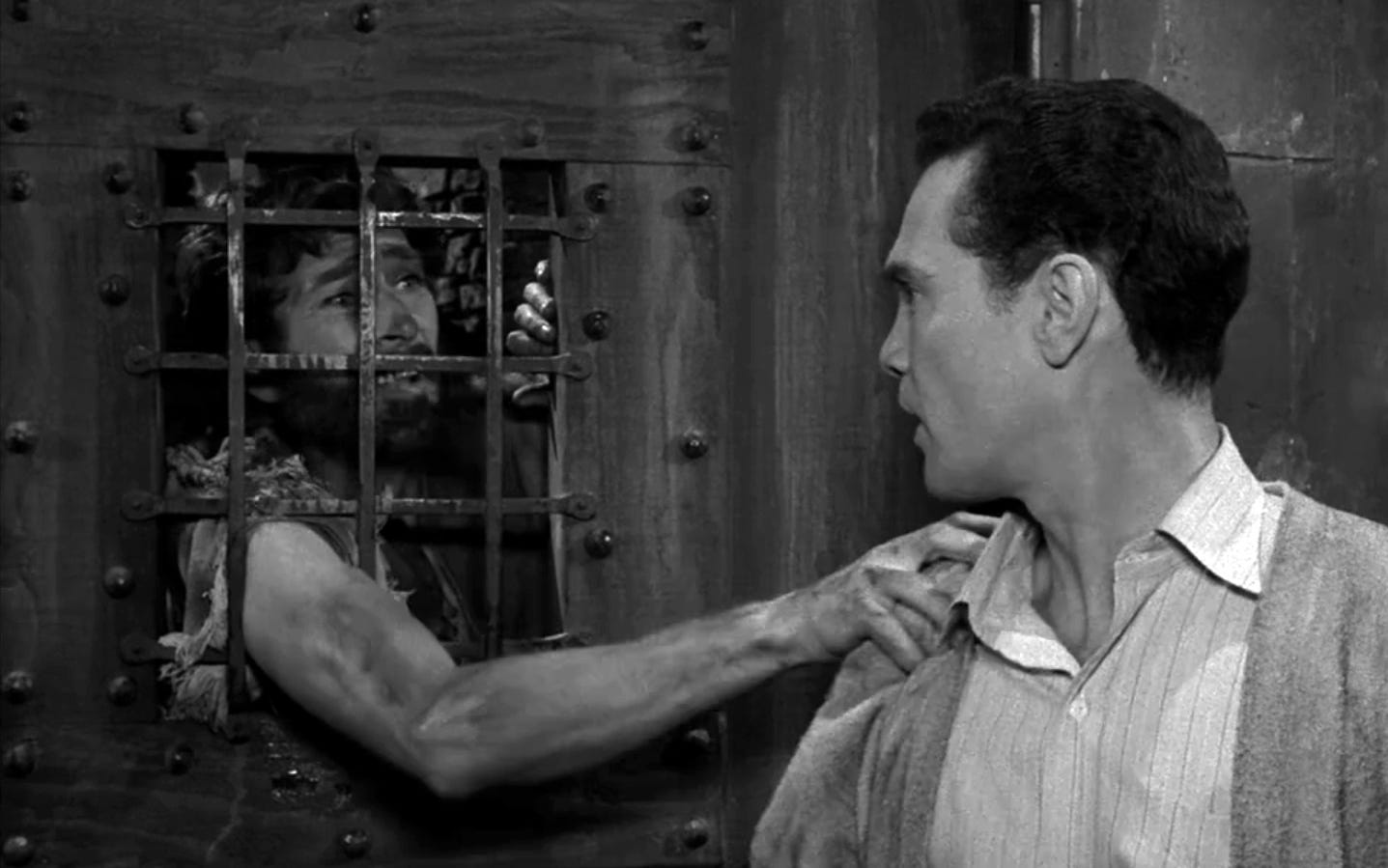
I don’t want to make it sound that Charles Beaumont, with his sad life cut short, is all doom and pessimism. But horror is a merciless genre, it can’t be otherwise, and if one wants to write it seriously, one must accept that and write mercilessly. Which isn’t to say, to write without hope. One of Beaumont’s most famous stories is “The Howling Man,” from 1960. It was adapted into a classic episode of The Twilight Zone. In it, a lost wanderer in Central Europe, sometime between the world wars, shelters in a monastery in the mountains. Overnight, the wanderer is disturbed by a man who relentlessly howls and screams all night. The monks have warned him not to open the door to this man’s cell. Unable to fight it, believing the man is in terrible distress, the wanderer releases the man from his cell, only to learn, subsequently, that the man was Satan himself, and in his attempt to help, the wanderer has loosed the devil out into the world. The wanderer can only watch, in the years to come, horror-stricken as war again sweeps over the planet. But the story ends with the wanderer receiving a letter from Brother Christophus, one of the monks who, after the howling man was released, tried to comfort the wanderer in his guilt. The letter was posted from Germany, and it reads: “Rest now, my son. We have him back with us again.”
In his introduction to the story “The Howling Man,” in the previously mentioned 1988 collection of the same name, Harlan Ellison sums up the impact of Beaumont—a cult writer, but a cult large enough to have brought almost all of his work back into print—on his chosen genres this way:
Charles Beaumont was one in a million, and perhaps rereading “The Howling Man” will remind the other 999,999 that what they do, when they do it with honor and high craft, has been profoundly influenced by what Chuck taught us in the pages of magazines now three decades gone.
 | A guest post by
|