How a Canadian Cult Hit Can Help Us Think About Creativity
Plus: An interview with the directors of a harrowing Oscar-nominated documentary.

On The Bulwark Goes to Hollywood this week, I talked to Charlotte Kaufman and Andrew Jarecki, the directors of the Oscar-nominated documentary, The Alabama Solution. It’s a fascinating, harrowing movie, one that takes viewers inside the Alabama prison system via smuggled-out cell phone footage and tracks the efforts to uncover what happened to an inmate beaten to death by a notoriously violent guard.
You can also watch on YouTube, if you prefer. And I hope you share this far and wide: it’s an important topic.
I want to emphasize one thing to try and hammer home the power of this film: I am not a prison reformer. I do not believe we should abolish prisons or work toward massive decarceration. Most of the people in prison deserve to be there. Indeed, most of the people in this movie deserve to be in prison. They are killers and crooks, and removing them from society is necessary and good. But we also have a responsibility to ensure the humane treatment of such individuals—HBO’s Oz should be a cautionary tale rather than a how-to guide—and, as The Alabama Solution demonstrates, it is a responsibility that we all too frequently fail to meet.
Anyway, you should watch the documentary, which is streaming now on HBO Max. And after you see it, you should check out the film’s website, TheAlabamaSolution.com, to really dive into some of the horrors of the prison system.
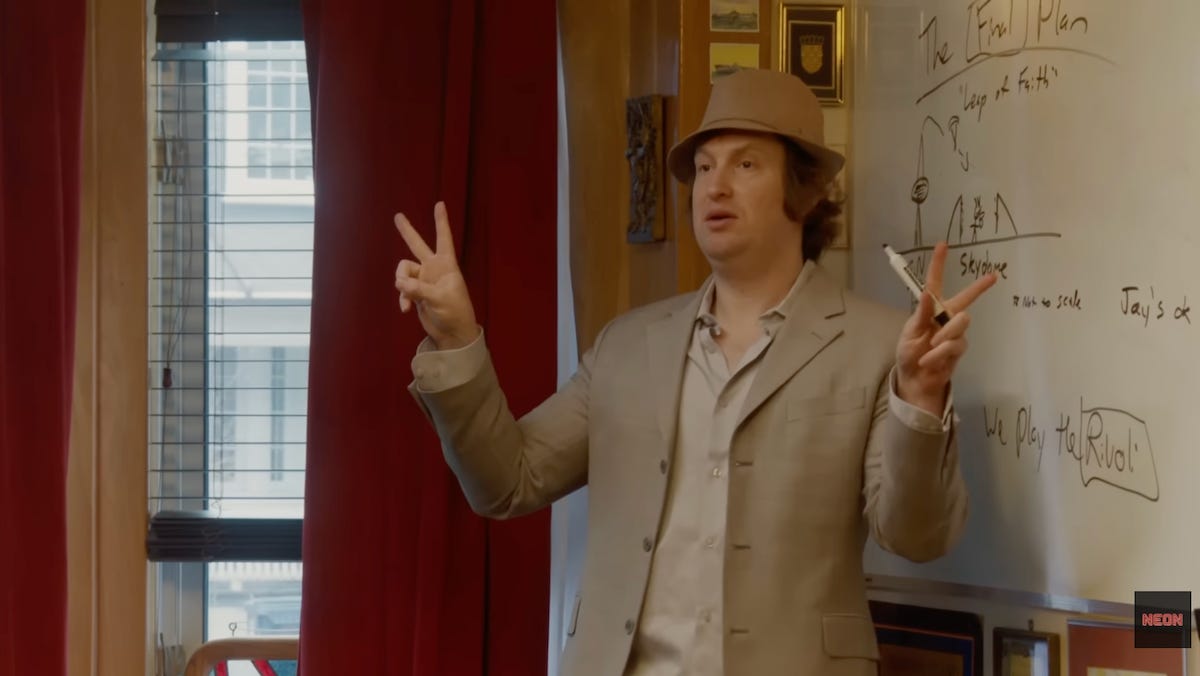
Nirvanna the Band the Show the Movie is a decidedly weird film: a cinematic adaptation of a cult classic web series and TV show that owes as much to Robert Zemeckis’s Back to the Future as it does its own history; a pastiche of cinematic time-travel ideas that nevertheless feels heartfelt and original; and a tribute to eternal truths of friendship and the very specific idea of Canadian nice.
Which is to say that despite sometimes feeling as though it’s cobbled together from the component parts of other things, Nirvanna the Band the Show the Movie nevertheless is wholly original and completely unique, a film that uses its reference points not as simple memberberries but as something deeper, more profound. In an age of artificial mechanical reproduction and recreation, Nirvanna the Band the Show the Movie has real soul and sweetness that puts it above all the AI slop that some people might be tempted to compare it to.
Full disclosure: I’ve never seen the series on which this is based. So I was coming in totally cold. But cowriters and costars Matt Johnson and Jay McCarrol nimbly navigate the terrain for newcomers like myself without holding our hands. The broad strokes of their relationship become obvious almost immediately: Jay and Matt are in a band; they don’t actually have any songs or albums to promote; Matt is a schemer, kicking off the movie with a harebrained plan to parachute off the CN Tower and into the Skydome to promote their show that night at the Rivoli, which they haven’t actually booked; and, finally, Jay is both the member of the “band” with some musical talent and also the one who is growing disillusioned with Matt’s idiotic plans.
Via a series of convoluted machinations involving an RV and a twenty-five-year-old bottle of Orbitz (the drink with the little floating balls made by the creators of Clearly Canadian), one of Matt’s moronic ideas accidentally succeeds, sending the pair back in time to 2008. When they return to our present, everything has changed, and the big question the film asks is how they can “fix” the future … and whether they even want to do so.
Again, this is a very strange movie, almost a metatextual prank of sorts. It’s not enough to simply borrow liberally from the plots of various Back to the Future movies, the film is often playing in the background and the guys riff on how much of the score they can use while staying within the confines of fair use. And there are other time-travel movies in the mix here as well, from The Butterfly Effect to Primer; a joke about how Matt learns about their predicament after the pair travels back in time to 2008 unfolds subtly and gracefully and then bluntly, like a slap to the face. It hits so hard and so hilariously that I guffawed in the theater, something I almost never do.
But this isn’t really a time-travel movie. It’s a relationship movie, a movie about friendship and what it means to put up with your pals and their idiocies and how such relationships shape your own life, your own idiocies. And this is one reason why the referential nature of the film works to its benefit rather than feeling like a stale copy of something better: If you’re a guy in your early-thirties to late-forties, you spent your whole life talking in referential pop-cultural code with your friends. Back to the Future could just as easily be Anchorman or Monty Python or Goodfellas or Napoleon Dynamite or Animal House; it’s a lingua franca, a sort of conversational shorthand. Like that Next Generation episode. “Darmok and Jalad at Tanagra. Biff, the sports almanac stolen.” You get the idea.
The mockumentary style of the film is never really explained—why would a camera crew be following these guys around for nearly two decades?—which only adds to the pastiche quality of the whole endeavor, aping the style so common in sitcoms since The Office and Modern Family dominated the landscape. There are also elements of Jackass and The Tom Green Show here, little bits and pieces of reality-TV trappings, and extras who don’t know they’re extras while filming is happening, which makes one wonder “What, how real is this?”
As I was watching the film and then afterwards considering why it works, I kept thinking about the recursive natures of the conversations we’re currently having about AI and originality, about the insistence that typing a prompt into a resource-hogging idiot box is the equivalent of making a feature film or drawing a panel of a comic book. Is Nirvanna the Band the Show the Movie not just borrowing the same reference points as Claude would be? How is Johnson’s appropriation different from ChatGPT’s?
And the answer, ultimately, is that this is simply real in a way that AI isn’t and can’t be. You’ll never ask “Wait how did they do that? How real is this?” with an AI prompt; the answer is that some box of circuits somewhere stole the imagery and rearranged it at your behest. But you’ll find yourself wondering that repeatedly while watching Nirvanna the Band the Show the Movie. I feel a greater human connection to these two guys I’ve never seen before than I ever will to the rivers of AI-generated fanfic “fixing” Game of Thrones or showing us the further adventures of Tony Stark that the tech-addled goobers of the world seem to think will replace the artists of our age.
Assigned Viewing: The Godfather (Paramount+)
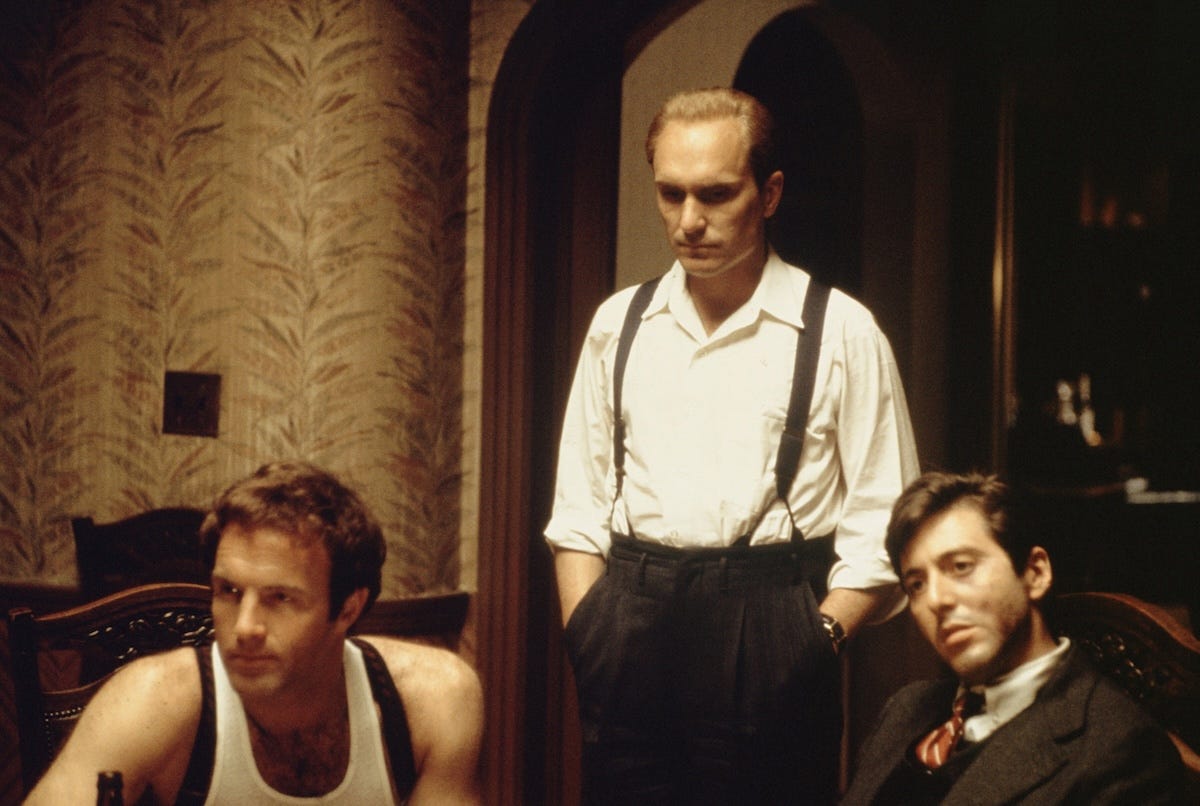
I spent a lot of time talking about Open Range in my obituary of Robert Duvall, but it probably wouldn’t crack most people’s list of the best Robert Duvall movies. It’s also not streaming for free or available on Blu-ray or 4K. (C’mon, Disney.) The Godfather, however, would have to be at or near the top of any such list. And Duvall is so ridiculously good in it. It’s fascinating to watch the film through the eyes of Tom Hagen: He’s the guy who has been trained in the family business but he can never take over the family business. So when Michael Corleone arrives on the scene, he’s almost an interloper, a kid who doesn’t know what he’s doing. There’s the faintest trace of resentment in Duvall’s eyes, a little anger hiding just behind the wry smile perpetually resting on Tom’s face. It’s a brilliantly subtle performance in a movie full of them.
In regard to prisons, since the debt that convicted individuals owe is to the state (society) prisons ought to be run and paid for by the state, not for-profit corporations.
This is the second rave I've read about "Nirvanna" and now I REALLY have to check it out. (I scanned Rotten Tomatoes, but I'm old-fashioned in wanting to stumble on reviews.) Loopy and Canadian? OK, I'll bite.
As for "The Godfather," my wife and I watch it every Thanksgiving. It gets better every time. The rhythms, the perfect casting (Talia Shire doesn't get shrilly annoying until the end; I always think, wouldn't Connie know better?), the amazing editing (Michael looking at his hand not shaking after saving his father in the hospital is so subtle someone had to point it out to me, that THAT'S the moment when he becomes the new godfather), the cinematography, the script ... jeez, this thing is incredible AND it was the box office king for awhile? How often does that happen? It's like the Beatles of movies. Or something like that.