How a Florida City Saved Its Pride Symbol from MAGA Erasure
Ron DeSantis met his match in a coalition of LGBTQ activists and straight city commissioners who refused to be bullied.

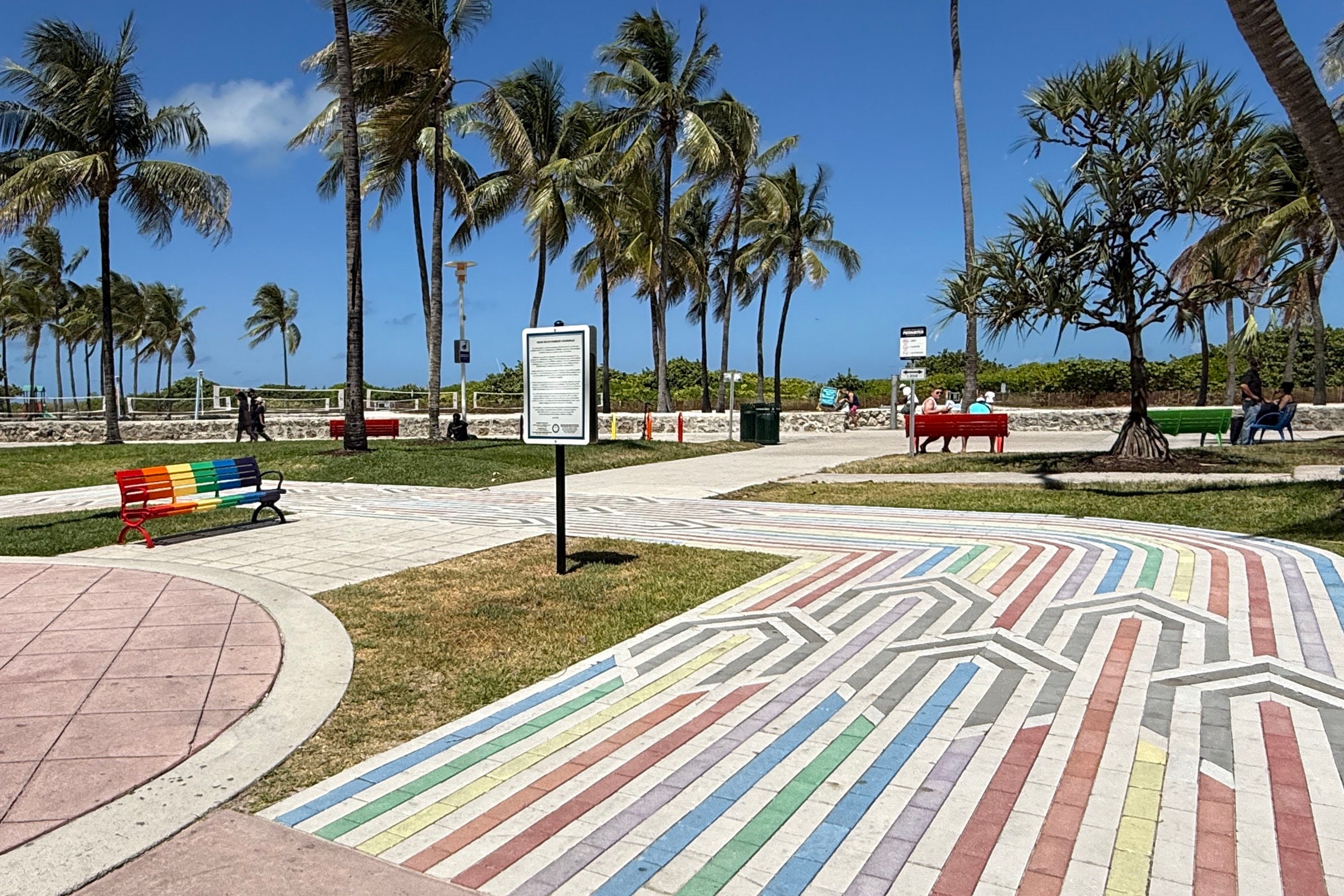
Miami Beach, Florida
THE DEMOLITION CREW ARRIVED late in the afternoon. The crowd came not long after that—to watch and to protest and to mourn the dismantling of a beloved landmark.
It was a Sunday night last October. The site was a crosswalk with pastel-colored bricks that officials had installed back in 2018. Its purpose had been to celebrate the LGBTQ community’s contributions to the culture and prosperity of Miami Beach—and to recognize the difficult, still-ongoing campaign for equality in America.
But that was before Ron DeSantis became Florida’s governor and launched a campaign against “woke” ideology that targeted pretty much anything with a rainbow or the letters LGBTQ attached. He had made a lot of headway, and by last summer his administration was ordering the statewide removal of rainbow crosswalks, including one in Orlando outside the site of the 2016 Pulse nightclub massacre. The directive covered any street art with political or social messaging—ostensibly for the sake of traffic safety, though almost nobody believed it given evidence that brightly colored crosswalks actually reduced accidents in pedestrian areas.
Miami Beach officials had tried to save their crosswalk tribute by appealing to the state Department of Transportation for a reprieve. When the last of those bids failed, on a Friday, community leaders knew destruction was imminent. But they had not expected the backhoes and crews with jackhammers to show up within forty-eight hours, or just how hard the scene would hit.
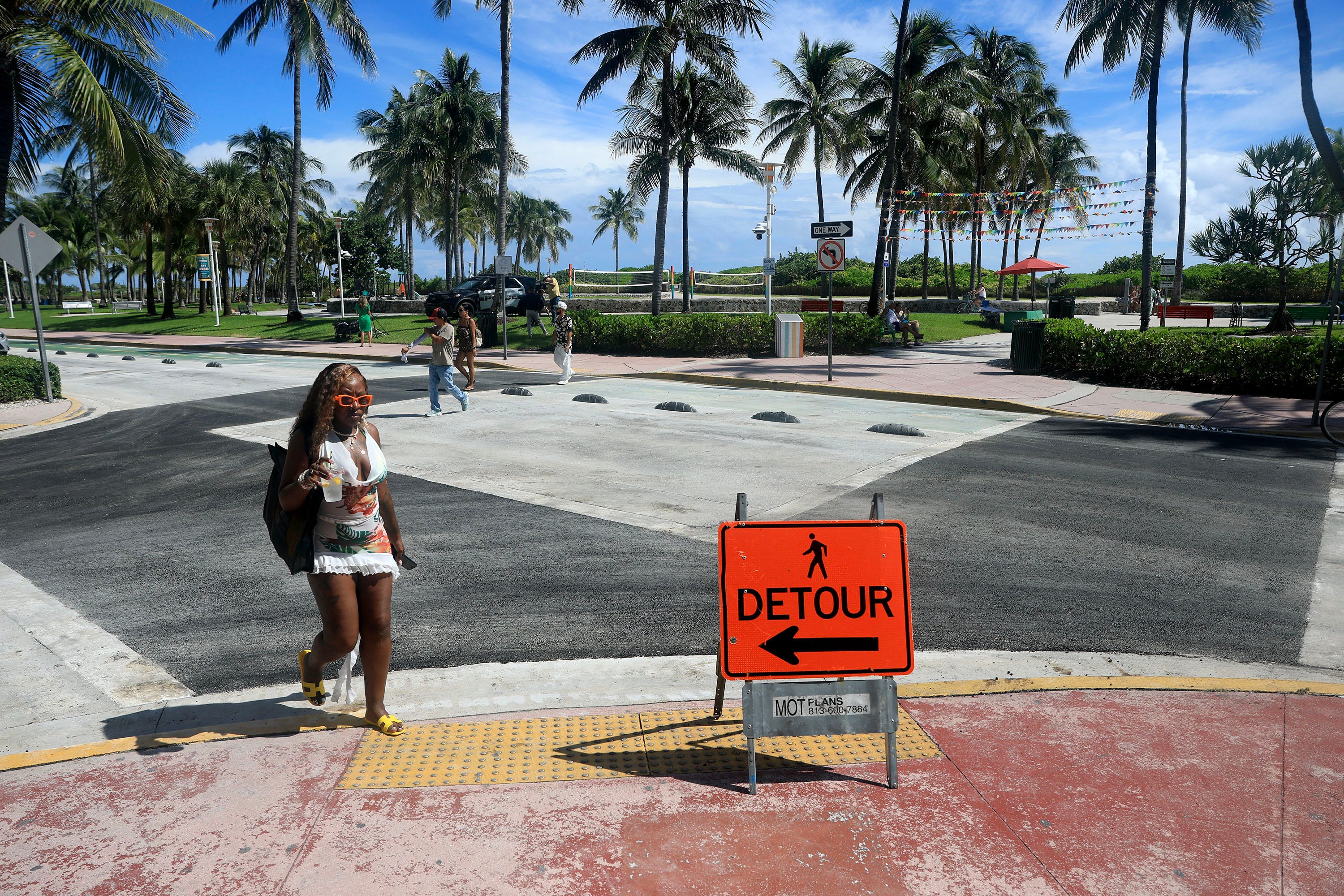
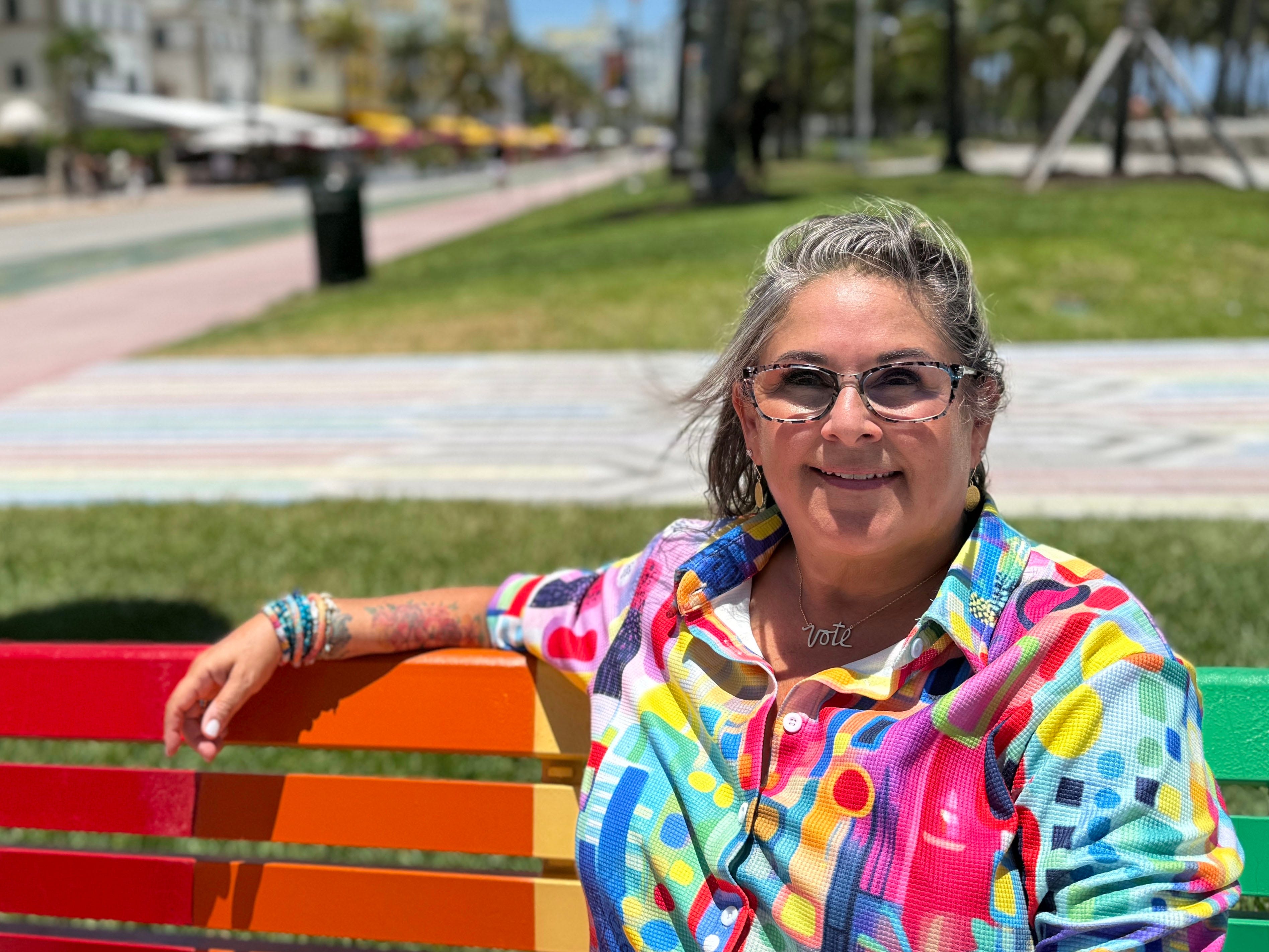
“The night that they tore out the crosswalk, it was like witnessing carnage, an act of violence,” city commissioner Tanya Bhatt told me this week, as we stood at the site. “There was the Miami breeze going off the ocean,” she recalled, “and people were stopping and watching and filming and crying.” But while her first instinct was to give everyone a “mom hug,” she and fellow community leaders quickly turned their attention to next steps: “We were all talking, part of this group saying it was not okay and that we couldn’t just let this happen.”
They didn’t. And about six months later, Bhatt was with those other leaders at the opening of a new tribute to the LGBTQ community, practically in the same location as the original. It even uses the same brightly colored bricks, which city officials had made a point of retaining. But this marker is on the sidewalk, not in the street, putting it beyond the reach of Florida’s Department of Transportation—and the Republican governor in charge of it.
“They can move the bricks,” Miami-Dade Mayor Daniella Levine Cava said at the ceremony, “but they cannot erase us.”
For a community of LGBTQ Floridians that has faced a years-long and at times highly effective political assault, restoring a singular piece of artistic expression may seem like the tiniest of victories. But sometimes symbolic victories matter. DeSantis after all wasn’t simply pulling colored bricks out of the pavement. He was taking away public recognition from a group that for most of human history has had to hide its identity. And if there is one place where that kind of effort seems particularly unconscionable, it’s Miami Beach.
MIAMI BEACH’S IDENTITY as a refuge for the LGBTQ community traces as far back as the early twentieth century, not long after industrialist Henry Flagler’s railroad first made South Florida a destination for northern tourists escaping the cold.
This was an era when homosexuality was simply not discussed, let alone accepted in polite society. It was also a time when being openly gay meant inviting arrest for deviancy, and when violence against members of the LGBTQ community—even lethal violence—was rarely met with public outrage.
Miami Beach was different. With its constant churn of people and cultures, including from abroad, it gained a reputation as a place where it was a bit more acceptable to stray from society’s conventions—a community where, as historian Julio Capo Jr. put it, “the confines of the real world, including the boundaries around gender and sexual expression, could loosen.”
Half a century later, Miami Beach played a central role in the birth of the modern gay rights movement—staging what is considered by some the nation’s first Pride celebration, and enacting through surrounding Dade County one of the nation’s first anti-discrimination laws for LGBTQ residents.1 It was at the 1972 Democratic convention, held in Miami Beach, that activists first pushed for an official party plank recognizing the importance of civil rights for the gay community.
These advances didn’t come easily. Dade’s anti-discrimination ordinance sparked a backlash led by the anti-LGBTQ activist Anita Bryant. Her “Save Our Children” campaign, which focused on the supposed menace of gay teachers in the schools, succeeded in getting the law off the books and helped establish a model for anti-LGBTQ efforts nationwide.
But by that point, Miami Beach was seeing a different sort of transformation: an economic one. A group of developers and preservationists led by a New York designer named Leonard Horowitz had obtained historical status for the city’s aging art deco buildings. They renovated the buildings and applied their now-signature pastel schemes—all while turning the area into a mecca for wealthy transplants like the designer Gianni Versace.
Versace was gay, as was Horowitz, whose family had shunned him after he came out of the closet. Plenty of other newcomers were gay too, most of them drawn to a place that, like in the 1930s, would let them be who they were and love whom they loved.2
“The whole resurgence of Miami Beach was due to the artists and photographers coming here, staying, and then bringing the arts and culture community with them,” Bhatt said. “The nightclubs and music, photography studios, model agencies, art installations—Miami Beach is built on the shoulders of the queer community.”
In 2016, a year after the Supreme Court’s Obergefell decision and Florida’s first same-sex marriages, Miami Beach officials decided it was time to recognize how much the LGBTQ community had achieved—not just nationally, but locally as well. They opened a design competition and picked as their location the intersection of Ocean Drive and 12th Street, the unofficial center of local LGBTQ life, where a painted rainbow sidewalk they’d approved years before kept fading from weather and street traffic.
Adriana Savino, a Venezuela-born architect whose specialty is design for public spaces, came up with the winning entry: Paving bricks in the pastel colors Horowitz had brought to Miami Beach, laid down in a pattern evocative of art deco style. They would cover and connect three street corners (the fourth side of the intersection fronts a park and the beach) so as to resemble a rainbow—a symbol of particular importance to Savino, whose gay brother had died just a few years before.
Making friends as an adult is hard. Making friends as an adult who actually cares about separating truth from ragebait? Even harder. This Father’s Day, give Dad somewhere to belong: a community full of people who are paying attention, take it seriously, and actually want to talk about it.
THE OFFICIAL UNVEILING was in November 2018—as it happens, just days after DeSantis won his first election for governor. He spent his first two years focusing on tax cuts and conservative education reforms, which was conventional Republican fare in those days. But starting around 2021, with his eye on the 2024 Republican presidential nomination, he turned into one of the nation’s most prominent anti-woke crusaders, pushing for (among other things) a statute restricting mere references to sexuality in schoolrooms in what critics derided as a “Don’t Say Gay” law.
In this and his other pursuits, DeSantis discovered the soft political underbelly of the broader campaign for LGBTQ equality. He focused on issues like transgender athletes and gender-affirming care for minors, about which even many people broadly supportive of equality had qualms. All along, DeSantis and his allies insisted they were not out to undo civil rights for the gay community—that, instead, they were simply maintaining the government’s neutrality, and protecting children from harm.
The DeSantis administration made a similar argument when it issued its directive to eliminate crosswalk messages: that it was merely preventing the state from endorsing political or social messaging. But however defensible in theory, that position rang hollow from a governor who enthusiastically signed a bill renaming a street after Rush Limbaugh and is now expected to do the same for a bill naming another road after Charlie Kirk.3
Other items in the DeSantis agenda contained similar contradictions. He insisted he was only out to protect children, even as he crusaded to cut off transgender care for adults. He swore he wasn’t anti-gay, even though he tried to defund a program that financed life-saving care for HIV patients. (He backed down when many of his fellow Republicans, responding to public outrage, thought that was going too far.)
“They start by saying they’re just deeply worried about girls’ sports, and before you know it, they’re introducing resolutions to oppose marriage equality in state legislatures across the country,” Brandon Wolf, a survivor of the Pulse massacre who is now senior director of communications strategy for the advocacy group Equality Florida, told me in a phone interview. “They believe that there’s only one right way to be a man, only one right way to be a woman, only one right way to build a family, only one right way to love and to live your life.”
In all of these efforts, DeSantis was following the same national anti-woke agenda that Donald Trump’s administration would adopt once he returned to the White House. “One of the things we say around here is that Florida has been living Project 2025 since 2023,” Joe Saunders, Equality Florida senior political director, told me. The crosswalk order was a perfect example of the national and state levels of this right-wing movement working in tandem: The DeSantis order came shortly after Sean Duffy, Trump’s transportation secretary, warned states to remove political and cultural street art from federally funded roadways or risk losing money from Washington.
That was one reason Miami Beach leaders like Bhatt knew that any replacement for the demolished crosswalk had to be beyond the reach of both Washington and Tallahassee. And after kicking around a few possibilities, including a sculpture that would go elsewhere in the city, Savino came up with the idea of simply recreating the crosswalk on the sidewalk, right next to the Ocean and 12th intersection.
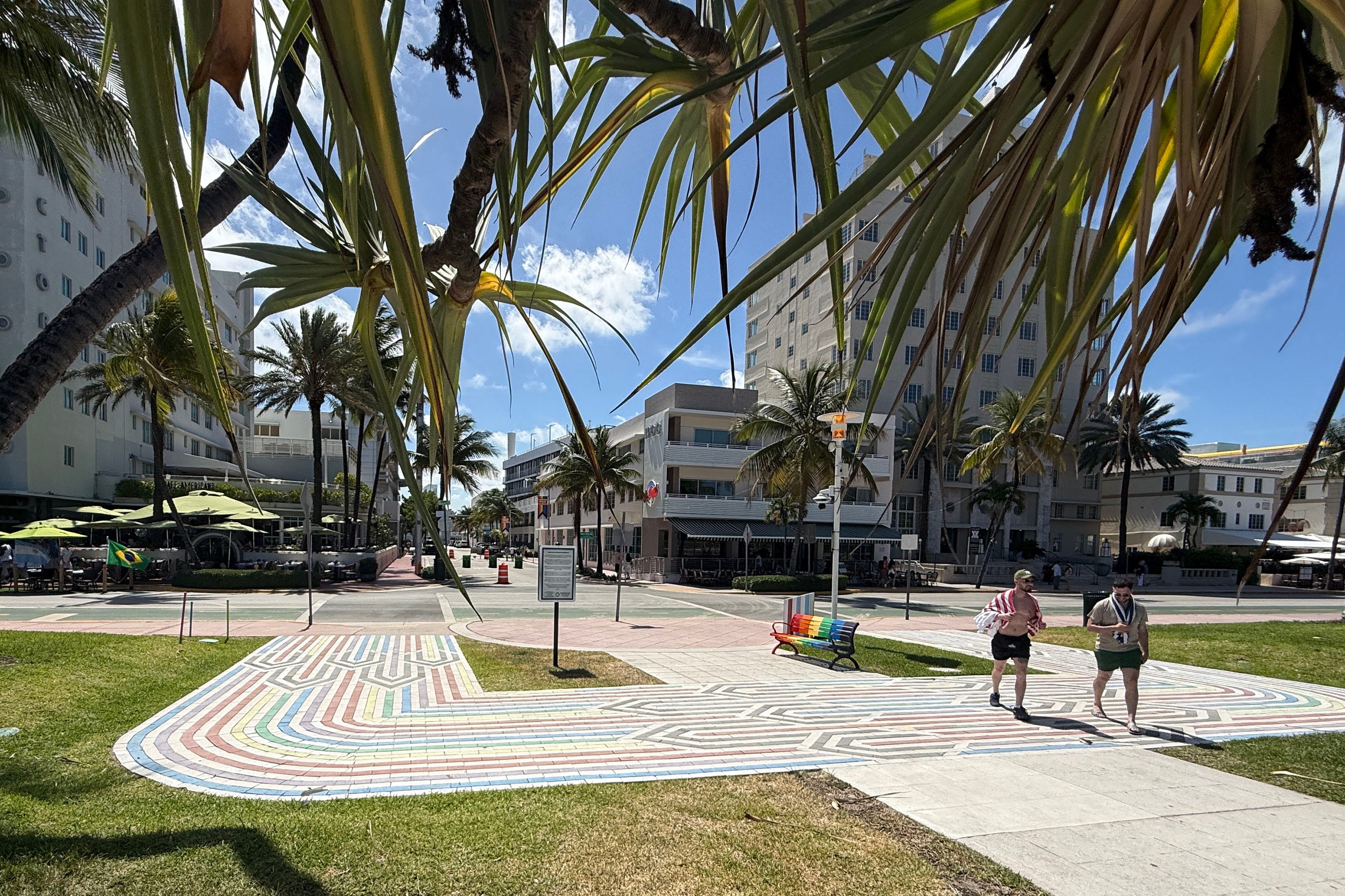
“We thought the location was important, because of that intersection—the Palace [a famed gay nightclub] was in that corner, and that’s where the original crosswalk was,” Savino told me in an interview. “We thought it was more impactful if we basically just mirrored the image, creating a gateway to the park and maintaining the symbolic importance of Ocean Drive.”
It was an easy sell politically, with unanimous backing from the city commission—something that Alex Fernandez, the commission’s only openly gay member commissioner, later hailed as a show of solidarity. “When the State forcibly removed this crosswalk,” Fernandez said in a prepared statement, “it was our straight allies on the Miami Beach City Commission who ensured our gay community would not be pushed into the shadows.”
At that point, the only challenge was the timing. Commissioners wanted the installation in place for its world-famous Pride celebration, which attracts more than 100,000 visitors annually and is held in April rather than the traditional June in order to avoid the worst of the Florida heat.
They got the job done and, at the ceremony, talked about the one big change designers had made. The old markers had angled corners, because it was meant to be a literal crosswalk. The new one had no such constraints, so the designers used material from some of the broken pavers to round the corners, making it look more like an authentic rainbow.
But it wasn’t just the aesthetics that had changed. It was the sense of purpose too. The 2018 tribute had been created at a time when the LGBTQ community felt confident—maybe a little too confident—about the place it had secured in American society. “The last one, I think a lot of people took it for granted,” Bhatt told me. “For this one, we fought back, we made it permanent. And we are very much aware now that we are all collectively fighting for our lives again.”
Dade County was renamed Miami-Dade County in 1997.
In the 1990s, when director Mike Nichols needed a locale for his movie The Bird Cage—an adaptation of La Cage aux Folles, the French play about a drag show—he chose Miami Beach. It’s a fantastic movie, and maybe the only film where an actor playing for laughs (Nathan Lane) manages to upstage Robin Williams.
Yes, both streets are named for people who have died, in one case killed. But the same could be said for the crosswalk outside the Pulse nightclub, which commemorated one of the deadliest mass shootings in American history.
So much of anti-"woke" is absolute blind rage. Kudos to Miami for using the law to resist the authoritarian mob effectively.
As we observe Pride Month, I cannot think of a more fitting tribute to the tenacity of the LGBTQ community and supportive allies than by shining a spotlight on this uplifting South Beach story. What started out as a vicious, petty affront by the neanderthal MAGAt governor's removal of the crosswalk evolved into the phoenix rising from the ashes with an even more prominent and beautiful thing to behold and celebrate.
As the chant of solidarity and strength reminds us: The people united will never be defeated.
Thank you, Jonathan, for sharing this inspiring story with all of us.