

How Delaney Hall Became Ground Zero in Trump’s Deportation Wars
This rundown detention center on an industrial strip in New Jersey is representative of what’s happening across the country.

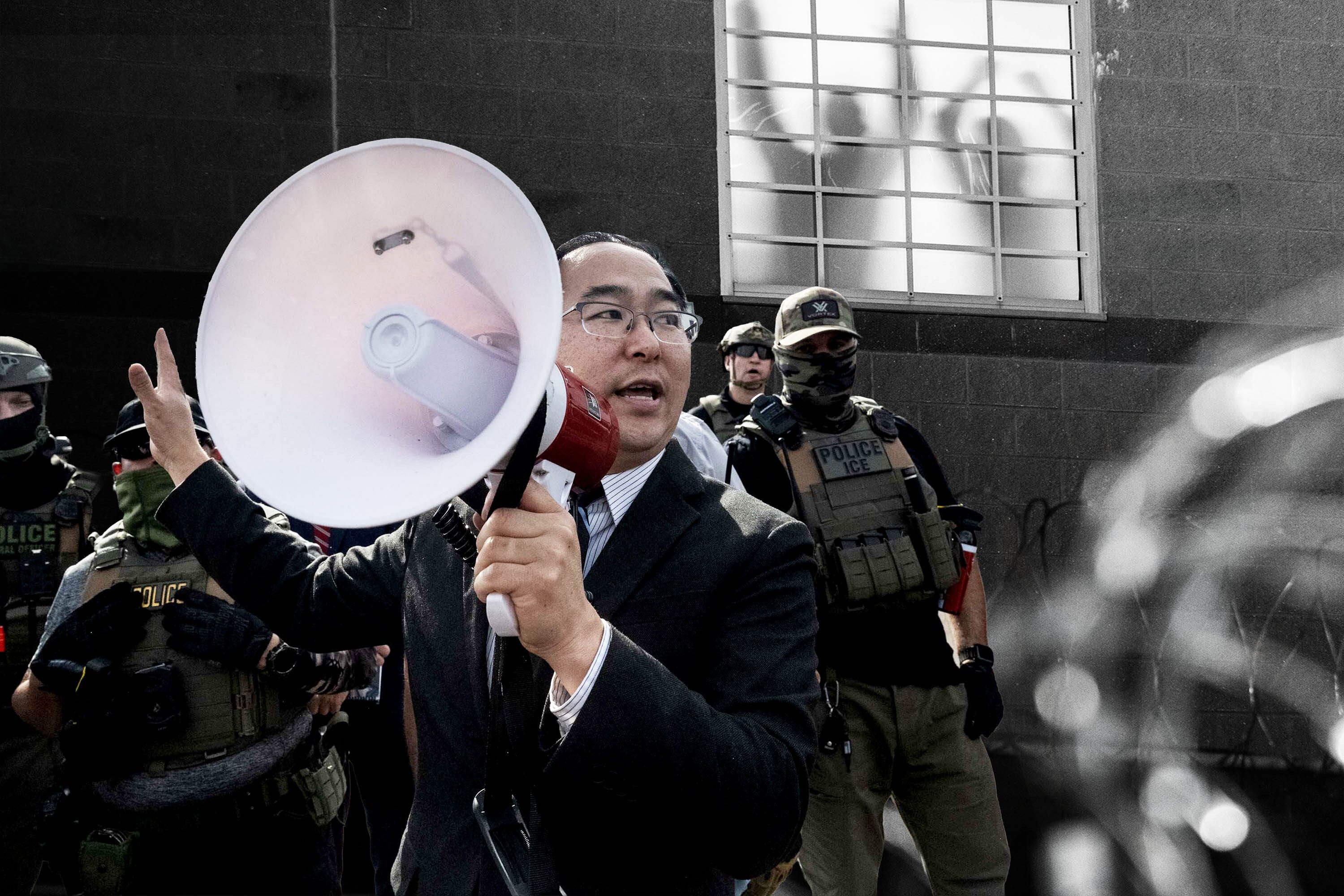
AT EVERY TURN SINCE DONALD TRUMP regained office, Delaney Hall, the detention center in Newark, New Jersey, has been central in the struggle against the administration’s cruel approach to immigration enforcement.
Democratic lawmakers have been arrested and physically harassed at the site. Detainees there have launched a hunger strike to draw attention to what they describe as its deplorable conditions. And as the protests have grown more regular, so too have the violent efforts by federal agents to quash them. The facility, situated in an industrial strip a stone’s throw from Newark Bay, is a composite of all that emerges from Trump’s punishing mass-deportation system.
But why Delaney Hall? What is it about that place that has made it the center of these clashes in Trump 2.0?
Part of it is that New Jersey lawmakers have proven keen to directly confront the administration.
Sen. Andy Kim (D-N.J.) is one of them. He showed up at Delaney in late May to monitor a hunger and labor strike launched in response to “disease, overflowing toilets, poor ventilation, and worm-riddled food.” While on site on Memorial Day, he attempted to de-escalate a confrontation between protesters and ICE agents and got pepper-sprayed for his troubles.
Kim, who has since said that that week was one of the most difficult of his life, says violence felt almost inevitable that day. He said he hasn’t seen New Jersey so close to the edge at any point in his time in office. The problems, he added in an interview with me, start with the facility itself.
Delaney Hall is run by the GEO Group. The private prison giant was last year awarded a $1 billion contract lasting fifteen years that quadrupled detention center space in New Jersey. The Delaney Hall compound is so shoddily constructed that four detainees broke out last June.
“First, the facility needs to be shut down. It’s not up to any type of standard,” Kim told me. “When there was this breakout of four detainees last year, I actually went to figure out what happened. GEO Group refused to let me in at first. Someone that worked there told me the exterior wall of that cell was just made of mesh and drywall.”
“It’s an exceedingly old building, not up to standards, which is causing so many of the problems and poor conditions—like the extreme heat detainees are complaining about now,” Kim said of the facility. Built a quarter-century ago, Delaney was used for much of the last decade as a halfway house; it reopened last year as a GEO-run immigrant-detention facility.
Keep up with all our coverage.
Support our independent journalism.
And join our growing pro-democracy community.
Sign up for Bulwark+ today.
The facility’s location is another reason it has become so central to the story of Trump’s immigration horrors. New Jersey is a “warehouse” state, as Nedia Morsy, director of Make the Road New Jersey, which is part of the ICE Out of New Jersey coalition, noted. Which means there are ample targets for an administration looking to ramp up workplace enforcement. On top of that, Delaney Hall is close to both a major airport and the second-largest port in the country—each critical pinchpoints for ICE operations. Morsy, whose group has protested Delaney Hall and advocated for immigrant rights, described it as the ideal place for the administration “to pilot and launch the deportation matrix.”
“What we’re seeing is a symptom of the infrastructure the fascist regime has laid out in New Jersey,” she added.
In fact, the first workplace raid of Trump’s second administration occurred in Newark. The Ocean Seafood Depot was raided in January 2025, within seventy-two hours of Trump returning to office. At the time, Newark Mayor Ras Baraka described the “indignity” experienced by a Puerto Rican veteran whose military credentials were questioned after he was swept up in the raid. Four months later, Baraka, who has long sought to close Delaney Hall, was himself arrested outside it.
In Trump world, though, we cannot overlook the political component when explaining why Delaney has become Ground Zero for Trump’s deportation efforts.
Flush with confidence from Trump’s victory in 2024 and his overperformance in the traditionally blue state, MAGA allies began viewing New Jersey as a swing state. Trump installed his personal lawyer, Alina Habba, as an acting U.S. attorney in New Jersey. And she quickly looked to make a splash. Confrontations with Democratic lawmakers were a simple way to impress MAGA zealots and further press Republicans’ “advantage” on immigration. Delaney Hall was the staging ground.
It didn’t hurt matters that the site sits not too far away from New York City. The Trump administration got the major media market publicity it craved without the risk of a swell of protesters fighting back.
“There was in late 2024 and early 2025 a push by Republicans saying New Jersey is a swing state and gains have been made, and Habba had been stoking that, talking in political terms about turning New Jersey into a red state,” Kim told me. “Early on this just became a real proving ground for Alina Habba’s ambitions and her efforts to perform for President Trump.”1
‘The who is the most important part of the story’
It’s worth recalling that in those early days, when Habba was ascendant and dreams of a red New Jersey didn’t seem so far-fetched, many Democrats thought they were powerless to stop the cruelty the president was imposing on undocumented immigrants. But not all Democrats. Some, like Rep. Joaquin Castro down in the Dilley facility in Texas, chose a path of greater resistance.
In New Jersey, one of those Democrats has been Rep. Rob Menendez, whose district includes the seafood depot raided in January 2025. When federal agents pushed around Rep. LaMonica McIver at Delaney and then blamed her for inciting violence, Menendez was there, shielding her.
Menendez has placed a high priority on uncovering the true story of Delaney. He has conducted oversight visits at the facility fifteen times, and, along with other New Jersey Democrats, is demanding accountability for systemic and life-threatening medical neglect there. I asked how many people Menendez has helped, both at Delaney Hall and including family members and people detained elsewhere and his office responded with pretty shocking numbers.2
Menendez told me that, while Newark hasn’t seen the paramilitary response from the administration that cities like Chicago, Los Angeles, and Minneapolis have endured, Delaney Hall illustrates the vision “Stephen Miller and others had” around mass deportation. It also, he added, shows what happens when people push back against that vision—“how it’s been falling apart and how you’ve seen a huge erosion of support for the president’s immigration policies.”
Trump sold the American people on going after criminals—not ordinary immigrants. So, as bad as the conditions in the detention center are, Menendez says, “the who is the most important part of the story.”
Menendez described to me the cast of humanity he has seen behind the doors of Delaney Hall:
Pregnant women—whose presence in the detention facility was, until recently, denied.
Immigrants with Alien Registration Numbers who believe they have been wrongly detained.
Medically vulnerable people—like Emanuel Rodrigues, 38, who requires crutches or a wheelchair and was deprived of both for forty days, then moved to medical isolation for four months.
People who have protected status—like Adriana Quiroz Zapata, who, because of the horrors inflicted upon her by her ex-boyfriend and his police buddies in Colombia, should have been protected by the Convention Against Torture yet was shipped to the Democratic Republic of Congo instead.
“I talk to parents: mothers who got their kids ready for school and left their house to go do a routine ICE check-in and never came home to their children,” Menendez told me. “And only by the grace of God and my grandparents being from Cuba instead of Guatemala or Honduras, I get to go back to my kids after visiting Delaney Hall.”
DELANEY HALL IS THE MOST VISIBLE manifestation of the administration’s cruelty in New Jersey, but it’s not the only one. There are other people detained nearby in the state.
Margarita and Filemon Ruiz are grandparents. They own 3 Hermanos Mexican Restaurant in Rockaway, New Jersey. It’s a 45-minute drive from Delaney Hall. Margarita has diabetes, while Filemon recently had back surgery.
I spoke to their son Osmar. He was told his parents are being held at the Elizabeth Contract Detention Facility in Elizabeth, New Jersey. He hasn’t heard anything about how they’re coping. But Osmar couldn’t talk long. With his parents gone, he was taking the restaurant’s orders. There was, as before, work to be done.
Rep. Menendez, in our talk, emphasized that these stories matter just as much as those from Delaney.
But he also acknowledged that the people inside Delaney were special to him—not because they had experienced dispiriting cruelty but because of how they had risen above it.
“The place is meant to break people,” Menendez said. “The place is meant to take humanity away from our communities, strip it all away. But to see them create something there to hold on to, to keep faith and keep hope, you have to do everything you can, and it’s powerful to see.”
Habba has since resigned, after courts ruled her appointment unlawful.
According to Menendez’s office, he and his staff have won the release of nearly one dozen people from Delaney Hall and other detention centers, aided more than a hundred family members of people held at Delaney and other detention center with cases, and connected over two dozen people held at detention centers as well as their families with their congressional representatives.
We must call these what they are: concentration camps. Language is so important, and the soft euphemisms allow the general public to remain on the sidelines, to go about their lives as though these sites are just a part of the bureaucratic immigration enforcement process. We fear and avoid hyperbole correctly, but in erring too far on the side of caution we are failing in this 1942-equivalent moment in the United States.
Once again, great reporting from Adrian. And very important reporting, as we need to be constantly reminded of how terrible and misguided these ICE policies and behaviors actually are. It's disgusting that people, human beings, are being treated like this in the US by the US government.