How Jimmy Swaggart Changed American Christianity
The disgraced televangelist built his career on an undeniable talent. His downfall contributed to a major shift in how Americans viewed religious leaders.

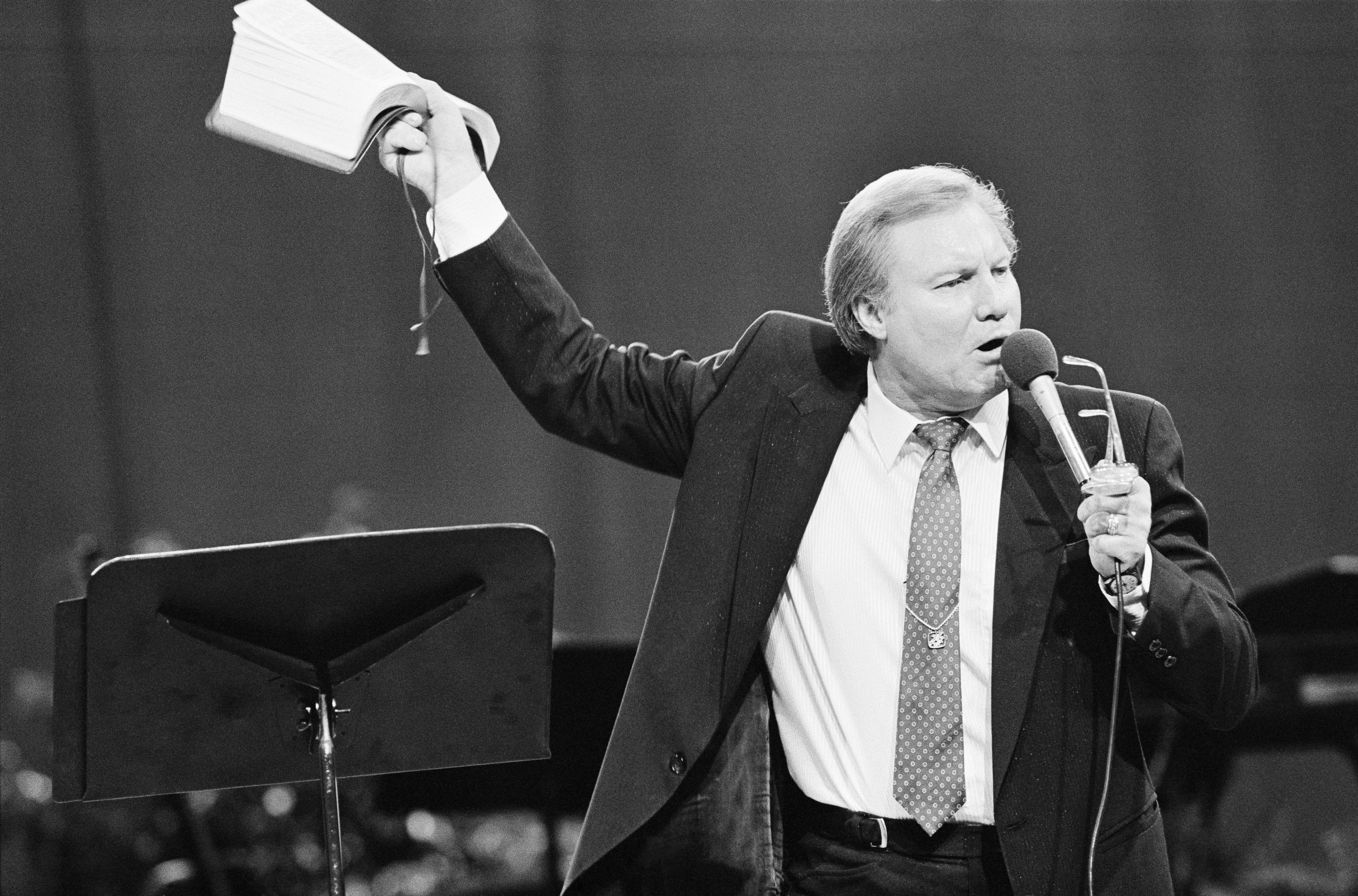
THE DEATH THIS WEEK OF JIMMY SWAGGART at the age of 90 brings to an end one of the most controversial and remarkable careers in recent American religious life. For younger Americans, Swaggart’s name might not mean anything; others might recall blurry footage of a weeping preacher confessing, “I have sinned.” And sin he did, but in a time when Americans have become accustomed to seeing headlines about sex scandals involving religious leaders, it’s hard to convey just how consequential his indiscretions seemed when they were first reported.
The story broke in 1988 and caused an immediate media earthquake. The ground shook because Swaggart had fallen from a great height: He was, for a time, one of the most powerful religious voices in America, commanding a global television ministry, shaping conservative politics, and presenting himself as a moral compass to millions.
One of the challenges when it comes to properly evaluating Swaggart as a public figure is that nowadays we are not inclined to imagine a televangelist as a figure inherently worthy of any real respect. But the man’s own scandals are one of the reasons for that. When Swaggart’s resonant voice first started being heard in living rooms across the country, TV preachers occupied a very different place in the American imagination than they do today.
Swaggart emerged from the rural Pentecostal world of midcentury Louisiana, where fervent faith and musical flair often went hand in hand. His family background offered intimations of his later path: His cousins, rock-and-roll legend Jerry Lee Lewis and country singer Mickey Gilley, both had the signature family blend of raw talent and unruly impulse. But while they chased fame across beer-soaked honky-tonk stages, Swaggart was drawn to a different kind of spectacle: revivals.
Raised by a part-time preacher father and a devout mother, he grew up steeped in the Assemblies of God, a Charismatic tradition that emphasized personal holiness, Spirit baptism, and fiery evangelism. At age 8, Swaggart had a personal conversion experience, and soon after, he began seeking out revival meetings—charged evangelistic gatherings that have been a feature of American culture for centuries. The Charismatic revival meetings he attended were filled with healing testimonies, speaking in tongues, and emotional altar calls.
A self-taught pianist and budding preacher, Swaggart had something more to contribute to these events than his mere presence in the crowd. He hit the road with his wife Frances when they were still teenagers, and they sang and sermonized in rural churches and makeshift tents wherever an audience would gather.
Swaggart quickly distinguished himself from other itinerant evangelists with his powerful preaching style: His fiery denunciations, stirring musical interludes, and emotionally charged appeals made his audiences feel the weight of sin and invited them into the drama of redemption. While his gifts captivated local crowds, he would turn his regional talent into a global one through his early and enthusiastic embrace of broadcast media, which he recognized as a tool he could use to amplify his message and build his ministry. In 1971, he launched his first weekly television program, The Jimmy Swaggart Telecast, a 30-minute program that combined preaching and music; it aired on a handful of regional stations. Within a few years, the show expanded nationally, aided by the deregulation of religious broadcasting and a growing appetite for Charismatic voices in American homes.
By the early 1980s, Swaggart’s televised sermons were reaching millions internationally, his ministry was estimated to rake in more than $140 million a year, and he had become one of the most influential Pentecostals in America. He even helped Charismatic expressions of Christian faith to join the American religious mainstream following decades of obscure disreputability. Unlike such contemporaries as Jerry Falwell, who explicitly linked conservative theology to political activism, Swaggart kept his focus on personal morality and individual spiritual renewal. His style combined emotional Pentecostal preaching and passionate musical performances with an intuitive mastery of media spectacle; prioritizing individual salvation over politics was, among other things, a shrewd way to prevent his audience from being preemptively limited by political orientation. Yet behind the scenes of his public ministry, as detailed in Ann Seaman’s biography, Swaggart was frequently engaged in denominational politics, internal power struggles, and televangelist turf wars—most notoriously during his feud with fellow Pentecostal televangelist Jim Bakker, whom Swaggart openly condemned for sexual misconduct and financial wrongdoing after Bakker’s own fall from grace.
From his Baton Rouge headquarters, Swaggart came to preside over a sprawling empire that included a megachurch, a Bible college, recording studios, and extensive broadcasting facilities. At its peak, his ministry was one of Baton Rouge’s largest employers: According to Seaman, it had over 1,500 employees, was generating as much as $500,000 a day, and “issued more building permits than the state of Louisiana.”
BUT WHEN THE LIGHTS in his ministry’s broadcast studio were pointed elsewhere, Swaggart was in the thrall of the secret sexual proclivities that would later become a public matter, bringing down all he had built in short order. In 1987, the same year his rival Bakker resigned from his own TV ministry amid a sex scandal, Swaggart was caught with a prostitute in a New Orleans motel.
According to Swaggart, he had long struggled with sexual urges, which he attempted to combat with prayer and fasting. After the scandal hit the news, a New Orleans motel owner recalled seeing Swaggart regularly checking into rooms with prostitutes over the previous “two or three years.”
During this same period, Swaggart delivered many harsh denunciations of sexual immorality from his pulpit on the small screen. He also took actions that were consistent with his words: In 1986, he led a public crusade to expose fellow Assemblies of God minister Marvin Gorman’s alleged adultery, which led to Gorman’s defrocking by their denomination.
Disgraced and humiliated, Gorman sought revenge. He was convinced that Swaggart was guilty of the very sins he had so loudly condemned in others. The defrocked minister enlisted his son and son-in-law to follow Swaggart around in the hope of catching him in flagrante delicto, and on October 17, 1987, they photographed him entering Room 7 of a New Orleans motel with a local prostitute. Gorman soon arrived and confronted a shaken Swaggart, who broke down in the parking lot and pleaded for mercy. He offered to issue a public apology and even help restore Gorman’s ministry in exchange for his silence. But after several months with no action from Swaggart, Gorman handed over the incriminating photographs to the Assemblies of God leadership.
Just days later, on February 21, 1988, Swaggart took to the pulpit and the airwaves to deliver his now-infamous “I have sinned” speech. With his normally powerful voice wavering and his face wet with tears, and in front of an audience of 7,000 at his Family Worship Center and a live television audience of millions, he confessed to having sinned and begged for forgiveness.
Swaggart’s scandal produced swift and devastating consequences. Suspended by the Assemblies of God and ordered into a two-year rehabilitation program, Swaggart refused to step away from the pulpit, which led to his being defrocked later that year. Rather than accept the discipline, he broke away from the denomination and established an independent ministry. The ripples of scandal continued to move outwards: Television networks dropped his broadcasts, donations and church attendance plummeted, his Bible college lost students and accreditation, and his reputation became a national punchline. (Ozzy Osbourne even wrote a song about him.) In 1991, a second scandal involving a prostitute seemed to make his cultural exile permanent.
While Swaggart quickly faded from public view—most Americans who grew up in the 1990s and later are unlikely even to have heard his name before his death was announced—the disgraced minister never did fully disappear. He kept preaching from his Family Worship Center in Baton Rouge. His radio broadcasts continued. His son Donnie and grandson Gabriel took up the family vocation. In 2022, he gave the eulogy at the funeral of his cousin Jerry Lee Lewis, evoking again the strange interplay of sacred and profane that defined his life.
THE PUNCHLINE THAT SWAGGART BECAME marked an important shift in the American imagination. Televangelists were once innovators working at the cutting edge of media and technology, and they enjoyed both respect and fame—until scandal after scandal in the 1980s tarnished their legacy. Swaggart’s downfall in particular did much to erode the credibility of religious leaders like him at a cultural moment when they claimed immense moral authority. His tearful televised confession, like the images of Jim Bakker weeping while being led away for psychiatric tests after claiming to have had hallucinations during his trial for fraud, helped advance widespread disillusionment about the whole project in which both men were engaged. Public-opinion research from the era indicates that such scandals hastened already-rising cynicism toward organized religion and pushed many Americans toward disaffiliation. Swaggart’s legacy is the cultural transformation that resulted from these trends; his scandal marked a turning point for Christian moral authority in public life.
His failings were consequential because his gifts were great. Had Jimmy Swaggart succeeded in his battles with personal sexual temptation, it’s conceivable that we might today be discussing his legacy with reference to Christian institution builders like Jerry Falwell and Billy Graham. Swaggart had the natural charisma of Graham, the pugilistic instincts of Falwell, and, arguably, a broader emotional appeal than either. Unlike Graham, who maintained mainstream respectability, or Falwell, who built organizations that continue to influence the present, Swaggart’s lifelong self-chosen task was to cultivate his raw spiritual intensity. He could have used this power to work toward more prominent roles in Republican politics or evangelical leadership. These paths were closed off to him, and today he is remembered more for what he squandered than what he built.
But it’s still possible to get a glimpse of Swaggart as a spiritual original, a new type of leader representing a uniquely powerful, distinctly American, and still poorly understood spiritual tendency. Harold Bloom wrote the following in his 1992 book The American Religion:
Ecstasy, from Cane Ridge to the present, always has been the essence of the American Religion. . . . As the speaking with tongues proceeds, whether you overhear yourself or listen to your pastor, direct evidence of the Spirit’s influence is vouchsafed to you. Mortality falls away, as when you are slain in the Spirit, for where the Spirit is, there can be nothing else. . . . [T]he marvelous Jimmy Swaggart (of whose televangelism I remain a sincere and ardent fan) . . . [is] a superb performer, . . . the archetype of a Pentecostal preacher old-style, apparently possessed, and famously convinced of his direct relationship to the Holy Spirit. . . . As Americans, we are compelled to judge Pentecostalism and the Assemblies of God as being incarnated in Jimmy Swaggart. He is as authentic a national image as Billy Graham, and reflects something in all of us. . . . There are no interpretive fictions that will encompass American Pentecostalism, even as it is a movement too large and urgent to be adequately held in any American narrative fiction to date. Americans never will stop questing for the Primitive Church, in itself a remarkable American interpretive fiction. We will have Pentecostals among us until the end of time, or until the end of the republic. . . . Pentecostalism affirms the American sense of the primal abyss, the fullness that preceded creation.
Swaggart is gone now, but the movement he represented continues to grow, and those who attempt to control the wild forces of Charismatic Christianity in America nowadays have set their aims higher than personal individual transformation. Will they succeed? It is still too early to say. But in the end, it may well turn out to have been easier to change the American political order than to restrain the impulses of one wayward man’s heart.
 | A guest post by
|