How Péter Magyar Toppled Viktor Orbán’s Illiberal Regime
. . . by reviving Hungary’s liberal traditions.

EVERY SO OFTEN history offers up events that feel so improbable and fortuitous that one is tempted to see in them the guiding hand of providence. The end of South African apartheid was one such epochal shift; the collapse of European communism was another. For most Hungarians, the end of Orbánism falls in that category as well. The year 2026 marks a dramatic turning point in their history, the second time in thirty-seven years that they have lived through a ‘system change’ (rendszerváltás).
To be sure, the significance of what happened is not apparent to everyone. Rod Dreher believes Viktor Orbán’s defeat on April 12 was simply a matter of economics. Ross Douthat took to X shortly after the election to crow that, “The results in Hungary tend to confirm one of my strongly-held views . . . the phrase ‘competitive authoritarianism’ is just a contradiction in terms.” Imagine a journalist who back in 1989, the day after thousands of Germans danced on the Berlin Wall, had said, Events in Germany confirm my long-held belief that physical barriers can never prevent people from leaving a country if they really want to; the phrase “Iron Curtain” is just a contradiction in terms. Readers would conclude that the author of these lines was a simpleton, unable to grasp world events, without the good sense to remain silent about subjects he knows nothing about.
Even Orbán’s shocked supporters know that they have lived through history. The fortress Orbán built had seemed indestructible. That it came tumbling down like the walls of Jericho feels like a miracle. It depended on good luck, an exceptional politician, and the birth of a social movement that changed Hungarian society by embracing its forgotten liberal traditions.
Péter Magyar’s incredible run
IN SOME WAYS, Péter Magyar was simply the right man at the right moment. In most ways, however, he was the man who made moments, manufacturing possibilities where none existed. Although people were weary of Orbán and wanted a change, they could find no viable alternative. That was a feature of an electoral system that had been redesigned to divide and conquer the opposition. The inability of opposition forces to produce a clear standard-bearer diluted the votes of their supporters by dividing them in ways that repeatedly delivered Orbán’s party, Fidesz, a supermajority. In fact, every election since Orbán changed the constitution in 2010 has produced a parliamentary supermajority. The twist this time is that it’s Fidesz on the outs, its parliamentary party having become small and irrelevant.
To defeat Orbán, the diffuse opposition parties needed to be reduced to one, so that voters would be presented with a single alternative. This proved impossible until Magyar managed it in a single stroke, winning 30 percent of the vote in the 2024 European parliament elections. At that point Magyar had been a politician for only a few months. He managed to register his party only at the very last minute. Had Magyar appeared on the scene even a few weeks later than he did, he could not have run in the European elections, and Orbán would be in power today.
The name Magyar chose for this party, a brilliant political stroke, also had to do with luck. Due to time constraints, Magyar had to find a party that was already registered but willing to join forces with him before the European election. He managed to find an obscure party with a silly name—Party of Honor and Truth (Tisztelet és Szabadság Párt)—which just so happens to abbreviate to Tisza, the name of an important Hungarian river. The Tisza flows through the countryside, not through Budapest like the Danube, so the name conveys the sense of a political outsider. It’s also the subject of a poem by Hungary’s national poet, Sándor Petőfi, a nineteenth-century liberal revolutionary, who used the river as a metaphor to express the power of the people.
Magyar would never have succeeded had he not been a former Fidesz insider. He needed—and must have been getting—help from friends on the inside. The government was spying on the Tisza party illegally, looking for ways to manufacture scandals. Somehow Magyar got word of every Fidesz smear campaign ahead of time. He preempted them by going to the media first, disarming and shaping the narrative in his favor. If Magyar had been boxing in the dark like a normal opposition politician, the government would have landed its blows. Instead, Magyar danced and weaved like Muhammad Ali, taunting a flatfooted opponent who was always one step behind.
Yet all this pales when compared to Magyar’s most impressive achievement. For two years straight he crisscrossed the country in a barnstorming tour that has no precedent in the history of Hungarian politics. Magyar visited the entire country, not once, not twice, but over and over and over. By his own account, he returned to some towns seven times. And when he came to town, he stopped to mingle, talking with people, learning about their problems, taking the time to understand them. No modern Hungarian politician, and few democratic politicians from other lands, ever spent as much time face to face with regular people.
Magyar describes his two-year tour as a life-changing experience. He has visibly matured. But beyond changing himself, Magyar changed the country. For two years he talked and listened to Hungarians. He gave voice to their frustrations, articulated their feelings, explained their situation, and channeled their longing for a better world by offering them a political alternative they could understand and believe in.
He did this by invoking the spirit of Hungary’s 1848 liberal revolution. Highlighting the contrast between the ideals of 1848 and the reality of Orbán’s Hungary, Magyar turned the election into a referendum on illiberalism. That Magyar, a “conservative,” managed to frame the election this way, something the “liberal” opposition had failed to do in sixteen years, is another of his remarkable accomplishments.
Hungary’s suppressed tradition of liberalism
HUNGARIANS CELEBRATE ST. STEPHEN, their first king, as the founder of their country. This is true enough, but the Kingdom of Hungary of a thousand years ago no longer exists. Without denying Stephen’s significance, one can make the case that the 1848 Revolution laid the foundations of the modern Hungarian nation-state more directly than Stephen.
The nineteenth century was the era of Hungary’s national awakening. In the early part of that century, the writer Ferenc Kazinczy spearheaded a reform of the Hungarian language, replacing German and Latin words with newly invented Hungarian ones, so that Hungarian could be used as a language of scholarship, literature, and political administration. Hungary’s national anthem was written at this time, as well as the nationalistic and (to my ears) maudlin Szózat, which children learn in school: “To your homeland be unwaveringly true, O Hungarian. . . . Here you must live, here you must die.”
This birth of national consciousness was fueled by the Enlightenment ideals of equality and self-determination. Throughout the nineteenth century great Hungarians worked to reform and modernize their country by advocating for equality under the law, the abolition of serfdom, freedom of the press and religion, modernized banking, and a greater role for Parliament in governance.
Liberal aspirations like these sparked revolutions throughout Europe in 1848. In Hungary, a national government was formed with the consent of the Habsburg emperor; it quickly passed a package of liberal legal reforms that created a modern constitutional state. Although the revolution was later crushed, the changes it wrought would endure. The Austrian-Hungarian Compromise of 1867 established the Dual Monarchy, which granted Hungarians much of what they had fought for in 1848.
Hungary’s age of Enlightenment ended abruptly, however, with the First World War, which destroyed the Dual Monarchy and choked Hungarian liberalism to death. Like the war’s other losers, Hungary was forced to submit to a severe peace, dictated by the Treaty of Trianon, which dismembered its historical territory. Motivated by liberal principles of self-determination, the Treaty of Trianon was also vindictive. It redrew Hungary’s boundaries to create new states for nationalities that had previously lived under the Austro-Hungarian monarchy. But those boundaries also placed millions of Hungarians inside multiple newly created states, rendering them national minorities in contradiction with the principle of self-determination.
Defeated and much smaller, Hungary had a regime in the interwar period headed by Miklós Horthy. The Horthy regime, a little like Orbán’s, is difficult to describe. It was autocratic, but had a parliament with regular elections that were frequently manipulated to ensure the governing party won. It was repressive, but not fascist like Mussolini’s Italy, and certainly not totalitarian like Nazi Germany.
Like Orbán’s, the Horthy regime described itself as “Christian” and “national.” This expressed opposition to both liberalism and communism. A prominent historian from the period, Gyula Szekfű, argued that the calamity of Trianon was the fault Hungary’s nineteenth-century liberals. Rejecting the achievements of 1848 and 1867, Szekfű argued that the true foundation of Hungary’s constitution had been laid by St. Stephen. The inviolability of Hungarian sovereignty derived from Christianity and was embodied in Stephen’s “Holy Crown,” which was the true guarantor of Hungarian independence and which “established a duty to recover the country’s lost territories.” The real problem with liberalism, it turns out, was that it had led to and justified Trianon.
After World War II Hungary fell behind the Iron Curtain. Communism suppressed Hungarian nationalism and placed its political culture in a deep freeze. When things thawed in 1989, old habits and political preferences began to return, demonstrating a surprising persistence.
One early decision concerned a choice for the country’s new coat of arms. Hungarians needed to decide whether their country should be represented by a shield that included the “Holy Crown” of St. Stephen or a shield without the crown from 1848. They chose the shield with the crown. When Orbán passed a new constitution in 2010, the name of the country changed from “Republic of Hungary” to “Hungary.” The preamble of Orbán’s constitution invokes the “Holy Crown,” which is supposed to embody “the constitutional continuity of Hungary’s statehood and the unity of the nation.”
These emphatic Hungarian affirmations of national identity were partly to compensate for their suppression by communism. But they were also a sign of something more subtle: a country separated from its own liberal traditions by the memory of Trianon.
As many have noted, communism ended differently in Hungary than the rest of Europe. There were no mass demonstrations, no tense confrontations with the state, no need for a ‘color revolution.’ Instead, reform Communists, already prepared to abandon the system, negotiated its end with a small group of dissidents. Communism ended in Hungary with a handshake. The people were handed democracy without asking for it.
The reasons for this are interwoven with the ironies of history. One should not conclude, as Hungarians often do, that they are a passive people. In fact, they fought vigorously for their freedom in 1956. The 1956 Revolution was quashed but still brought benefits. It led to a mild form of “goulash communism” that by the 1980s was rapidly liberalizing. That Hungarian communism died a quiet death was thanks to the heroes of 1956.
Yet 1956 was not a democratic revolution in the pattern of 1848. It was a violent protest and a brave attempt to regain national independence. The leader of the revolution, Imre Nagy, was a reform Communist, not an advocate of liberal democracy. Had the 1956 revolution succeeded, Hungary would likely have traveled a path similar to Austria, gaining freedom to develop a democracy in exchange for neutrality. But the revolution itself was more indeterminate. One can claim its mantle, as some Hungarians do, without embracing liberal democracy.
What Hungarians cared most about in 1989 was regaining their national independence. Not everyone embraced the idea of liberal democracy, of which they had no direct experience. Many were irritated that the biggest beneficiaries of Hungary’s new democracy appeared to be former Communists or the children of Communists. Arguments about the character of the Hungarian political system became entangled with difficult questions about the Communist past. Dormant attitudes from the Horthy period, which had viewed liberalism and communism as related siblings, began to re-emerge.
Orbán’s American admirers were right to recognize that he offered an alternative to liberal democracy, but—largely because they saw all this through the lens of American culture wars—they had no real understanding of what made that model attractive to Hungarians. Orbán made his career as an anti-Communist. He drew on Hungary’s anti-liberal, Horthyite traditions to channel and mold anti-Communist sentiment into a political system that seemed familiar to Hungarians while serving his personal greed and ambition. America’s culture war had nothing to do with it, although Orbán learned to exploit that culture war to sell himself to American conservatives. To some extent, Orbán reinvented himself during the migrant crisis of 2015, using it to emphasize the “Christian” (i.e., non-Muslim) character of his regime. But his core appeal was anti-communism. As the generation that lived through communism grew older and began dying off, Orbán’s populist appeal started to wane, and the rotten truth about the regime he created became harder to hide.
Péter Magyar and the spirit of 1848
HUNGARY HAS THREE NATIONAL HOLIDAYS. The largest, on August 20, is St. Stephen’s Day. It commemorates Hungary’s founding and is celebrated with large fireworks, like July Fourth. October 23 commemorates the 1956 Revolution. And on March 15, Hungarians remember the Revolution of 1848. But March 15 sits next to the other two holidays like a dangling participle. It clearly modifies the national character, but one isn’t sure quite how. One might view March 15 as expressing the irrepressible Hungarian desire for national independence, in which case it reads like an earlier version of 1956. Or one can see March 15 for what it really was, a foundational event in modern Hungarian history built on liberal principles.
Viktor Orbán was masterful in appropriating the legacy of 1956 and making October 23 his own. In 1989, he called for Soviet troops to leave Hungary at the reburial of 1956’s biggest martyr, Imre Nagy. On the fiftieth anniversary of the Revolution in 2006, egged on by Orbán, demonstrations in Budapest turned into riots. They fueled weeks of unrest and aggravated a political crisis that Orbán used to propel himself back into power in 2010.
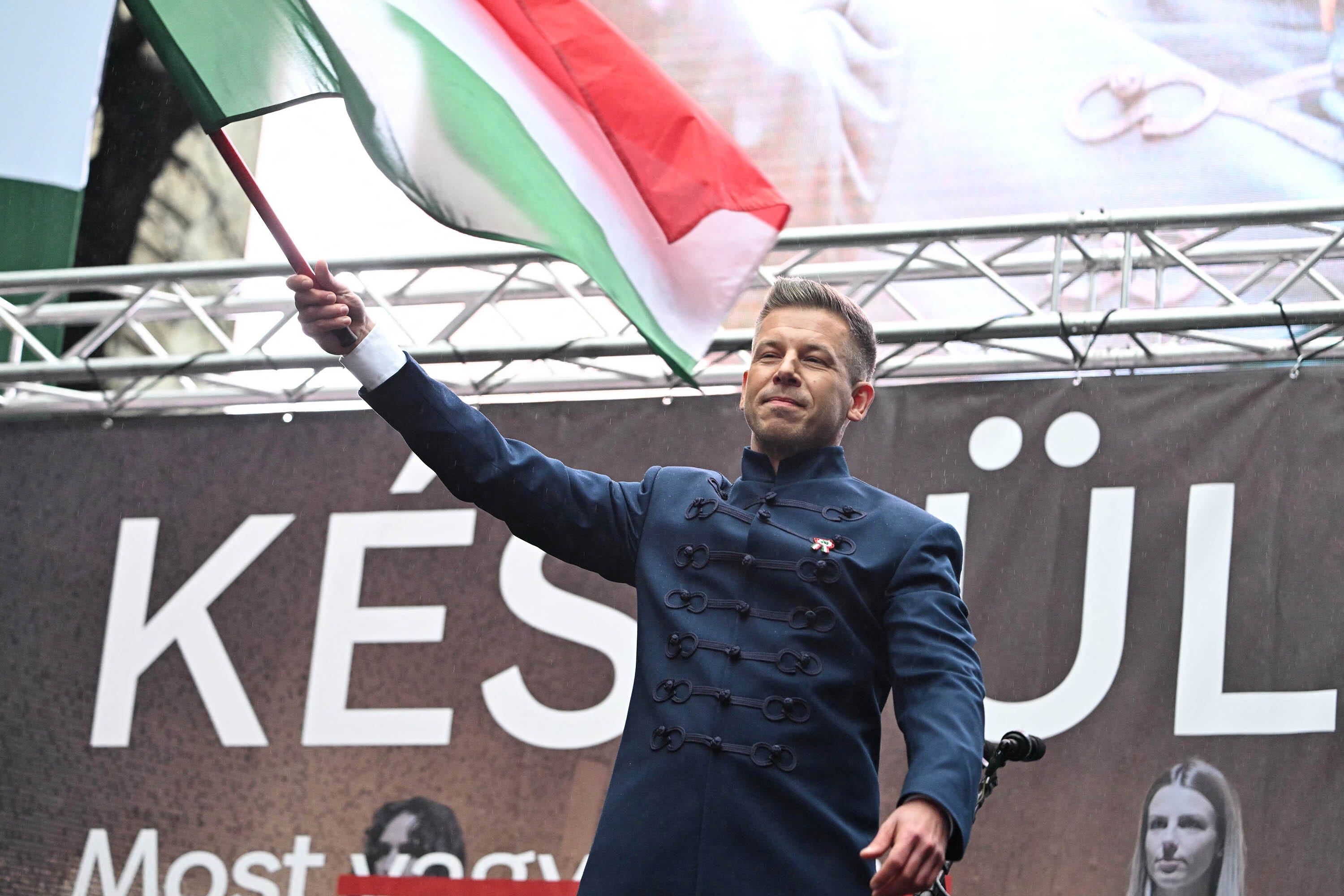
Péter Magyar, by contrast, has owned March 15. The spirit of 1848 infused his campaign from start to finish. On March 15 two years ago, he launched his political career. This year on March 15, less than a month before the election, he spoke to many tens of thousands of Hungarians about the importance of political freedom, wearing a traditional Hungarian Bocskai suit, recalling the style and evoking the spirit of 1848. On election night, he held his victory party on Batthyány Square, named after the man who became Hungary’s first prime minister in 1848. Magyar’s rallies often ended with the crowd singing a folk song about Lajos Kossuth, leader of the 1848 Revolution. And Magyar made extensive use of the great national poet Sándor Petőfi. Petőfi’s National Hymn, written on the eve of the 1848 Revolution, became the charter for Magyar’s campaign. And, as mentioned, Petofi’s poem about the Tisza River inspired the chant “The Tisza is flooding,” which stamped Magyar’s campaign.
By reviving the rhetoric and poetry of 1848, Magyar made democracy attractive to Hungarians again. He reclaimed Hungary’s national symbols in order to present voters with, dare we say, a new kind of national liberalism.
The word “liberalism” here must, especially for American readers, be distinguished from “progressive.” The conventional progressive-conservative divide concerns political disagreements that take place within a framework of agreement about the value of liberal democracy. The older liberal-conservative divide is different and more fundamental. Classical liberals are heirs of the Enlightenment. They believe in natural rights, human equality, freedom, the power of reason, and constitutional government built on the separation of powers. Old conservatism opposes all these things. It despises the idea of enlightenment and romanticizes “tradition” to produce a reactionary anti-liberal politics, opposed to separation of powers and dependent on a strongman, that purports to offer a political alternative superior to liberalism.
Péter Magyar is not “progressive,” which explains why progressives label him conservative. But he is liberal in a classical sense. And Orbán is not a modern conservative, but a reactionary anti-liberal one. Throughout the campaign, Magyar studiously avoided engaging issues that align along the progressive-conservative axis, precisely so that he could run a campaign on fundamental values. Presented with a clear, stark choice between reactionary conservatism and national liberalism, Hungarians chose liberalism.
This rejection of reactionary conservatism was helped along by generational change. Magyar was born in 1981, making him too young to have experienced the traumas of communism. He drew overwhelming support from people under 30, a generation for whom communism was no more than a history lesson.
Orbánism might be described as an unhappy inheritance bequeathed to the present generation by three preceding generations. The first generation lived in the Horthy period and, embittered by Trianon, embraced reactionary politics. The second generation lived under communism, hating but also shaped by it. The third, post-Communist, generation was handed freedom too easily. It sought to sort through the legacy of the second generation by drawing on the worldview of the first, and came up with Orbánism.
But the fourth generation, untouched by communism and suffocating in post-Communist politics, chose to bring this chapter of Hungarian history to a close. They found their way in Péter Magyar, who showed them an earlier, more glorious period from their history, and promised a new age of reform.
The fall of Orbánism has indeed brought something new to Hungary. It holds out the promise of profound societal change. Orbán’s fall has also been a rare moment of truth that renders clear things that were once disputed. Foremost among them: The truth is that Christian conservative nationalism is a lie. It is an ideological product, a kind of cheap political Tupperware parading as fine crystal, that distorts the true history of nations and ignores the actual needs of real people.
Of course, that truth about Orbán’s Hungary was always visible to those with eyes to see. Orbán’s dismantling of democracy and rampant corruption have been documented exhaustively over the last decade and half. That Orbán’s admirers know nothing of these things must be attributed to willful ignorance. Were they to admit the ugly truth about Orbán’s Hungary, they would be forced to confront the hollowness of their Christian conservative dream. Alas, now that Orbán is gone, where can they go to find a model? Perhaps to Russia, or China? Maybe Elon Musk will build an illiberal paradise for them on Mars.
But whatever they do, they should not look to Hungary. Hungary may indeed provide the glimpse of a better future—just not the future they dream of.
 | A guest post by
|