How Political Obsession Turned a Novelist Boring
Once a witty, perceptive writer, Lionel Shriver now produces books that are painful, predictable polemics.


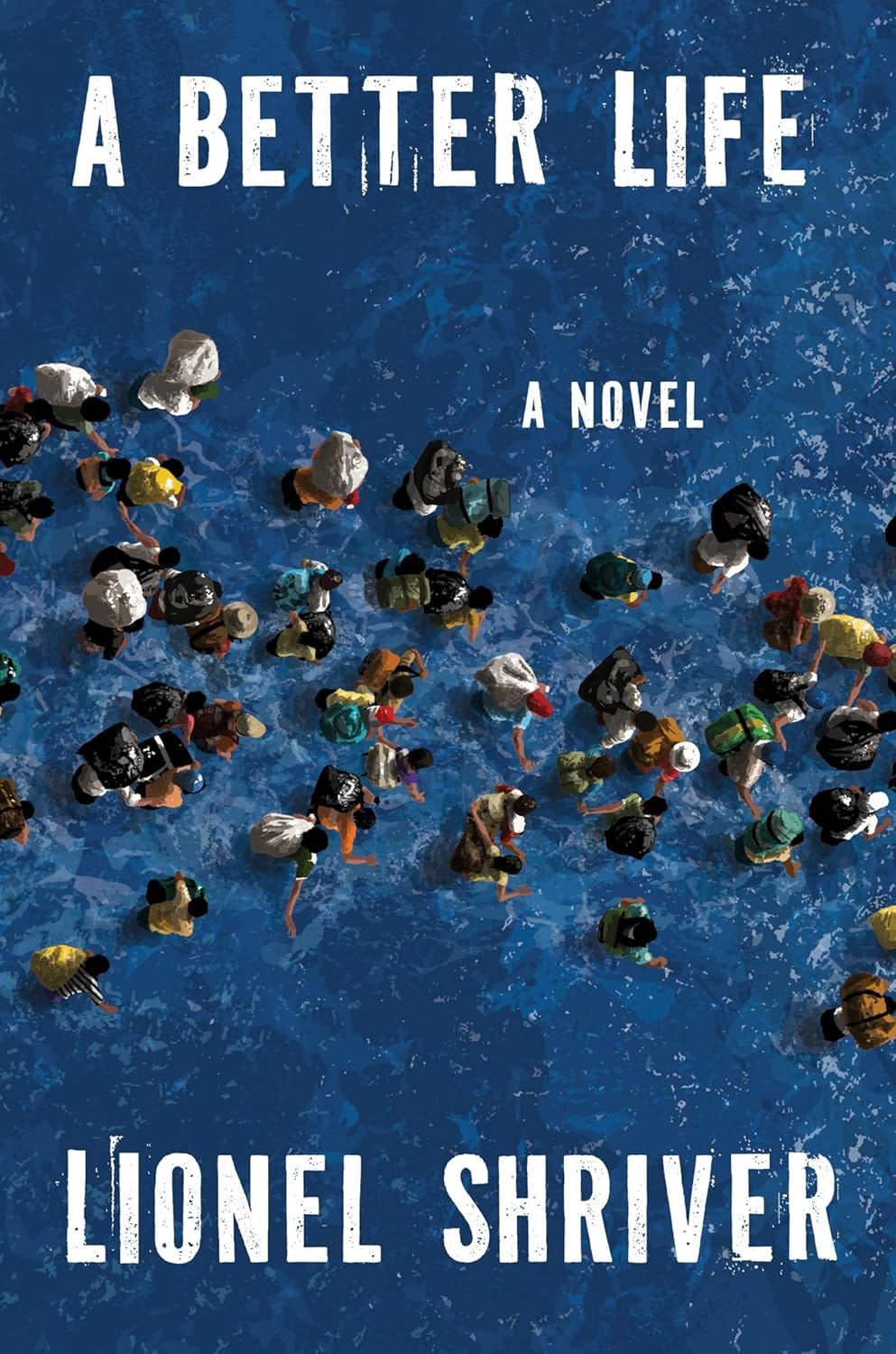
A Better Life
by Lionel Shriver
Harper, 289 pp., $24 (hardcover)
LIONEL SHRIVER, PROPELLED TO LITERARY FAME by her searing, beautifully written 2003 novel We Need to Talk About Kevin—the story of a (fictional) school massacre told by the teenage killer’s mother—has long been a political and cultural maverick. After a seemingly left-coded indictment of America’s profit-driven health care system in her 2010 novel So Much for That, Shriver, an American expat living in the United Kingdom since 1987, ruffled many liberal feathers three years later with a Margaret Thatcher obituary hailing the conservative prime minister as the right kind of “muscular” feminist. Her 2013 novel, The Mandibles: A Family, 2029–2047, was well received but also criticized as an anti-welfare state, pro-flat tax, pro-gold standard diatribe with shades of Ayn Rand. In her 2016 keynote speech at the Brisbane Writers Festival in Australia, the pugnacious novelist ripped into then-trendy “social justice” critiques of “cultural appropriation”—the supposed hijacking by the “privileged” of ideas, characters or images from oppressed groups or cultures—and hit back at a critic who had objected to her depictions of minorities in The Mandibles. At one point during this talk, Shriver donned a sombrero, in a nod to some white college students accused of racism over a tequila-themed party with miniature sombreros. A few outraged people walked out.
Since then, Shriver, an erstwhile Democrat who dislikes Donald Trump but endorsed Florida Gov. Ron DeSantis for president in 2022, has leaned in to her role as an anti-woke culture warrior—a role very much in evidence in her new novel, A Better Life. The main lesson to be learned from it is that activism, “woke” or “anti-woke,” is where literature goes to die.
In a recent column in the British Spectator, Shriver writes about her angst at learning that several of her novels have been used as learning material for a large language model—meaning that in the future, someone could prompt an LLM to “write the first chapter of a novel about [insert pressing social issue] in the style of Lionel Shriver” and “get a plausible simulacrum.” Why start a new novel, Shriver frets, “when ChatGPT could write it for me?” Funny that: Reading A Better Life, I found myself thinking more than once that ChatGPT could produce something like this if trained on right-wing media and fed a prompt for a dark satire about virtue-signaling, immigration-loving libs getting their comeuppance. (At least one other critic, generally a fan of Shriver’s work, has had a similar thought.)
In essence, A Better Life is a dramatization of a social media taunt frequently directed at anyone seen as sympathetic to migrants: “Why don’t you take one into your house?” Gloria Bonaventura, a sixtysomething, divorced Brooklyn homeowner and progressive true believer, does just that as part of a “Big Apple, Big Heart program” (based on an actual 2023 proposal by then-Mayor Eric Adams to pay New Yorkers to house asylum seekers). There’s a $3,000-a-month stipend, but Gloria’s motivations are primarily idealistic. If you suspect that this will be a morality tale about ‘suicidal empathy,’ you’re not wrong. Spoiler alert: Readers wishing to avoid plot details are advised to stop reading here. ‘Suicidal,’ in this case, is not a metaphor, because Gloria actually ends up dead. There are more spoilers ahead, but warnings are almost beside the point: Pretty much everything that happens in A Better Life is entirely predictable if you know anything about Shriver’s politics.
The story is told from the point of view of Gloria’s 26-year-old son, Nico, an unemployed, way-too-online college grad who habitually hangs out on the right-wing internet; he’s the kind of guy who seethes about the “girlification of everything” because Google Translate audio uses a female voice. Needless to say, Nico is aghast when his mother decides to take in a Honduran asylum seeker, Martine, who claims to be fleeing gang violence as well as an abusive marriage.
A failson who literally lives in his mom’s basement (until the migrant boarder’s arrival forces him to move to an upstairs bedroom) and off his grandfather’s inheritance while ranting about freebies for parasitical migrants: That might seem like an excellent setup for a hilariously mean satire of nativist politics. At times, Shriver does seem aware of the irony, and some of Nico’s bitter reflections on his shortcomings are funny and on-target. But despite those moments, it is clear that Nico largely represents the authorial perspective. And, before too long, his misgivings about Martine are validated: She’s not who she says she is. Worse, she turns out to be the vanguard for a chain-migration invasion. First, her supposed brother Domingo arrives, then Domingo’s jovial “business associate” Alonso, and then four other “business partners”—strapping young men with shaved heads and sinister tattoos. They refer to Domingo with a nickname that Nico initially hears as “Elijah,” until he figures out that it’s “El Hacha,” i.e., “The Hatchet.”
Even the cluelessly progressive Gloria finally gets fed up, and cops are called in to evict the “occupiers”—but the men claim to be tenants and produce fake leases, invoking the protection of New York’s tenant-friendly laws. It all culminates in an off-camera confrontation during which Gloria gets shot in the face; compounding the brutality, her corpse is found degradingly exposed, dress hitched up and underwear pulled down. A distraught Martine tells Nico, his sisters, and their father that one of the men (all of whom have vanished) tried to rape Gloria as punishment for disrespecting him, Martine tried to intervene, and the gun went off in the scuffle. But is she telling the truth—or was the whole thing a setup for murder, for which a subsequent twist provides a strong financial motive? The final scene leaves little ambiguity.
SHRIVER IS STILL A HIGHLY gifted storyteller, and the novel’s thriller elements can be compelling; the “Elijah/El Hacha” reveal packs a particularly satisfying punch of dark humor. (“Elijah,” Nico reflects, “was an awfully Judaic nickname for a Honduran, especially once whose given name was supposedly Domingo.”) For a while, Nico’s relationship with Martine, complicated by sexual attraction, becomes sufficiently ambivalent to create genuine suspense as he wonders whether the “real” Martine is the plucky, hardworking, fundamentally decent refugee she claims to be or the crafty, sinister scammer of his paranoid suspicions. And the narrative is enriched by Shriver’s eye for the grisly and unsettling detail, such as Nico’s horrified and guilty reaction to his dead mother’s nudity: “Yet even illicit glimpses of the torso he was frantic to cover were preferable to looking at her face—what was left of it.”
Unfortunately, in the end (and at the beginning and in the middle), A Better Life sinks under the weight of its ideological baggage, and the characters never quite transcend cliché. Too much of the Nico/Martine interaction stays mired in debates and harangues in which Nico is always right even when Martine seems to score a point: for instance, that his own ancestors were German and Italian immigrants. So what, says Nico—that doesn’t mean “we have to let fucking everybody in”:
That would mean we don’t deserve to have a country because of what our ancestors did, since if you let everyone in you’re not a country, you’re just an outline on a map. Some of the people who feel this most strongly are other immigrants, who came here before you, and who don’t want you to take their jobs for lower wages. . . . Who actually liked the halfway orderly, halfway coherent, predominantly European country they emigrated to in the first place and don’t want it to turn into the kind of dog-eat-dog shitholes they left behind.
Nico goes on to explain that this isn’t about Americans being better than other people, only about the accident of birth in a “good” or “bad” country; but that’s not good enough for Shriver, and she steps in to tell us what Nico would have said if he’d been more cogent (the sparring with Martine takes place over shots of liqueur). “Good” and “bad” countries, Shriver editorializes via Nico’s alcohol-fogged thoughts, are the product of “good” and “bad” behavior accumulated over generations—social cooperation and innovation vs. tyranny and corruption—and migrants like Martine are “trying to cash in on civilizational benefits their forbears [sic] hadn’t amassed,” which amounts to “a kind of cheating, mooching, or theft.” It’s a rather grim, and extremely collectivist, idea of ancestry-as-destiny. It’s also hard to see how the same logic wouldn’t have applied to a lot of European immigrants in the late nineteenth or early twentieth centuries.
Such preachy conversations abound in A Better Life; Nico gets ideological reinforcement from his parents’ friend Vernon, a filmmaker making a documentary about the border crisis who gripes that “we’re paying to invade ourselves” and lectures Nico’s mother on why words like “invade” and “plunder” fit. Sometimes, even Martine and the other “conquistadors” say things to which we’re clearly meant to nod along: the gringos have grown too soft, aren’t having enough bebes, and will lose their country if they don’t fight for it. On the other hand, poor Gloria never sheds her rose-colored glasses: She remains naïvely trusting toward Martine even after she has soured on her boarder’s male compatriots, and she continues to insist that “most of the millions of people crossing the border are nothing like the bullies in our house.” We’re clearly meant, along with Nico, to roll our eyes at that.
None of this is remotely subtle. But, just in case we still don’t get it, one chapter ends thus: “No less so than if the Nazis had billeted in their farmhouse in France, the Bonaventuras were under occupation.”
AFTER FINISHING A BETTER LIFE, I reread We Need to Talk About Kevin and found the contrast striking. Shriver’s 2003 novel—written as a series of letters from the narrator, Eva, to her husband, Frank—masterfully builds up to the horror gradually glimpsed through unsettling hints, from the first pages in which we learn that Eva is something of a town pariah. (One of the eventual, shattering reveals is that Frank is dead.) As the story unfolds toward the awful truth, we follow Eva’s relationship with her difficult son, with whom she has never really bonded and whom she has tended to treat with antipathy and suspicion. Is his hostility a reaction to hers, or vice versa? Is her unloving motherhood partly to blame for Kevin’s killing spree, which starts with his sister Celia and his father before moving on to classmates and school staffers? Is it justice that the 16-year-old killer only gets a seven-year sentence, both because of his youth and because his lawyers blame a psychotic break caused by Prozac? Is there a glimmer of redemption in Kevin’s quasi-apology to his mother and in Eva’s belated discovery of love for her son in the wrenching final pages—or is it simply weary desperation on her part and, perhaps, manipulation on his? Here, Shriver consistently avoids simplistic answers, and the novel, written in response to a pressing social issue in the wake of the Columbine shootings, never becomes a vehicle for a message.
Another of Shriver’s ‘social issue’ novels, Big Brother (2013), is a likewise non-sermonizing, sensitive exploration of obesity and dieting—with a “What’s real?” narrative twist that isn’t entirely original (it recalls Ian McEwan’s Atonement) but adds to the complexity and nuance.
But A Better Life isn’t Shriver’s first foray into heavy-handed polemics. The Mandibles (2016) is a gritty, often powerful dystopia of American decline; but it’s marred by too much editorializing about runaway entitlements and a nasty streak of anti-immigrant prejudice. The road to perdition includes mass amnesty in 2020 and a constitutional amendment allowing the 2028 election of a Mexican-born president, who delivers his inaugural address entirely in Spanish. He also makes the decision to default on the national debt, causing both the dollar and the stock market to crash, and moves to confiscate all privately owned gold right down to wedding rings. The depiction of social unraveling amid economic collapse in The Mandibles is often grimly funny; the fragility of civilization is a compelling theme, and, as in her other novels, Shriver has a knack for vivid, even grotesque physical details that bring it home. (The Mandibles’ travails include dealing with a dementia-afflicted family member who is both incontinent and prone to constipation in the absence of adult diapers or laxatives.) Yet far too many conversations amount to lectures on fiscal discipline, and most of the characters are far more schematic than in Shriver’s earlier novels.
Mania (2024) skewers “wokeness” even more unsubtly, conjuring an alternate timeline in which a 2010 bestseller titled The Calumny of I.Q.: Why Discrimination Against “Dumb People” Is the Last Great Civil Rights Fight launches a “Mental Parity” movement against “smartism.” It’s so successful that by 2012, the offensively “brain-vain” Barack Obama is trounced in a primary challenge by the virtuously uncerebral Joe Biden. Narrated by a grumpy English professor who is clearly a Shriver alter ego, the novel has its incisive woke-parody bits, with “We support cognitive neutrality” yard signs and language-policing that seeks to purge words like “dim” and “dense” even in their non-cognitive meaning.1 But the joke drags on far too long and well past even fictional plausibility: There seems to be no real pushback against the anti-smart revolution, even when incompetent pilots, engineers, and doctors start causing predictable disasters. Then, just as implausibly, the exasperated heroine’s caught-on-video rant against these “retarded” policies goes viral, and the “death grip of Mental Parity” is broken. Mania picks up energy and verve at the end when it chronicles the backlash—so extreme that, by 2027, there are proposals to tattoo IQ scores on wrists and deny voting rights to the low-IQ. It also has a good villain in the narrator’s “frenemy” Emory, a slickly opportunistic pundit who gets on both bandwagons with equal gusto—first as “the intelligent face of stupidity,” then as “the affable face of tyranny.” But ultimately, the novel fails as both alternate history and satire: This is material for a Saturday Night Live sketch, not a book.
SINCE WE’RE DISCUSSING Shriver’s evolution into an anti-woke polemicist—which hits its nadir in A Better Life—it’s worth pausing to examine her claim of persecution by progressive zealots. As I wrote at the time of Shriver’s controversial Brisbane speech, I agree with her harsh judgment of the campaign against “cultural appropriation,” but the Washington Post critique of The Mandibles, which she invoked as a case in point, simply doesn’t fit her argument. As reviewer Ken Kalfus wrote in his response, what he criticized was not the fact of Shriver writing minority characters but the way she treats them.
Remember the family member with dementia? That’s the novel’s only recurring black character, Luella, wife of family patriarch Douglas Mandible—and it’s Shriver who makes her race relevant. We’re told that when 60-year-old Douglas ditched his first wife for the glamorous, much younger Luella, her trophy-wife status was enhanced by being “trendily Afri-merican”—one of the novel’s many clunky future-language inventions. Then, she develops early-onset dementia in her fifties, and the marriage becomes a relationship of “master and pet.” (Please, Shriver, don’t make me wish for sensitivity vetting.) Things get far worse when the now-broke family is stuck with Luella amid general social descent into chaos, with no nursing care or basic conveniences; she has to be kept tied up much of the time and led on a dog leash during a house move. Moreover, her degrading plight is treated with more cruel mockery than sympathy, since the family has always regarded her as a conniving gold-digger.
I don’t think you need to be particularly “woke” or “politically correct” to be put off by this—especially when, as far as I can tell, the only other black person (briefly) appearing in the book is Selma, a main character’s coworker who cheers for el presidente’s ruinous fiscal policies. Selma gets such dialogue as, “I don’t see why the gubment ever pay anything back. Pass a law say, ‘We don’t got to.’ Presto. No more loan.” In the same scene, a “stocky Guatemalan” named Mateo shrugs off the default, pointing out that he “declared bankruptcy six years ago”: “Sorted everything out bien bonita. No reason the country can’t do the same thing.”
More broadly, The Mandibles is fairly explicit in its view that American decline is at least partly the result of Latino cultural ascendancy: “Instead of our assimilating the illegal immigrants, the illegal immigrants have assimilated us,” says Nollie, the quick-witted, argumentative novelist—or ex-novelist, the profession having been killed by the societal collapse—who is probably the most obvious of Shriver’s authorial alter egos. When a Hispanic in-law reminds Nollie that he was born in the United States and is as American as she is, she snaps back, “Thanks to our generous Constitution.”2
Did Shriver get “canceled” for this novel? Nope; other than the Washington Post and Vox, most of the major “liberal media”—the New York Times, the New Yorker, the Guardian—gave The Mandibles a respectful and even favorable treatment. Shriver was interviewed about it on National Public Radio; we should all be so persecuted. This is not to say that progressive pressures in the literary world are all merely imagined by the “anti-woke” crowd: They have been documented by PEN America, hardly a right-wing outfit. But by the time those pressures became a significant factor, Shriver was too high-status to be affected by them.
IN A NEW INTERVIEW WITH Bloomberg News podcaster Mishal Husain, Shriver confirms that the house invasion in A Better Life is meant as a metaphor for the immigration surge under Joe Biden, who “let in at least 10 million immigrants”—or “as much as 20 million.” Her facts are dubious: While the 10-plus million figure has a basis in actual estimated data, most of it is legal immigration, to which Shriver claims she doesn’t object. In any case, a look at her past writings shows that her “consuming preoccupation” with this issue (her words!) long antedates the Biden border crisis: In a Guardian column twenty years ago, she wrote that she was “obsessed with immigration” and had been so “for decades.” In part, she admitted, this obsession stemmed from a difficult inner conflict: On the one hand, the knowledge that if she had been born in a poor underdeveloped country, she would have tried her best to escape to the United States or Europe, legalities be damned; on the other, a legal immigrant’s resentment toward “folks who cheat and get away with it,” as well as annoyance that “the entire world seems to believe they have a right to live in my country.”
It’s not clear whether “my country” in that 2006 piece referred to the United Kingdom or the United States. The column was written on a visit to New York, and Shriver’s pique seems to have been triggered by the fact that the foreigners in line at passport control at JFK Airport were “indistinguishable from the jumble of foreigners—taxi drivers, fast-food vendors—on the other side of customs.” Needless to say, she had zero evidence that any of these drivers or vendors were here illegally; the reaction feels like pretty straightforward racial and ethnic profiling. Shriver’s more recent comments have an even clearer whiff of demographic essentialism: “For westerners to passively accept and even abet incursions by foreigners so massive that the native-born are effectively surrendering their territory without a shot fired is biologically perverse,” she wrote in 2021.
A Better Life thus seems to be the product of an almost lifelong obsession. Unfortunately for Shriver, it couldn’t have landed at a worse time: After one year of an aggressive crackdown on illegal immigration, American attitudes have grown more favorable to migrants, and Trump is now underwater on the issue (previously one of his strongest). The novel’s use of tattoos as a gang-membership signifier may not play so well after real-life horror stories of apparently innocent Venezuelans being shipped off to a gulag-like prison in El Salvador mainly on the basis of tattoos that were mistaken for gang imagery. And while Shriver conjures a scary fictional tale of a progressive white woman whose sympathy for migrants gets her killed, in real life it’s been less than four months since an actual progressive white woman—Renée Good—was shot to death by an Immigration and Customs Enforcement agent.3 Shriver herself, in the Bloomberg podcast interview, expresses unease with ICE tactics and doesn’t think that the shootings of Good and Alex Pretti “look justifiable.” Yet she still likes the fact that the large-scale deportations are sending a “signal”—and seems to grasp for reasons to justify restrictionism, often contradicting herself in the process.4
I was hoping that, between Mania and A Better Life, Shriver had gotten the anti-immigration bug and the culture wars out of her system and that her next novel would bring back the subtlety, complexity, imagination, and fine psychological portraiture of which she was once capable. But it looks like her next subject is . . . “the whole trans thing”—a topic that seems guaranteed to bring out Shriver the polemicist. If A Better Life is any indication, she might as well farm it out to ChatGPT.
There have been some sporadic real-life attempts to discourage the “ableist” use of “lame” and “blind” as metaphorical pejoratives. But there is no record of such words being censored or of anyone being “canceled” for using them.
To be fair, the novel does include the ironic role reversal of Mexico building a border fence to keep out American refugees and stereotyping them as lazy “Ameri-trash.”
The current moment also puts The Mandibles—which starts in an eerily-soon 2029—in ironic perspective: If someone does drive the American economy into the ground by 2029, it sure won’t be a Mexican-born president elected thanks to the amnesty-boosted Latino vote
Thus, at one point Shriver suggests that we should “let in some people” but with a preference for “more culturally compatible nationalities”; when pressed on the fact that the Hispanic immigrants at the southern border are largely Christian, she concedes that they “have a higher likelihood of ultimately assimilating” but says that the real issue is massive illegal immigration. “We should let more people in legally, and make it easier and cheaper,” she says. Yet only a little earlier she had ventured that a complete immigration “pause” would be desirable, because “we have taken in so many people,” and repeats the nativist myth that the post-1924 “pause” in immigration helped ensure national cohesion.