How to Counter the GOP’s AI Psyops
Leaning into authenticity.

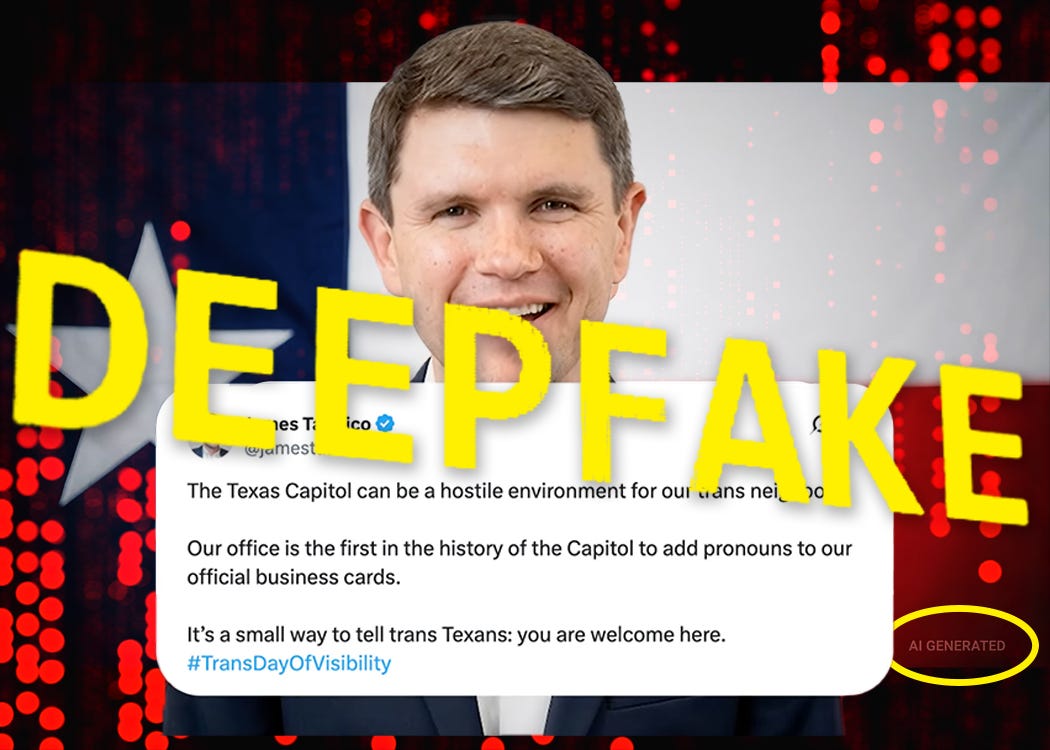
IN A VIDEO SPOT PUT OUT LAST WEEK by the National Republican Senatorial Committee, James Talarico is shown reading aloud some of his old tweets. The tweets are displayed on screen, obscuring the Texas Democrat’s mouth as he reads them. A deep, hollow reverb voice repeats specific words from the tweets—like “white men” and “pronouns.” The video culminates with the viral “FAHH” meme-scream edited in after Talarico reads an old tweet reminiscing about participating in a Planned Parenthood–sponsored march in 2004, when he was just a teenager.
Except it’s not actually Talarico in the video: It’s a high-quality deepfake.
Republicans aren’t just running attack ads anymore. They’re running AI-based psyops—psychological operations—designed to get inside people’s heads and quietly shape how they see a candidate.
The point of the Talarico video isn’t to debate his ideas. It’s to make him feel subtly “off”—to take a guy who reads as a normal, grounded teacher and public servant and give his words just enough visual and audio strangeness that they code as “not normal.” Covering his mouth with his own tweets makes him harder to read, and hammering “white men” and “pronouns” with the echoes tries to mark him as culturally suspect.
The good news: Talarico’s Senate race offers an early playbook for how Democrats can dismantle AI attack ads before they stick.
WE’VE SEEN THIS AI PSYOP STRATEGY play out before. During last fall’s government shutdown, NRSC operatives released an AI deepfake of Senate Democratic Leader Chuck Schumer grinning and saying “every day gets better for us.” The deepfake lifted part of a real Schumer statement quoted by a reporter and turned it into a taunt designed to put blame for the shutdown on Democrats. At the time, the NRSC bragged to reporters that this AI stunt showed how smart operatives could use the technology to crank out “effective content” faster and cheaper.
And in Georgia, Rep. Mike Collins’s Senate campaign has used AI to deepfake Sen. Jon Ossoff—in one case altering a rally photo to make Ossoff’s supporters look like gang members. (Collins is the Georgia candidate whose launch video famously misspelled the name of the state he’s running to represent, so it would be fair to say that his dedication to accuracy has been questionable from the start.)
Political psychology helps explain why these tricks keep showing up. As Drew Westen notes in The Political Brain (2007), voters respond first to emotional tone and nonverbal cues: Music, voice, and framing all make impressions long before policy arguments start to work on the conscious mind. Westen points to the Willie Horton spot in support of George H.W. Bush in 1988 and the “RATS” ad put out by the Republican National Committee in support of George W. Bush in 2000 as prototypes of this move—coded or even subliminal cues that aim to rewire how voters feel about a candidate without ever saying the attack out loud.
The viral “FAHH” sound at the end of the anti-Talarico ad isn’t random either—it’s a 2025 TikTok trend used to emphasize painful hits and epic fails. The NRSC basically connected a Gen Z fail sound to a teenage boy’s memory of marching for women’s rights, hoping to turn conviction into cringe.
The problem for Republicans is that this is a very online phenomenon. Following the Schumer deepfake, an NBC News poll conducted a week later found that 52 percent of voters blamed Trump and congressional Republicans for the shutdown, compared to 42 percent that blamed Democrats. The deepfake may have grabbed views on X, but that doesn’t mean it was effective in changing voters’ minds in real life.
Because it turns out that voters care about authenticity and solving problems. I saw this up close in 2018 when I worked on a statewide race in Florida for Nikki Fried, a first-time Democratic candidate for agriculture commissioner. She focused on three issues most Floridians cared about: protecting natural lands and waterways, fixing a broken concealed-firearm background check process, and standing up for medical marijuana patients and hemp growers trying to navigate a system that wasn’t built for them.
In a year when every other Democrat lost statewide, Fried was the only Democrat who won statewide—a victory that didn’t come from online stunts, but from showing up as who she was and focusing on problems people actually felt.
REPUBLICANS THINK AI CAN HELP THEM FLIP that script by misrepresenting their opponents. This can only work effectively when voters don’t ever get to see the true candidate in action.
It helps that Talarico has a robust social media team of his own. That allows him to show his true self—an antithesis to the AI-slop version churned out by Republican oppo teams. The deepfake is undercut when there’s video of the real Talarico during a town hall taking questions from Texans and talking about the same real-world problems his supporters say they’re living with. That’s where the psyop misreads its target.
Talarico doesn’t present as a niche online figure—he comes off like the former teacher who quotes scripture in hearings and walks straight into hostile rooms. He’s gone on Fox News and, after backing the host into a corner on gerrymandering, watched as the segment was wrapped early. He’s sparred with Texas Republicans in committee, and in one clip from a hearing that went viral, he quotes scripture to dismantle a bill forcing the Ten Commandments into every classroom. At his rallies and town halls, former and current Republicans, including Trump voters, describe him as a “truth-teller” and a leader who “stands up for everybody.” That’s the kind of authenticity that attack ads like the NRSC’s just can’t touch.
If anything, by staging a dramatic reading of his tweets, Republicans have essentially cut a trailer for Talarico’s core values—calling out radical violence, insisting trans people deserve to be safe, and grounding his politics in a faith that sees God as bigger than bigotry. The Talarico deepfake also breaks a basic rule of political persuasion: never help your opponent tell a strong moral story in their own words. The NRSC has created an opportunity for Talarico to seize the moment and respond by owning his words—doubling down on his conviction and authenticity.
Westen’s advice to Democrats facing emotional attacks is to skip fact-checks and counterpunch with character. Talarico is already doing it. When Senate Republicans blasted out a clip of him saying “Christ is the immigrant deported without due process” and comparing Christ to people harmed by Trump’s regime, he simply quote-tweeted it with “I approve this message.” A classic of political judo. His post outperformed theirs sixfold.
If Republicans keep leaning into AI psyops, they’ll only widen the gap between their feeds and the rest of the country—and hand candidates like James Talarico an opening to remind people what normal actually sounds like.
Max Flugrath is the senior director of creative, communications, and digital for Fair Fight Action and a political strategist who has worked on campaigns in Georgia and Florida, including a successful statewide race.
 | A guest post by
|