How to Fix America’s Geriatric Politician Problem
Sure, some people can work well into old age. But we still need age limits on candidates for office.

MY HUSBAND AND I are baby boomers, and we know how lucky we are. We know it from the house we bought in 1984 that has appreciated to nearly ten times the purchase price. From the steady jobs we had for decades in a field—“traditional” journalism—that’s hit hard times. From the pensions we have (remember them?) in addition to IRAs, 401(k)s, and whatever else we’ve managed to set aside.
It’s not a fortune, and from what we’re learning about finances in five years (so far!) of managing care for two ninetysomething parents, it may not cover even our own eventual costs—much less leave anything for our kids.
And speaking of those kids, they had the fortune (or misfortune, take your pick) of being gifted, tunnel-vision musicians at a time when the arts are struggling. The older one, a violinist, managed to land a spot in an orchestra with relatively solid finances. The younger one, a composer, is adapting after a maelstrom of setbacks in California’s TV and film industry.
It’s a tough country for young people. Buying a home is out of reach for many. AI and climate change are existential threats to their jobs and lives. And on top of all that, millions of retirement-age boomers—nearly 20 percent of us—refuse to step aside. Heck, even some Silent Generation holdovers won’t retire.
I plead guilty to still working. My husband is in that cohort as well. But there’s a big difference between people like us (a politics writer and a magazine editor) and politicians who run for public office in their eighties or nineties, or even late seventies.
We can move to part-time work whenever it feels right, and nearly one in four seniors 65 and over were doing just that in 2024. Furthermore, to be brutally honest, if we vanished from the scene due to death, illness, scandal, or retirement, it would be like the unheard tree falling in the forest. That is, it wouldn’t be disruptive or even particularly noticeable, except by those close to us.
Government service is the opposite. Voting—the voice of the people—is the foundation of the nation, from town hall to the White House. The death, illness, diminished capacity, or fading energy of an aging politician in the middle of a term or campaign can create havoc, uncertainty, and openings for political mischief. That’s especially true when expensive special elections are needed. There can also be cost, sometimes incalculable, when the judges or justices they nominate and confirm stay past their time.
The octogenarian caucus
Joe Biden (a Silent Generation holdout who belatedly abandoned a run for a second four-year White House term in July 2024 at age 81) and Donald Trump (an early Boomer turning 80 next month, with two and a half years remaining in his second term) are the most famous examples of how messy things can get. But they’re far from the only politicians to test the outer limits of seniors in office.
NBC News reported in January that two dozen lawmakers from the Silent Generation (sandwiched between the “Greatest” and the boomers) were serving on Capitol Hill. One of them, Sen. Chuck Grassley of Iowa, age 92, is right behind JD Vance in the presidential line of succession. Why? Because he’s president pro tempore of the Senate. And why is that? Because he’s the senior member of the majority party.
Grassley, the oldest member of the Silent Generation caucus, was 89 when he ran for his seventh term in 2022 and will be 95 when it ends in January 2029. At the time of the NBC analysis, Georgia Rep. David Scott, 80, was the youngest. He filed to run for re-election in March but died in April.
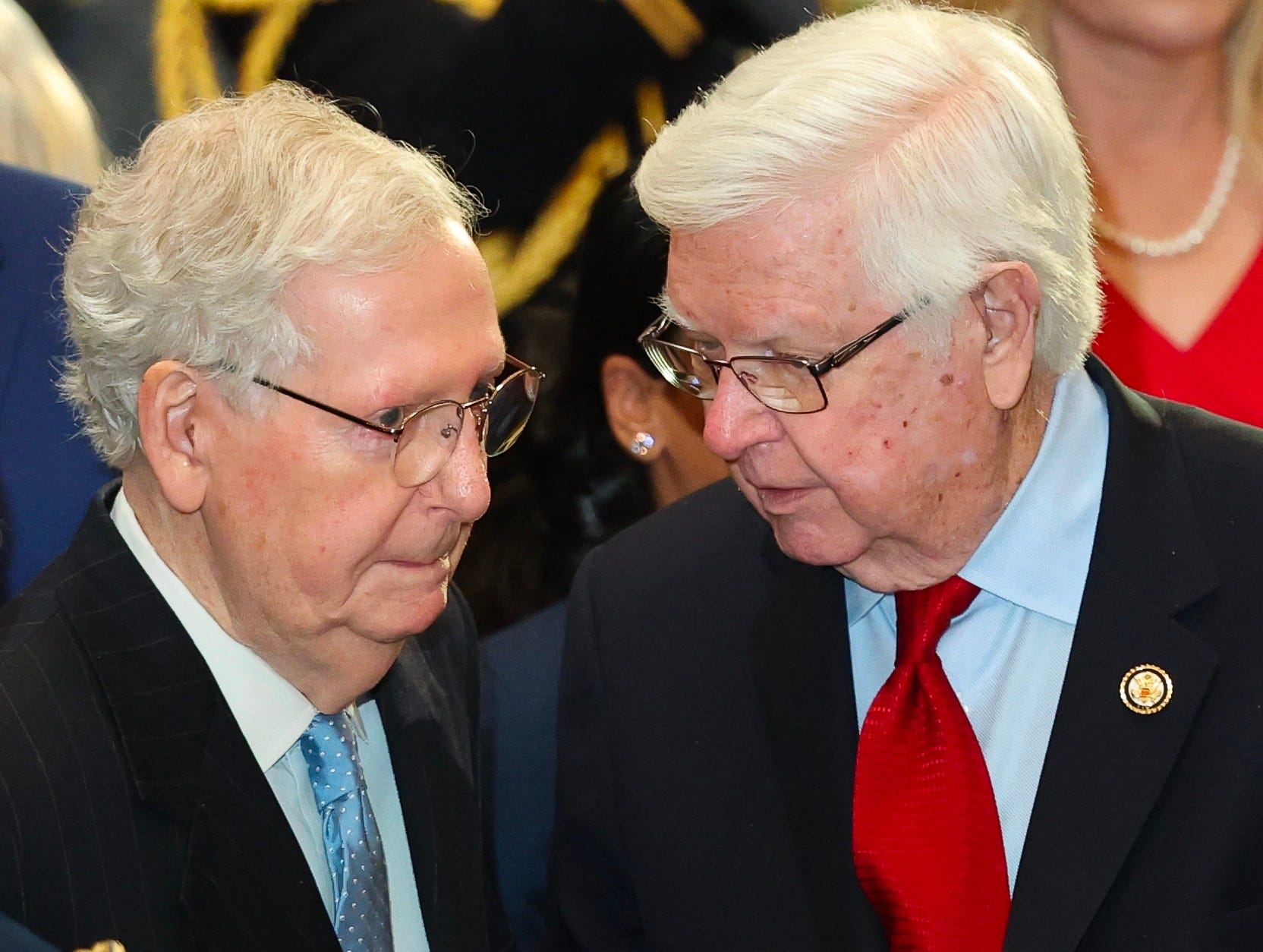
Several Silent Generation politicians are retiring this year, including former House Speaker Nancy Pelosi, 86, and former Senate Majority Leader Mitch McConnell, 84. But many others want to stick around, NBC reported—among them Sen. Jim Risch (83) of Idaho, California Reps. Maxine Waters (87) and Doris Matsui (81), and Reps. Jim Clyburn (85) of South Carolina, Hal Rogers (88) of Kentucky, Virginia Foxx (82) of North Carolina, and John Carter (84) of Texas.
Some lawmakers don’t have to decide yet. Sen. Bernie Sanders of Vermont and Sen. Angus King of Maine ran for re-election in 2024 aged 83 and 80, respectively. When their six-year terms end in January 2031, Sanders will be 89 and King will be 86.
This year, we are seeing some aggressive challenges to older boomers. Sen. Ed Markey of Massachusetts turns 80 in July and would be 86 at the end of another term in January 2033. Rep. Seth Moulton, 47, says that’s too old. A new poll showed Moulton has shrunk Markey’s lead to 5 points, months ahead of the September 1 primary.
In Maine, 78-year-old Gov. Janet Mills was the Democratic establishment choice in the state’s June 9 Senate primary. But she quit the race a few weeks ago, steamrolled by the viral candidacy of Graham Platner, 41, an oyster farmer, harbor master, and combat veteran.
Deciding the future
Five House members have died in office since the 119th Congress began in January 2025, and the minuscule GOP majority has at times played politics with their successors. Texas Gov. Greg Abbott set the special election to replace Rep. Sylvester Turner, a Democrat, for eight months after his death, though there were several earlier opportunities. And House Speaker Mike Johnson waited fifty days before swearing in Arizona’s Adelita Grijalva, who had won the seat her late father held, during the House struggle over releasing the Epstein files.
Let’s stipulate that youth, or even relative youth, doesn’t guarantee health or wisdom. Right now, New Jersey Rep. Tom Kean—at 57, practically a teenager by congressional standards—hasn’t voted since March 5 due to an unspecified “personal medical issue,” and it’s unclear when he’ll be back. And to put it politely, trust-fund supported Jack Schlossberg, President John F. Kennedy’s 33-year-old grandson, does not come across as in any way “ready” for Congress in his primary campaign for an open House seat in Manhattan.
And conversely, let’s stipulate that senior candidates can be attractive to voters. Former Gov. Roy Cooper of North Carolina (68) could flip an open Senate seat for the Democrats this year, and former Sen. Sherrod Brown of Ohio (73) is widely viewed as the party’s best chance to unseat Republican Jon Husted, age be damned.
And finally, let’s stipulate that old age does not mean a person is necessarily incapable of performing at a high level in a demanding job. There are plenty of elder statesmen and women in the private sector, many of them famous names. CBS’s Lesley Stahl (84) and NBC’s Andrea Mitchell (79) come to mind. Disney CEO Bob Iger said he’d leave that post in 2018, when he would have been 67, but then stayed until 2020, answered the call to return in 2022, and finally stepped down last February—the month he turned 75. Warren Buffet was 95 when he retired early this year as CEO of Berkshire Hathaway.
Still, employers and employees in the private sector have flexibility—to assess, hire and fire, quit and retire, renew contracts or not. These are not options after voters have made their choices. When it comes to America and decisions on the future we leave behind, it seems clear that we need to set a retirement age for federal officeholders and the judges and justices they install.
Running a country of 340 million should not hinge on people in their 80s and 90s playing the odds that they can complete their service at full capacity or at all, whether their term is two years in the House, four years as president or governor, six years in the Senate, or a lifetime on the bench.
The 75-year-old solution
An overwhelming majority of Americans across the political spectrum back maximum age limits for federal officials, including judges and justices. This was true in a 2023 Pew Research Center poll, and if anything, it is even more true in an NPR/PBS News/Marist poll of 1,322 Americans conducted just three weeks ago. Eighty percent of Americans support both age caps and term limits, with slightly more Republicans than Democrats on board.
This surprised me, but it probably shouldn’t have. Both parties have had back-to-back presidents moving from their late seventies to early eighties while in office, and showing obvious signs of age over those years. And the older presidents have coincided with an increasingly younger electorate. By 2028, the Brookings Institution reported in 2023, Millennials and Gen Z—born from 1981 to 2012—will be a majority of potential voters.
Biden’s abrupt exit from the presidential race triggered a wave of discussion about our political gerontocracy. “If there is a mandatory retirement age for the top officers in the U.S. military, why isn’t there one for the commander in chief?” asked a September 2024 headline in Kellogg Insight, a magazine published by Northwestern’s Kellogg School of Management. Inside Elections editor Nathan Gonzales made a similar case a few months later in a Roll Call column headlined “It’s time for age limits for members of Congress.”
The Constitution set minimum ages for the House (25), Senate (30), and president (35), and lifetime appointments for federal judges and justices. Brandy Figuera wrote in the Harvard Political Review last year that “our best bet” is to create another requirement: “an upper age limit backed by science, examples, and the people’s approval.”
The Constitution was ratified in 1789, when the average life expectancy for a male baby in sixty-two towns in Massachusetts and New Hampshire was 34.5 years. Updating it for modern times by enacting upper age limits would likely entail a constitutional amendment that must be approved by two-thirds of Congress and ratified by three-quarters of the fifty states. That’s the bad news. The good news is that, in addition to the overwhelming consensus on this among Americans, there are a few people advancing specific proposals.
Rep. John James, a Michigan Republican currently running for governor, introduced the RETIRE Resolution as part of a 2023 “accountability package” that also included term limits. “The resolution would amend the United States Constitution to ban candidates for President, Vice President, Senate, or Congress from running for office if at any time during the term the person would turn 75 years of age or older,” he said.
It didn’t go anywhere. But Rahm Emanuel—a former U.S. representative, White House chief of staff, Chicago mayor, and ambassador to Japan—mentioned a similar idea several times at events this year in the capital. “Clean it up, all of Washington,” he told a student audience. “And when you’re 75 . . . you should not be in government at all. Thank you for your service, up and out.”
Emanuel, a prospective 2028 presidential candidate, would impose that age limit across Congress, the White House, and the judiciary. He is 66, so would he pledge to serve only one term? “I’m not looking for an escape hatch for me. It applies across the board,” he told reporters at a breakfast, adding that “I’m well aware of my age. Of course it would apply to me.”
But first, he said, he’d have to run and it would have to pass. And about that: Emanuel asserted that Congress could impose a mandatory age limit by simply passing a law, rather than a constitutional amendment. That’s arguable, but I wouldn’t argue against trying. Especially now, when there’s a rare groundswell for common sense.
 | A guest post by
|