Hungary Could Free Itself from Orbánism Next Spring
An upstart opposition leader, Péter Magyar, is shrewdly capitalizing on the prime minister’s blunders.

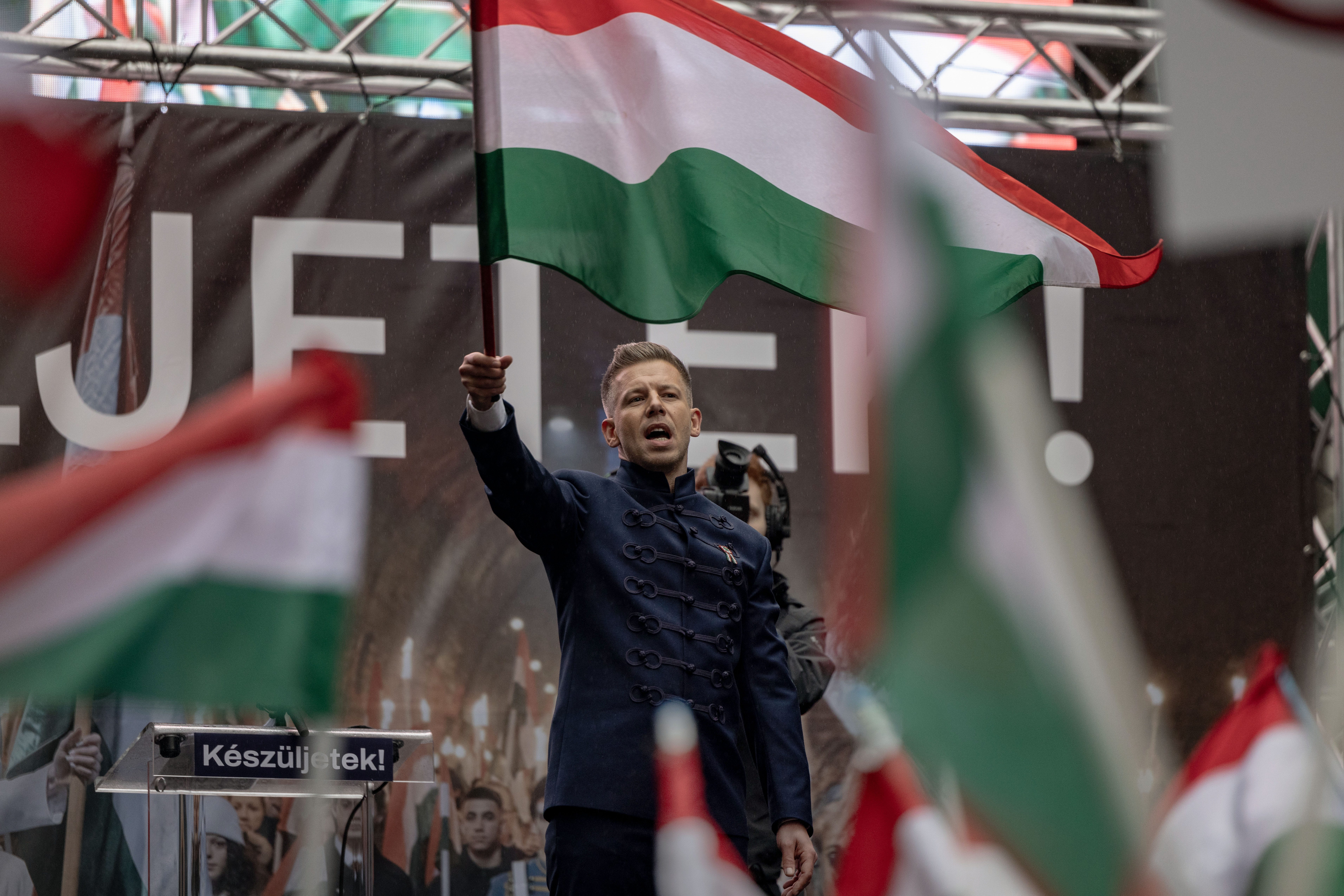
THIS IS ONE OF THOSE TIMES when it’s tempting to apply the principles of physics to politics, because it appears that the second law of thermodynamics—that’s the one that explains that entropy tends to increase over time—may at last be catching up with Viktor Orbán. Hungary’s Christian conservative Disneyland, a shining beacon for Tucker Carlson, JD Vance, and others in the Trump administration, may be heading toward collapse.
The catalyst for the crisis has been Péter Magyar, Orbán’s young and dynamic political opponent, whose energy and success appear to have helped to spark a social movement that could bring Orbánism to an end. Magyar’s political party, Tisza, now holds a steady lead over Orbán’s Fidesz in independent polls, somewhere between 5 and 10 percent. With elections likely in Hungary next April, Orbán looks beatable.
A large part of Magyar’s success derives from the fact that he has developed a serious ground game. Tisza has built a network of local community clubs or associations, called Tisza Islands, where civically minded people meet to share ideas about the condition of the country. In the meantime, Magyar keeps crisscrossing the country tirelessly, visiting even small villages in an effort to build support. According to Medián, a research company with an excellent reputation, Tisza now leads Fidesz in all large and small cities throughout the country—everywhere, in fact, except in villages.
Confronted with a serious challenger, Orbán, who has carefully cultivated his image as a political genius, can’t stop making blunders. “The thing to avoid,” Napoleon once said, “is not so much error as self-contradiction. It is especially by the latter that authority loses its force.” Thanks to Magyar, the self-contradictions of Orbán’s regime are becoming ever more apparent.
For example, in May, during Romania’s presidential election, Orbán delivered a speech in which he extolled the virtues of Christian nationalist politics. He ended his remarks with praise for George Simion, the far-right Romanian presidential candidate. Shortly afterwards, clips of Orbán praising Simion were featured in paid political advertisements that appeared on social media in parts of Romania with a large Hungarian minority. Orbán had effectively endorsed Simion.
But Simion—good right-wing Romanian nationalist that he is—has a history of anti-Hungarian bombast. He has allegedly referred to the Hungarian minority in Romania as terrorists, and suggested Romania’s borders should be redrawn to include parts of present day Hungary. He may also have been involved in desecrating a Hungarian cemetery. Leaders of the Hungarian minority in Romania, who are normally aligned with Orbán, criticized his endorsement of Simion vehemently. Orbán, the great Hungarian nationalist, looked like he was selling out Hungarians in Romania in hopes of gaining an autocratic ally in Europe.
Péter Magyar immediately seized on the mistake. He announced that, to express solidarity with the Hungarian minority in Romania, he would take “a million steps for peace and national unity” by walking from Budapest to the Romanian city of Oradea (Nagyvárad), an important city in Hungarian history. The distance between the two cities is approximately 185 miles. The hike lasted two weeks, winding through small towns and the Hungarian countryside. As Magyar worked his way through the country, crowds would come out not only to see, but also to join him for part of the way.
ANOTHER OF ORBÁN’S BLUNDERS was to pass a law in March outlawing LGBTQ+ events, including the capital’s annual Pride parade. Orbán was drawing upon a well-worn playbook: He has used culture-war issues in the past to force the political opposition into adopting unpopular positions, and gay advocacy probably seemed like a perfect one for him to press into his young opponent’s hands. Péter Magyar was reluctant to address the issue and avoided taking a clear stance. But the law banning the parade violated democratic principles so blatantly that even without Magyar’s involvement it sparked protests throughout Hungary.
Week after week, demonstrators in Budapest occupied bridges and major squares. On June 28, the day of the illegal Pride parade, hundreds of thousands of people marched through Budapest in defiance of the regime. Rather than deflecting attention away from problems with Orbán’s rule—the way a wedge issue ought to do—the Pride parade became a vehicle for channeling public anger against Orbán’s regime. That this enormous demonstration occurred despite being illegal made Orbán look weak. And although Magyar himself did not play a role in the demonstrations, his rise and successes contributed to a growing sense in the country that Orbán can be defeated, which undoubtedly emboldened people to take to the streets.
Indeed, the mood in Hungary is palpably different than it was a year ago. Not only is everyone talking about Péter Magyar, but people are also more comfortable criticizing Orbán in public (on trains and subways, for example). Public figures speak about the “Orbán regime” instead of the “Orbán government,” and talk openly about the need for a “system change.” The term “mafia state,” once used only by liberal intellectuals to describe Orbán’s manner of governing, has entered the mainstream. Shifts in public rhetoric like this suggest that Orbán’s Christian nationalist state is starting to struggle with legitimacy issues.
In response, the rhetoric from the regime has also changed drastically. It has become more threatening, violent, and openly fascist. In a speech delivered on a major national holiday in March, Orbán announced that, “After today’s holiday gatherings comes the big spring cleaning. The bedbugs (poloskák) survived the winter. We’re going to eliminate the economic machinery which used corrupt dollars to buy politicians, judges, reporters, fake NGOs and political activists. We’re going to eliminate the entire army hiding in the shadows.” This Putin-like threat on the courts and civil society was disturbing enough, but Orbán’s use of the word poloskák caused even more outrage. Poloskák are a family of insects (including but not limited to bedbugs) that stink, bite, and suck blood. Critics allege that used this way the word has clear antisemitic connotations, hearkening back directly to the 1930s. That Hungary’s prime minister used such language, and used it on a national holiday, was chilling.
Orbán’s open embrace of fascist rhetoric has led many to doubt that he will willingly relinquish power. Prominent critics of the regime have argued that Hungarians need to start organizing civil resistance to prevent the country from converting to open Putinism. Autocratic systems are opaque by design, which makes discerning Orbán’s plans and intentions difficult. But even though one can’t rule out a full authoritarian turn in Hungary, my own view is that the country will hold elections next spring and that Orbán will accept electoral defeat if the results are clear.
Blatantly disregarding election results would cost the regime far too much. It would almost certainly mean a suspension of Hungary’s EU membership and the freezing of EU funds that Orbán needs to keep his struggling country afloat. It would also create enormous domestic legitimacy problems likely to spark mass demonstrations, which in turn could require the repressive use of police force to control.
Moreover, Orbán still has a real chance to win next year’s elections, and all indications suggest that is his strategy. His use of fascist rhetoric is mostly intended to intimidate. He is testing the country, trying to size up where the opposition is strongest and boldest, and looking for ways to disarm the resistance and frighten the population into passivity. Still, as his impotent response to the defiant Pride parade suggests, Orbán is unlikely to follow through on the worst of his threats.
However, Orbán’s strategy also includes bringing government pressure to bear on leaders within the opposition. A recent example involves a constitutional law professor named Zoltán Fleck. Speaking at a Tisza Island event, Fleck was asked about a scenario in which Hungary’s president (an Orbán puppet) refused to recognize a Tisza electoral victory. Fleck replied that organized demonstrators would need to gather in public places to use “promises, threats, and blackmail” to force the president to accept the election result.
Some weeks later, Hungary’s president responded to Fleck’s remarks with a Facebook post in which he accused Fleck of inciting violence against Hungary’s democratic order. The very same day, the paper Magyar Nemzet, a government mouthpiece, published an editorial referring to Fleck as “a mentally ill, filthy crook, who calls himself a law professor,” and demanded that the “rotten bastard” be fired immediately. Hungary’s Putinesque Sovereignty Protection Office has filed a report accusing Fleck of breaking the law. As of this writing, Fleck retains his job, but the clear purpose of the orchestrated public campaign against him is to frighten public figures into silence, thereby depriving the opposition of leaders.
IN SHORT, THINGS IN HUNGARY have gotten wild and ugly. The course of events leading up to next April’s elections is impossible to predict. Broadly speaking, however, here are four possible scenarios.
The first is a clear Orbán victory. Fidesz has a record of mobilizing its base and surging in the final weeks before an election. The electoral system is also heavily rigged in Orbán’s favor. He controls the public media, has far more money than the opposition, has gerrymandered the voting districts, and can change the electoral laws at the last minute to give him any additional advantage he needs. Hungarians also understand that removing Orbán from power means regime change. Regime changes come with instability, and on election day, voters may choose the evil they know over the evils they don’t.
The second scenario is a contested election. Orbán, one mustn’t forget, can cheat. While large-scale electoral fraud is unlikely, cheating on the margins is not. Fidesz will certainly bribe and purchase votes in the poorer parts of the country, as they have allegedly done before. One can also imagine election officials tossing out batches of “invalid” ballots that favor the opposition in closely contested districts. Mail ballots arriving from Hungarians in Romania, Serbia, and Ukraine can be stuffed. Manipulations like these might be enough to push Fidesz over the top in a close election, or at least make the true result unclear. If the latter happens, Orbán would likely refuse to step down. His regime would suffer from a growing legitimacy problem, and the political crisis in Hungary would deepen.
The third scenario is a narrow Tisza victory, one in which Magyar’s party wins control of parliament but is denied the two-thirds supermajority it needs to govern effectively. The party-state system Orbán has built would allow him, even in defeat, to retain control of virtually all public institutions other than the prime minister’s office. The constitutional court, the office of the president, the public prosecutor, the ombudsman, and the fiscal council are all controlled by Orbán loyalists. They would work to sabotage any decisions made by a new government, creating political and economic instability that Orbán could use to mount a political comeback.
The fourth scenario is a Tisza landslide that sweeps Magyar into parliament with a supermajority. A supermajority would allow Magyar to change the constitution, thereby removing Orbán’s cronies and dismantling the Orbán system. Without the power of patronage, Fidesz would quickly shed its membership. Politicians in the top echelons as well as many oligarchs would leave the country in the hope of avoiding prosecution for corruption. Orbánism would collapse, and Hungary would enter a new phase in its post-Communist history.
Although this scenario seems less likely than the others, it should not be ruled out completely. If Magyar can maintain a commanding lead in the polls through to spring, voters may come to expect him to win. Hungarians understand the kind of regime they’re living in, and they know that without a supermajority, Magyar will have trouble governing. The same desire for stability that has worked in Orbán’s favor in the past might cause Hungarians to break for Magyar this time around, because they believe Magyar will need a two-thirds majority to govern effectively.
Despite what his far-right American admirers believe, Orbán is not popular in his own country. A lot of his staying power is just that: inertia, which has given rise to a feeling in Hungary that he is inevitable. Yet things in Hungary have started to move, creating political and social instability. Over the years, the Orbánization of Hungary has shown signs of entropic decline. Perhaps the time has come for something new to emerge out of the old.
Correction (September 2, 2025, 1:25 p.m. EDT): When this article was originally published, the caption under the photo at the top—a caption supplied by Getty Images—misstated the year of the Hungarian Revolution as 1948/49.
 | A guest post by
|