ICE Wants a Weapon That Leaves No Mark
The dark, twisted logic of the agency’s new electric-shock gloves.

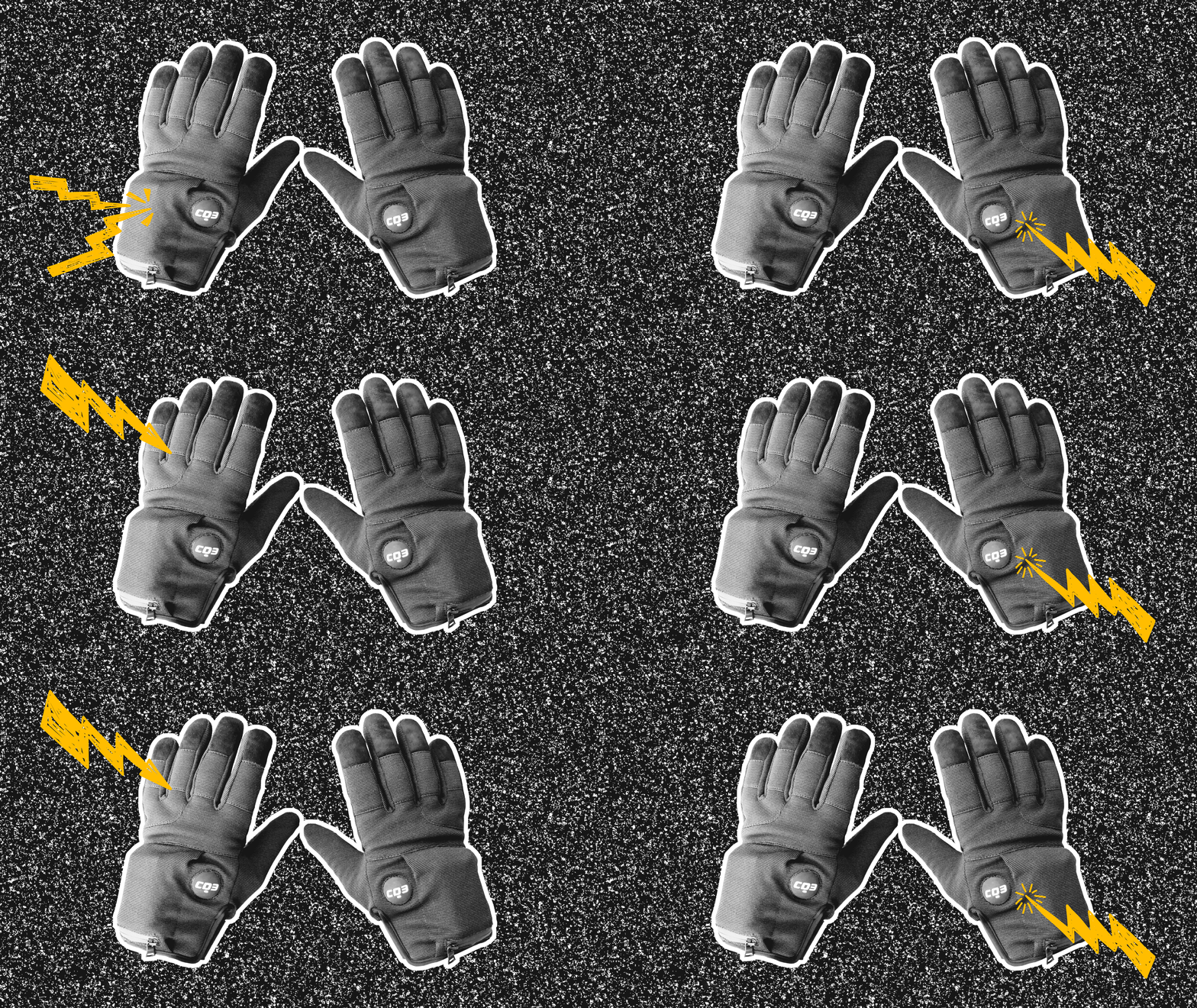
ICE’S NEW INVESTMENT—a purchase of thousands of electric-shock gloves—sounds like something out of a dystopian movie. And it turns out that the likely logic behind the purchase is disturbing.
According to an acquisition-planning form published by the Department of Homeland Security last week, ICE is purchasing what it calls “a Conductive Distraction and De-escalation Device.” In reality, they’re wearable tasers.
While immigration czar Tom Homan emphasizes that the gloves—cartoonishly called “Generated Low Output Voltage Emitters” or “G.L.O.V.E.s”—will reduce the need for ICE agents to use lethal violence, critics already suggest the move is actually more about optics and what agents can get away with.
More discreet than a taser or a gun, the gloves are ideal weapons for the age of social media video. There’s no swing, no jab—just the laying on of hands. Agents will be able to use the devices to shock whomever they deem “disorderly” with less risk of being the subject of the type of video that goes viral or results in messy lawsuits.
The weapon’s manufacturer calls it an “invisible partner.”
Monitoring Trump’s deportation agenda requires constant vigilance and deep cultural knowledge. Join Bulwark+ for both.
Compliant Technologies, the company that makes the gloves, pitches itself as an alternative to lethal violence. “By providing non-lethal alternatives, we aim to create a safer world for everyone involved,” the company’s website reads. “We believe this technology can lower liability, lessen risk, and create a more amiable atmosphere for the general population and those who protect and serve us.”
This peaceful image is undercut by the site’s visual of a powerful electric current flowing behind the gloves, looking like the aftereffect of Thor charging up in an Avengers movie.
Homan seems to agree with their de-escalatory claims. “It’s another device to help someone get compliant when they are not,” Homan told Fox & Friends last week. “You can’t just go from zero to one hundred, right, and the first thing you go for is lethal force.”
ICE’s planned purchase is between $10 million and $20 million, which, at the rate the Omaha Police Department1 was quoted by Compliant Technologies for the same model last year, could put well over 12,000 gloves in and on the hands of ICE agents.2
Jason Houser, who served as ICE chief of staff in the Biden administration and still maintains connections within DHS, told me he believes the gloves will be in use on the street before the end of the year, and agents will be using them in field training. A senior DHS official told NBC News they expect ICE to have the gloves in a little over a month.
“All this buying capability when officers aren’t trained to use these tools is very dangerous for the officers and the public,” Houser told me. “I know these tools from . . . when they were pitching them to us, and if you put your hands directly on their chest or certain body parts, in a situation where you’re putting your hands on an individual, they can be extremely dangerous.”
LET’S SORT OUT some of ICE’s claims here, starting with the idea that the gloves are de-escalatory. What does that mean in the context of how ICE operates?
Compliant Technologies promises conductive distraction and de-escalation devices “within the Force Continuum to supplement existing tools” of clients such as ICE. A force continuum is a framework that describes an “escalating series of actions an officer may take to resolve a situation.” Strictly speaking, according to ICE’s “Firearms and Use of Force” directive, issued in late May, the glove should be used at the fourth stage of their continuum, “Hard Techniques,” to prevent the confrontation from reaching the fifth, “Deadly Force.”
ICE’s use-of-force guideline states:
Authorized Officers may use force, including intermediate force, only when no reasonably effective, safe, and feasible alternative appears to exist and use only the level of force that is objectively reasonable in light of the totality of facts and circumstances confronting the Authorized Officer at the time force is applied.
And they are allowed to use weapons like these only when empty-handed techniques are not enough to “bring a disorderly or violent subject under control.”
So much for ICE’s rules as written. But the obvious question here, given ICE’s track record over the last year and a half, is: Can an agency that deploys undervetted, overly aggressive agents and lies about its involvement in the deaths of both immigrants and U.S. citizens be trusted to deploy a weapon that leaves no physical trace? After watching David Brouillette, a violent ICE agent who never should have had a gun, kill Johan Sebastián Durán Guerrero in Maine, does anyone believe the best of the best will be receiving and using these devices?
In ugly and sometimes deadly incidents, ICE agents and other DHS personnel have repeatedly failed to demonstrate the type of training and judgment that the G.L.O.V.E. user manual is clear the devices require:

The red “warning” label, the manual explains, means the instructions “May result in injury or death if not followed or observed.”
Some of these instructions, straight from the manual, include:
The G.L.O.V.E. SHALL NOT be deployed for any of the following:
Verbal defiance or belligerence
Punishment
Torture. . . .
Avoid using the G.L.O.V.E. against certain portions of the population to include:
The elderly
Small children
Pregnant women
The severely handicapped
Again, given the agency’s track record, it’s hard to believe that ICE personnel will diligently follow these warnings—that they will recognize someone too old to be shocked, or people with underlying health conditions, or in mental distress, or even in the early stages of pregnancy.
And it is all too easy to imagine ICE agents exceeding Compliant Technologies’ instructions that “no more than two . . . G.L.O.V.E. devices should be applied at one time to a single subject” and for no more than 15 seconds.
Law enforcement departments that have started using these gloves have already seen some disturbing incidents. For example, there is a lawsuit underway in Kentucky where a man died after allegedly being shocked twenty-seven times by the gloves and thirteen times by a taser by correctional staff while in a Madison County jail. An internal investigation found two of the glove shocks lasted 99 seconds and 45 seconds each, vastly exceeding the recommended 15-second limit.
The Compliant Technologies manual for the G.L.O.V.E. says users “must be trained and qualified on this tool” and describes a “certification” that’s “good for two years.” Users who don’t go through the training and re-up it every two years will be “disqualif[ied] . . . from using the device” until they do so, as far as the company is concerned. But while this sort of manufacturer’s requirement can be meaningful in liability disputes, a government agency’s own training requirements before deploying the device might be very different. Without seeing the exact language of ICE’s procurement contract, it’s impossible to know whether the agency agreed to abide by the company’s certification policy. ICE is reportedly still developing its own training protocols around the gloves.
THERE ARE STILL so many unanswered questions here: Will the gloves be used in ICE detention centers or on the streets or both? Will they be used only on targets accused of violent crime? Did Compliant Technologies lobby for the contract?3
But listen, don’t worry about any of that, suggests Homan.4
Again, when thinking about how this device will be used, we have to start with ICE’s track record. To borrow a phrase, past performance probably will be indicative of future results.
Kelly McCarthy, police chief of Mendota Heights, a small town in Minnesota, spoke to members of Congress earlier this year about federal agents’ lack of professionalism when they descended on Minneapolis.5 She told me she does not expect these gloves to de-escalate ICE confrontations.
“Any tool, it depends on who is using it, and I don’t think they have the trust of people to be asking for more money for this. Why would we trust you’re going to use this tool ethically when you don’t use others ethically?” she said.
Some ICE agents already carry tasers, which break the skin and override the nervous system with shocks of up to 50,000 volts. In February ICE outlined its request for a $220 million purchase of over 17,000 tasers (and unlimited cartridges) over five years, quadrupling its current stock of tasers. So what, actually, is the use case for these gloves?
McCarthy thinks she knows why ICE wants gloves rather than tasers.
“Tasers are much more evident in their use. If you shoot me with a taser, people will see it. There is limited use, the cartridges are expensive, they leave behind AFIDs [Anti-Felon Identification tags], which are numbers that correlate back to the taser so you can tell who used it.”
The stun gloves, however, leave behind no physical evidence. They do record data about their usage—but given ICE’s track record about, for instance, the use of bodycams, there’s little reason to expect the data about G.L.O.V.E. use to be rigorously maintained and released.
“If I knew they had these gloves, I wouldn’t even let them get close to me,” McCarthy said. “I don’t think they’re going to de-escalate. I think they’re going to escalate situations.”
The Fight for Civil Rights
Democrats, civil rights groups, and immigration advocates say they plan to fight back against ICE’s deployment of the shock gloves with lawsuits.
While electric-shock gloves might seem inherently cruel and unusual (and on those grounds perhaps a violation of the Eighth Amendment), Karen Tumlin, the founder and director of the Justice Action Center, told me that it’s more likely litigation would focus on due process rights.
“You don’t need a law degree to know why this is bad, you just need to know what ICE has been doing in the last year and a half,” she told me. “If there ever was an agency that needs less force and less ability to use force in cruel ways—instead of more tools to inflict suffering—it is ICE.”
Rep. Delia Ramirez (D-Ill.) is working with civil and human rights groups like the Center for Victims of Torture, the ACLU, and Physicians for Human Rights, to open a congressional inquiry via a letter to DHS Secretary Markwayne Mullin next week, calling the gloves “a uniquely dangerous tool for unaccountable abuse.” Ramirez, whose office previewed the letter to The Bulwark, will call on Mullin to cancel the contract and ban the use of the gloves. Outlining these policies could open DHS up to civil rights litigation, which is the goal of the groups.
“Using surveillance tech and tools of torture, DHS has already proven its capacity to perpetrate state-sanctioned abuse and arbitrary cruelty,” Ramirez told me. “All the more reason they should not possess devices with the power to inflict ‘sudden death,’” she said, citing the manual’s warning that the gloves could exacerbate the effects of underlying health conditions on their targets.
The news of the gloves led New York Gov. Kathy Hochul and New York Attorney General Letitia James last week to deem their use likely illegal and threaten future lawsuits should they be used on New Yorkers.
“That appears to me on its face to be a violation of civil rights to cause that kind of physical harm to an individual regardless of what the offense may be,” Hochul said, adding that laws the state passed this year would hold ICE agents accountable for violating constitutional rights.
James said she is reviewing ICE’s plans for the gloves and would prepare to sue.
“It appears to be arbitrary and capricious. It appears to be in violation of a number of laws including our Constitution, [and] the Administrative Procedure Act,” James said. “Of course we are outraged.”
Immigrant rights activists I spoke with said states don’t have to wait to legislate and litigate on the gloves, although they acknowledged that previous state laws relating to ICE—like the laws passed in California and a handful of other states requiring ICE agents to remove their masks—have done little to change the agency’s behavior.
A CONSTANT THEME in my conversations with ICE critics this week was the gloves’ dystopian nature.
“This kind of stuff does shock the conscience at a time when people are getting quite numb,” Chris Newman, the legal director of the National Day Laborer Organizing Network and an attorney for Kilmar Ábrego García, told me. “Forget that the new ICE hires are the January 6th protesters, they’re clearly incompetent to begin with, and a selling point of these gloves is to help incompetent agents.”
But Newman also pointed out that purchases like this can be boondoggles. For-profit companies can and have shaped federal immigration laws and policies.
“Part of what has gone off the rails in the last twenty-five years is immigration policy has been made through procurement,” he added. “I drive along the border all the time here in San Diego; these guys are bursting at the seams with new squad cars and military gear.”
Whatever the case, these gloves continue ICE’s dehumanization of migrants, critics, and brown people generally, treating potential violators of a civil offense—unlawful presence in the United States—as criminals needing heavy-handed punishment.
“This is civil immigration enforcement. The vast majority of these people have lost TPS or legal status, and now they’re going to use these capabilities that the military would normally use against national security threats on them?” Houser said.
It keeps coming back to ICE’s obsession with doing whatever they want with zero accountability.
“It’s cruelty with a purchase order,” Murad Awawdeh, executive director of the New York Immigration Coalition, told me. “Why does an agency that claims it has nothing to hide want a weapon that leaves no evidence?”
A headline on an article published while we were finalizing this newsletter: “Nebraska’s largest school district [Omaha] asks police to stop using electric shock gloves on students.”
The rates paid by the federal government might of course be very different from those paid by local law enforcement. It’s worth noting in this context that the Department of Defense in 2024—under the Biden administration—also bought G.L.O.V.E. technology, although at a much smaller scale than ICE. The Pentagon contract was for under $400,000, which would come to about 250 gloves at the rate paid by Omaha law enforcement.
Worth noting: While the founder of Compliant Technologies, Jeff Niklaus, doesn’t seem to be a major Trump donor, he does feel, um, strongly about President Trump.
The same Homan who recently conceded that David Brouillette never should have passed a background check in the first place.
Not to sound too Woke (1), but the obvious path to de-escalation is to abolish ICE.
Masked police with electrified gloves, huge chips on their shoulders, and itchy trigger fingers. Where the hell are we living? Is this what America has become?