“If Marco Rubio Is the Nominee for President, We Are in Trouble”
While Trump’s approval is floundering, a Latino vote summit in Washington laid out the stakes of engaging Latino voters who have blanched at his mass deportation program.

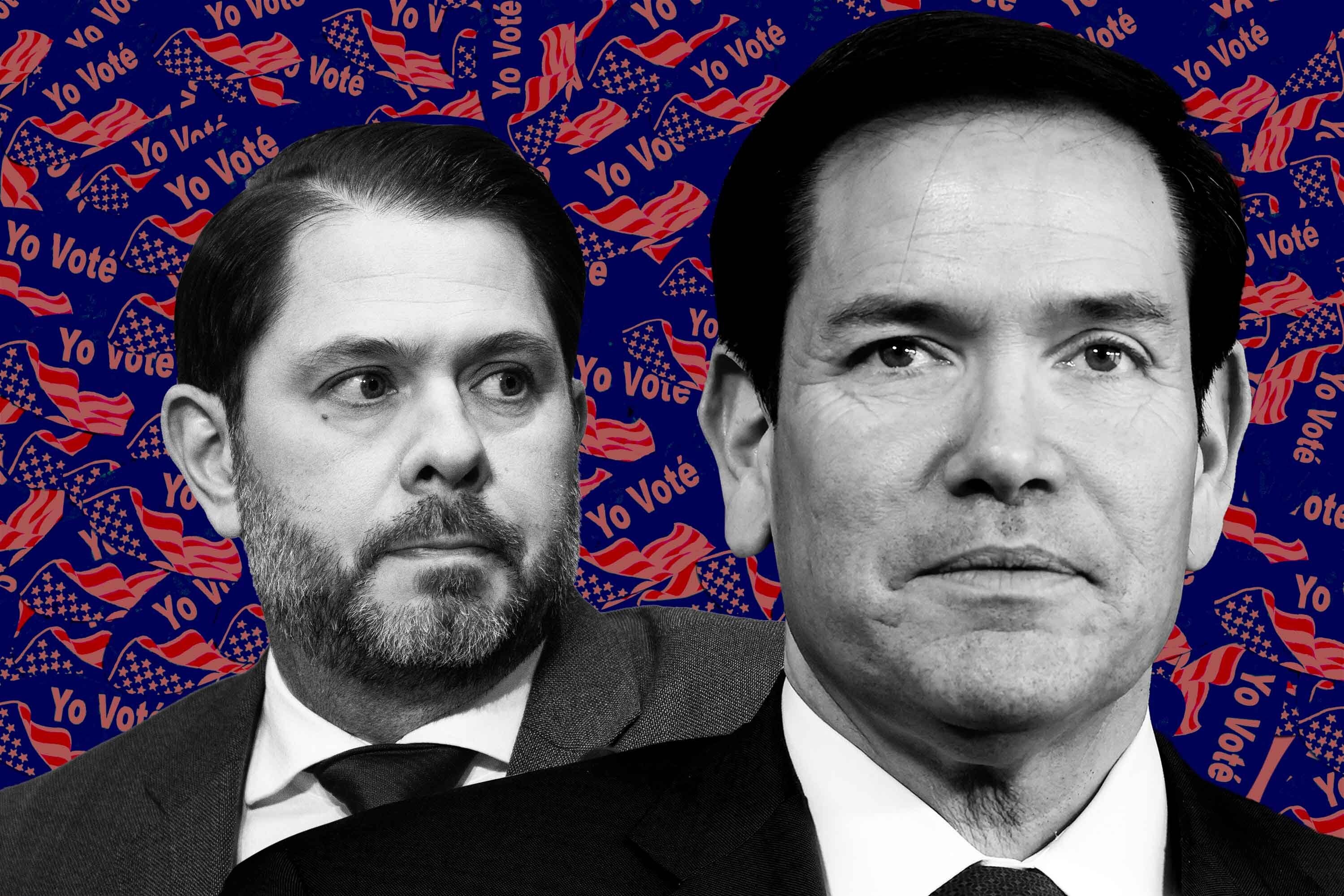
DURING A LITTLE NOTICED FIRESIDE CHAT this week in Washington, D.C., Sen. Ruben Gallego (D-Ariz.) told a gathering of fellow lawmakers, beltway types, and activists a scary campfire story.
“If Marco Rubio is the nominee for president,” Gallego warned, “we are in trouble.”
Gallego wasn’t definitively declaring that Secretary of State Rubio would win the Latino vote if he mounts a presidential bid in 2028. He was arguing something more nuanced: that the bilingual Cuban-American would blunt the growing strength Democrats have been showing in states like Arizona, Nevada, Texas, and Florida with voters who have recoiled at Trump’s policies and priorities.
Gallego was doing his best impression of Dr. Strange in Marvel’s Infinity War—looking ahead to see a dark hellscape of a future. But he also had a remedy to offer: If the Democratic party got its act together not just with Latino voters but with better messaging immigration ahead of the 2026 midterms, a presidential election letdown could be avoided in 2028. He had reason to believe that Democrats could do just that.
Polling in recent months has shown how deeply Trump has slipped with Hispanic voters. A March poll of 1,054 Latino adults by Florida International University’s Latino Public Opinion Forum showed 67 percent of those surveyed disapproved of Trump, with cost of living, immigration, and health care as respondents’ top issues. In April, the Pew Research Center showed that Trump had reached a second-term low approval rating among Latino voters who backed him in 2024, with a 27-point drop in approval since his inauguration.
These numbers formed the backdrop for the event at which Gallego spoke: the inaugural Latino Vote Summit convened on Tuesday at the National Press Club. Speaking alongside the senator were Chuck Rocha and Mike Madrid, a duo from opposite sides of the aisle who have worked on campaigns for a couple decades and also host the Latino Vote podcast.
They and others discussed how Trump’s problems with voters stemmed largely from their belief that he had misplaced priorities and that none included a laser-like focus on the state of the economy. Carlos Odio, co-founder of Equis Research, a Democratic-aligned group, said that Trump came into office with a grace period with Latinos, which ended thanks to a combination of flailing on the economy and over-aggressive immigration enforcement last summer.
“With Trump it’s never one thing. It’s the experience of it all—everything, everywhere, all at once,” Odio told me after his panel:
It’s not just immigration, or just the tariffs. It’s an overall sense of priorities in the wrong place. People getting mad about Iran is not that different than when they get mad about the ballroom. They did think there was a problem with the immigration surge and wanted him to take measures to restore enforcement, but they don’t like what they’ve seen from his administration and don’t think it should be the priority.
And here’s where Rubio enters the equation.
Trump may be a singular, disruptive presence in American politics. But someday some Republican will have to take his place. It’s not that Rubio is beloved—though Republicans like him a lot, and more than JD Vance. It’s that a bilingual, bicultural South Florida Cuban-American is by definition different from Trump. Gallego’s worry was that if Democrats stumbled on how they talk to persuadable Hispanics, Rubio could sell a story that recaptured them and their votes.
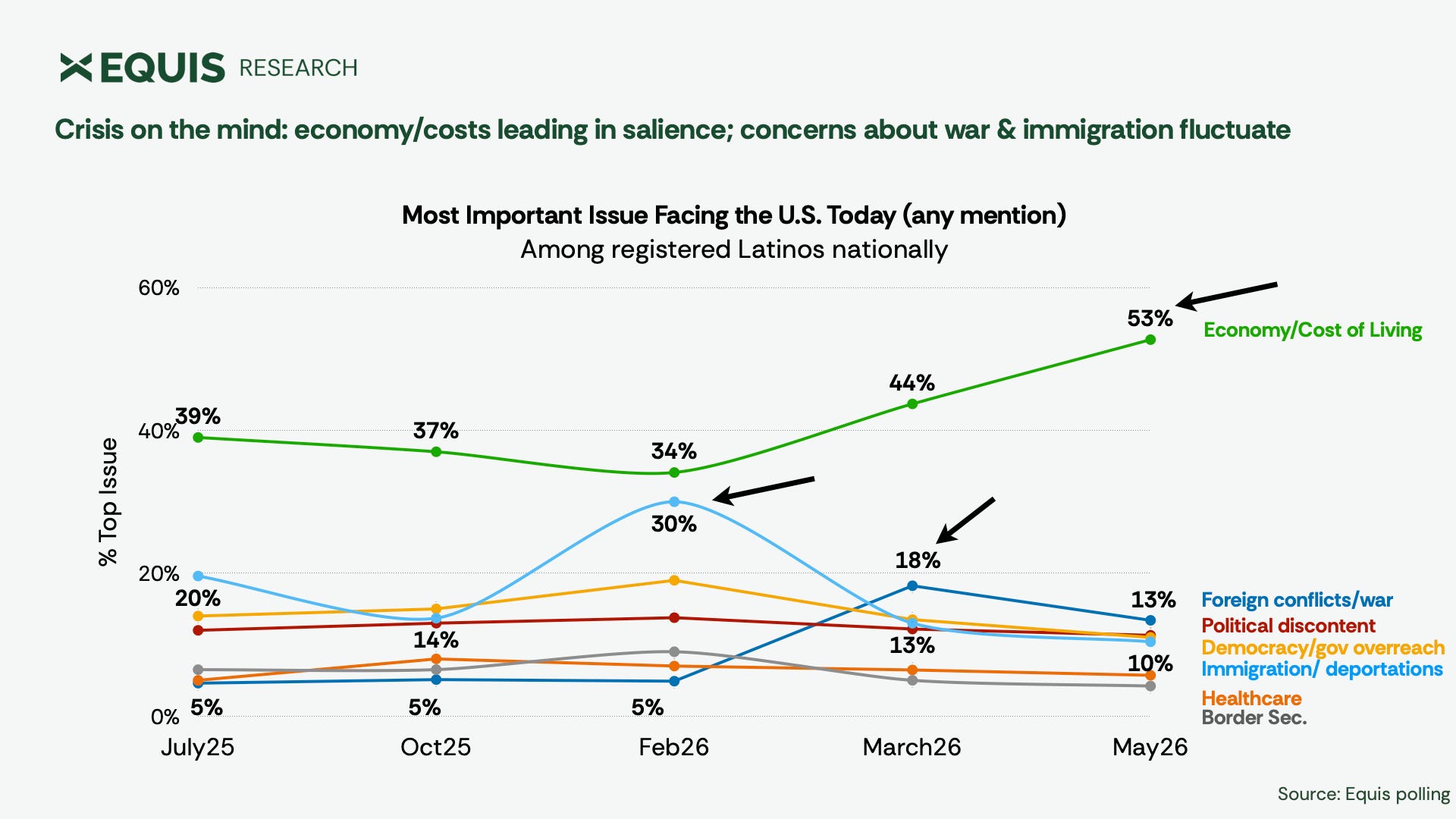
FOR ALL THE TALK OF HOW the economy and cost of living are the top issues for Americans—and they are—there was one stat from Equis’s polling over the last year that I found particularly instructive. When the Trump administration swarmed Minneapolis in the new year, leading to the killings of Renée Good and Alex Pretti, immigration spiked as a priority for Hispanics, jumping up to 30 percent. That was nearly as high as the 34 percent of those who named the economy as their top issue during that same period in February. It then plummeted down to 13 percent in March and 10 percent this May.
The volatility illustrated the dilemma the Trump administration finds itself in: Immigration becomes top-of-mind for voters when the news around it is alarming. That’s widely different from 2024, when Trump ran successfully on mass deportations and border security.
Odio said that only now, seventeen months into Trump’s second term, are Trump’s approval ratings among Latinos looking the way they did in 2018, when Hispanics helped Democrats engineer a blue wave rebuke of Trump.
Aileen Cardona, a pollster with the polling firm Hart Research, told me that while immigration is not the top issue for these voters, it can nonetheless be a dealbreaker. And while she doesn’t anticipate that one election will erase the gains Republicans made with Hispanics over the last decade, she did see the possibility of real backsliding.
“Trump said he was going to get in there, bring down prices, deport violent criminals, and make us safer,” she said. “Instead, he’s gone all-in on immigration, not just criminals, and the failed promises and priorities theme matches people’s experience. Prices have not gone down and they’ve seen people deported beyond what he said he was going to do.”
Those perceptions could change if inflation slows, or if Trump softens his policies on deportation. The former may happen, the latter seems less possible as long as Stephen Miller & Co. have the president’s ear and the Supreme Court makes it easier for the administration to get away with skirting the law to end programs like TPS. Democrats know voters can be convinced that candidates with extreme histories are palatable enough. What they fear is that someone like Rubio, with a prior history pushing for immigration reform, could tack to the center and still hold on to them.
ANTICIPATING THAT POSSIBILITY, participants at the summit said that Democratic leaders and candidates would be wise to sketch out what they actually support on immigration, and draw contrasts with the zealotry and cruelty of the modern Republican party.
Newly-elected Rep. Analilia Mejia (D-N.J.), whose district is 17 percent Latino, used her time at the summit to speak about centering humanity in her work. The congresswoman, who has visited and spoken to people at the infamous Delaney Hall and Elizabeth detention centers, said she rejects the implication that the federal government can take people, strip them of their legal status, incarcerate them with a lack of thorough medical care, and cost them their lives.
“I can see what’s happening to all immigrants,” she said. “The data bears out that what we are witnessing is an erosion of constitutional protections, which should scare every single American. . . . Protections being dismissed for immigrants, [both] legal and undocumented.”
For Gallego’s part, he was keen on explaining how he won his Senate race by heavily engaging Latino men, while often eschewing advice from the national party on how to run his race. Playing comically off Rocha, Gallego described his 2024 opponent, Kari Lake, showing up to the border with a gun strapped to her hip as if she was ready for a shootout, Sicario-style. He didn’t take the bait to match her with his own theatrics.
“They trusted us more, not the crazy, gung ho, show-up-with-guns at the border and put a hand to the border wall like it was the Wailing Wall in Israel,” Gallego said.
“It doesn’t work,” he said, before Rocha interjected, “because it’s crazy.”
Rocha, meanwhile, regaled attendees with other ways the campaign reached out to Latino men. He described setting up a Canelo Álvarez fight watch party at Gallego’s behest that made consultants worry that Gallego himself was going to spar at the event. And he laughed while recalling when the campaign threw a rodeo that Gallego attended. When Rocha said they had “secured bulls” for the event, the consultants believed they had bulls tied up somewhere in the parking lot.
Gallego stressed that commitment to authenticity was critical for his election. Trump’s overreach is toxic and not supported by Hispanics, he explained, but those voters are not as liberal as commonly believed, and they still want border security.
“The Democratic party still does not understand that there is no national Democratic party without the Latino vote being part of that coalition. And you have to answer to where the Latino voter is, not where you want the Latino voter to be,” Gallego said. “The fact is, not all Latinos are liberal.”
Gallego commended Pennsylvania Gov. Josh Shapiro, whom Gallego has advised on reaching Hispanic voters, as someone open to doing that work. Gallego said he told Shapiro that he should ask retired Puerto Rican baseball players to attend local baseball games in Reading, Pennsylvania, which is two-thirds Latino.
It’s the kind of localized and culturally attuned advice that the party may want to listen to in case Gallego’s nightmare comes to pass and Rubio runs in 2028.
Rubio is a Cuban-American conservative with some charm and youth—or what passes for youth in Washington these days (he’s 55 and will be approaching 58 on January 20, 2029). And while he has debased himself and abandoned his old positions countless times, he seems to have an appeal that other possible 2028 candidates do not.
Does Rubio’s possible rise, Gallego was asked, mean that Democrats need to nominate someone Latino, like him, for president, too? Gallego said not necessarily.
“I don’t think Democrats need a Latino candidate,” he said. “But they need to make sure there is a targeted campaign to Latinos if Marco Rubio runs. . . . We would be playing with a lot less territory, because of the voter out there excited about the first Latino candidate running for president on top of the ticket.”
I cannot for the life of me understand why elected dems in congress aren't going after Marco right now, who has basically sat out his job as SecState during Operation: Epic Stupidity. The man is responsible for promoting peace and negotiating with other countries as head of the ambassador wing of the government. That is literally his job and he was confirmed by congress to do it. Where the fuck has he been during the Iran negotiations? Why is he delegating his job to unappointed/walking-conflict-of-interest Jared Kushner? Why are dems letting him get away with this?
The GOP understood that they needed to tar and feather the next likely candidate for president when they hammered HRC to the wall for Benghazi and her emails. The dems should be giving Marco and JD Vance this exact kind of treatment. They need to tie both of them to Trump's unpopularity, especially around the Iran war and the economy where possible. They should also be calling Marco and JD Vance anti-free speech and citing Marco's revoking of status for legal residents for saying the wrong thing about Israel (Israel being another very unpopular thing at the moment). Call Marco an anti-free speech bootlicker to Israel who will punish Americans and legal residents alike for being critical of Israel or Charlie Kirk if elected to higher office.
“A March poll of 1,054 Latino adults by Florida International University’s Latino Public Opinion Forum showed 67 percent of those surveyed disapproved of Trump, with cost of living, immigration, and health care as respondents’ top issues. In April, the Pew Research Center showed that Trump had reached a second-term low approval rating among Latino voters who backed him in 2024, with a 27-point drop in approval since his inauguration.”
Wait until the mass immigration expulsion crisis occurs and then I’d say it’s game over—Rubio—I mean Little Marco won’t be able to hide! They’ll need a much bigger propaganda and efficient machine to even compete. And that’s only if we still have elections in 28’—don’t be so sure, I’m definitely not! IMHO…:)