If the Shoe Fits: Trump and the Florsheim You Can’t Refuse
The strangely Soviet odor of the week’s weirdest story.

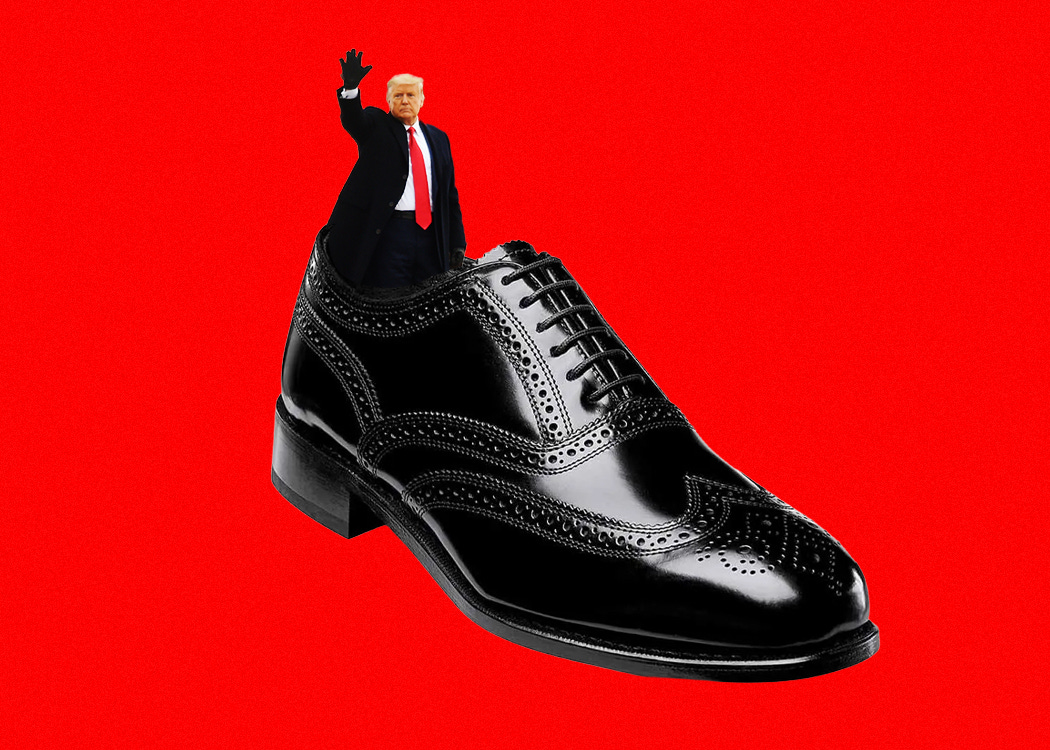
AT FIRST GLANCE, the latest Trumpian weirdness seems almost endearingly harmless: The Wall Street Journal reports that late last year, Trump developed a passion for black Florsheim Oxford shoes and started giving them as gifts. “All the boys have them,” according to a female White House official. Among “the boys” are Vice President JD Vance, Secretary of State Marco Rubio, Secretary of Defense Pete Hegseth, and several other cabinet members, as well as Fox News host Sean Hannity and Sen. Lindsey Graham. Tucker Carlson, too, apparently got a pair at a January lunch meeting (brown in his case, perhaps to match his favorite shirt color).
As amusing as the anecdote might seem, if you read the Journal story closely, it starts to look more like a case of “beware of Trump bearing gifts.” For one, the gift shoes are not universally welcome—but recipients are reportedly “afraid not to wear them,” especially since Trump badgers them with “Did you get the shoes?” nudges at cabinet meetings. Some of the disgruntled recipients have issues with the downscale, non-designer brand. But also, it looks like many of the shoes just don’t fit:

The origin story of the shoe-gifting ritual, supplied by Vance, also has a fittingly creepy vibe. It all began, apparently, with Trump staring at people’s feet at a December Oval Office meeting and abruptly telling his heirs apparent, “Marco, JD, you guys have shitty shoes,” then asking for shoe sizes. Vance said he wears a size 13. Rubio said he is an 11.5. And a third, unnamed individual present said 7. Then, Trump reportedly remarked that “You can tell a lot about a man by his shoe size.” Wait: Was that a jab at “Little Marco,” who made a similar joke about Trump and the size of his, erm, hands during the 2016 presidential campaign? And why are Rubio’s shoes seemingly oversized? Did he, as some suggested, deliberately overstate his shoe size in that Oval Office huddle?

Or maybe, as Foreign Policy deputy editor James Palmer posited on Bluesky, the presidential shoe-giving is both a humiliation ritual and a test of submission—at least in Marco’s case.

Another poster in the same thread then had the perfect reply:

The stories of Joseph Stalin deliberately humiliating his future nemesis Nikita Khrushchev—among other things, by forcing the flat-footed Khrushchev to dance clumsily at his revels with members of his inner circle—may be apocryphal: Khrushchev’s son Sergei denies this claim in his biography of his father, explaining that everyone was expected to dance after these late-night dinners and Khrushchev simply happened to be a clumsier dancer than most. Nonetheless, the junior Khrushchev writes that his father dreaded these dinners, to which he was regularly summoned with a phone call: The revelry usually lasted into the early morning hours, and dozing off at Stalin’s table “could end badly.” Unless, that is, one passed out from drinking, as people often did since Stalin also expected his guests to eat and drink their fill. Ritual humiliations were also part of the fun: The senior Khrushchev recalled, according to his son, that the boss would sometimes throw tomatoes at his guests or taunt them with embarrassing anecdotes from their past.
Come to think of it, a scene of Stalin doing what Trump did—foisting oversized gift shoes on his terrified henchmen and snickering quietly while watching them shuffle around—would not have been out of place in The Death of Stalin, Armando Iannucci’s brilliant and very dark 2017 satire.
MAYBE SHOES IN POLITICAL HISTORY are an underappreciated subject. Khrushchev’s dramatic performance at the United Nations on October 12, 1960 is obviously the most (in)famous political shoe moment—and, apparently, a more complicated one than commonly believed. It’s quite possible that the Soviet premier never actually banged his legendary shoe on the podium but only shook a finger or fist. But earlier at the same session, he had reportedly lost the shoe on the floor of the U.N. General Assembly chamber after a journalist stepped on his heel. (Call it the Khrushchev Cinderella story.) After it was retrieved, he left it lying on his desk—and then either banged or brandished it while demanding to be given the floor. He probably put it back on before going up to the podium, where some eyewitnesses are certain he was fully wearing both shoes. This gave rise to speculation that there was a third shoe, brought as a prop in a calculated stunt. But it seems far more likely that the shoe-banging actually happened at the desk—and was conflated with Khrushchev’s angry hand gestures at the podium.
An especially memorable shoe-related incident in American politics occurred in December 2008, when President George W. Bush spoke at a news conference on a visit to Baghdad and was interrupted by a shoe—and then another—flying at his head. Bush deftly dodged the projectiles and showed commendable sangfroid, even suggesting afterward that he regarded the incident as healthy self-expression. Even so, for many people, the incident came to embody the American fiasco in Iraq—in particular, the failure to win hearts and minds: “This is a farewell kiss from the Iraqi people, dog!”1 shouted the thrower, a 28-year-old journalist. (Plenty of Iraqis saw him as a hero, and he served only nine months of a three-year sentence.)
For a very different kind of footwear symbolism, one may look to a well-known 1971 photo of Richard Nixon strolling on the beach. The point was to show him as a man of the people in the runup to the 1972 election and to counter his reputation for stiffness and awkwardness. The effect was the opposite: Who walks on the beach in a suit and black wingtips?
Nearly two centuries earlier, Thomas Jefferson’s appearance in laced-up—rather than buckled—shoes at his 1801 inauguration had a deliberate symbolic meaning: an affirmation of democratic politics and allegiance to commoners rather than aristocracy. (Twenty-three years later, Daniel Webster would describe him as wearing “shoes of the kind that bear his name”: ankle-high laced shoes that, for a long time, were known as “Jefferson boots” or simply “Jeffersons.”)2
Outside the U.S. context, the biggest footwear-centric political story of the last century was that of Imelda Marcos, wife of Philippines president-turned-dictator Ferdinand Marcos and powerful political player in her own right. In 1986, Marcos was ousted by mass protests after trying to overturn his election defeat by falsely claiming victory. (Ahem.) The Marcoses, who actually held an inauguration ceremony at the presidential palace a few hours before hightailing it to Hawaii, were later honored by the Guinness Book of World Records for the “Greatest Robbery of a Government.” Their staggering corruption came to be exemplified by the First Lady’s hastily abandoned hoard of clothes and accessories—including 1,060 pairs of shoes. Some 700 pairs went on display at a shoe museum in 2001.
Believe it or not, there’s a link of sorts between the 1986 Imelda Marcos shoe bust and the 1961 Khrushchev shoe tantrum. Khrushchev was angered by Filipino delegate Lorenzo Sumulong, who had just countered Soviet fulminations against American imperialism by pointing to Soviet imperialism in Eastern Europe. The Marcoses were ousted by Sumulong’s niece—born Maria-Corazon Sumulong, known as Corazon Aquino, the Philippines’ first female president. Call it two degrees of shoe-paration.3
Back to Trump, and today: What are we to make of a corrupt wannabe autocrat foisting shoes on his underlings in a petty display of dominance disguised as generosity? We can only hope that the American political system will ultimately be able to beat back his authoritarian aspirations. That day may draw closer when he no longer can be said to possess the Republican party, body and sole.
Shoe-throwing is a traditional expression of extreme contempt in Arab culture; even flashing the sole of one’s shoe at a person is considered insulting, a visual “you’re dirt under my feet” statement.
The laces vs. buckles controversy was not limited to the United States: In the spring of 1792, when the reformed constitutional monarchy in revolutionary France was limping toward its demise, a liberal cabinet minister’s appearance at the Tuileries palace in shoes with no buckles scandalized courtiers.
Unfortunately, this story has a not-so-happy ending. In Russia, the Kremlin has returned to a far more cynical version of shoe-banging Khrushchevian anti-Western belligerence, minus Khrushchev’s anti-Stalinist reformism. In the Philippines, the Marcos dynasty is back in power. Imelda herself, now 96, is barred from public office after being finally convicted of corruption in 2018 (with her 42-year prison sentence effectively suspended because of age, health, and ongoing appeals). But her daughter Maria-Imelda “Imee” Marcos—a senator who dismisses the human rights abuses under the Marcos regime as “just accusations” and who almost certainly reaped major rewards from that regime’s corruption—is there to, as it were, fill her mother’s shoes. And the shoe queen herself is a de facto dowager queen as the mother of current Filipino president Bongbong Marcos.