

‘In the Grey’ Review
Moral ambiguity only extends so far when it comes to repaying debts.


The hardest-working Guy in showbiz is back.
Since 2019, Guy Ritchie has directed eight feature films and created a pair of TV shows for two separate streaming services. Even more remarkable is the varied nature of the work: big-budget family-minded fantasy fare (Aladdin and Fountain of Youth), Brit crime callbacks to his earlier work (The Gentlemen, both the movie and TV spinoff), hard-bitten crime dramas with a nasty edge (Wrath of Man), period piece war films (The Ministry of Ungentlemanly Warfare and The Covenant), and something like corporate espionage spy thriller comedies (Operation Fortune: Ruse de Guerre).
In the Grey belongs mostly to this last category—it is about a lawyer/fixer named Rachel (Eiza González), whose two guys Friday, Bronco (Jake Gyllenhaal) and Sid (Henry Cavill), help enact her various schemes to collect enormous debts from the fabulously wealthy—though it combines some elements of nearly all these pictures. It has a heavy, string-based score like the one Christopher Benstead introduced into Ritchie’s work to great effect in Wrath of Man; pulse-pounding small-arms action and chase sequences à la The Covenant; and regular onscreen collaborators like González, Gyllenhaal, and Cavill.
It also feels like more of a sketch, a doodle, than a proper, fully fleshed-out feature film. Rife with voiceovers that hop us from plot beat to plot beat as Rachel explains how she will recover a billion dollars owed to private equity powerhouse Bobby (Rosamund Pike) by international criminal Salazar (Carlos Bardem). It’s all quite convoluted and the legality of everything under discussion is so opaque that you just kind of accept that Rachel is able to command the courts over the course of a few days to seize all of Salazar’s assets. Indeed, Ritchie’s stylish enough and the cutting by Martin Walsh is electric enough that you almost don’t realize that Rachel is quite literally narrating everything we’re seeing happen in order to help us make sense of the plot, but that is very much what’s happening.
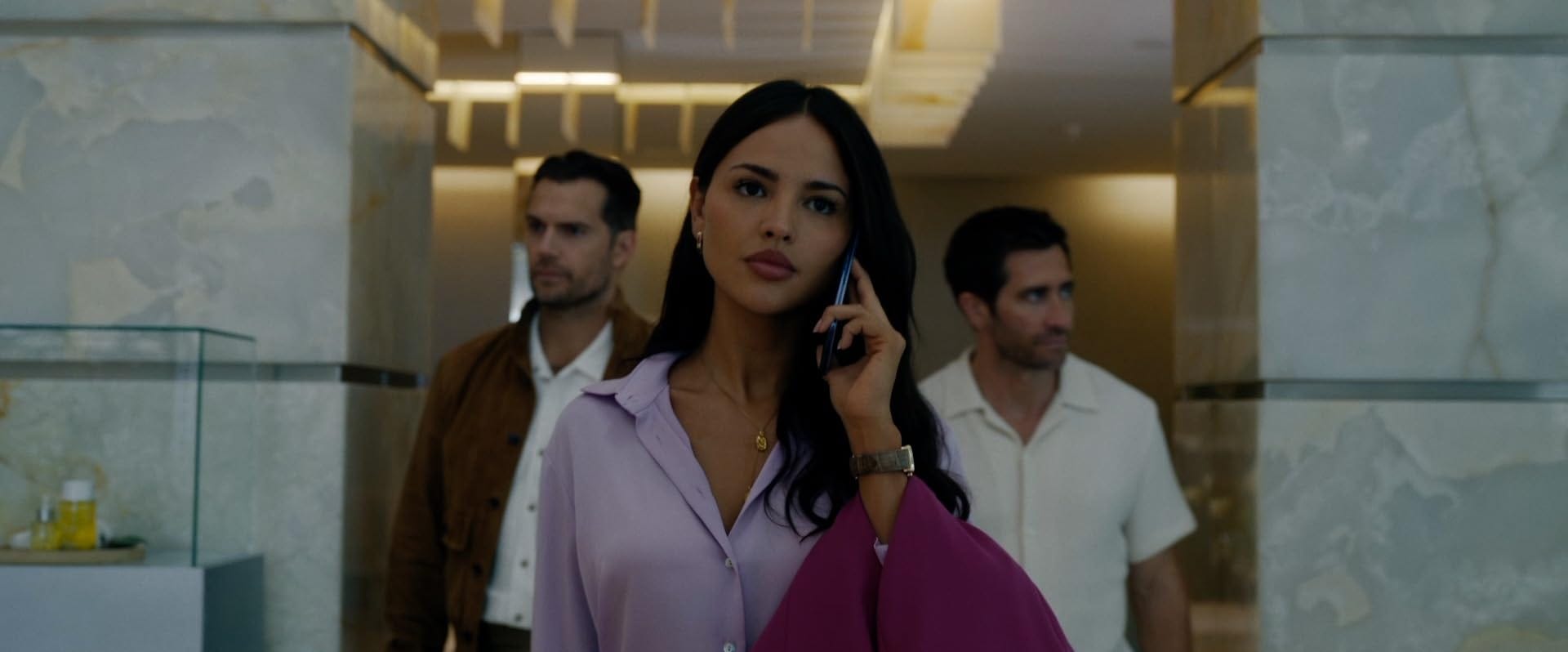
Ritchie has always been a somewhat vibes-based director, and I mean that complimentarily: Even if you don’t care about diamond heists and bare-knuckle boxers or American pot dealers cornering the market in British weed, his films are a pleasure to look at and luxuriate in because the characters all look so damn cool. In the Grey is no exception. This is a movie of very carefully popped collars and rolled sleeves, of impeccable layering for combat in any clime. It’s a movie in which we are, for no reason other than the fact that it looks cool and screams class, shown step by step how to make a Stovetop Negroni (Negroni Svegliato).
Your patience with this sort of thing will vary. Mine wasn’t terribly taxed, but then In the Grey clocks in at just under 100 minutes, including credits, so it doesn’t outstay its welcome. And I do just find González, Cavill, and Gyllenhaal delightfully charming; I’m glad she, in particular, has entered into Ritchie’s pantheon of regulars.
That said: This is a very strangely structured movie. It almost feels as though it’s been truncated, abbreviated. The constant voiceovers, the plot threads that are introduced but never really tugged on, the backstories that are so aggressively unexplored it almost seems like Ritchie is daring you to ask for more information. What’s the deal with Rachel and Bobby and their simmering animosity? What, precisely, does Bobby’s trillion-dollar investment firm do? What illegal business is actually being run by Salazar? We only ever see his above-board properties. One senses that a third of this movie has just been stripped clean in an effort to efficiently move us into position for the big third-act action sequence.
As such, I have a hard time offering a full-throated recommendation, as I did for recent Ritchie efforts like The Covenant, The Gentlemen, and Wrath of Man. This is a decidedly more niche product. But it’s a niche I happen to enjoy.