

An Inventory of Trump’s Second-Term Wreckage
‘Betrayed,’ a new summary of the appalling damage so far, is a midterms turnout tool—and hopefully a roadmap for repair.

SAY YOU WANTED TO CREATE a record of all the damage Donald Trump inflicted on America in the first year of his return to the Oval Office. And then, as abominations large and small continued to spew from the firehose, you kept going. Thirteen months, fourteen months, fifteen, sixteen.
That’s what happened to a bipartisan group of former government officials, former military officers, experts, academics, and scholars determined to document the “American carnage” they say has evolved from a Trump warning in 2017 to “a threat fulfilled” in his second term.
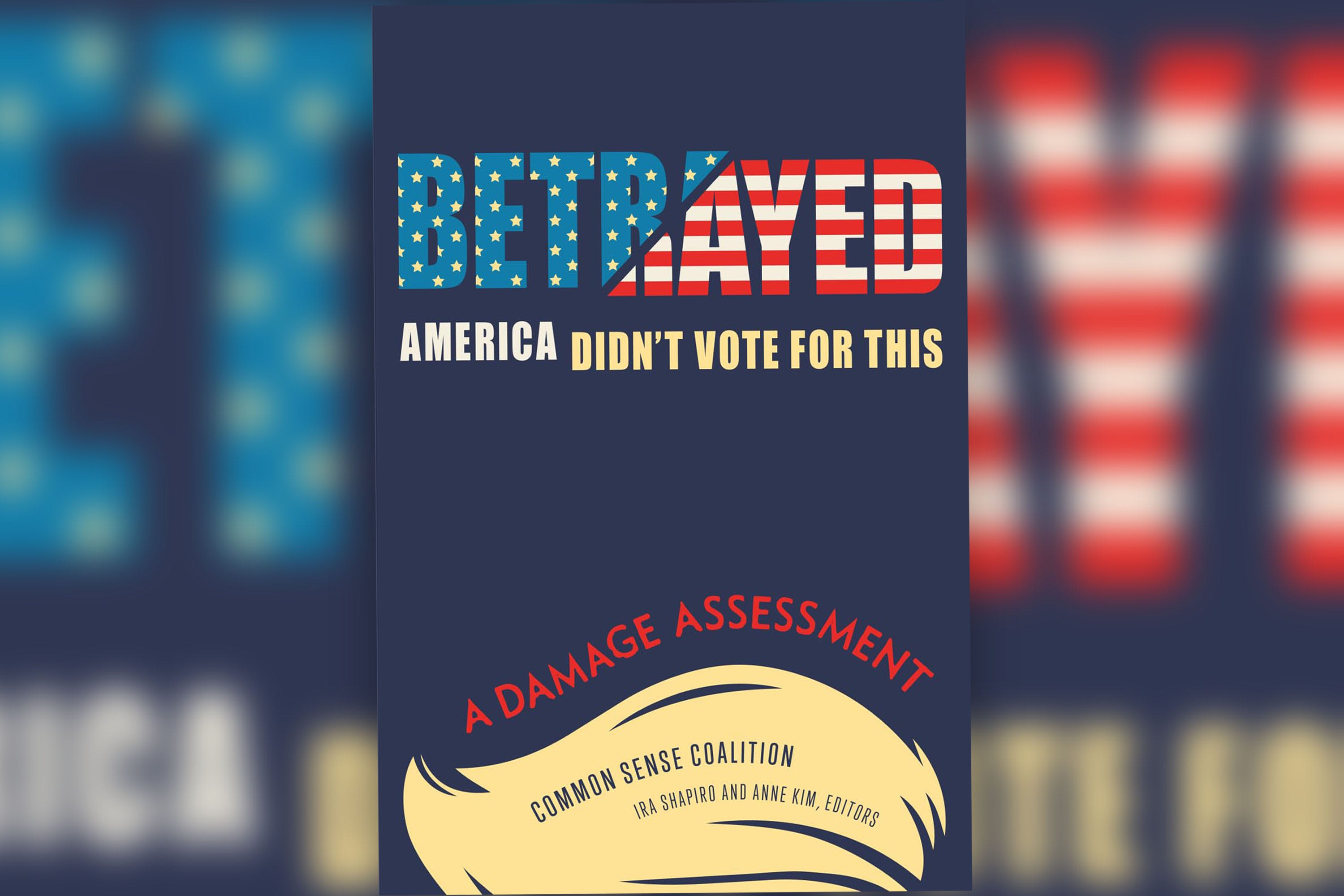
The authors—co-editors Ira Shapiro and Anne Kim and their many contributors—call themselves the Common Sense Coalition, an homage to Thomas Paine. Their new book, Betrayed: America Didn’t Vote For This, covers the first third of Trump, the sequel. Four months more than their initial plan because, the authors write, “the damage continued to metastasize.”
Shapiro, a lawyer, former U.S. trade negotiator, longtime senior Senate aide, and the author of three books on the Senate, says even the extended deadline was tough to accept. ICE was terrorizing Minneapolis. Trump had started a no-win war of choice on Iran. The Trump-instigated redistricting wars kept taking new turns, and the near-daily bonfire of corruption and incompetence was, if anything, accelerating.
“We were going to try to finish in March. It took longer. Too many things happened,” Shapiro said when we spoke last week. “But you have to stop somewhere.”
In contrast to the brain-breaking overloads of Trump 2.0, currently tracked in a McSweeney’s list of 930 items to date, Betrayed is relatively short and disciplined. Its 176 pages and dozen chapters, from first (“A Relentless Assault on the Rule of Law”) to last (“A Collapse in Civil Discourse”), clock in at or slightly over 3,000 words apiece. That’s up from the planned 2,500, but still mercifully brief given the scale and scope of the ruins.
The table of contents alone is enough to trigger despair, but it’s also a reassurance and a promise: We can’t forget, we won’t forget, and this catalogue of betrayals lays groundwork for the reckoning to come. And it doesn’t rely on all-caps rants to do it.
Betrayed is factual and as measured as the authors could manage, to the point that even a slightly sardonic line like “Make Americans Greatly in Debt Again” (a description of Trump health care “plans”) stands out. The book’s myriad details and authoritative contributors will make it a valuable resource for future students and historians. In the near term, it’s a tool to educate the public, a road map to accountability and repair work, and maybe even a way to shorten the Trump era.
Shapiro came up with the idea last year and started lining up contributors, including co-editor Kim—a journalist, lawyer, social policy expert, think tank veteran, and author of two books. He says the group has aimed for “a comprehensive compendium” that paints a credible picture “of just how wide and deep the damage has been.” The goal, he says, is to raise public awareness of the magnitude of the harm, the fact that it’s continuing, and the importance of stopping it—“and then you hope to find ways to stop it.”
Did Americans really vote for this?
Almost all of Trump’s second-term moves are detrimental to the nation’s jobs, costs, health, values, and future. One mark of Betrayed’s restraint is what I’d consider its admirably sparing use of the word “sabotage.” As in, a few times but not on every page.
The affordability chapter starts by correctly stating that Trump policies across the board have “sabotaged the American economy.” The climate chapter aptly labels Trump’s approach “institutional sabotage” that’s “designed to destroy federal climate capacity and move decisively to lock in more fossil fuel pollution”—reversing “the most significant clean energy and industrial momentum the U.S. has ever built,” just when economic opportunities in the sector are “exploding.”
In another self-own, Trump has managed to, as Betrayed puts it, “sabotage America’s future competitiveness and technological leadership,” as well as jeopardize medical progress and weaken local economies, by disrupting “the unique and successful partnership between universities and the federal government that has produced decades of cutting-edge innovations and research.” A section on research is headlined: “Sabotaging the Search for Future Cures.”
The subtitle of this book is “America didn’t vote for this.” You can certainly argue that most Trump voters didn’t think they were voting for this, since their candidate constantly promised to lower prices “immediately” on Day One, stop the Russia-Ukraine war also on Day One, and generally start no more wars—especially the forever kind in the Middle East.
Shapiro throws out a few more unanticipated consequences of electing Trump: detention centers and masked ICE agents, razing the East Wing and closing the Kennedy Center, making Canada “a former friend,” and cutting off the war on cancer. “It’s the difference between reform and destruction,” he says.
In a section called “Destroying Trust,” the authors lament that “Donald Trump’s loose relationship with the truth has also made honest debate impossible.” At the most basic level, Trump made pie-in-the-sky campaign promises he couldn’t or didn’t want to keep, told lies that were easily provable as lies, and fudged on critical issues—from health care and abortion to religion, science, immigration, and foreign policy. Too many voters were inclined to trust him.
But now the gulf between what Trump said and what he’s done is obvious, on the news, at the grocery store and at the gas pump. As his impact on daily life is increasingly felt and measurable, polls suggest people may be ready for a reality-based assessment of what has happened to America since January 20, 2025, from a lineup with credentials that would inspire confidence in any normal time—and maybe even in our time.
Embracing expertise
Some of Betrayed’s contributors are well known. Attorney and mediation specialist Kenneth Feinberg oversaw compensation funds for victims of 9/11, the Deepwater Horizon disaster, and the Boston Marathon bombing; worked out product liability settlements for people damaged by asbestos, Agent Orange, and the Dalkon Shield; and as compensation czar after the 2008–09 financial collapse, sharply cut pay and benefits for 175 executives at companies that got taxpayer bailouts.
J. Brian Atwood, a former undersecretary of state, led the U.S. Agency for International Development for over six years in the 1990s—long before Trump “shredded every element of our soft power” in his first year back, as Betrayed puts it, and allowed Elon Musk and his rogue DOGE pseudo-agency to dissolve USAID in his first two weeks.
The national security roster also includes former ambassadors to Japan, Germany, and Ecuador; a retired admiral; a retired CIA senior analyst; a former deputy secretary of the Army; and the former CEO of Global Communities, an international relief organization.
Paula Stern, a former chair of the U.S. International Trade Commission, is among the many other contributors, along with a former chief of staff to Sen. Bob Dole; a former CEO of the American Association for the Advancement of Science; a former president of Ohio State University and the University of Maryland–College Park; and a former Capitol Hill aide who now tracks corporate spending on politics as president of the Center for Political Accountability.
There are more than six hundred endnotes in Betrayed—dozens for each chapter, topped by seventy-two for Chapter 3, “An Unaffordable Economy,” and seventy-nine for Chapter 11, “Rampant Corruption and Self-Dealing.” These are the conjoined topline liabilities for Trump and Republicans on the campaign trail this year, as Georgia Sen. Jon Ossoff and other Democrats build the case to voters that Trump is looking out for himself and “the Epstein class” instead of for them.
Shapiro tells the short version of the Trump story this way: “He has a remarkable political comeback like nothing that’s ever been seen. He gets this extraordinary opportunity to be president for a second time. And what he gives us in return, us being the American people, is a lawless presidency driven by grievance, self-glorification, and greed.”
In short, pretty much what many of us expected, and what many others are now learning the hard way. This new book is not just a corrective for them, it’s a kick in the pants to everyone—an explicit reminder of the stakes in a midterm election as important as any in U.S. history, and an urgent call to vote.
 | A guest post by
|
The flaw here is assuming that Trump's voters didn't know what they were voting for. Despite the stereotype description, most people aren't too stupid to live. I know a lot of MAGAs. Most of them aren't dumb, and the ones that are exist in numbers too small to take over an entire party, or win a national election. I posit that the vast majority of MAGA voters know in their hearts (and minds) that Trump is incompetent at governing, that his impulses are unpredictable and destructive, that he surrounds himself with incompetents and grifters, and that they really can't believe anything he says as factual or true. You can see it in their responses when you back them into a corner with logic arguments. They resort to emotional appeals and vicious personal attacks (and I come at them from the Right, as a believer in much of the same conservative ideology that Trump pretends to believe in).
So, why do they support, vote for, and defend him. In the end it's simple. He pisses off all the people they hate. Period. It's not even that he actually "hates" the same people they hate. He doesn't. He employs illegals in his hotels and at his golf courses. He hobnobs with the "elite" billionaires who are fleecing the rubes blind. He doesn't hate "Criminals". He loves them. He IS one. He doesn't hate the morally bankrupt. Epstein was his friend, and nobody is more morally bankrupt than Trump himself.
But, he gives them permission to be the worst version of themselves. He gives them permission to hate out loud, and to focus their rage and insecurities on targets about whom he neither really cares, nor values. His victories, his presidencies, enrage the people who "think they're better than us". His attacks on brown people, who they have always hated, validate their world view and satisfy their bloodlust. His degradation of women satisfies the deep resentment that a lot of men feel because some woman rejected them and "did them wrong", and then got away with it.
And this alone is enough for them to disbelieve their own eyes and ignore all the carnage they can see as plainly as we can. They vote for him not because they were "voting for this", but in spite of it, because they are just awful, mean, resentful, jealous people. At least they have finally been exposed.
I am curious to read this - BC I do believe his voters voted for this. I personally do not give any credence to the He said he would, I thought he would blah blah blah - Trump was a known liar and destroyed any business he started on his own. He is doing and behaving and a very predicatable manner. Anyone who says they didnt know are no better than full grown adults who do not understand fire is hot.