Worst. Senate. Ever.
Republican senators surrendered to Trump, and now they own this catastrophe.

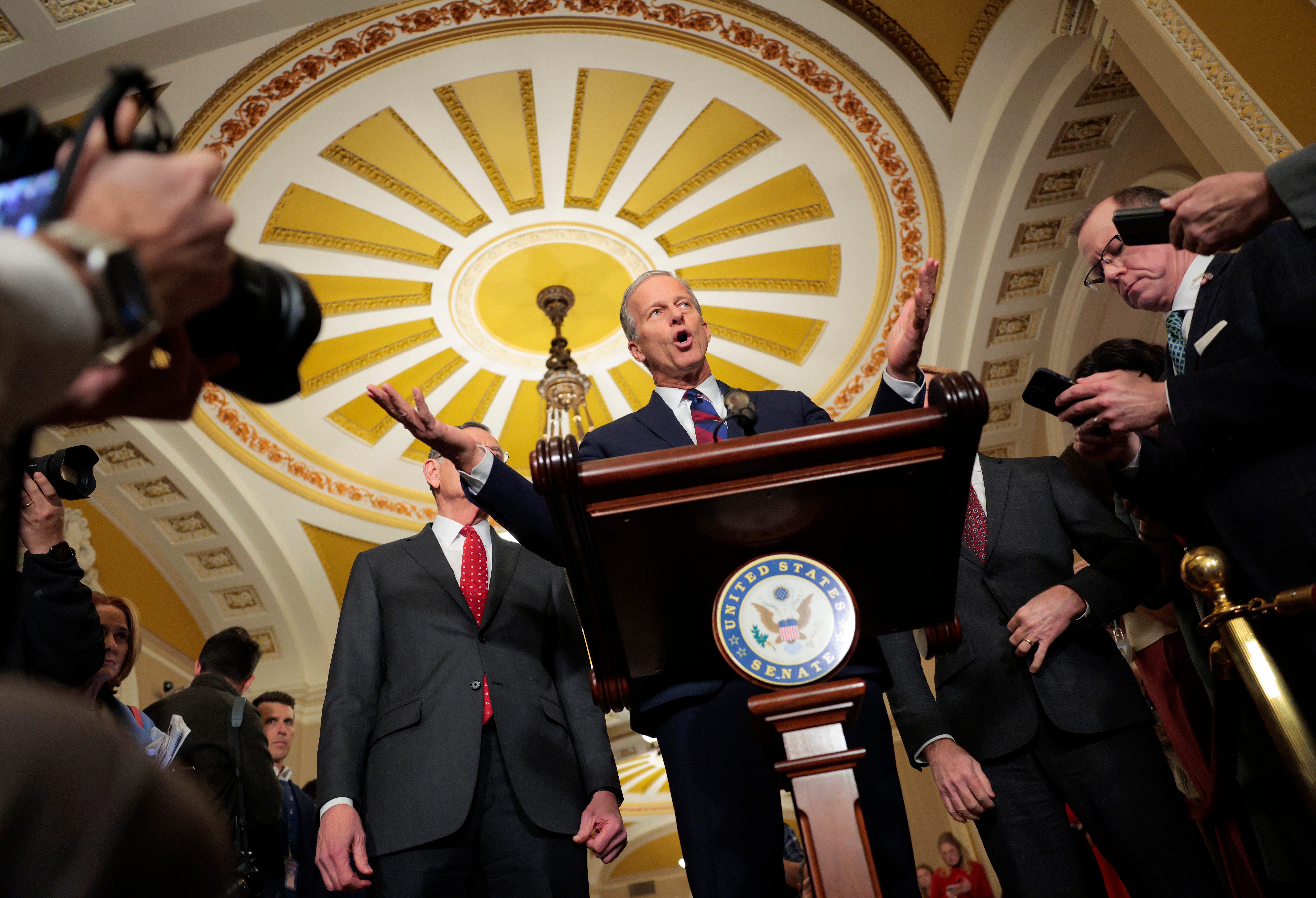
THE EMAILS COME POURING IN at all hours, day in, day out, and the headlines are fill-in-the-blank riddles that could refer to anyone or anything. It’s a multiple-choice horror show.
“The Malignant Incompetence of …” shows up, incomplete, on the phone screen, and I wonder who: Pete Hegseth? Pam Bondi? Kristi Noem? Tulsi Gabbard? “Health” secretary Bobby Kennedy Jr.? This time, it’s Kash Patel.
Then there’s “Profile in Awfulness”—another case of too many contenders to count, but the winner that day is Sen. Tom Cotton.
“GOP’s Health Care Mess” goes by and I automatically think, what has Kennedy done now that’s going to kill people? But this is not about the uproar over life-saving hepatitis B shots for newborns. It’s about the millions of Americans on track to lose health coverage because President Donald Trump and Republicans canceled the premium subsidies that have made it affordable.
And let’s not forget Trump’s illegal tariffs, illegal use of taxpayer money, and illegal boat strikes and murders—all responsibilities Article I of the Constitution assigns to Congress.
The common thread in all of this is the Republican Senate. The Senate that played dead while Trump stole its powers to tax, spend, raise armies, and declare war. That has left millions in the lurch by zeroing out health insurance help, most recently on Thursday, instead of finding a way to save it. That confirmed a succession of Trump nominees despite their documented incompetence, misogyny, racism, sadism, conspiracism, and blind loyalty.
The only debate about our current Senate and its leader, South Dakota’s John Thune, is whether it is the most catastrophic Senate ever, or simply a continuation of the first Trump-era Senate of 2017 to 2021. “Catastrophic failure” is how Senate expert Ira Shapiro—an international trade lawyer, former Capitol Hill staffer, and former U.S. trade negotiator—described that Senate in his 2022 book, The Betrayal: How Mitch McConnell and the Senate Republicans Abandoned America.
“What the Senate did or didn’t do constituted an enormous betrayal of their responsibilities that we’re still living with today,” Shapiro told me this week. “That was the Senate that essentially gave us the extreme Supreme Court. . . . And when McConnell had the chance to make sure Trump would never be in office again, he failed.”1
What’s unfolded over the past year is hardly any better. “The notion that the Senate could stand by and watch the Article I powers of Congress be usurped and not do anything is quite awful,” Shapiro said. “And no Senate that I can think of would have ever confirmed the nominees who are so extreme and unqualified for positions in law enforcement, national security, and public health.”
In a previous book, The Last Great Senate: Courage and Statesmanship in Times of Crisis (2012), Shapiro recounted an “era of greatness” in the Senate, from 1963 to 1980, that peaked in its final four years. “Working with presidents when possible, holding them accountable when necessary, the Great Senate provided ballast, gravitas, and bipartisan leadership for America during the crisis years of the 1960s and 1970s,” he wrote.
Among its achievements: Passing laws to overcome racism, questioning the premises of the Vietnam War and ultimately cutting off its funding, explaining Watergate in televised hearings, holding Richard Nixon to account, investigating abuses by U.S. intelligence agencies, spearheading new environmental and consumer protections, strengthening the safety net, and expanding rights for minorities and women.
All this in a country deeply divided by Vietnam and at a hinge point in race relations. A country where, in September 1963, a dynamite bomb killed four black girls and injured twenty others at a Birmingham, Alabama, church. A country that experienced three traumatic assassinations—John F. Kennedy, Martin Luther King Jr., and Bobby Kennedy—in a five-year period.
What’s different now? Why has today’s Senate, individually and collectively, surrendered its free will, backbone, and constitutional duties? The key is Trump. “It is a catastrophic Senate,” Shapiro says. “And it doesn’t fundamentally change as long as Trump is on the scene” with his continuing hold on the Republican party.
When I pressed him on whether the current Senate is worse than the first Trump-era Senate, Shapiro said he sees today’s Senate as a continuation, and his verdict hasn’t changed since 2022: “I said they betrayed the country, and they’re still betraying the country.”
Shapiro did mention two rays of hope: McConnell’s steadfast support for Ukraine, and Senate pushback this year against funding cuts at the National Institutes of Health. But cowardice is much more common, along with futile protests after Trump appointees have broken their commitments to credulous senators.
SENATORS ARE SCARED, and that is understandable. Using Capitol Police data, Mother Jones reported in March that “threats of violence against members of Congress rose in January and February, at the same time that Trump and his allies were strong-arming lawmakers over confirmations.”
And Trump has not limited his targets to officeholders in Washington. He has been hyperfocused for weeks on Indiana, pushing Republican state legislators to redraw the state’s congressional districts—currently a 7–2 delegation favoring the GOP—to produce a 9–0 Republican shutout. The pressure from Trump and his allies even included a Heritage Action warning that Trump would cut off all federal funds if the Hoosier State Republicans dared to resist his demands. He repeatedly named specific Republicans and threatened dissenters with primaries.
No surprise then, given the cues Trump sent his loyalists, that there have been at least a dozen bomb threats and swatting attempts against GOP state legislators, including a pipe bomb threat the night before the vote. “I fear for Indiana and all states if we allow intimidation and threats to become the norm,” GOP state Sen. Greg Walker said after voting against the remap in committee.
The final vote came Thursday, and it wasn’t even close. Only nineteen Republicans caved to Trump, while twenty-one of them plus all ten Democrats held firm. Let this be a reminder of what it looks like, and feels like, when senators stick to their principles—in Indianapolis, if not in Washington, D.C.
The Senate acquitted Trump in two impeachment trials—the second one for his “incitement of insurrection” at the Capitol on January 6th, 2021. Led by McConnell, most Republicans chickened out, allowing Trump to remain in public life.
 | A guest post by
|