Is This a Trump Turnaround on Ukraine?
Or is Donald throwing Vladimir another lifeline?

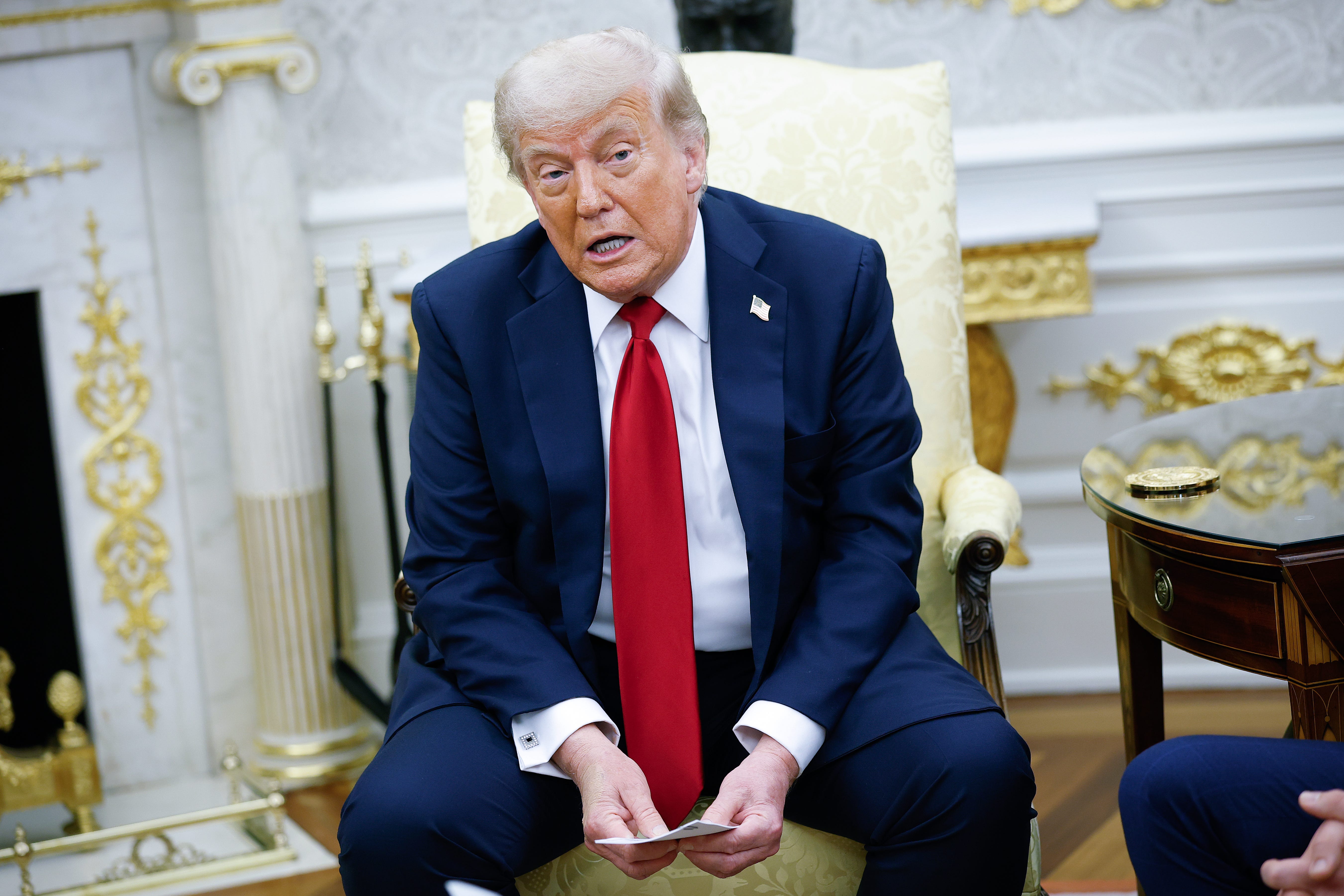
AFTER DAYS OF SPECULATION about Donald Trump’s promised “surprise” on Russia and Ukraine following his unusually harsh remarks about Vladimir Putin’s “bullshit” last week, the actual announcement at a Monday press conference with NATO Secretary General Mark Rutte could be seen as more of a whimper than a bang. Trump dangled the possibility of tough sanctions against Russia and its trading partners, but with another delay: Putin now has fifty days to make a peace deal. On the other hand, deliveries of American weapons, defense systems, and other military supplies to Ukraine are resuming, and apparently with no delay—with NATO countries as the middlemen purchasing the materiel from the United States and delivering it to Ukraine.
Is this a new hawkish Trump? Or will it prove yet another TACO (Trump Always Chickens Out) episode? The fifty-day deadline to end the war (up from twenty-four hours, a week, and thirty days) suggests the latter; one exiled Russian Putin critic, Meduza news site publisher Galina Timchenko, suggested that it’s the sort of threat the Kremlin can only see as a weakness. But other commentators with high and personal stakes in the fortunes of the Russia-Ukraine war, such as Ukrainian journalist Vitaly Portnikov and expatriate Russian journalist Michael Nacke, believe that Trump’s decision to start arming Ukraine again—even at Europe’s expense, especially since Europe seems prepared to shoulder that expense—is the important part and represents an actual policy shift. Another Ukrainian journalist, Roman Tsimbalyuk, even called it “Bloody Monday” for Putin.
That’s wishful thinking, as of now. But Trump’s verbal volleys against Putin are surprisingly sustained and strongly worded this time around. Last week, he remarked that “we get a lot of bullshit thrown at us by Putin” and that “he’s very nice to us all the time, but it turns out to be meaningless.” He expanded on this theme during the meeting with Rutte:
I always hang up and say, well that was a nice phone call, and then missiles are launched into Kyiv or some other city, and I say, “Strange.” And after that happens three or four times, you say, “The talk doesn’t mean anything.”
He even credited Melania Trump with some of this insight:
I go home, I tell the first lady, “You know, I spoke to Vladimir today, we had a wonderful conversation.” She said, “Oh, really? Another city was just hit.”
Here, one could ask if the president of the United States really needs the first lady to brief him on Russian strikes on Ukrainian cities. One could also point out that the utter meaninglessness of Putin’s “nice” words was precisely the point Ukrainian President Volodymyr Zelensky tried to impress on Trump during February’s Oval Office meeting—only to get yelled at in a disgraceful display by Trump and Vice President JD Vance for being so mean to Vladimir, the guy who “went through a hell of a lot” with his good buddy Donald as a fellow victim of the “Russia, Russia, Russia” witch-hunt. (At the time, the Trump administration insisted on a quasi-apology from Zelensky to even start talking to Ukraine again, so maybe Zelensky should be expecting an apology from Trump this time around? But let’s get back to the real world.)
Even so: If, as Nacke and others think, Trump is finally “getting it,” that’s a good thing. One trope popular among Russian dissident punditry is that Putin is like the fairy-tale character who finds a wish-granting genie but blows it by pushing his luck and getting greedy. According to this view, Trump, intent on reaping glory as the man who ended what he absurdly calls “Biden’s war” in Ukraine, was happy to offer Putin the best “deal” he could have had: one that allowed Russia to keep the occupied territories and even granted recognition to Russia’s annexation of Crimea. But Putin kept holding out for a “peace settlement” that would have forced Ukraine not only to give up even more land but to accept de facto military and political surrender. What’s more, he kept pummeling Ukrainian cities and killing more people every time he and his friend Donald had a “wonderful conversation”—until the thin-skinned Trump at long last realized that he was being humiliated.
It’s certainly a possible scenario—if you set aside the more conspiratorial theories of the Trump-Putin “bromance” and accept the Occam’s razor explanation of Trump’s conduct as stemming from an unholy stew of ego, ignorance, affinity for strongmen, and distrust of Ukraine due to its perceived affiliation with his Democratic foes. Maybe Vladimir really has pissed off his buddy Donald one too many times. Maybe Zelensky’s canny efforts to cultivate Trump (he even wore a sort-of suit for last month’s NATO summit!) are paying off. Maybe Trump’s respect for Putin’s strongman credentials has been diminished by Russia’s recent massive losses in Ukraine: While Putin’s troops continue to advance in the Donbas at a fitful crawl, they have suffered an estimated 100,000 fatalities just in 2025, a figure Rutte made a point of mentioning during Monday’s meeting. Maybe Putin’s increasingly obvious geopolitical impotence—the loss of Syria, a display of utter irrelevance during the recent conflict involving its client state Iran, and more recently a rift with former close ally Azerbaijan—is playing a role as well.
It seems, moreover, that Trump has found an ego-boosting way to frame a possible anti-Putin pivot: In his new narrative, not only is he selling arms to Ukraine with NATO footing the bill, unlike that chump Joe Biden who was just giving the stuff away at the expense at the American taxpayer; he is, apparently, the only man in the White House who truly had Putin’s number all along. As he put it during the meeting with Rutte: “He fooled a lot of people: He fooled Clinton, Bush, Obama, Biden. He didn’t fool me.” Of course, this is an Orwell-worthy rewriting of history (remember that time Trump said that he trusted Putin over U.S. intelligence agencies?); but if Trump’s narcissistic fantasies can give us a better U.S. policy on Russia and Ukraine and give Ukraine the weapons it needs, we have to take what we can get.
THAT SAID: DON’T COUNT OUT Trump’s hopes for a “deal” with Putin just yet (and certainly don’t count on Lindsey Graham and other Republican chickenhawks to stand in Trump’s way if he does opt for a deal). One very obvious explanation for the fifty-day deadline is that it will give Russia time to complete its summer offensive and that Trump is giving Putin his last shot at achieving his de minimis goals—that is, seizing all or most of the Ukrainian land he formally annexed in September 2022 with an amendment to the Russian Constitution. That theory is floating around in Ukraine, and some Russian milbloggers (i.e., war propagandists) are already fantasizing about Russia hitting Ukraine with everything it’s got to achieve those goals.
Whether Russia can do it is another question, and one to which the answer is probably “no.” (Émigré military analyst Yuri Fedorov believes that it’s unlikely to complete even the capture of the Donetsk province, despite snipping off a deserted village here and an abandoned factory there.) Pessimism is currently running pretty high in the Russian war-hawk camp. Most recently, Pavel Gubarev—one of the insurgents who helped create the pro-Kremlin “Donetsk People’s Republic” in 2014, and who has recently been on the frontlines in the region—has given a two-and-a-half hour interview in which he paints a dire picture of the state of Russia’s war effort and warns of a coming catastrophic defeat.
What’s more, while the 50-day mark can be seen as a “take what you can” signal to Russia, Ukraine can also read it as a “this is how long you have to hold the Russians off” signal. And while it’s unclear so far what offensive weapons Ukraine is going to receive, it’s notable that the White House denial of plans to deliver long-range missiles that could strike Moscow or St. Petersburg has been cagey: Press Secretary Karoline Leavitt has even acknowledged that Trump did, in fact, raise the question with Zelensky. The Washington Post’s David Ignatius reports that such missiles are off the table for now but could be sent to Ukraine in the future. Ignatius believes that Trump’s Iranian adventure has sold him on the benefits of peace through firepower and that he finally wants to play hardball with Putin.
To Portnikov, the Ukrainian journalist—who says he has little faith in sanctions given the many ways to circumvent them—the bottom line is that the United States, in partnership with Europe, is now prepared to arm Ukraine for as long as it takes for Russia to get tired of the war. This is certainly how many Ukrainians are perceiving the latest signals from the White House. Of course, if this pivot depends on Trump’s ego and current mood, it is by definition unstable. The best-case scenario is that it gives Ukraine and its European partners some time to turn the tide against Russia—enough time to bury the narrative of Ukrainian defeat.