

These Are the Issues That Could Decide Michigan’s Crucial Senate Race
Watch my interviews with all three candidates.

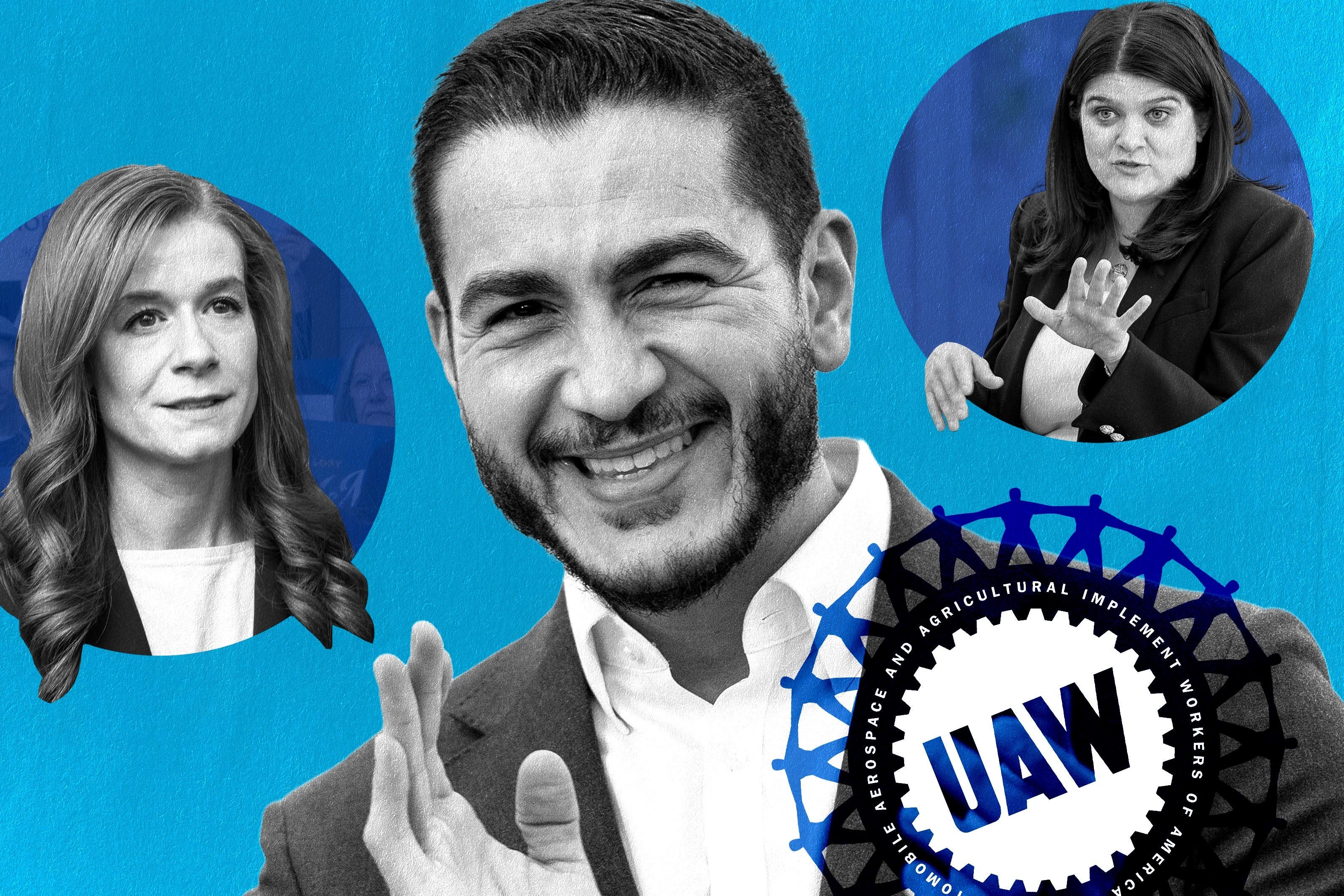
A PRETTY BIG JOLT just hit one of this year’s most critical Senate races. And I don’t mean the one in Maine.
On Friday, Michigan’s chapter of the United Auto Workers announced it was endorsing Abdul El-Sayed’s bid to become the Democratic nominee for the state’s open Senate seat. El-Sayed is the former public health director for Detroit and Wayne County, a Bernie Sanders–backed progressive whose campaign mantra is “money out of politics, money in your pocket, Medicare for All.” The union in its announcement signaled that all three parts of the slogan resonated.1
The endorsement means El-Sayed can count on phone banking, mailers, and other forms of organizing from a union that—with more than 300,000 members in Michigan—is the state’s largest. It also means that same support won’t be there for his two rivals, state Senator Mallory McMorrow and U.S. Representative Haley Stevens.
The blow to the Stevens campaign seems especially noteworthy, given how much her candidacy is tied up with manufacturing in general and the auto industry in particular. She first came to national attention while working for the Obama administration’s task force that in 2009 saved General Motors and Chrysler—and, most likely, the jobs of countless UAW members. On the campaign trail, she has portrayed herself as the best friend of labor, the strongest champion for Michigan’s economy, and the logical heir to Gary Peters, the popular Democratic incumbent whose retirement has created the vacancy she wants to fill.
That’s hardly the only case for her candidacy, or for McMorrow’s. An argument for both—sometimes implied by the candidates themselves, often stated explicitly by their supporters—is that they are more electable in a purple state that is practically essential to the hopes for a Democratic Senate majority. The idea here is that El-Sayed will have a much harder time winning over moderate-minded voters who would never even think of pulling the lever for somebody who embraces the likes of Hasan Piker. Already, GOP strategists are attacking El-Sayed as “fringe” and “radical.”
It would be a mistake to assume the UAW endorsement will simply give El-Sayed the inroads with working-class voters to counterbalance any loss he might suffer with moderates. The union is not as synonymous with the hard-hat crowd as it once was, thanks to an influx of graduate students and other members of the professional class whose politics skew reliably to the left on a variety of issues. That includes Middle East policy, which has been as divisive for Democrats in Michigan as in any state—and on which Stevens has struggled to defend her history of strong support for Israel (and her backing by AIPAC).
But plenty of Michigan UAW members are still in manufacturing.2 And to local leaders like Chad Fabbro, the financial secretary of UAW Local 598 and cohost of a weekly podcast on politics called “Unapologetic Americans,” it’s not hard to imagine why the kind of factory workers who frequently disdain “the left” might still find El-Sayed appealing.
“It’s based on people being frustrated with the party, blaming a lot of shortcomings on the current leadership,” Fabbro told me when we spoke Friday, after the endorsement came out. “They just don’t have a lot of faith on what was done, what worked in the past. They think the rules have changed, so the way we play the game has got to change too.”
It’s hard to know exactly how prevalent this mentality really is, either inside or outside the UAW.3 But it picks up an underappreciated way the candidates are different—one that is less about where they each sit on the traditional ideological spectrum and more about how they imagine change happening in Washington.
It’s a difference that became most apparent to me over the last two weeks, when I had a chance to interview all three of them. We spoke by video, each for about thirty minutes. Going in, my primary goal was to suss out what the candidates actually believed on key domestic policy questions that might come up if they were in the Senate—like why they have all said they would support the federal government taking a more active role in helping families to raise kids, or under what circumstances (if any) they thought it was alright to approve spending even if it meant running higher deficits in the near term.4
You can decide for yourself what you think of their answers. Excerpts of their interviews are intercut here:
And you can watch the full interviews here: Haley Stevens, Mallory McMorrow, Abdul El-Sayed.
ALL THREE CANDIDATES gave relatively forthright answers, at least by the standards of American politics. And they all showed they could wonk out on their favorite topics (even if I wouldn’t stipulate to all of their claims).
But the more I listened to them, the less I thought about the positions they were taking and the more I thought about their very different conceptions of how to operate in office—in particular, the extent they imagine themselves trying to overturn the system, rather than working within it.
With El-Sayed, pretty much every answer he gave involved some kind of broader critique of the political debate, and the false choices he said it created. You can’t talk about how to help the auto industry, he told me, without recognizing the way executives and shareholders prioritize short-term gain over investments. And you can’t talk about fiscal policy, he said, without pointing out the way demands for balancing budgets apply only to social expenditures and not tax cuts.
This is also his approach to his signature cause: his calls to create a Medicare for All system in which a government health plan would largely displace private insurance.
During the campaign, El-Sayed has said that people who want to keep employer or union health care plans should get to do so. His rivals, meanwhile, have said they want to create a “public option”—that is, a government plan into which people could enroll voluntarily. When I asked whether those two were really so different, he said they were conceding too much ground to the insurance industry. A public option wouldn’t give Americans the kind of security they’d get from Medicare for All, he said, because it would be grafted onto the existing system.
“If you’re for a public option, you actually don’t want to guarantee shit,” El-Sayed said.
McMorrow rejected the suggestion that a public option wouldn’t provide meaningful security, telling me it would create “a universal standard that ensures that we are not leaving anybody outside of having health care” while introducing “real competition in the marketplace.” And she was just as emphatic about why lawmakers need to recognize the real-world political constraints on action—which, in health care reform, include not just the overwhelming power of the private health care industry but also the fear of change among people who already have coverage.
As proof of the difficulties, McMorrow cited a failed attempt to create a version of Medicare for All in Vermont, even though it is arguably the most politically progressive state in the country. Then she talked about hearing from constituents who were struggling with medical bills now—and who, she said, “cannot afford to wait for a single-payer option [like Medicare for All] that may be too large of a hurdle.”
That emphasis on talking about policy within the frame of what seems politically possible extended beyond health care. When I asked her to list initiatives for young families she would try to promote, McMorrow mentioned creating a national version of Rx Kids, a Michigan program that gives direct cash payments to new parents that she supported in the state Senate. She also talked about enacting a national law to guarantee paid leave, versions of which already exist in more than a dozen states.
“Eight years in the legislature has taught me a lot,” said McMorrow. “You need to build coalitions. You need to move the ball forward constantly.”
Building coalitions and moving the ball forward is also the way Stevens talks about getting things done. But with Stevens, pretty much every answer she gave me started with a bill she had sponsored in the House (like the Unearth America’s Future Act, which would invest in domestic mineral development) or a constituent she had met (like Jimmy from the Iron Workers local who, she said, is worried about data centers).
And when we got to discussing how she’d make complicated policy tradeoffs—like weighing whether to bring back Biden-era car-emissions standards that Trump has repealed—Stevens’s solution always involved sitting down with the interested parties and finding some kind of path forward. “It depends on where our suppliers are, where our Big Three is, where our auto industry, and, of course, the environmental groups that I work with,” she said.
This is the essence of the case for the Stevens candidacy: She will listen to every constituent group, go back to Washington to craft a workable bill, and then push to get it through Congress. It’s not the most glamorous conception of politics. And insofar as working alongside interest groups often means winning their support and taking their donations, it’s high on the list of her qualities that critics find objectionable.
But there’s no question the approach can be productive. The Center for Effective Lawmaking has recognized Stevens as the most effective member of Michigan’s Democratic delegation, precisely because of her ability to build partnerships and play legislative small ball.
It also happens to be the way Peters has approached his tenure in the Senate, just as it was for Debbie Stabenow, who served four terms before retiring after the 2024 election. They are both beloved old-school pols with records of delivering tangible benefits for their communities.
This approach could still work for Stevens, as well. One lost endorsement, even from the UAW, isn’t going to make or break anybody’s candidacy in this campaign. There’s still plenty of campaigning to go before the August 4 primary, and more than enough undecided voters to swing this three-way race in her direction—or in McMorrow’s, for that matter.5
But if the UAW’s backing of El-Sayed says anything, it’s that some significant portion of Democratic voters want something different from the kind of methodical bill-writing, coalition-building politician the party has elected in the past—a feeling that, as Fabbro put it, that “the worker bee isn’t working for us anymore.” Just how large that portion is could end up determining the Democratic nominee.
The union’s statement said, “UAW members in Michigan want a fighter in Washington, D.C. who isn’t afraid to push forward a strong working-class agenda with moral clarity. Having never taken a dime from corporate PACs, Dr. Abdul El-Sayed is someone we can trust to have our backs. . . . From Medicare for All to banning stock buybacks, Dr. Abdul El-Sayed is ready, eager, and well-equipped to move our core issues in the U.S. Senate.”
I was not able to track down an exact percentage. But a state UAW official not authorized to speak on the record told me “it’s more than half for sure,” with state employees (including teachers, social workers, and nurses) accounting for much of the rest.
Here’s how Jeff Timmer, former executive director of the Michigan Republican Party and now a senior adviser to the Lincoln Project, assessed the endorsement’s impact: “The UAW endorsement is unquestionably a significant development for Abdul. It alone is not likely to be the deciding or differentiating factor unless or until a preponderance of such groups, powerful in Democratic politics, follow suit.”
I focused on domestic policy because that’s what I know best; it’s entirely possible, though, that foreign policy—such as the candidates’ stances on Israel—will play a decisive role in the race.
August 4 is the official primary date. But mail-in ballots will go out at the end of June and early in-person voting will be available starting on July 6.
Abdul is also doing the work of meeting with voters in Michigan to try to win their support. I met with a volunteer for his campaign last week because he wanted to find out what farmers are concerned about in Michigan and then he held a meeting in our town a few days ago that I unfortunately wasn’t able to attend because of illness in our house, but from what I’ve heard some of the local well known farmers did attend, so they at least were willing to hear him out. I haven’t seen anything from Stevens campaign and McMorrow has been supposed to come to our town but that never happened, and they certainly didn’t do any outreach to local farmers. He also went to the local mosque, since our small town has the second highest percentage of Muslim population in the state outside Dearborn. I know there is a lot of worry about how electable he would be in Michigan, but I also know a lot of people who were Trump voters but also liked Bernie because they are fed up with how things work and nothing ever changes to help them, so if he is putting in the effort in this way, I don’t think it’s impossible for him to win statewide the way people from outside Michigan seem to think.
I'm considerably more worried about holding Michigan than I am flipping Maine. Ugh.