

It’s Not Enough to Defeat Orbánism. You Have to Drive a Stake Through Its Heart.
First you have to beat the authoritarian. Then you have to reform the system that allowed him to subvert democracy.

Webby Update: Guys—the Webby voting ends on April 16 and we’re still winning, but it’s closer than I’d like.
If you didn’t vote for me the first time please do it now? You can vote here.
A reminder of what’s on the line: If I win this totally meaningless award I am going to make myself a WWE-style championship belt which I will carry around at live shows and display prominently whenever I’m on the Focus Group.
I’ve never wanted anything more. Help me live my dream. 🙏
1. The NYT’s House Illiberal
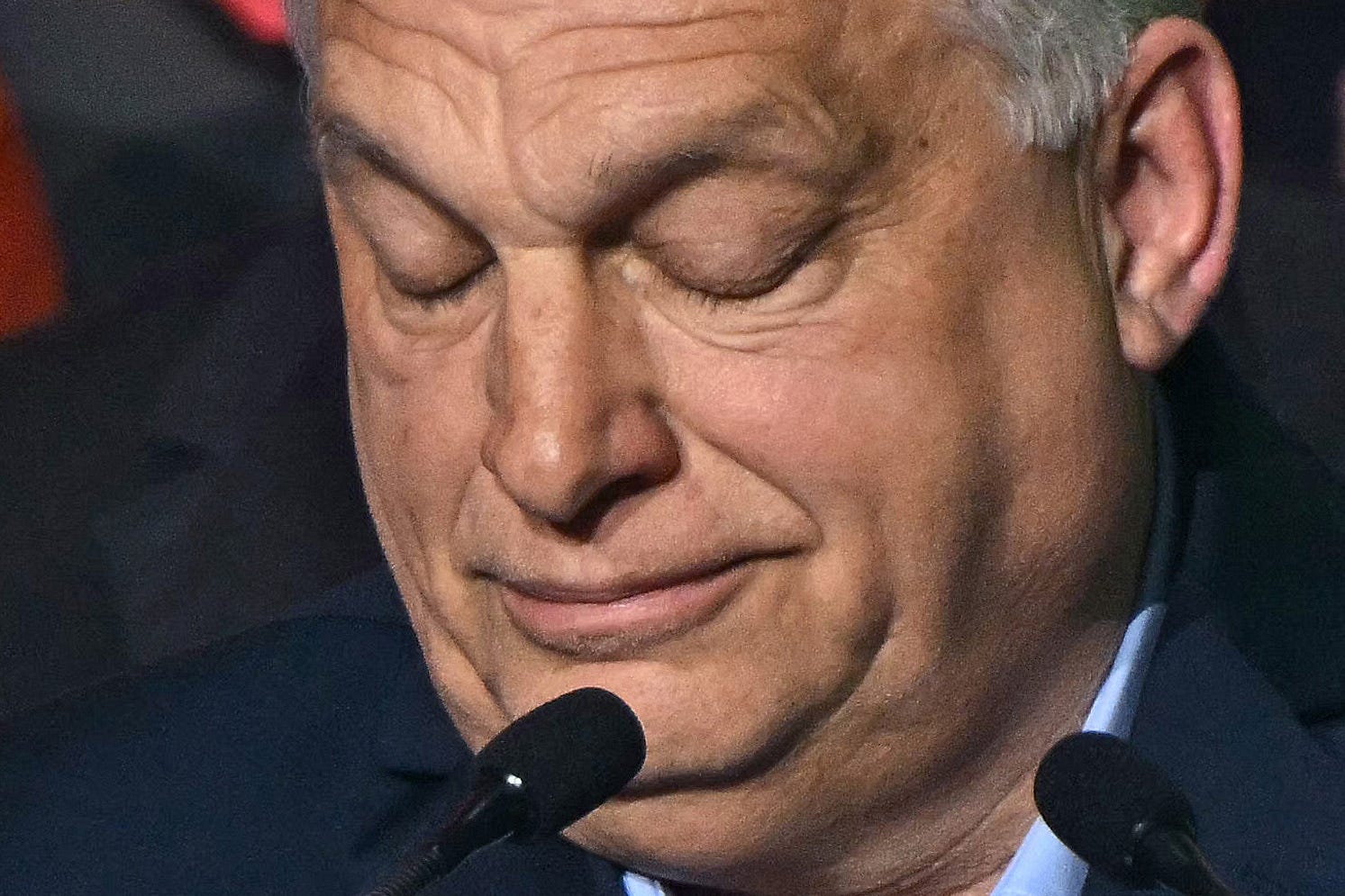
Ross Douthat celebrated the end of Viktor Orbán’s rule by arguing that ackshually Orbán governed totally within the bounds of normal democracy and everyone who was upset about him should now see how silly and alarmist they were.


There will be no Orbán coup!
The Douthat position is: If the ruling regime leaves power without bloodshed, then that regime was, by definition, a democracy consistent with our understanding of the word.1 (To understand Douthat-ism, see this footnote.2)
But this isn’t about Ross. It’s about noticing what he’s up to. Because the rehabilitation of Viktor Orbán is the opening gambit in the attempt by American illiberals to prevent accountability and reform should Trumpism be defeated.
Because when Ross Douthat and his friends look at Hungary, they fear that they are looking at their future.
2. What Orbán Did
We start by understanding what Orbán actually did to Hungary’s government and the rule of law.
When Orbán returned to power in 2010 he did so with 52.7 percent of the vote. His support was concentrated in rural areas, which had disproportionate representation—so his majority was greatly magnified. His party controlled 68 percent of the seats in parliament. This supermajority allowed Orbán’s party, Fidesz3, to amend the Hungarian constitution on party-line votes. Orbán took this as license to rewrite the entire constitution and then pass it on a party-line vote.
Among the new constitution’s first objectives was to neuter the courts, because Orbán understood that he could not consolidate power if the courts were independent. So the new constitution:
expanded the Constitutional Court from eleven to fifteen judges;
created a new process for appointing Constitutional Court judges that allowed the ruling party to do so without consultation;
relocated the power of the Constitutional Court to elect its own chief judge to parliament (i.e., to the ruling party);
forced the removal of many sitting judges by putting the retirement age at 62;4
forced the removal of the Supreme Court’s chief justice by inventing a requirement that disqualified him from service on the high court;5 and
created a government office in charge of hiring and firing judges; this office would be controlled by an appointee from the majority party.
The next step was capturing the administrative state. Orbán embarked on a campaign to replace the heads of nonpartisan government agencies with political loyalists. (Sound familiar?) Simultaneously, he established terms for these appointments that were incredibly long—often nine or even twelve years.
The goal was to ensure that even if Orbán lost an election in the near term, his people would maintain control over both the courts and the administrative state, preventing the new government from undoing his actions6 and making a return to power easier.
Orbán next turned to attacking the political system itself. Here’s Johan Norberg’s excellent account:
The 2012 constitution also gave significant powers to a restructured Budget Council. This three-member body consists of officials appointed to long, staggered terms—up to twelve years—ensuring they remain in office long after the government that appointed them may have left. They can veto the budget and if this results in no budget passed on time, the president can dissolve parliament and trigger new elections. As Orbán told an Austrian newspaper: “I make no secret of the fact that in this respect I tie the hands of the next government. Not just the next one, but the next ten.”
Then Orbán changed the voting system. Hungary is a multiparty parliamentary system. Before Orbán’s changes, voting had been done in two rounds—the idea behind this being that in any given election, the first-round results typically split between the majority party on one side and the various opposition parties on the other. After the first round, the opposition parties consolidated around the leading vote-getter and the second round was a one-on-one runoff.
Orbán eliminated the second round of voting. In a two-party system this would not have meant much. In a multiparty system it created an enormous advantage for the party in power and a huge hurdle for opposition movements.
The next step was the creation of a majoritarian multiplier. This is somewhat complicated but the upshot is this: First Orbán changed the electoral system to make it easier for the ruling party to get a majority and then he changed the representation system to give extra seats to the majority—the net result being that even if Orbán’s party won only a plurality of the votes cast, they would still have a supermajority in parliament and hence the ability to change the constitution at will.
Then, just for good measure, Orbán gerrymandered the hell out of the parliament map to provide extra cushion for Fidesz.
Here is the net effect of these machinations: In the 2014 elections, Orbán’s share of the vote dropped from 52.7 percent to 44.9 percent. Yet Fidesz maintained a supermajority in parliament and could unilaterally alter the constitution to perpetuate itself in power.
This is not “bending the rules”; it is not “democracy qua democracy.”
There’s more. A lot more. Another constitutional amendment prohibited all political advertising—except on publicly owned broadcast media. Meaning: State-owned channels, controlled by Fidesz, could choose not to air ads from opposition parties.
The government used its power to deny opposition parties almost any chance at communicating with voters. Here’s Norberg again:
When the opposition realized that their only chance to grab public attention during the 2014 campaign was advertising on Budapest streetlamps, the city council banned such ads, supposedly for road safety purposes (sidewalk kiosks owned by a Fidesz-friendly company were exempted from the ban). This almost ruined the company that sold such ads. After the election, that company was bought by a businessman close to Fidesz, and after that, advertising on streetlamps was once again permitted.
These are merely the legal things Orbán did in his quest to subvert democracy. We haven’t even begun to touch the outright corruption and illegality of the regime.
Here’s Norberg, one last time:
Orbán and the group around him are lawyers, and they were meticulous in making sure that their power grab was done in a technically legal way. They also defended every single step of the process by saying that almost all of these institutional changes, taken separately, exist in other consolidated democracies. But that is institutional cherry-picking. The problem is that all these steps led in the same direction: toward unrestrained executive power, since other countervailing checks and balances that make such institutions work in other systems were also dismantled.
And that, right there, is the challenge.
Like us, the Hungarians discovered that their democracy was run on the honor system. The question is: Once a society understands this reality, how do they respond?
What happened in Hungary—what is happening in America—is not a feature of normal “democracy qua democracy.” If it were, then there would be many fewer democracies in the world.
If a democratic system can be turned against itself in this way, then it is not sustainable. It’s like building your house next to a barbarian encampment and hoping they respect your property line.
There are two questions in confronting competitive authoritarianism.
The first is: Can you defeat the aspiring authoritarians through nonviolent means?
The second is: If you defeat them, are you willing to take democracy off of the honor system and do what is necessary to make life harder for the next aspiring authoritarian?
And that’s what we’ll talk about tomorrow.
3. Worst. Car. Ever.
I’ve been waiting for Mr. Regular to do one of his essays on the Cybertruck and he finally has—and it’s everything I’d hoped it would be. Enjoy.
The Douthat position is also: If a ruling regime leaves power after some bloodshed, this is also no big deal because the important part is that they left power. Any coup that fails wasn’t really a coup.
Douthat’s ideology can be summed up as:
Liberalism is like a black hole and its dangers are so great that they cannot be seen over the event horizon.
Conservatism is like the theory of quantum immortality: If nuclear holocaust and the extinction of the human race do not directly follow from a conservative position, then the conservative position was never actually dangerous and concerns about it were unmerited.
Technically the parliamentary majorities since 2010 were held by an alliance of Orbán’s Fidesz party and another party, the KDNP, but the latter is by far the smaller member of the partnership.
This was later raised to 65.
The existing chief justice had served on the European Court of Human Rights for seventeen years; the new Hungarian constitution required the chief justice to have sat on Hungarian courts for at least five years.
Unless the opposition won a super-majority. The victory against Orbán this past weekend would have been hollow if the opposition had only won 60 percent of the vote.
JVL ends on exactly the right two questions, but there's a third one underneath both of them, and it's the one nobody wants to ask.
His second question, are you willing to take democracy off the honor system? That question assumes the political will to do so exists somewhere in the system, waiting to be activated by the right electoral outcome. Maybe it is, but before we get there, someone has to answer this: What do you do about an electorate that, with full access to the evidence, chose to empower the person who broke the honor system in the first place?
Magyar won because Hungarian voters lived inside Orbánism without insulation. They felt it in their wallets, their courts, their newsrooms. The suffering was direct and unmediated. Enough American voters seem to have a cushion (of ignorance) between themselves and the consequences of their choices, a media environment that buffers, reframes, and algorithmically replaces lived experience with the next outrage cycle, that the same unmediated education never seems to fully land.
JVL is right that the structural damage is the real problem. He is also right that defeating the authoritarians is only the first question. The answer to his second question requires a functioning civic organism capable of demanding it. Building that organism is a longer, harder project than any election, and it is the project almost nobody in this conversation is willing to name, because naming it honestly requires admitting how much was already lost before Trump ever touched the machinery.
The United States of America, the country that spent eighty years as the global reference point for democratic governance, the country other nations measured themselves against, the country that sent observers abroad to certify whether elections met our standard, is now looking to Hungary for inspiration. Hungary. A country Freedom House currently classifies as only partly free. Let that recalibration of the compass fully register, because the distance between where that needle used to point and where it points today is the most precise measurement available of what has already been lost.
My question is: why does the NY Times continue to give Douthat a platform? He is a convert to Catholicism of the worst kind, he supports authoritarian rule etc etc. Surely there are better options to present the conservative viewpoint.