

DOJ’s Anti-Anti-Racism Indictment Has Major Holes
A close look at the accusations against the Southern Poverty Law Center.

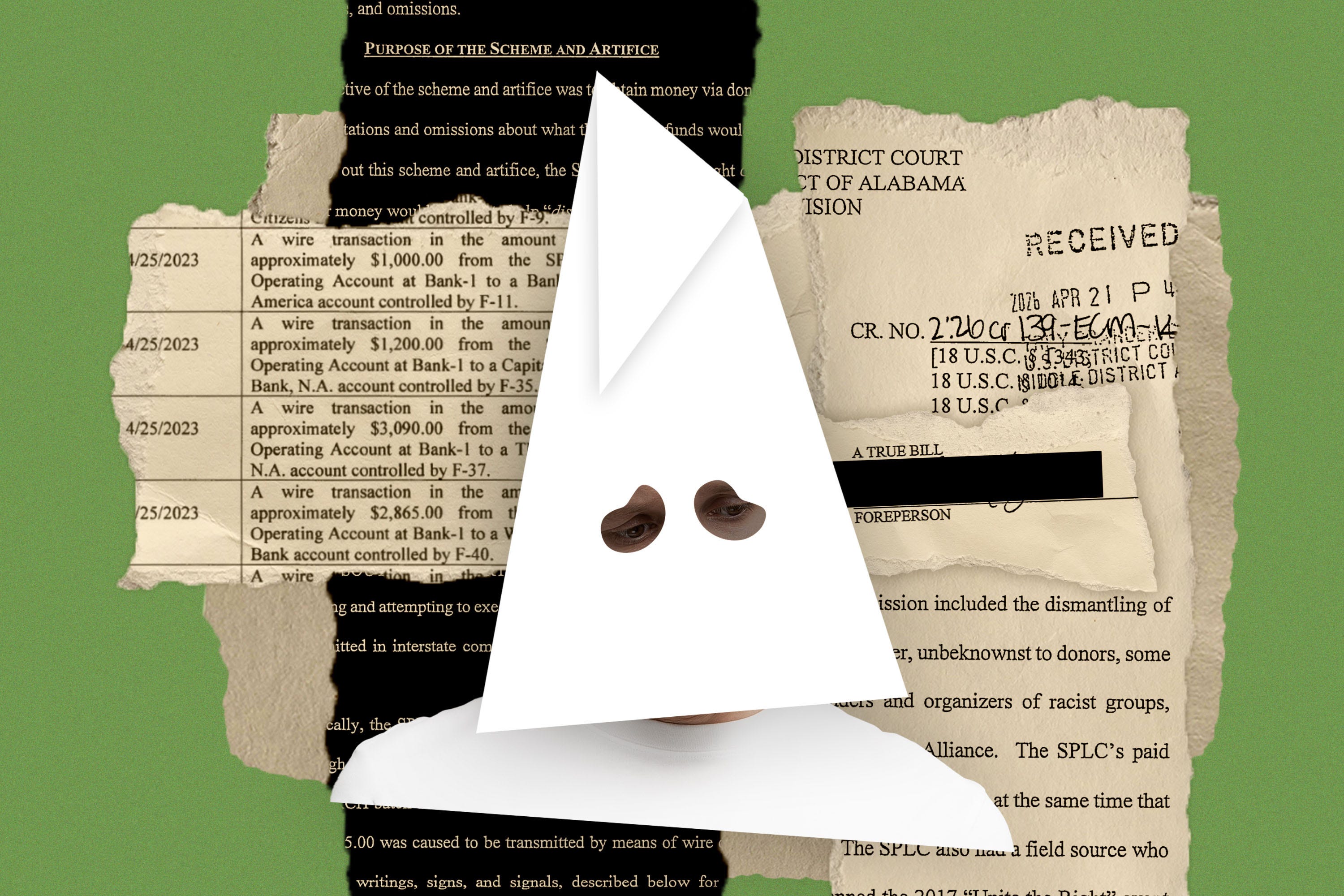
TO MUCH FANFARE, the Department of Justice this week announced a new indictment of the Southern Poverty Law Center, a group known for monitoring and calling out the rise and prevalence of right-wing extremism and hate groups.
In the indictment, the DOJ accused the group of bank and wire fraud as well as conspiracy to commit money laundering, arguing that SPLC’s use of paid informants to monitor extremist groups was, in actuality, a funding mechanism for those groups.
Reading through the eleven counts, however, I noticed a telling omission.
In order to make the argument that “the SPLC is manufacturing racism to justify its existence,” the government listed several informants in white supremacist groups who received payoffs from the SPLC. One of them was described as an “Imperial Wizard” in a Ku Klux Klan group called the United Klans of America.
The indictment cites an SPLC article describing the United Klans of America as a “millennial reboot of what was once a serious domestic threat.”
Yet the DOJ left out one key word from that SPLC article: “pathetic.” In the actual 2013 story, the SPLC described United Klans of America as a “pathetic millennial reboot of what was once a serious domestic threat” (emphasis added).
That doesn’t sound like “manufacturing racism” so much as mocking it. If the SPLC were really trying to whip their donors into a frenzy over groups like United Klans of America, why would it describe the organization as “pathetic”?
And why would the DOJ leave that one word out of the indictment?
Those questions will almost assuredly be adjudicated in the courts, as the SPLC has pledged to fight the indictment. But, for now at least, they don’t seem to be causing much pause or hesitation on the right, which has seized on the indictment not just as a chance to crush a hated liberal institution, but as proof that essentially every politically unpalatable extremist on the right has been secretly funded by the SPLC.
“The supply of right-wing ‘hate’ was so low that a left-wing ‘anti-hate’ group had to subsidize it, so it could then raise money to fight it,” conservative activist Christopher Rufo tweeted.
“These extreme right-wing things that are supposedly everywhere, I swear to you, it is probably nothing but paid-off people from the SPLC and FBI informants,” Glenn Beck said Wednesday on his show.
THE DOJ’S INDICTMENT OF THE SPLC comes, ironically, when the group is far removed from the powerful perch it occupied during its civil rights heyday, or even what it was a decade ago. The SPLC was founded in the early 1970s as a legal clinic focusing on a racial discrimination. But it gained a name for itself later in the decade by filing lawsuits against the Klan. Over the subsequent years it expanded its remit to include other hate groups.
The SPLC has long faced allegations that it has amassed far more money than it needs to fund its activities, with more than $800 million in assets as of 2024. Working at the SPLC in the early 2000s, writer Bob Moser suspected he was working at what he would later describe as a “highly profitable scam.”
But conservatives despised it not just because it was flush with cash but because they believed the group spuriously ruined the reputation of people and institutions that were not hate groups and that it chilled speech.
In his new book, Strange People on the Hill, former SPLC investigative reporter Michael Edison Hayden wrote about how, in the face of this conservative pressure—which became amplified in the MAGA era—the SPLC shrank away from its aggressive reporting on the right.1
Much of the DOJ’s indictment against SPLC focuses on the group’s use of paid informants to gain information on politically marginal neo-Nazi and Ku Klux Klan groups. But for many on the right, the real intrigue in the indictment has been the government’s allegation that the SPLC had an informant involved in helping organize the fatal “Unite the Right” Charlottesville march in the spring of 2017.
Jack Posobiec called the revelation proof the march was “a complete hoax from top to bottom.” And conservative personality Priya Patel tweeted that the march was a “Leftist psyop.”
But here too, it’s what is not in the indictment that stands out. The mention of the informant is brief. All the government says is that the individual received $270,000 from the SPLC between 2015 and 2023 and that they participated in the march and played some ill-defined organizing role.
“[Informant] was a member of the online leadership chat group that planned the 2017 ‘Unite the Right’ event in Charlottesville, Virginia and attended the event at the direction of the SPLC,” the indictment reads. “[Informant] made racist postings under the supervision of the SPLC and helped coordinate transportation to the event for several attendees.”
What does that really mean? Who knows?
A couple hundred hard-right demonstrators marched in Charlottesville, and this informant arranged transportation for “several attendees.” That might mean a single rental car. As for the informant’s presence in an organizing chatroom, the best-known Charlottesville organizing chat, whose Discord logs were later leaked to the antifascist group Unicorn Riot, featured more than thirty people.

The gang returns to California for two live shows in May. Join Sarah, Tim, and Sam in San Diego on May 20 or in L.A. on May 21 for a night of politics and laughs, and a community built on good faith. Bulwark Live: California is sure to sell out—don’t delay.
THE DOJ’S INDICTMENT MAY CENTER on the legal definition of what constitutes bank and wire fraud. But the larger question it raises is whether it is useful or even smart for a group devoted to disrupting violent racist groups to have people giving them information from the inside?
While certainly grimy, it’s not always illegal to pay someone for information. Private investigators do this. And while the practice is widely frowned upon in American journalism, it’s not forbidden. TMZ pays its sources. The National Enquirer buys stories—and buys them to kill them, too.
For their part, the SPLC leaders have tried to justify the program on the grounds that it was investigating potentially violent groups, and shared that information with law enforcement.
“This use of informants was necessary, because we are no strangers to threats of violence,” interim president and CEO Bryan Fair says in a video posted on the group’s website.
Even getting the money to the sources in a way that would protect their identities appears to have exposed the SPLC to prosecution. The indictment charges the group with making false statements to banks, over the SPLC’s use of bank accounts for fictitious front businesses to handle the payments.
But much of the government’s case rests on the idea that the SPLC committed wire fraud by not telling its own donors it was paying white supremacists for information.
Here again, more information would be helpful, specifically the reaction from the donors. Are they disappointed by the use of paid informants? Given that prosecutors admit in the indictment that the information provided by paid tipsters was used to write articles critical of the groups, why would donors feel defrauded?
WHILE THERE ARE ULTIMATELY some missing elements in the DOJ’s indictment that caught my attention, in one major respect it is the oversharing of information that stands out.
Reading the document, I was struck by how much detail the prosecutors provided about the identity of the SPLC’s alleged informants, considering that these are people who exist in a world where white supremacists are murdered with regularity.
I was able to confidently identify five of the ten informants described in the filing based only on their descriptions in the filings and some articles on the SPLC’s website. The government provided specific titles for several informants and at least one relative, and there are only so many “exalted cyclops” involved in adopt-a-highway lawsuits out there. Someone more familiar with the violent racist demimonde—like a vengeful Klansman or neo-Nazi biker—could likely figure out more.
Who would want to risk their lives to reveal the inner workings of right-wing extremist groups if they know the FBI is comfortable revealing their identities? Then again, perhaps that’s a fringe benefit of this whole case for the Trump administration.
Full disclosure: I provided a nice blurb for Hayden’s book, which is well worth a read!
Every accusation is a confession.
Only a gigantic blue wave can stop the facists!