Justices’ Questions Reveal the Stupidity of the Case Against Birthright Citizenship
Awkward SCOTUS staredown as the president watches his government lawyer flail.

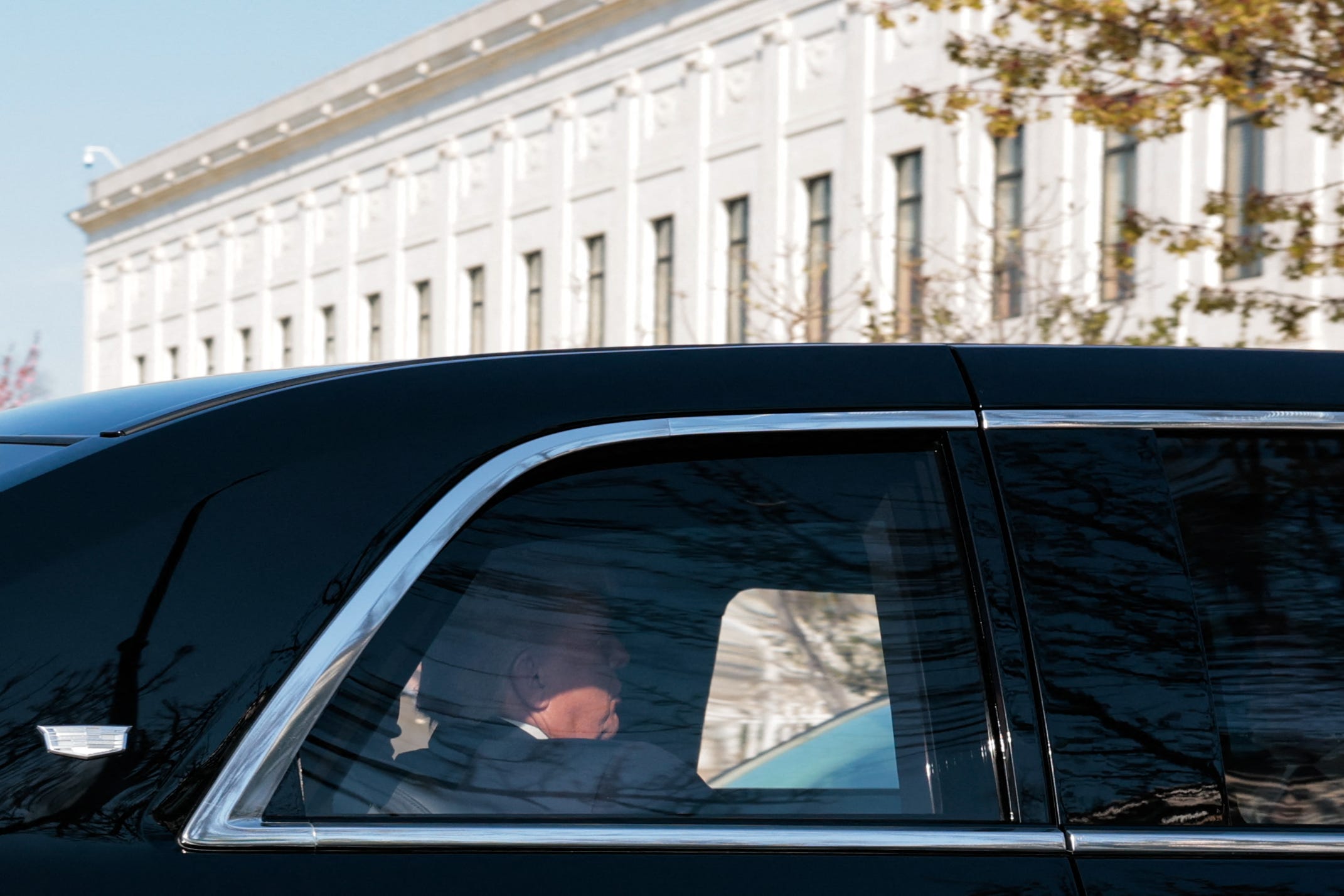
IT WAS AN APPALLING SPECTACLE without precedent in American history: the president of the United States sitting in the Supreme Court chamber while the justices heard his lawyers make the case for ripping a provision from the Constitution.
That was what happened yesterday during oral argument in Trump v. Barbara, the long-awaited a case about whether the Fourteenth Amendment’s Citizenship Clause is still valid. Donald Trump’s glaring presence in the courtroom as Solicitor General John Sauer attempted to defend the 2025 executive order purporting to invalidate the clause did not dissuade the justices from grilling Sauer on the myriad absurdities of the government’s position—or from signaling that his boss is poised to lose.
The Fourteenth Amendment states: “All persons born or naturalized in the United States, and subject to the jurisdiction thereof, are citizens of the United States.” Since 1898, the Court has understood the words “all persons” to mean “all persons,” and the words “subject to the jurisdiction” to mean born within the territory of the United States—as opposed to, say, within a foreign embassy operating in the United States under another nation’s authority. Sauer conducted himself like a Cirque du Soleil performer, spinning wildly in logic-defying attempts to persuade the justices—three of whom Trump appointed—that the Fourteenth Amendment means something other than what it says, and that the entire world has been reading the governing precedent, U.S. v. Wong Kim Ark, egregiously wrong for 128 years.
Sauer’s tortured argument went something like this: The word “jurisdiction” doesn’t mean what jurisdiction has always been understood to mean (i.e., authority). Instead, it means “allegiance.” But by allegiance, it does not mean “loyalty,” presumably because that would require identifying the subjective allegiance of newborns, which is an impossible task. Rather, allegiance means “domicile.” By “domicile,” Sauer continued, the word “jurisdiction” actually means lawful presence in the United States plus an intent to remain. But because intent to remain gets into the same newborn conundrum, “jurisdiction” really only cares about the part of “domicile” focusing on lawful presence. If a newborn’s parents were not lawfully present in the United States then their child cannot be domiciled there, so the baby cannot be subject to the jurisdiction thereof, and thus cannot benefit from birthright citizenship.
Sauer ran into many problems making his case, however. For one thing, it turns out that the Constitution’s language says nothing about parents—it only talks about those born in the United States, meaning the newborns. Sauer acknowledged this wrinkle, noting again that newborns cannot have subjective allegiance to the United States as their sovereign or know anything about where they intend to reside, so the key question regarding domicile has to be about the parents. Justice Neil Gorsuch then asked, whose domicile matters—the mom or the dad? Sauer responded as if not to worry: Trump picked moms in the executive order. In an instant, Sauer had been forced to highlight not just the arbitrariness of the executive order—as if Trump is the boss of the Constitution—but also the fundamental unworkability of his interpretation of the Citizenship Clause. It was one of many such deflating moments for Sauer.
The two-hour discussion diverted in many directions, including toward what Justice Samuel Alito (hardly a Trump skeptic) called a “humanitarian problem” regarding people who have made the United States a permanent home and established roots here. Then there’s the problem of stateless newborns who come into the world in American hospitals with parents whom Trump thinks lack allegiance/domicile/lawful presence. The Universal Declaration of Human Rights (Article 15), which the United States voted for in 1948 but which is not legally binding, declares that “everyone has the right to a nationality.” (There is also a 1961 Convention on the Reduction of Statelessness that specifically obliges states to grant citizenship to children born on their territory who would otherwise be stateless, but the United States is not a party to it.) Under the Fourteenth Amendment’s Citizenship Clause the status of such newborns a non-issue; under the interpretation Trump endorses, those newborns would be left in the limbo of statelessness.
But those practical considerations, as grave as they may be, took second place to the plain language of the Constitution as definitively interpreted over a century ago.
Wong Kim Ark involved a man born in the United States who was denied re-entry after visiting his parents in China because the 1882 Chinese Exclusion Acts prohibited Chinese laborers from entering the United States and becoming U.S. citizens. At the time, anti-Chinese sentiment was rampant among Americans who blamed Chinese laborers for depressed wages and other social tensions. The government argued that, although he was born in the United States, “the mother and father of the said Wong Kim Ark [were] Chinese persons and subjects of the Emperor of China,” so he didn’t qualify for citizenship. The Court disagreed, holding that Congress could not override the Fourteenth Amendment to deny a man born in San Francisco his constitutional birthright. The facts that his parents were non-citizens and the public was eager to slow the flow of Chinese immigration made no difference. The Fourteenth Amendment controlled.
Fast-forward to 2024 and Trump’s rise to power on the tide of anti-immigration rage, which has since ballooned into violent ICE crackdowns, unconstitutional detentions and deportations, and the deaths of numerous migrants and American citizens. In his flailing presentation, Sauer resuscitated the arguments rejected by the Court in 1898: that birthright citizenship was contingent on the status of the parents, and that although “illegal immigration did not exist” back then, today it’s a “pull factor” that “has spawned a sprawling industry of birth tourism as uncounted thousands of foreigners from potentially hostile nations have flocked to give birth in the United States in recent decades, creating a whole generation of American citizens abroad with no meaningful ties to the United States.” We’re in “a new world now,” Sauer said, “where 8 billion people are one plane ride away from having a child who’s a U.S. citizen.”
With a mic drop, Chief Justice Roberts retorted: “Well, it’s a new world. It’s the same Constitution.”
 | A guest post by
|