Killing Khamenei Is Not the Same as Regime Change
President Trump has committed to regime change, but doesn’t seem to know how or to what.

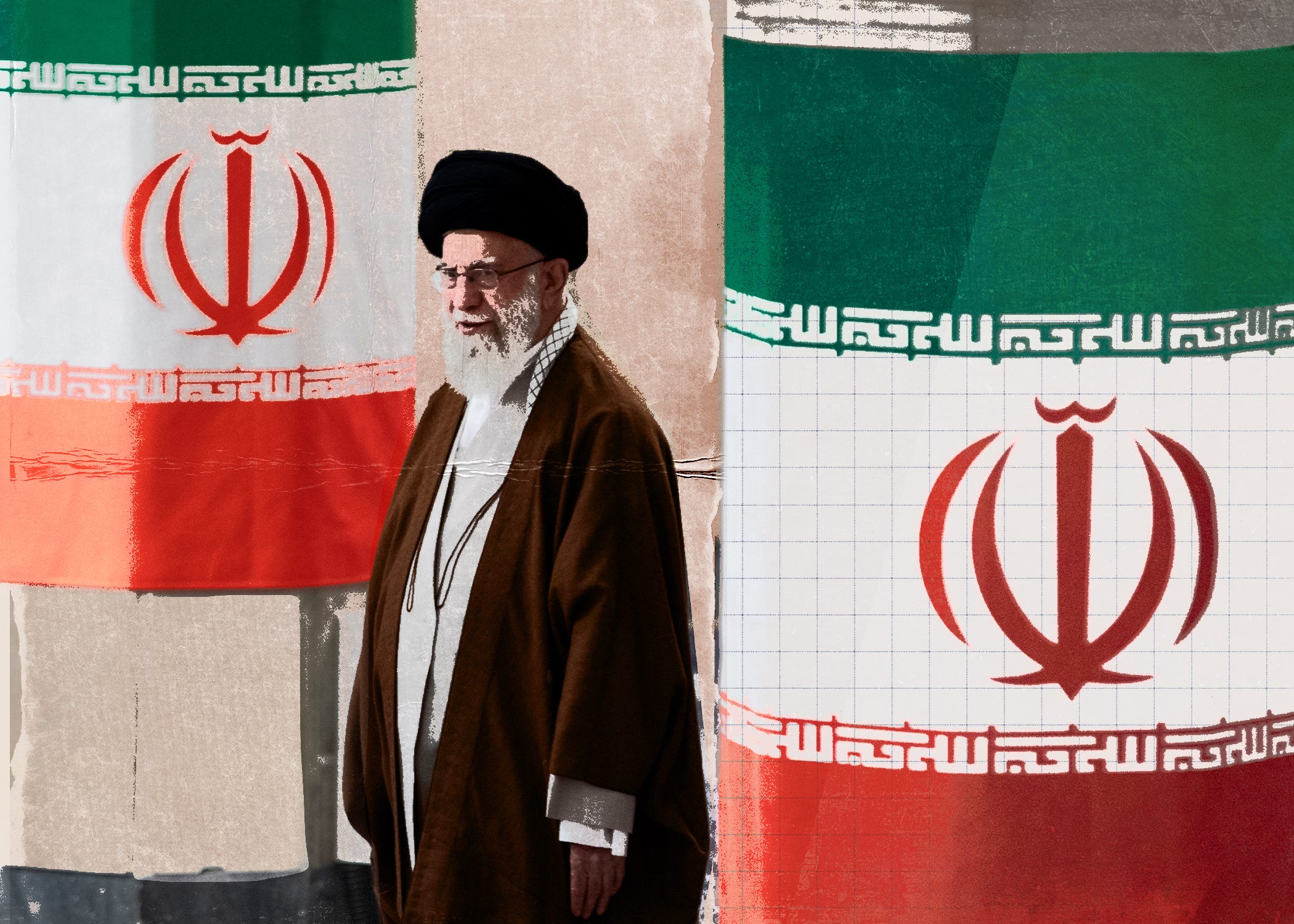
ONE OF THE BIGGEST HEADLINES from the first day of “Operation Epic Fury”—the United States’ series of airstrikes on Iran in collaboration with Israel—is that Iran’s Supreme Leader Ayatollah Ali Khamenei was killed, apparently by an Israeli strike on his office. The Israelis, who were targeting Iran’s top leadership as the United States attacked military sites, may consider this assassination as a larger-scale version of the decapitation strikes they’ve used against terrorist groups for years.
President Donald Trump is one of many in Iran and around the world rightly celebrating Khamenei’s demise. But even as he rejoiced that “one of the most evil people in History” is no more, he affirmed that the intent of these attacks is regime change. “Hopefully, the IRGC and Police will peacefully merge with the Iranian Patriots, and work together as a unit to bring back the Country to the Greatness it deserves.” Anything less than regime change will be an epic failure.
Khamenei, who was nearing his 87th birthday, has ruled Iran for more than thirty-six years, since the death of the original revolutionary ayatollah, Ruhollah Khomeini. Israeli sources also report that “dozens” of other senior Iranian political and military leaders may have been killed.
Yet Khamenei’s fate—and the fate of the other leaders targeted in the campaign—is but a small part of the regime-change picture. Trump has made it clear that Iran’s future is up to the Iranians, and that his commitment is simply to bomb things from a distance. “The heavy and pinpoint bombing . . . will continue,” he promised, “uninterrupted throughout the week or, as long as necessary to achieve our objective of PEACE THROUGHOUT THE MIDDLE EAST AND, INDEED, THE WORLD!”
A LOFTIER GOAL could not be imagined. But the history of “decapitation” strikes is checkered. Brutal regimes can become brittle and collapse rapidly and unexpectedly; ask the Soviets. But the Islamic Republic has weathered many storms, from the catastrophic losses in the Iran–Iraq War to the nationwide protests of last December. The ayatollahs came to power through violence, and violence has sustained them since 1979. They have created and sustained a powerful internal security apparatus that has killed as many as 30,000 protesters, mostly in indiscriminate attacks, in the last two months.
Moreover, it is difficult to assess the state of the Iranian opposition. It contains secular and Western-oriented urbanites, and Islamists with various objections to the regime, as well as Kurdish and other nationalists. It includes Maryam Rajavi, formally head of the National Council of Resistance of Iran, but married to the leader of the Mujaheddin-e-Khalq, or MEK, which was until 2012 designated as a terrorist organization by the U.S. government. At the other end of the spectrum stands Reza Pahlavi, the “baby shah” and heir to his late father’s “Peacock Throne.” Both Rajavi and Pahlavi are exiles unlikely to command broad support in Iran.
No doubt the United States, the Israelis, and the Gulf Arab states know more about Iranian opposition groups than the Bush administration or its contemporaries did about Saddam Hussein’s Iraq in 2003. But that’s a very low bar. And, more generally, we should not underestimate the damage that long-running dictatorships can do to their people, their polities and their societies: Even in Eastern Europe, and in states that are European Union members, the scars of Soviet rule have yet to heal entirely.
THE REGIME, CURRENTLY BEING LED by a leadership council consisting of the heads of the various branches and institutions of the government (including the clergy), may choose another supreme leader according to the Iranian constitution. But the struggle for power in a post-Khamenei Iran may nonetheless be ugly and protracted. It could even become a multi-sided civil war. If that happens, the value of U.S. and Israeli airpower will be exponentially decreased. Targets will be harder to find and verify, and it will be hard to tell the good guys from the bad guys. Collateral damage will increase, as will the likelihood of unintended consequences. Destroying the Ghaddafi regime in Libya in 2011 was not an unalloyed success.
Such a war would necessarily engage Iran’s neighbors, which have significant interests in who runs Iran. Even more dangerously, powers from outside the Middle East also may want a say. China buys about 80 percent of Iran’s oil exports; that accounts for 13.4 percent of Beijing’s imports. Tehran has sold Russia more than 50,000 Shahed drones, a staple of its attacks on Ukraine. Russia, in particular, may have reason to intervene after its embarrassing failures to save its clients in Syria and Venezuela, though it may lack the ability due to its quagmire in Ukraine.
Just as the chaos of the French Revolution ended in Napoleon, regime change in Iran could make things worse. Strategic stability is perhaps the least likely outcome. An even more ruthless strongman would be preferable to yet another sucking chest wound in the Middle East, depleting munitions, people, and American willpower.
Trump has given himself mostly bad options. The first is to commit wholeheartedly to regime change in Iran—a massive war for which the American people and military are unprepared. The second is that the Iranian regime is replaced by something as bad or worse, in which case his bluster and bellicosity will have been for nothing. The third is that the regime survives essentially intact, with new leadership but fundamentally unchanged—again, a failure of the goals Trump has, in his way, explicated. The odds that Iran spontaneously sprouts a democracy are too small to be measured, however fervently such a thing might be hoped.
These are the wages of his narcissism. “No president was willing to do what I have done tonight,” he boasted. That’s true—maybe with good reason. Trump is an old man, increasingly unloved by his own people, including some of his staunchest past supporters. He wants a golden legacy—ballrooms, an arc de triomphe, anything that “no one has ever seen before”—for a “golden age.”
A free Iran would be a glorious and golden thing, but it is more probable that we will add a new nightmare to the one they have endured for nearly five decades. This is moral as well as strategic vanity.
 | A guest post by
|