

Let’s Not Sportswash Trump’s Authoritarianism
The Olympics, the World Cup, and cheering for our nation’s athletes but not the current administration.


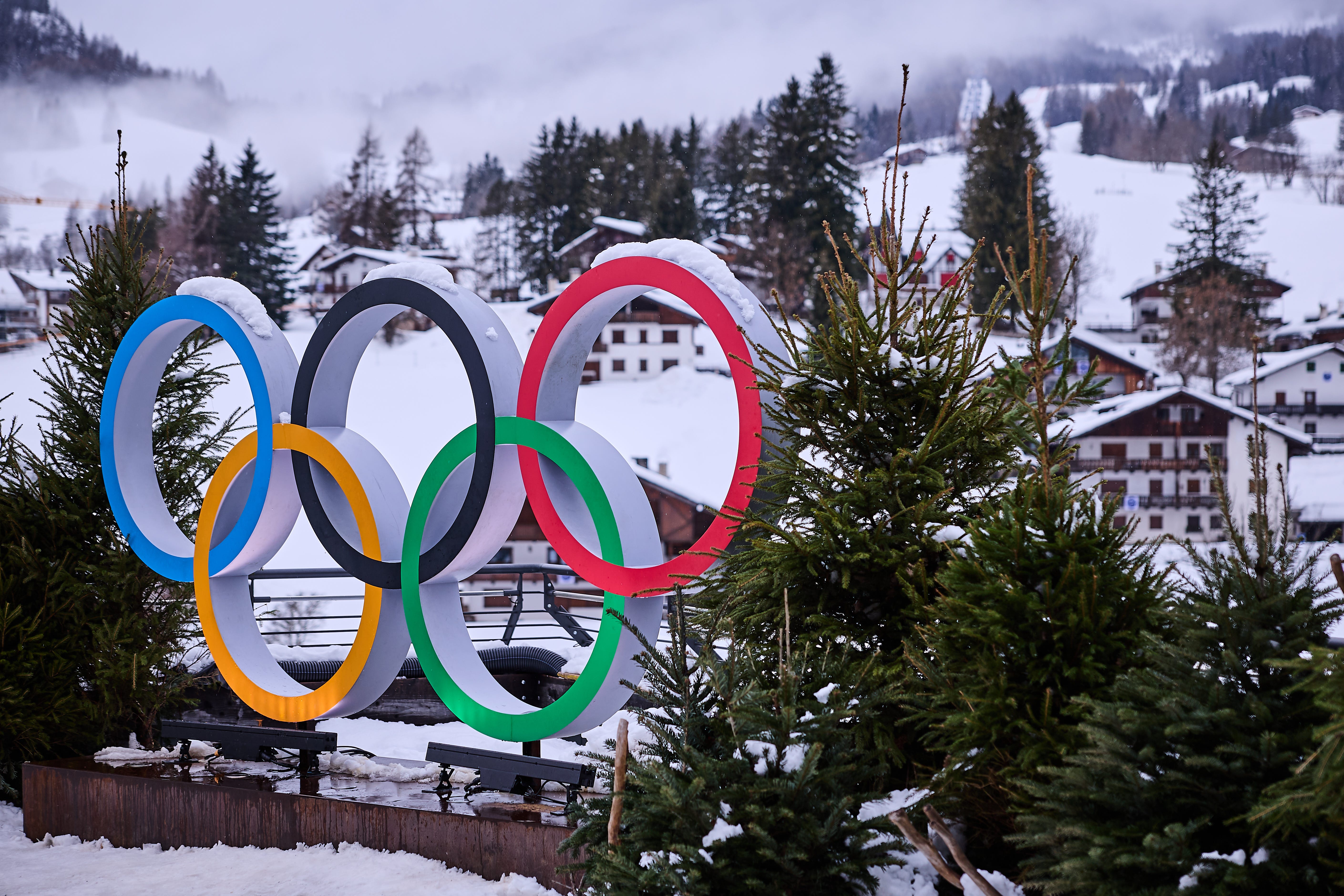
HOW DOES ONE CHEER Team USA’s premier athletes when America is in the grips of an authoritarian attempting to entrench himself in power? With the Winter Olympics in Italy upon us and the World Cup looming this summer, sports fans will soon face precisely this challenge. We will have to find a way to support our nation’s athletes without seeing that support co-opted by a president who claims nearly everything for himself, from prizes he did not earn to legal authorities he does not possess. It will be a test for our athletes, as well.
International sports are an opportunity for athletic competition and excellence, a celebration of national pride, and, more often than the International Olympic Committee might like to admit, soaked in politics. Hitler used the 1936 games in Berlin to showcase Nazism; Israeli athletes were murdered by terrorists in Munich in 1972; the United States boycotted the 1980 Olympics in Moscow in protest of the unprovoked invasion of Afghanistan; and in Sochi in 2014, Russian dictator Vladimir Putin used the games as a domestic propaganda tool and a way to line his friends’—and presumably his own—pockets.
Autocrats have long used sports and athletic success to hype nationalist sentiments and boast of their countries’ and their own personal “strength.” While Trump is liable to tout any American athletic victories as a sign of his new “golden age,” he’s unlikely to stop there. If his narcissistic track record is any indication, he could claim any gold medals the USA wins for himself. His presence may be even heavier during the World Cup, hosted simultaneously by the United States, Canada, and Mexico, as his administration prepares to flex its power over which athletes and fans enter and remain in the country. For the 2028 Olympics planned for Los Angeles, Trump has already signaled his willingness to call in the military.
The Trump administration has been thinking about how to use the Olympics, the World Cup, and other sporting spectacles to advance its agenda. Politico reported last month on a nine-page “Sports Diplomacy Playbook” the State Department quietly distributed to employees late in 2025 to capitalize on the Super Bowl and other sporting events both global and here at home.
Sports diplomacy got off to an icy start in Italy ahead of the Winter Games in Milano and Cortina, after ICE agents were sent to serve “a security role” for Team USA. Boycott vibes are brewing ahead of the World Cup, as well.
Politics and international sporting events aren’t shaped by national leaders alone; athletes, too, have used the Olympic stage for political statements since nearly the very beginning of the modern games, and that’s unlikely to change in Italy over the coming weeks. In 1906, Peter O’Connor, an Irishman chagrined to have to compete under the English flag, scrambled up a flagpole after winning his track event to wave an Irish flag. In Mexico City in 1968, while on the medal stand, Americans Tommie Smith and John Carlos each raised a clenched and gloved fist to protest racism back home—triggering perhaps the most famous political moment staged by Americans on the Olympic podium. Also at the 1968 games, Czechoslovak gymnast Věra Čáslavská’s protest of the Soviet anthem sent a subtle but clear message just two months after Soviet-led forces invaded Prague to forcibly reverse the country’s political reforms. Players on Iran’s national soccer team have sported green armbands, remained silent during their own national anthem, and spoken out on behalf of Iranians protesting their regime—at some genuine personal risk.
SO WHAT ABOUT THE FANS? What are we to do when cheering and flag-waving can be claimed by President Trump, who has sought to put his name on anything he can?
In the former Soviet Union, soccer clubs, with their varying patronages, often served as stand-ins for different elements of society—industry, the military, etc. This afforded Soviet sports fans opportunities for “carefully calibrated oppositionalism,” said Prof. Robert Edelman, a University of California San Diego scholar who has written extensively on sports in the Soviet era, in a recent interview.
One such team, Spartak (“Spartacus”), largely came together as an effort by local merchants to help promote a broad set of local Moscow sports including gymnastics and hockey. Cheering this team over one associated with, say, the Red Army, or state police, gave fans a subtle and safe opportunity to root against armed pillars of the authoritarian state.
Iranian fans protesting the repressive rule of the clerics have even cheered for the other team, as they did during their loss to the U.S. team in the 2022 World Cup, when they took to the streets honking horns and spreading glee on social media. In the stadium in Doha, fans protesting the regime held up posters of Ali Karimi, a former soccer player who has been a vocal supporter of the protests, while clashing with supporters of the state.
And as Mexico prepared to host the 1986 World Cup, cracks in the authoritarian Institutional Revolutionary Party’s (PRI) longtime rule began to show. Its persistent economic mismanagement and inept response to the 1985 Mexico City earthquake transformed the World Cup into a rare platform for Mexicans to voice their dissatisfaction with the PRI’s “perfect dictatorship.” Even before the first match, “We don’t want goals, we want beans” became an unofficial rallying cry for millions facing economic hardship, and President Miguel de la Madrid’s remarks at the opening ceremony were drowned out by massive boos from the stadium crowd. As one government official said at the time: “It seemed to be the right metaphor for the mood of the country.”
For American sports fans seeking inspiration, history provides a guide. Raucous chanting in arenas and pubs has been an option for generations of fans. Until the dawn of this century, the at-home viewer had no similar opportunity to celebrate en masse. Now everyone is connected, inside and out of the stadium, from the pithy social media poster watching on TV to the poster-in-chief himself. There are now myriad ways to root for your team without endorsing its government. Here are some suggestions that might make that divide easier to bridge:
Cheer enthusiastically for all of the athletes on Team USA who embody the virtues of hard work and dedication—and especially uplift those who have spoken out against the administration’s lawlessness, divisiveness, and chaos (the previous Winter Games offer some guidance here).
Where Team USA isn’t in competition, consider supporting democratic allies that the administration has recklessly turned on (Canada, Denmark, France, Germany, and Ukraine, to name a few).
And if President Trump ever attempts to take gold medal credit for himself, ruthless mockery works, too.
Fans of Team USA also found ways of separating their support for the country and its athletes from the president that were rather more direct.
“Ridiculing the tyrant sends a powerful message,” Alejandro Quiroga, a scholar of Franco-era Spain at Newcastle University, said in a recent interview. “It doesn’t change governments as such, but in my experience, the use of humor and irony is pretty powerful to show that the king is naked.”
It’s also important for the protest at home to be connected to those in the stadium, Quiroga said, offering the recent Bruce Springsteen protest song “Streets of Minneapolis” as a potential common starting point. “Link the message. Athletes are fighting for the country, not him. As are we.”
“You lose nothing when you fight for a cause,” Muhammad Ali, the Olympic gold medalist, Olympic torch bearer, and human rights activist once said. “In my mind, the losers are those who don’t have a cause they care about.”
 | A guest post by
|
 | A guest post by
|