Living Waters
Robert Macfarlane’s meditation on the life and times of great waterways poses many perplexing questions but answers few.

Is a River Alive?
by Robert Macfarlane
Norton, 384 pp., $31.99
IN VICKSBURG, I TWICE HAD OCCASION to think of the Mississippi River as a living and capricious thing.
First, as I stood on what is left of the old fort that once secured Confederate control over a crucial portion of the Mississippi, I found myself wondering where, exactly, the river was. I came to realize, only from maps, that the river was the distant shimmer I’d seen among distant trees.
This unsettled me. I would never claim to be a Civil War expert, but I was certain that Vicksburg’s placement directly along the Mississippi River was the reason its capture was so vitally important to the Union—that the battlements of this fort had rained cannon-fire on approaching ships, making its capture an impossible and urgently necessary task for a year, forcing Grant eventually to go all the way around to approach it by land. Yet here I was, standing on the site, and the river was gone.
That’s because on April 26, 1876 at about 2:00 in the afternoon, thirteen years after Ulysses S. Grant sawed the Confederacy in half by capturing the city, the River moved. The Mississippi finally cut through De Soto Point after working on the project for centuries; in a moment, its waters circumvented the Vicksburg Bend entirely, leaving the city quite literally high and dry. So it is that the Gibraltar of the Confederacy has not looked out over the reason for its strategic importance in almost one hundred and fifty years.
Later, during a visit to the Jesse Brent Lower Mississippi River Museum, I watched a short video about the staggering quantities of articulated concrete mats that the Army Corps of Engineers sinks into the banks of the Mississippi every fall to prevent it from eroding its banks and changing course once again. I watched an informational video about the process half a dozen times, struck by the ingenuity and hubris of human beings and by the raw power of the Father of Waters. The river wants to move; by what authority, I wonder, do we think we can stop it?
The acclaimed nature writer Robert Macfarlane, in his new book, asks a version of that same question: Is a River Alive? In search of an answer, he visits river systems in Ecuador, India, and Canada, because:
Each of these places has become a focus for revolutionary thinking about what the philosopher Michel Serres called ‘the natural contract’. Each is a place where rivers are understood in some fundamental way to be alive – and in each place, too, the survival of rivers is under severe threat: in Ecuador from mining, in India from pollution and in Nitassinan from dams.
On each of these expeditions, Macfarlane encounters the rivers and waterways themselves, along with the ecosystems they make possible; he spends time with stalwart defenders of the environment, whose near-hagiographic portraits he carefully composes; he considers the ramifications of his fundamental question.
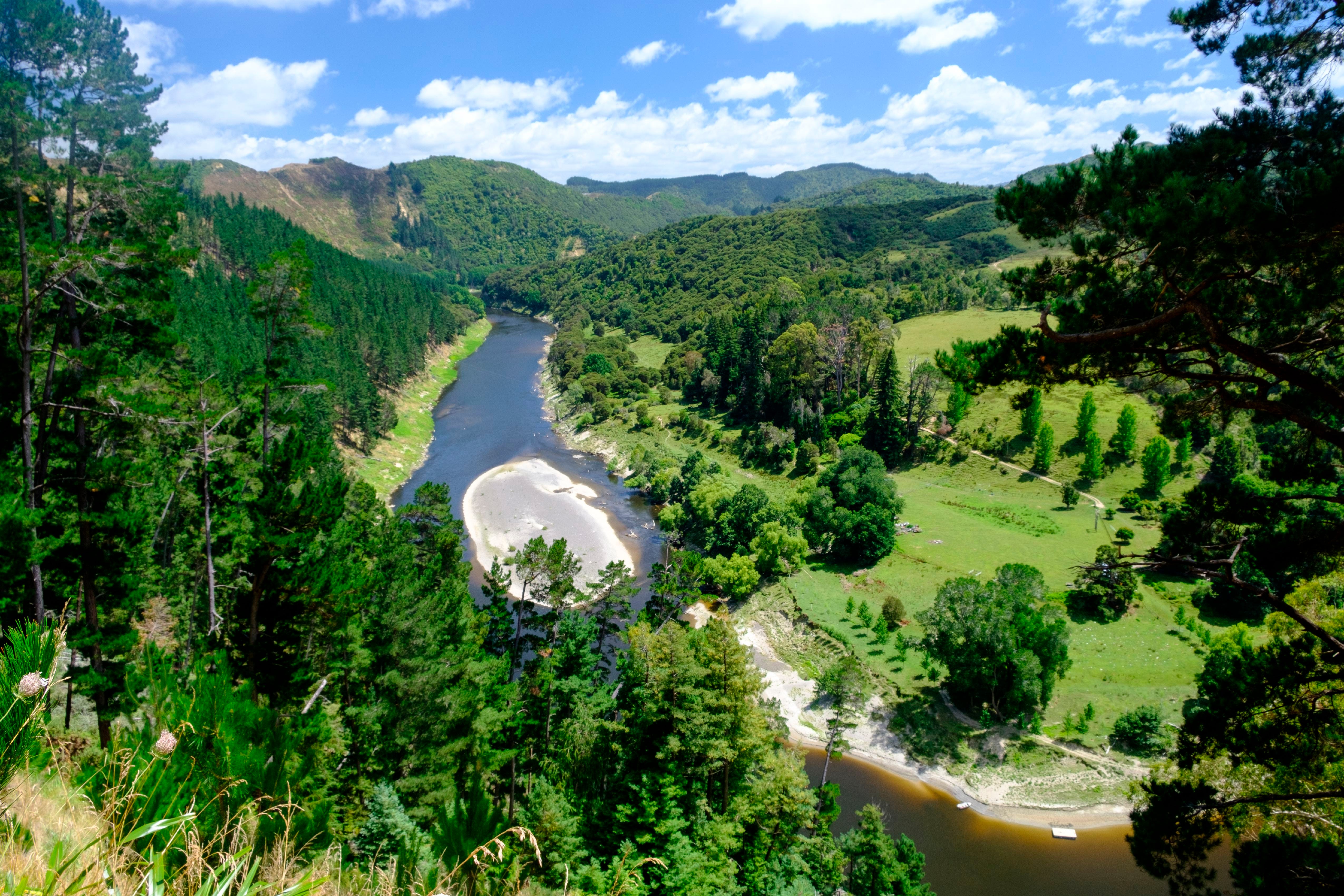
“Is a river alive?” Macfarlane is not only interested in the question’s metaphysical or mystical aspects, but also its unexpected legal ramifications. He describes several movements to grant rivers legal rights and legal personhood, including New Zealand’s Te Awa Tupua Act, passed in 2017 to grant the mighty Whanganui River the “capacity to represent itself in court and to bear rights – the right to flow unpolluted and undammed to the sea, for example, and the right to flourish.” The Whanganui’s interests are represented by “a body of River Guardians known as Te Pou Tupua, who constitute the river’s ‘human face’. The Guardians’ task is to speak with and for the river; their obligation is to promote and protect its life force.”
Macfarlane returns to this idea repeatedly throughout the text. Two of the Ecuadoran people he travels with are judges who ruled that a proposed mining concession in the Los Cedros forest would violate the forest’s rights under the Ecuadoran Constitution. The Mutehekau Shipu, the river he kayaks in Canada, became “the first river in Canada to be recognized as a living, rights-bearing being” thanks to a joint resolution passed in 2021 by local indigenous and municipal councils.
Recognizing rivers as “alive” in a legal sense offers a way of protecting them from humanity’s depredations, and the depredations are many. Macfarlane’s description of the horror that is the polluted waterways of Chennai makes clear that something needs to be done, and urgently. But affording legal personhood to a natural phenomenon results in a proliferation of metaphysical quandaries. Macfarlane writes that he “can’t help but feel a fundamental incommensurability between the stiff discourse of ‘rights’ and ‘standing’ and this quicksilver being running three yards away from me,” and he worries that the need for human proxies to press claims of rights on a river’s behalf will end in a cacophonous spectacle of people “ventriloquizing ‘river’ and ‘forest’ in a kind of cos-play animism.”
These are good and interesting questions, and they raise fascinating problems. The lawyer in me wonders what precise legal mechanisms exist that could allow for recognizing a river’s “rights” in our context; the mystic in me wonders if it is not merely anthropomorphizing but, in some sense, blasphemous to bind a river in juridical chains. (Legal personhood entails legal vulnerability to claims made against you, after all; can you imagine Chevron Corporation vs. The Marañón? More on that sort of thing below.) To my disappointment, Macfarlane is interested in noting these questions as passing curiosities, primarily, not as challenges requiring a real answer from him. That’s partly because, for all its speculative byways, this book is ultimately more a traditional travelogue than a philosophical journey.
So—is it a good travelogue?
PARTS OF IT CERTAINLY are. The cloud-forest of Los Cedros, for example, is drawn like something out of a Studio Ghibli movie. (Ghibli films are a frequent point of visual and imaginative reference throughout the book.) Macfarlane’s friend in Chennai, Yuvan Aves, is beautifully depicted as emerging from a terrible, abusive childhood into a sort of beatific life of teaching children, rescuing sea turtles, and peacefully sharing his apartment with both his mother and colonies of wasps and bees.
But it’s his time in Canada that is the highlight of the book. Macfarlane and several friends kayak the Mutehekau Shipu, the Canadian river recently afforded legal rights. It’s a memorable trip; the group slowly struggles through the long, narrow lake that forms the middle of the river, before, only a few days later, hectically trying to manage the river’s many rapids. The gorgeous vistas and beautiful isolation and the camaraderie make the trip seem heavenly; the blackflies and mosquitoes and recurring opportunities to drown make it seem hellish. Macfarlane is winningly vulnerable about his own deficiencies as a kayaker even as he is awed by the professionals’ ease in navigating even the choppiest waters.
At night, he talks philosophy with his friend Wayne; by day he alternates between fighting with and gliding through the river. This delightful portion of the narrative made me want to go on a long kayaking trip of my own, even though the last time I went kayaking (only a few days ago) my wife and I discovered that we have no idea how to operate a tandem kayak: We spent the entire time describing clumsy S-shapes across Maryland’s lazy Wye River. There were, thankfully, no rapids.
THE PROSE IN A ROBERT MACFARLANE BOOK book is intended to be an end in itself; he aims for poetry. The results, to my ear at least, are mixed. The prose of Is a River Alive? is lush and vivacious, as befits great nature writing, but sometimes it shades into feeling overcrowded and overcooked, those feelings of too-muchness that characterize so much of our artificial human world.
Occasionally, Macfarlane’s lines achieve the texture of good metaphor but forgo the powerful elucidation of authentic figurative language. An example: while traveling in the Ecuadoran forest, which is haunted by the danger of strip-mining, Macfarlane offers this sketch of hummingbirds:
They move around and between us with ear-vibrating thrums, shifting so quickly they seem to beat time. They are so gifted and interdimensional that I long to become one. These are the real ores of the forest, I think, its rare earths: the coppers, silvers and golds, all lapped metal and whirring clockwork.
The first line ends on a note of unhelpful ambiguity: If the hummingbirds “beat time,” it should be because they are moving rhythmically, not quickly, unless he means that the birds are outracing time from one destination to another—but a few extra words are needed to guarantee this meaning; he breaks off instead. Then, too, I understand the urge to frame the birds as the true treasures of the forest, in contrast with the raw materials the rapacious corporations seek so slobberingly, but is “ore” the right word for a hummingbird? Ore is unrefined, rough, unpolished; I suppose it is untouched by human hands, as ideally birds are, but in what world is a hummingbird unfinished? If they are ore, which is raw metal, how are they also “lapped metal” or “whirring clockwork,” both of which denote metals that have been worked by human hands? Does he mean to suggest that the hummingbirds should be understood as a resource to be tapped by humans in some way? And what on earth does “gifted and interdimensional” mean?
I offer these tasting notes partly out of recognition that whether one finds Macfarlane’s stylistic flights enlivening or frustrating will be a matter of taste. While I would never say I prefer prose to be free from ornament, I would be inclined to choose a drier climate over Macfarlane’s swelter. (I will note that I found his prose less distracting in River than I did in Underland, his previous and much-acclaimed book, which I found to be so easily carried away with itself that it became an effortful chore to get through, in places.)
This is not to say that I find all of Macfarlane’s stylistic choices to be unsuccessful. In the interest of fairness, here’s a paragraph I liked quite a bit:
Red ghost crabs are starting their nightly clean-up work on the Chennai beach, flowing up and out of their burrows before scuttling sideways then forwards, like knights on a chessboard, one outsized claw held across their faces like dying heroines, their eyes out on the ends of stalks like Tom when he spots Jerry. The crabs are so alien I can only see them in similes.
The self-aware allusion to his own preceding succession of loosely related images reframes what came before as being as much about seeing as what is seen.
And dying heroines! That’s very good.
YET WE STILL HAVE Macfarlane’s opening question: Is a river alive?
If a river is a legal person with rights, does it also have duties? If the River Guardians can sue a proposed mining operation on the grounds that it will violate the river’s rights, can I also sue the river if it damages me? When the Mississippi shifted away from Vicksburg in 1876, it threatened to destroy the town’s entire economy. Should the people of Vicksburg have been able to sue the Mississippi, whose fickle changes of course cannot be blamed on climate change, or pollution, or any other human action?
How do we define “the river” as a legal entity? Must we painstakingly chart its current course on the day the recognition is signed, or its current course plus its 10-year floodplain? Or is it a violation of the river’s rights to prevent it from redirecting its course entirely? The Mississippi wants to move; must we allow it to do so, or are we within our own rights to bind its current shape with those concrete mats?
And what is the relationship between the rights of the river and the animal inhabitants therein? By recognizing the river’s rights to be free from pollution, it seems to me that our true intended subject is the fish and waterfowl and invertebrates and aquatic vegetation that live in the river—the ecosystem within, not the waterway itself. How do we demarcate the protected population? Is it the population at the time of recognition or at some ideal point prior to current levels of human “interference”? How do we protect the river’s rights without simply creating another opportunity for rent-seeking NIMBYism?
These are the sorts of questions that came to mind as I read this book, and they are almost without exception questions that Macfarlane never addresses. Is it fair to criticize the book for ignoring them? Possibly not. Macfarlane is not a lawyer, and he is not writing for an audience of lawyers; he is writing a meditation, a travelogue, a conversation-starter, not a polemic. I have no doubt that the people who have worked hard to get the governments of New Zealand and Ecuador to recognize the legal personhood of their rivers and forests have thought about these things, and presumably answers to my questions can be found online. But it is odd that a text that claims to wonder what recognizing a river as alive does to “perception, law and politics” spends no time on the practical dimension of creating a whole new kind of legal entity.
 | A guest post by
|