Locking Down the Pentagon Press Is Dangerous
Pete Hegseth’s proposed restrictions would harm the people whom both the military and the press are meant to serve.

VERY FEW INSTITUTIONS are explicitly named in the Constitution and the Bill of Rights, the Framers having settled on a general outline with many blanks left to be filled in later. But among those mentioned are the Army and the press. Congress is empowered “to raise and support Armies”; the Federalist Papers indicate that was specifically to keep military power accountable to the people’s representatives. And the First Amendment draws an even brighter line around journalists: “Congress shall make no law . . . abridging the freedom of speech, or of the press.” One of these institutions exists to defend the Republic; the other exists to inform it. Together, they protect the same ideal—self-government built on public trust.
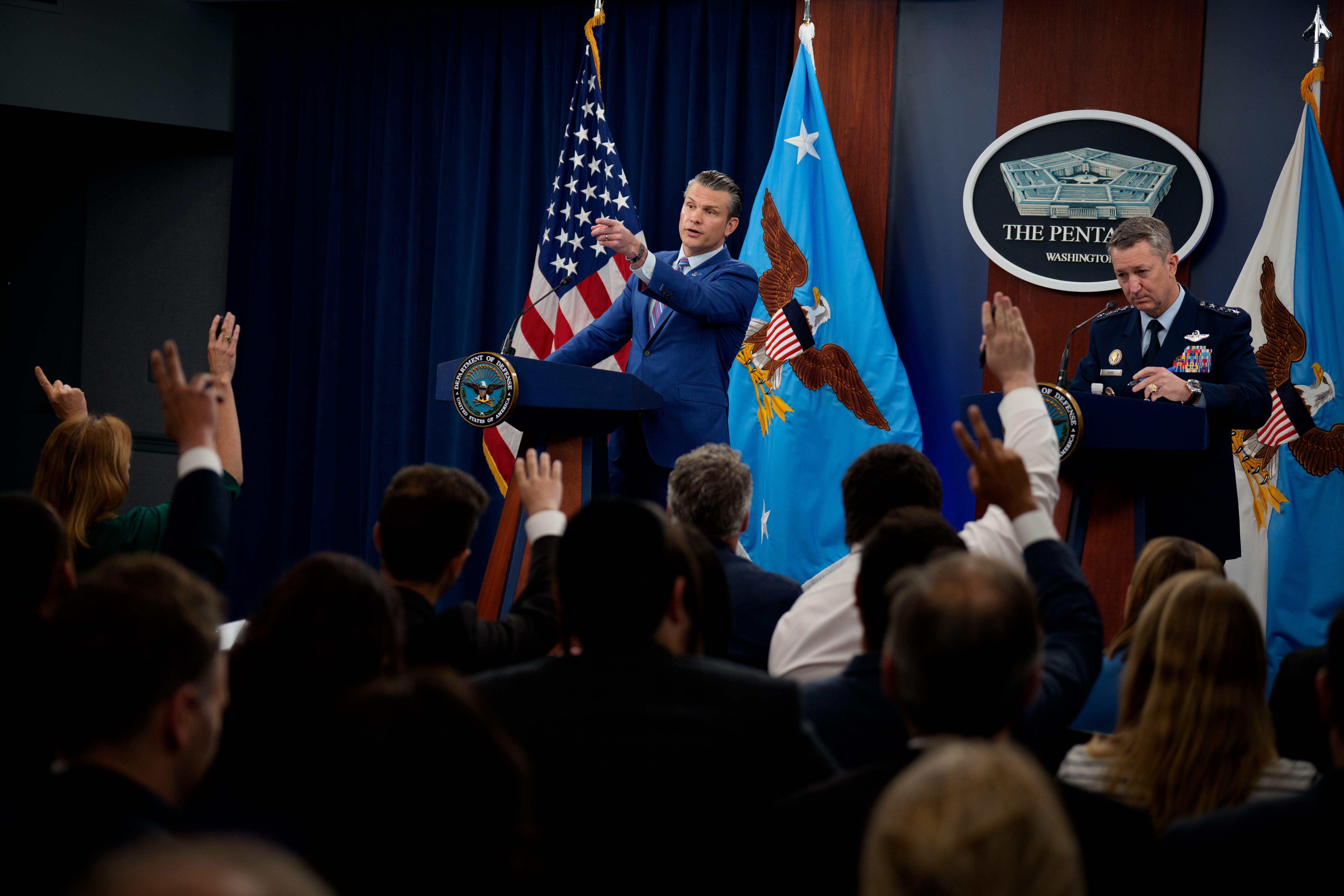
That’s why what’s being considered at the Department of Defense is troubling. Secretary Pete Hegseth has moved to impose sweeping restrictions on the journalists who cover the military—restrictions that would require reporters sign or acknowledge new rules. Those rules condition reporters’ access on a promise not to gather or solicit any information the Pentagon has not pre-cleared for release, even if the information is unclassified. Those who refuse risk losing their credentials and being expelled from the building; movement inside the Pentagon would be tightly controlled with mandatory escort in many areas; and there is threat of revocation of access for “unauthorized disclosure,” a sweeping term that includes broad categories of “controlled but unclassified” information.
The pushback from across the spectrum of media organizations has been telling. The Washington Post, the New York Times, the Associated Press, Newsmax, CNN, and others have said their reporters will not sign. Several outlets reported that refusal could mean surrendering building badges and loss of workspace access. Others noted that the Pentagon has already tightened building movement and rotated longstanding newsroom offices out of preferred spaces. When news organizations with such different editorial perspectives reach the same conclusion—that the policy is incompatible with a free press—that ought to tell us something.
I HAD A LOT OF EXPERIENCE with journalists while in uniform. My first on-camera interview happened during Desert Storm, when an NBC crew approached my Bradley in the middle of the Iraqi desert after the war was over, looking for information on a torture chamber our cavalry squadron had found. Later, in 2003 when I was an assistant division commander with the 1st Armored Division, my division commander, General Marty Dempsey, gave me several tasks, one of which was engage with the press—a distinct mission that, in practice, had me working closely with the media. As a result, we instituted weekly press conferences, and I watched courageous U.S. and international journalists ride our convoys, go on patrols, cover our soldiers, and stand at our memorials. As a result of the work of our public affairs team, three of our soldiers were pictured on the cover of Time magazine as “persons of the year.” The pattern became clear to me: when we were candid, trust grew; when we hedged, suspicion filled the gap. Truthfully, I was never completely comfortable stepping to the microphone or in front of a press gaggle, but my boss had asked me to do it because citizens, our families at home, and soldiers in the field deserved straight answers.
One relationship from those years captures the point. Later in 2007, while I was commanding a division in northern Iraq during the surge, journalist Thom Shanker of the New York Times embedded with us during a particularly dangerous period. I had first met him during my one tour in the Pentagon, when he was a reporter there and I was on the Joint Staff. Knowing him from that previous assignment, I trusted his professionalism. In combat, we gave him unprecedented access, including a seat in some operational planning sessions so he would become familiar with what we were about to do, but with the explicit agreement that he would not publish until the missions were complete. He never broke that trust. In return, his reporting conveyed the reality of what soldiers were doing with clarity and context—neither romanticized nor cynical. After the deployment, we co-wrote a story for a military journal that called the military–media relationship “a dysfunctional marriage.” It wasn’t meant as a sneer; it was an honest description. Ours are two professions with different cultures and incentives, joined by the same obligation to the public. Like parents staying together for the kids, we argue, we often disappoint each other, but we remain in the relationship because the “kids”—for the press, the American people; for the military, the American soldier—need both of us to do our jobs.
That’s the frame I’d offer for those civilian leaders in the Department of Defense. The Pentagon is not merely tightening a policy. It is attempting to redefine journalism inside the building as a narrow privilege granted on condition of obedience—“authorized” questions only, escorted steps, badges forfeited if you decline to sign. The effect is a kind of prior restraint: The government decides what reporters may seek before they seek it, and punishes them for seeking anything else. That view collapses the vital distinction between operational security—protecting specific plans and capabilities so people don’t die—and institutional protection, which too often means shielding organizations from scrutiny or embarrassment. The first is essential; the second is poisonous to public trust.
Let me stress that point: Operational security matters. Every experienced commander knows the difference between information that would get people killed if it’s disclosed and information that would get a staffer disciplined if it’s reported. In the field, commanders handle that with rules and relationships. We embedded reporters and lived the ground rules with them. We told them what they could not release yet—and why—and we trusted them with the rest. That approach was hardly perfect. It was, however, constitutional, and it helped the American public understand what their sons and daughters were doing in their name. As we built trust, I never saw that relationship fail.
The policy now on the table in the Pentagon errs in the opposite direction. It treats routine newsgathering as a presumptive threat and assigns overseers to herd journalists into controlled spaces and controlled questions. It’s not just that this runs against the First Amendment; it’s that it runs against the interests of the Department of Defense itself. A military that becomes opaque becomes mistrusted. A leader who cannot answer basic questions without requiring a signed obedience form will not increase confidence among troops, families, or allies. These rules will increase speculation, rumor, and the belief—fair or not—that someone is hiding something. That’s not how you build legitimacy in a democracy. It’s how you lose it.
SUPPORTERS OF THE NEW RESTRICTIONS say they are “common-sense security” measures. But “security” is not a magic word that suspends the Constitution. Consider the details as reported: a seventeen-page directive warns that journalists may lose credentials for “unauthorized access” or “unauthorized disclosure,” categories now stretched to include broad swaths of “controlled unclassified information.” Another provision requires that even unclassified information be “approved for public release” before it may be shared, and not simply by the reporter’s or editor’s judgment; the government would pre-clear the topic itself. These are not seat-belt rules. They are content rules. The Pentagon Press Association, Reuters, ABC, and others have documented these changes and criticized them accordingly, and, as mentioned, multiple outlets have publicly refused to sign.
Some will argue that if the Pentagon revokes access, reporters can still call sources or file FOIA requests. That misunderstands how public oversight—and the speed of war—works. The Pentagon is a nerve center of American policy, budget, and contingency planning. The ability of journalists to work inside the building—moving, asking, comparing accounts, catching leaders between meetings, attending briefings, and meeting with public-affairs professionals and subject-matter experts—is not a cosmetic perk. It is the mechanism by which ordinary citizens keep eyes on the largest single slice of discretionary federal spending and the institution that sends their loved ones into danger. Shutting down meaningful access at the nerve center does not primarily hurt the press. It hurts the public.
Transparency is not always easy for commanders, either. I know that firsthand. There were days in Baghdad when the last thing I wanted was to stand before cameras or answer questions from a reporter. We had lost soldiers that morning. A mission had gone sideways. Some rumor was bouncing around the wires that would take a paragraph of context to correct and still leave people angry. But each time I considered ducking the press, I tried to imagine the family at Fort Bliss or somewhere in Europe waiting for the evening news. They were not waiting to hear me massage a narrative. They were waiting to hear what was happening to their soldiers—and why. They deserve the truth, spoken plainly. And the nation whose uniform I wore deserves the same.
That instinct does not vanish in peacetime. The Pentagon’s institutional muscle memory should flex toward openness as a default, reserving secrecy for true secrets. If reporters misstate something, pick up the phone and fix it. (General Dempsey called the Fox News reporter in Baghdad many times and told him he didn’t have the information correct, and the network’s chyron was misleading; on one occasion, we watched in the Division Operation Center as the chyron changed in real time on the broadcast.) If someone crosses a line that endangers operations or personnel, enforce the line. But do not pretend that restricting movement, pre-clearing topics, and revoking badges for disfavored inquiries is how free people hold a military accountable. It is how an insecure bureaucracy tries to hold at bay questions of public concern.
There is a deeper symmetry here worth remembering. The Army is constitutionally designed to be powerful and accountable. Congress funds it in two-year cycles to force periodic public debate and control. The press is constitutionally protected to ensure that debate is informed by facts rather than slogans. This is not an accident of drafting. It is the heart of the American idea: force under law; truth without permission. When those two institutions are healthy, the Republic is strong. When either grows contemptuous of the other—soldiers rolling their eyes at “the media,” or reporters assuming the worst about everyone in uniform—the people we serve pay the price.
Most military commanders I know get this. They want Americans to understand what their units are doing, and they want journalists in the building and in the field asking hard questions. They know that even when the press misses a nuance—and it happens—the answer is engagement, not gag orders. They also know that the families of the force deserve transparency worthy of their children’s service. In my experience, soldiers are not afraid of the truth. They are afraid of being reduced to someone else’s narrative.
Let me end where I began. The Constitution explicitly mentions the Army and the press for a reason. One carries rifles; the other carries notebooks; both are instruments of national trust. I’ve been privileged to serve in both roles—defending the American people as a soldier and helping to inform them as a military analyst on CNN—and the lesson is the same in each: If the audio doesn’t match the video, if what they hear doesn’t match what they know exists, trust collapses. The Pentagon should not fear scrutiny by the press corps that walks its halls. It should welcome it and rise to it. In a free country, the Army defends the people—and the press ensures the people know what is being done in their name.
 | A guest post by
|