The Long Road to Peace and Trump’s Short Attention Span
The Israel–Hamas ceasefire is a welcome achievement—but the next steps are vague and the president lacks the temperament to get more.

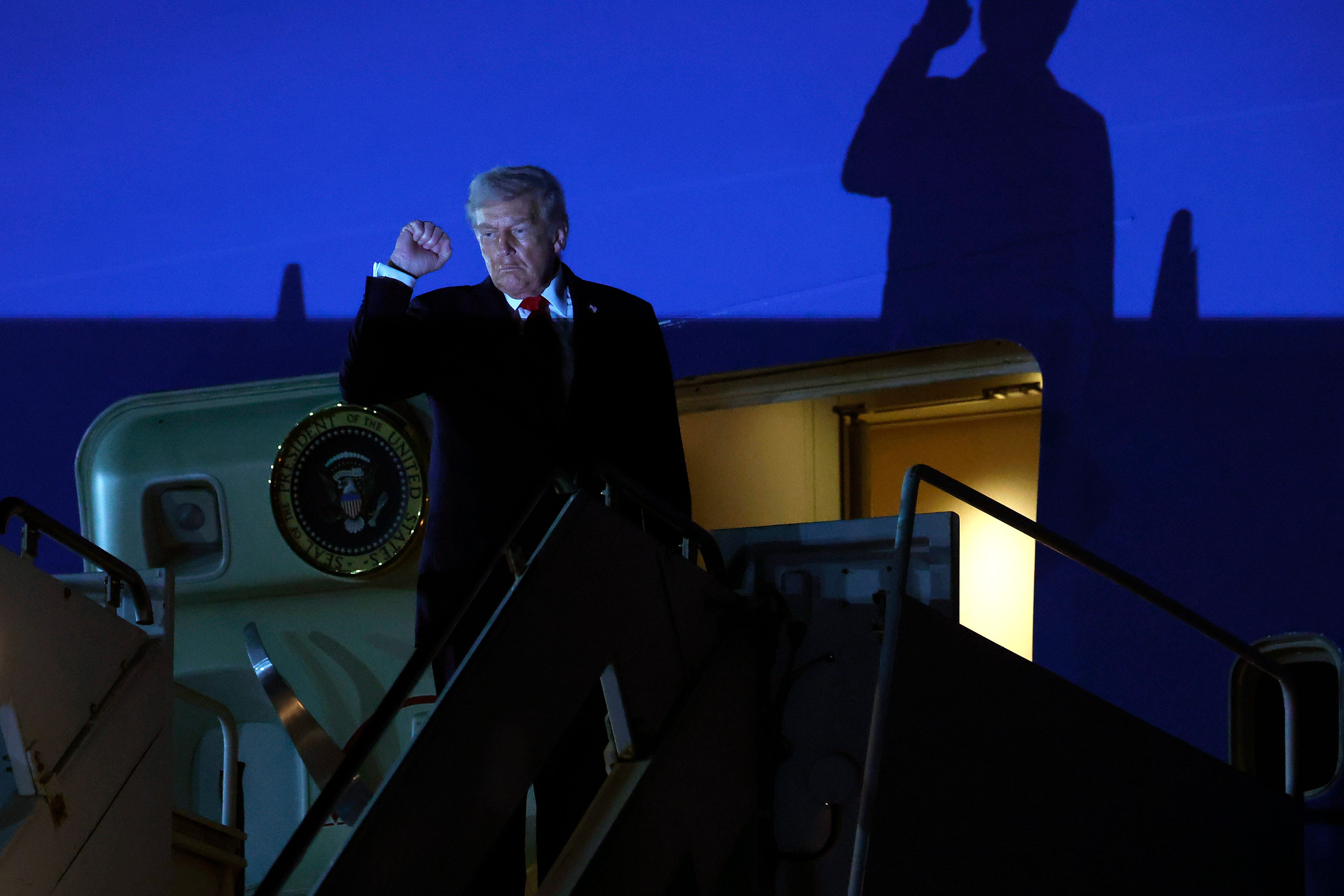
REP. ANNA PAULINA LUNA of Florida was among the first Republican members of Congress to proclaim that President Donald Trump deserves a Nobel Peace Prize for achieving a ceasefire between Israel and Hamas and securing the release of the remaining hostages. House Speaker Mike Johnson, a quick study in the art of laying it on thick, went further, announcing that he was teaming up with Israel’s Knesset speaker to invite parliamentary leaders from around the world to jointly nominate Trump for the peace prize—and for nothing less than inaugurating “a new golden age.” Marco Rubio said Trump had resolved “3,000 years” of conflict.
Though refraining from that level of MAGAfication, Democrats have not stinted on the praise due to Trump for achieving the ceasefire and hostage agreement. Former National Security Advisor Jake Sullivan, Bill and Hillary Clinton, Senate Minority Leader Chuck Schumer, Joe Biden, and Kamala Harris have all offered kudos. They might also have praised the late Alfred Nobel, who, by endowing a peace prize, incentivized generations of leaders to do good—even those whose natural inclinations tend in other directions.
But the rush to declare a new dawn in the Middle East, as Trump and his claque have done, is unworthy of grownups. Yes, it is an unmixed good that the bombs have stopped falling on Palestinian neighborhoods and that the hostages, imprisoned in dungeons for two years, are at last free. Trump deserves praise for getting us to this moment with whatever combination of promises, threats, and inducements he offered. All good. Furthermore, it’s important to note that Benjamin Netanyahu, having placed all his chips on Trump, was uniquely vulnerable to Trump’s pressure.
But let’s keep our heads. This is a ceasefire; it is not peace.
Peace requires that both parties to a conflict accept they cannot achieve their objectives through further violence. The attacks of October 7, 2023 shattered what was left of Israeli trust in their Palestinian counterparts. Support for a Palestinian state once commanded majority support in Israel. That optimism took a big hit after the Second Intifada and collapsed after October 7th. Today, only 21 percent of Israeli adults believe they can peacefully coexist with a Palestinian state.
The views of ordinary Palestinians are difficult to determine with accuracy due to the stress of war, Hamas’s ruthless repression, and other restrictions, but recent polling has found that fewer than 40 percent of Palestinians support Hamas (though 90 percent disbelieved accounts of Hamas atrocities against Israelis on October 7th). While Palestinians apparently wish for different leadership, they don’t seem keen on peaceful coexistence. A 2021 poll found that majorities of Palestinians in the West Bank and Gaza rejected the idea of a two-state solution in favor of one Palestinian entity “from the river to the sea.” The same poll found majorities endorsing the statement “eventually, the Palestinians will control almost all of Palestine, because God is on their side.”
Supporters of Palestinians tend to focus on Israel’s opposition to a Palestinian state while supporters of Israel point to the fact that Palestinians don’t concede the right of Israel to exist. This was the status quo before October 7th. Now things are worse. Deep grief and suffering on both sides have hardened hearts and strengthened resolve. Arguably, no previous war between Israelis and Arabs has been as pitiless and paradigm-shifting.
While one can (just barely) imagine a scenario in which a consortium of nations, including Arab and Muslim countries, unites to restore Gaza’s infrastructure, the crystal ball gets cloudy when you try to picture a governance plan for Gaza that excludes Hamas, let alone an independent Palestinian state without Hamas.
Leading up to the ceasefire and hostage release, Hamas and Israel signed onto a twenty-point plan that is aspirational but also unspecific, vague, and already being violated.
The fourth declaration in the twenty-point plan specified that within seventy-two hours of signing the agreement, all hostages living and dead would be returned to Israel. That has not happened. Only eight of the twenty-eight bodies have been released, and one of those has been determined not to be that of any of the hostages.
NO SOONER DID THE BOMBS CEASE than Hamas fighters began hunting down members of clans who challenge their supremacy. One video showed masked Hamas gunmen assassinating eight bound and blindfolded kneeling figures in a public square in Gaza City. The first declaration of the twenty-point plan reads: “Gaza will be a deradicalized terror-free zone that does not pose a threat to its neighbors.” And the thirteenth item adds that “Hamas and other factions agree to not have any role in the governance of Gaza, directly, indirectly, or in any form.” It’s a worthy aspiration, but saying it—even flanked by world leaders at a meeting in Sharm el-Sheikh, Egypt—doesn’t make it so.
The outlines of what the plan calls a “New Gaza” are gauzy. A “technocratic, apolitical Palestinian committee” will run Gaza until such time as a reformed Palestinian Authority can take over. Who will choose these technocrats? And how can “apolitical” technocrats (whatever they are) really run a territory? To whom will they be answerable? Who will police the streets? Who will disarm Hamas? Will forces from Turkey, Qatar, and Egypt put their soldiers on the ground in Gaza? If Hamas fighters are taking aim at blindfolded clan leaders in a Gaza City square, will Turkish soldiers stop them? What about Qataris? (Qatar has been Hamas’s most munificent benefactor.) And how long would these international monitors remain?
Another item on the twenty-point list is a glancing reference to a “Palestinian Authority” reform program. Who will reform the Palestinian Authority, and along lines designed by whom? Will such reform include deradicalization of textbooks to remove anti-Israel incitement? Will they promote religious tolerance and pluralism?
One can imagine a truly gifted statesman or group of them with huge doses of dedication, time, money, and, perhaps, a dash of humility, undertaking such a mission on the understanding that this would be the work of years if not decades.
Instead, we have the leadership of Donald Trump, who has inserted himself mostly out of lust for glory (read: Nobel Peace Prize), whose time horizon can usually be measured in nanoseconds, and who has been known to claim a win long before the game is over. Recall that after one brief visit with Kim Jong-un during his first term, he declared the nuclear threat from that nation to be over.
Statesmanship requires vision, tact, consistency, and patience. Trump, as even his admirers concede, is more inclined to shooting from the hip and then pivoting and shooting in the opposite direction. It was just a few months ago that Trump was toying with ethnically cleansing the Gaza Strip and turning it into an Arab Riviera under U.S. authority. Presumably, that plan has been permanently shelved.
President Trump did join Israel’s bombing of Iran’s nuclear sites and insisted that the nuclear program was “obliterated,” a finding that intelligence assessments did not support. As the former head of the Bureau of Labor Statistics discovered, our president cannot tolerate inconvenient facts.
Just since the ceasefire agreement was signed, Trump has threatened that if Hamas does not disarm, “we will disarm them.” Is that a true threat or another Riviera? And, by the way, are Trump’s actions consistent with his America First foreign policy agenda? Asked the classic, even clichéd question about the conflict, Trump’s off-the-cuff response was, “We’re talking about rebuilding Gaza. I’m not talking about single state or double state [sic]. . . . At some point, I’ll decide what I think is right.”
He may do just that, or he may be off on another tear about something else. Character is destiny, and Trump’s character is made for division and chaos, not the spadework of diplomacy. The ceasefire and hostage release should be celebrated, but it would be folly to expect much more.