

Loose Talk of ‘Fake News’ Is Bad for Democracy
The secretary of defense shouldn’t pit the military against the media.

DURING TIMES OF WAR, Americans instinctively look for two things: protection and truth.
Our citizens expect our military to defend the nation, and they expect our press to tell us what is happening. That expectation is not a cultural accident or partisan preference; it is constitutional design. The First Amendment to the Constitution states plainly, “Congress shall make no law . . . abridging the freedom of speech, or of the press.” The Founders cherished that protection because they had lived under a crown that punished dissent and manipulated information. They understood that a republic cannot survive if its citizens are kept in the dark or are misled.
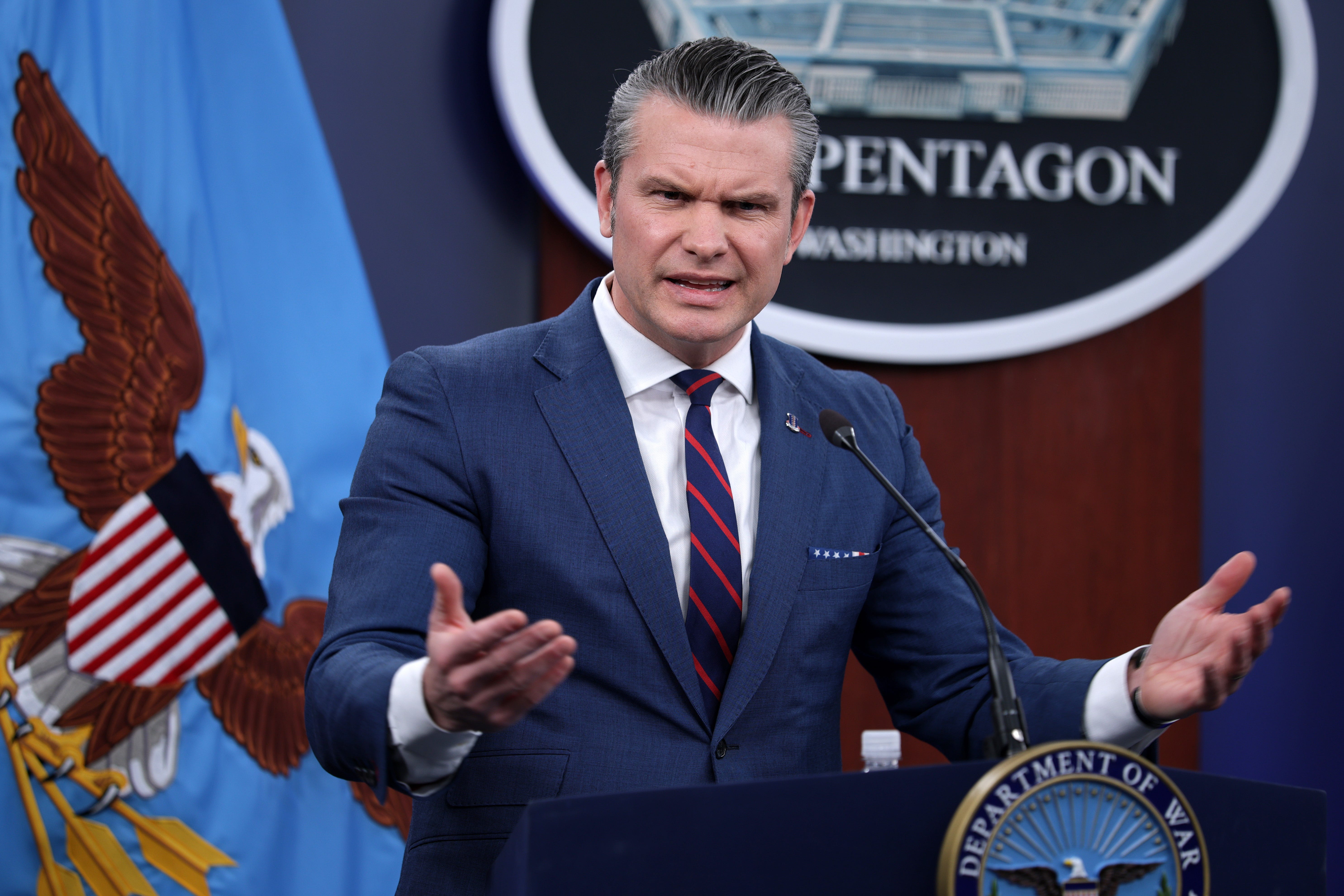
That is why it is so troubling when senior government officials stand at a podium, especially during wartime, and point at reporters and dismiss them as “fake news”—especially when their statements could be taken as equating the American media with foreign enemies. That’s why I grimaced when, in his first public remarks since the beginning of the attack on Iran, Secretary of Defense Pete Hegseth said on Monday, “President Trump and I have your back always, through fire, through criticism, through fake news, through everything, we unleash you because you are the best, most powerful, most lethal fighting force the world has ever seen.” When senior American officials talk like this—especially during combat operations involving American troops—they are undermining a constitutional institution specifically designed to inform the people and hold power accountable.
I wore the uniform for nearly four decades and commanded soldiers in peace and war, and I will readily admit that reporters can often be—using doctrinally correct language—a pain in the ass. They ask hard questions, show up unannounced, and press for details a commander may not be ready to provide. But that’s their job, and soldiers ought to understand that.
As a young major conducting post-combat operations after Desert Storm, I received word that an NBC News crew was at one of our checkpoints in southern Iraq. Our troops there didn’t have a public affairs officer with them, and we had guidance not to allow unescorted journalists into our sector as the battlefield was still dangerous. My first reaction was suspicion, but I checked with higher headquarters, and they agreed to the interview.
What I did not fully record in the short journal entry I made that day—a story that now appears in my forthcoming book, If I Don’t Return: A Father’s Wartime Journal—were the horrors that those journalists had encountered in the wake of Saddam Hussein’s army: torture chambers with iron beds and jumper cables used to shock prisoners, industrial dryers with bodies inside, hooks dangling from ceilings where people had been beaten and hanged. When NBC showed up, we all realized the American people deserved to know what soldiers were confronting. Not slogans. Not sanitized accounts. The truth.
That moment began my decades-long relationship with the media—briefing reporters in Baghdad, embedding journalists with our units, engaging through weekly press conferences, and eventually serving as a military analyst in retirement. Over time, I learned that if you are honest with reporters, most—not all, but most—will respect your honesty. That trust works both ways. During the surge in Iraq, we gave reporters access because Americans wanted to know whether we were making progress, whether their sons and daughters were safe, and what the strategy was. Today, 99 percent of Americans have never worn the uniform; they rely on journalists to bridge the gap between what soldiers experience and what civilians can imagine.
The relationship between the military and the media has always been tense. In an article I wrote with New York Times reporter Thom Shanker, we described the military-media relationship as a “dysfunctional marriage.” Neither side is entirely comfortable, and both sometimes feel misunderstood, but we stay together for the “kids”—that is, for the American soldier and the American public. The Constitution reflects that dual necessity: Article I, Section 8 empowers Congress to “raise and support Armies” and “provide and maintain a Navy,” while the First Amendment protects the press. Security and transparency are not opposing forces; they are both pillars of a democratic republic.
When leaders label reporters “fake” simply because they ask difficult questions or pose queries they don’t want to address, they erode public trust. In modern conflict, if credible journalists are denied access or sidelined, information does not disappear; it is replaced by rumor, propaganda, misinformation, and adversarial narratives. Our enemies understand this; we see in Russia, China, Iran, and extremist movements leaders who exploit information vacuums with disinformation precisely where transparency is weakest.
There are, of course, irresponsible actors in the American media, and errors and bias exist, as they do in every profession—including the profession of arms. But throwing around general accusations of “fake news” is intellectually lazy, strategically shortsighted, and just plain dumb. It signals to the public that independent reporting should be distrusted whenever it challenges those in power. That is not how republics endure. There’s a reason authoritarian regimes target journalists: free reporting constrains unchecked authority.
Thomas Jefferson—no stranger to harsh criticism from newspapers—once wrote, “Were it left to me to decide whether we should have a government without newspapers, or newspapers without a government, I should not hesitate a moment to prefer the latter.” Jefferson did not enjoy the attacks leveled against him, but he understood the necessity of an informed citizenry. So should we.
When American troops deploy, they do so under civilian authority and in the name of the American people. Citizens have both a right and a responsibility to understand what their government and their military are doing, why, and at what cost. Journalists are the conduit. The men and women in uniform do not swear an oath to a person or a party; they swear an oath to support and defend the Constitution—including the First Amendment that protects a free press.
Throwing around baseless accusations of “fake news” during wartime may generate applause, but it weakens one of the institutions that distinguishes us from the regimes we often oppose. The military and the media serve different roles—one defends the nation, the other informs it—but both have been specifically named in our founding documents and both are essential to the health of the republic. Truth, even when it is uncomfortable, is a strategic asset.
If we believe in the Constitution our troops defend, we should show it not only on the battlefield, but also in the briefing room.