Love Advice from the First President
Wisdom and warnings on matters of the heart from the man who was “first in the hearts of his countrymen.”

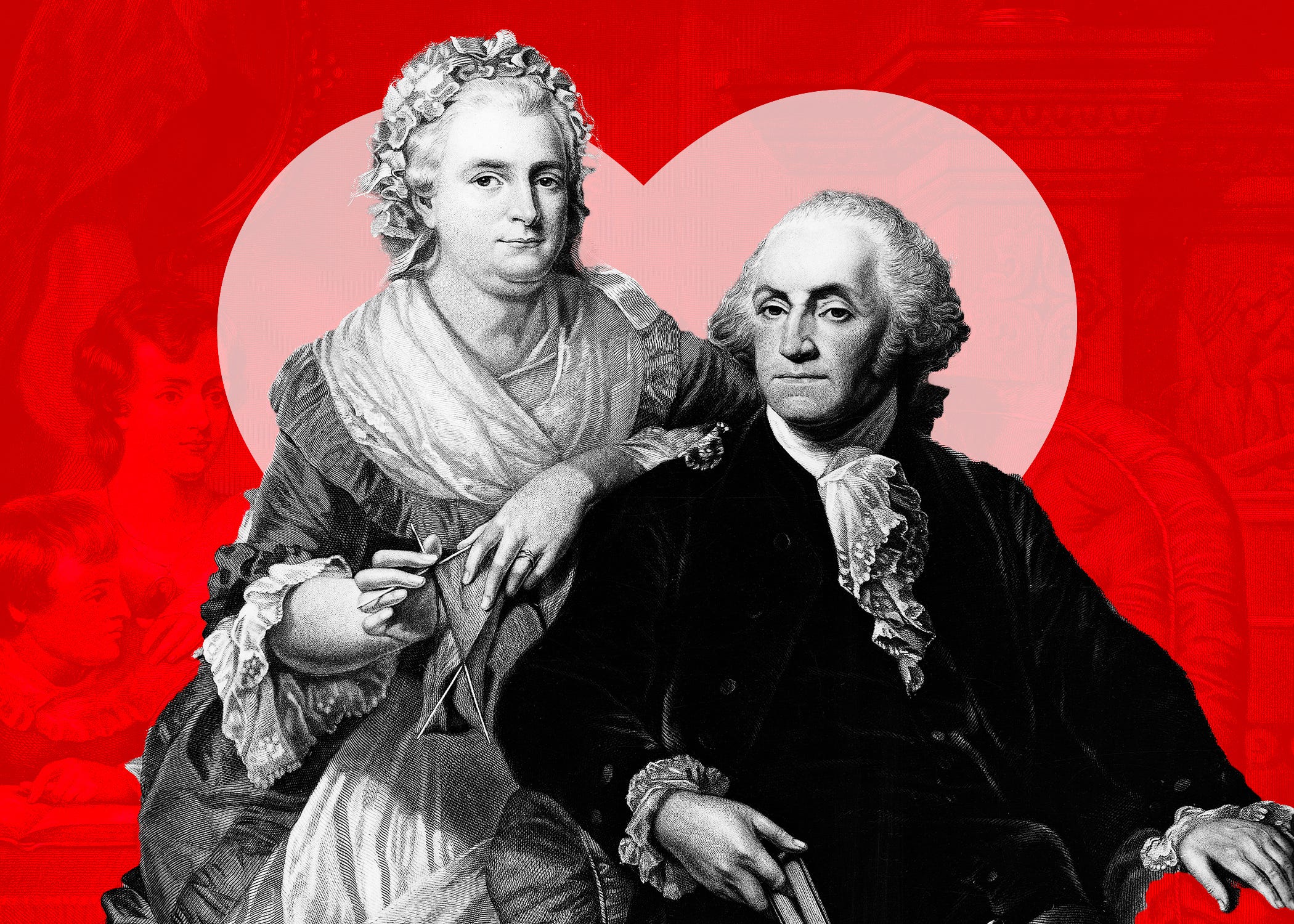
A QUIRK OF THE CALENDAR places Valentine’s Day and George Washington’s birthday a week apart each February, and this year’s calendar is especially quirky with the celebration of both holidays landing on the same long weekend. Presidents and love may not seem a natural combination. It’s certainly one Washington would have appreciated, though. The first president often opined on matters of the heart and dispensed advice to young men and women who asked for his guidance.
For Washington, the “sweets of Matrimony” gave life its truest joy, and he urged the young people in his life—including his stepchildren, his stepgrandchildren, and the officers he came to know with the intimacy of arms during the Revolution—to look carefully for a partner capable of sharing not only the feelings of love, which he compared to a kindling fire, but also the deeper satisfaction of companionship. “For in my estimation,” Washington wrote a French officer, “more permanent & genuine happiness is to be found in the sequestered walks of connubial life, than in the giddy rounds of promiscuous pleasure.”
Always the systematic planner, Washington offered practical advice for discerning love from passion. On one occasion in 1796, he warned Eleanor “Nelly” Custis, the daughter of Martha Washington’s late son John Parke “Jack” Custis, to guard her heart from a gentleman “invader” before her feelings “burst into a blaze.”
Ask yourself, Washington counseled as Nelly considered marriage, how well you know the man, what kind of character he has, and whether he is a “man of sense,” because “a sensible woman can never be happy with a fool.” At the same time, Washington challenged Nelly to admit to herself whether she had engaged in any coquetry, flirtatiously encouraging a man’s ardor without foundation in real feelings. The “thorough coquette dies in celibacy, as a punishment for her attempts [to] mislead others,” Washington reminded.
Washington naturally encouraged Nelly to be certain of a man’s financial prospects. Of course, she should flee a suitor with a taste for gambling, drinking, or free spending. All were sure to bring ruin.
George and Martha had raised Nelly after Jack’s death, and they knew the lifestyle she expected. Ask yourself, Washington said, “Is his fortune sufficient to maintain me in the manner I have been accustomed to live?” Love and financial security went hand in hand, according to Washington.
Two years earlier, he’d given much of the same advice to Nelly’s sister, Elizabeth Parke “Betsey” Custis, when she’d looked forward to an engagement. “Love is a mighty pretty thing; but like all other delicious things, it is cloying,” Washington observed. “Love is too dainty a food to live upon alone.”
A husband, he said, “should possess good sense—good dispositions—and the means of supporting you in the way you have been brought up.” Virginia marriages tended to place financial security above feelings and family property above passion. But Washington was both tender and realistic as he guided his step-granddaughters.
Washington shied away from playing matchmaker directly. He didn’t want to promote the marriage of a couple who might not be well suited for each other, and he understood that if he expressed disapproval, a young man and woman, with minds of their own and resentful of adult interference, might run off together just to prove him wrong. “It has ever been a maxim with me neither to promote, nor to prevent a matrimonial connection,” he told Burwell Bassett, the father of the girl his nephew George Augustine Washington intended to wed. (But Washington did approve of the match, as the couple’s “attachment to each other seems of early growth, warm, & lasting, [and] it bids fair for happiness.”)
Even without Washington’s prodding, the young officers who served as his aides during the war did tend to glow a bit more brightly in the eyes of the ladies because of their proximity to the great man.
Alexander Hamilton met his future wife, Elizabeth Schuyler, while on a mission for Washington that took him near her family estate in Albany; they renewed their acquaintance two years later when she visited the army at Morristown, New Jersey. Aaron Burr likewise met his future bride Theodosia when he accompanied Washington to dine at her home following the Battle of Monmouth. Later, Burr introduced his shy lawyer friend James to a vivacious young widow named Dolley, giving the Madisons their own presidential love story.
WASHINGTON CALLED MARRIAGE the “most interesting event of ones life” and “the foundation of happiness or misery.” He understood what made his marriage a happy one: an emotional connection to Martha that brought peace and contentment. When the pair wed, Martha was famously the wealthiest widow in Virginia, thanks to her first husband, and her assets vaulted George to the top of colonial society. But as Washington biographer Peter Henriques points out, Martha’s role as quiet confidante and unwavering supporter “gave George Washington a gift every bit as valuable as the economic security her wealth conferred on him—the gift of psychic security.”
Washington had his own dangerous passions as a young man. While serving in the Virginia militia during the French and Indian War, he became smitten with Sally Fairfax, the wife of his neighbor and close friend. The two shared flirtatious letters, socialized as part of the same elite circles, and when Washington fell ill with dysentery she visited Mount Vernon (while her husband was in England).
In time, Washington moved on from the crush that was never meant to be, but he could not quite break things off without telling Sally of his feelings in the fall of 1758, around the time of his engagement to Martha. So when, four decades later, Washington cautioned the Custis sisters about how much “inflaminable matter” there is in the human heart, he knew from firsthand experience that it “may burst into a blaze.”
Washington as love doctor may feel incongruous to the image of Washington as commander-in-chief and father of his country, but it was a role he clearly relished.
As we mark the 250th anniversary of the Declaration of Independence, it’s important to imagine the Americans of 1776 in their own context, not only living lives that created enduring ideals of liberty and self-government but also finding love and charting the course of their futures. They debated the high politics of resistance to British rule and the promise of creating the world anew and wrestled with the questions that every person asks, including How can I find someone to love and be loved by?
Although Valentine’s Day was beginning to emerge as a romantic holiday in George Washington’s day, it was really the Victorian age that made it about cards and gifts and sweethearts. Had he lived into the nineteenth century, Washington probably would have enjoyed Valentine’s Day more than celebrations of his birthday, which began in his lifetime and which he endured as something the public demanded.
Only two of George’s letters to Martha survive, both dating to June 1775 as he took up the mantle of commander-in-chief of the Continental Army. Both are addressed to “My dearest.” In the first, he worried about Martha’s safety while he was away and sent along a gift of “two suits of what I was told wa[s] the prettiest Muslin.” In the other, he assured Martha of his love. “I retain an unalterable affection for you, which neither time or distance can change.”
For all his stolid, statesmanlike demeanor, George Washington was a romantic.
David Head is associate lecturer of history at the University of Central Florida. He is the author of, among other books, A Crisis of Peace: George Washington, the Newburgh Conspiracy, and the Fate of the American Revolution (Pegasus, 2019).
 | A guest post by
|