‘Madman Theory’ Confronts a Real Madman
Pretend irrationality has long been a part of U.S. foreign policy. Now we have the real thing.

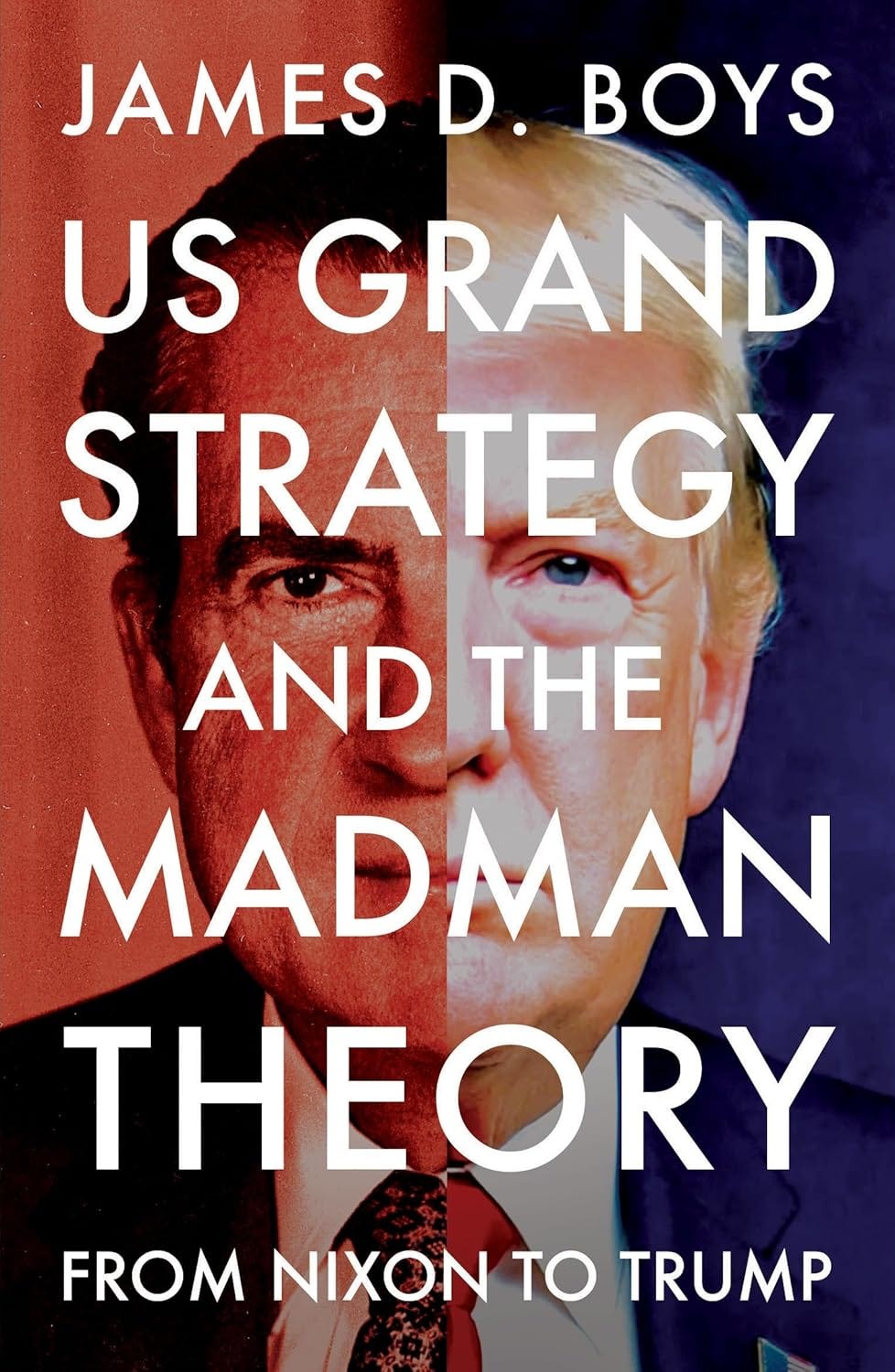
US Grand Strategy and the Madman Theory
From Nixon to Trump
by James D. Boys
Manchester, 288 pp., $21.95 (paperback)
FEIGNED INSANITY IS NOT A NEW development in international politics. Niccolò Machiavelli observed in Discourses on Livy that “It is a very wise thing to simulate madness.”
A certain appetite for risk and the use of deception is essential to effective diplomacy in a violent and anarchic world. The capacity of a great power to think the unthinkable and insinuate that it’s capable of anything—including launching ICBMs—may be necessary to confounding a wily and determined enemy. The bad guys can’t be the only ones capable of making threats. When forced to operate in an insane environment, wrote Bernard Williams, “it is insanity to carry the decorum of sanity into it.” In October 1998 in Belgrade, Slobodan Milošević asked U.S. envoy Richard Holbrooke, “Are you crazy enough to bomb us over these issues we’re talking about in that lousy little Kosovo?” Holbrooke replied: “You bet, we’re just crazy enough to do it.” Within a few months, U.S. airpower was laying waste to targets across the Serbian capital.
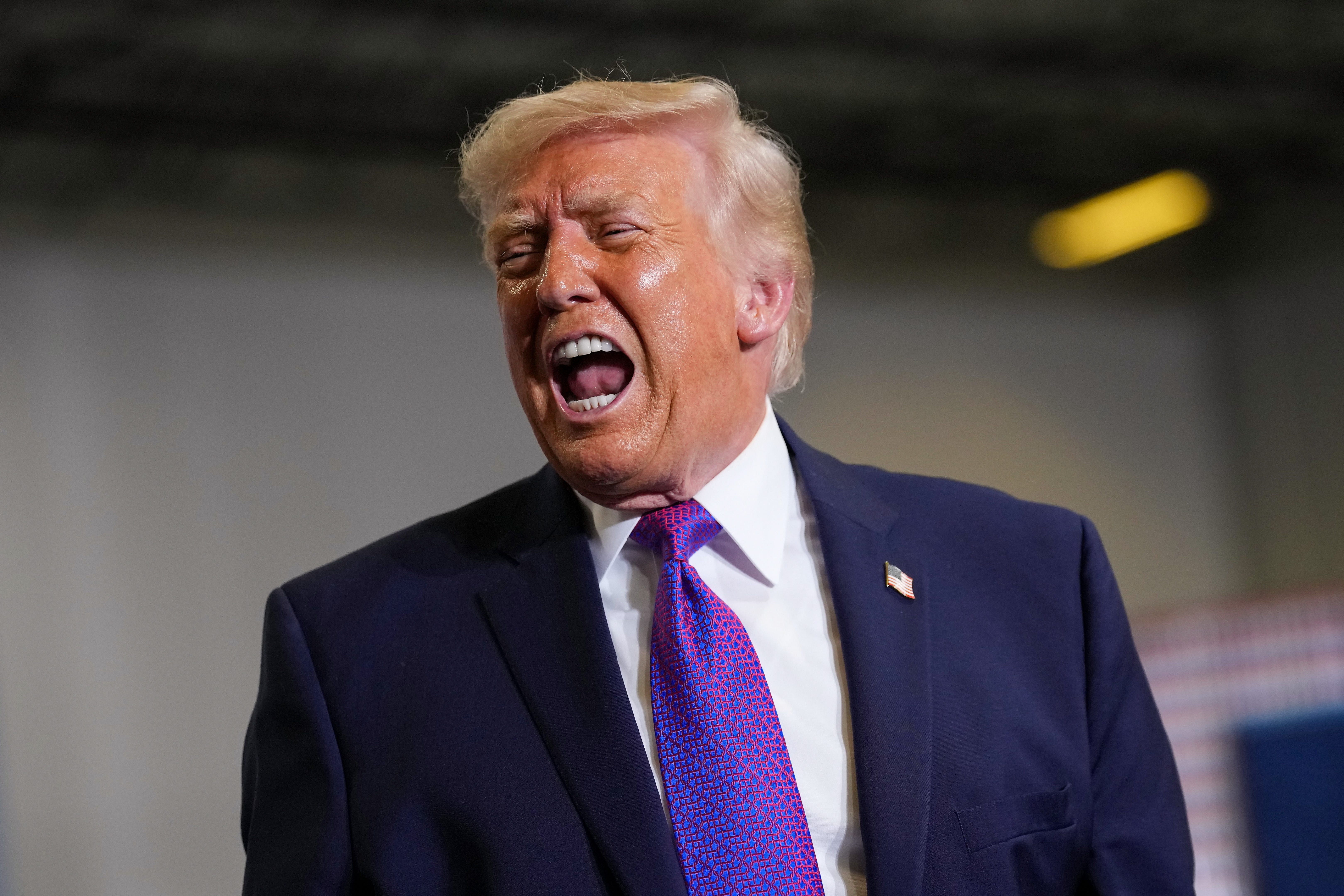
Donald Trump is not a student of Machiavelli, but his mad-cap brand of leadership nonetheless exhibits a strong inclination toward feigned irrationality and the appearance of almost infinite risk tolerance, especially in foreign affairs. President Trump has brought a degree of uncertainty and unpredictability to America’s conduct in the world that is without precedent in the post-war era.
Trump’s first term gave rise to acute concerns that a conflict loomed on the Korean Peninsula. Since previous presidents had failed to quell North Korea’s nuclear ambitions, it fell to the Trump administration to convince Pyongyang of the devastation it risked if it sought to strike the United States with its nascent nuclear arsenal (a capability the Hermit Kingdom still apparently lacks). This involved a major shift, dispensing with “strategic patience” and inaugurating a policy initiative referred to as the “bloody nose.” As Trump threatened “fire and fury like the world has never seen,” he ordered the military to devise new plans for a bombing campaign against North Korea to destroy its nuclear capacity and missile technology. But the new confrontational posture fizzled out without any progress on the outstanding issue of Pyongyang’s illicit arsenal.
Now Trump’s distinctive madman approach has been repurposed in the conflict with the Islamic Republic of Iran. Having failed to bludgeon the theocratic regime into submission, Trump merely escalated his rhetorical firepower. This scheme reached its terrifying zenith when he threatened to destroy the foundations of the Iranian state and eradicate Iranian civilization. But Trump’s mercurial and erratic nature asserted itself, and he agreed to a ceasefire which, apparently, only applies to the United States, while the status of the Strait of Hormuz—and much else—remains in doubt.
In international politics, power is generally presumed to speak in a steady voice. US Grand Strategy and the Madman Theory: From Nixon to Trump asks what happens when it doesn’t—when a superpower tries to make itself feared not for its consistency, but for its volatility. In James D. Boys’s account, the current reliance on unpredictability and the threat of extreme military force to advance U.S. national interests is scarcely novel in the record of U.S. foreign policy. Rather, it’s a tradition with deep roots in American statecraft.
A senior research fellow at the Center on U.S. Politics at University College London, Boys claims that the conventional wisdom about the madman theory deriving from Richard Nixon is somewhat misleading. In the general narrative, Nixon was said to have believed that a certain calculated unpredictability could succeed where traditional measures to establish credibility failed. The premise is simple enough: if your adversary thinks you might act irrationally—might escalate beyond what the situation warrants—they may decide it is safer to concede. And while Nixon may have given the theory its name—“I call it the Madman Theory”—Boys’s contribution is to argue that this logic not only appeared before Nixon, but has lingered, resurfacing in different guises across administrations, adapting to new constraints and finding new claimants. In the book’s opening pages, Boys suggests that Trump, at the beginning of his second term, may be have been “embracing the Madman Theory, an extreme form of coercive bargaining, designed to create the impression of irrationality in the mind of an opponent to gain a favorable outcome.”
THE ORIGIN STORY OF MADMAN THEORY resists neat packaging. For one thing, it was Dwight Eisenhower’s secretary of state, John Foster Dulles, who was credited by many in Washington with having ended the Korean War by hinting to the Chinese that the former Allied commander was ruthless enough to use nuclear weapons in Korea. “Brinkmanship,” the policy closely related to “massive retaliation,” called in Dulles’s words for “the free world to develop the will and organize the means to retaliate instantly against open aggression.” Playing “the role of the tough guy,” Dulles advocated “an extreme form of deterrence, designed to gain major concessions in negotiations by taking nations to the brink of war.” Nixon called this posture the “Dulles Ploy.” (In point of fact, the American threats to use nuclear weapons in Korea probably had less to do with the end of the war than the death of Stalin.)
At this point in history, the madman theory wasn’t so mad. Truman had actually used nuclear weapons. For Eisenhower, using them again wasn’t as unthinkable as it is today.
This was the concept of Massive Retaliation. It was combined with John Foster Dulles’s extreme form of deterrence, Brinkmanship, to establish a new paradigm for US grand strategy. It was a credible threat to resort to extreme firepower predicated on precedence, derived from the nation’s use of atomic weapons in Japan only a decade before, and on Eisenhower’s personal reputation derived from his role in the Second World War. It was a combination that proved inspirational to Richard Nixon’s subsequent embrace of the Madman Theory as he observed Dulles’s machinations and willingness to quietly threaten America’s adversaries with the full extent of its military capabilities.
Yet Nixon himself repudiated the theory that bears his name. As the U.S. Department of State Office of the Historian points out, the “madman theory” entered the historical record not through policy papers but through the 1978 memoirs of H. R. Haldeman. Haldeman described a president keenly aware of his own reputation. Referring to himself in the third person, he said, “They’ll believe any threat of force that Nixon makes because it’s Nixon.” The strategy, if that is what it was, depended less on doctrine than on persona.
Haldeman’s recollection is vivid enough to have fixed the idea in place. Nixon, he wrote, explained it bluntly in 1968: “I call it the Madman Theory, Bob. I want the North Vietnamese to believe that I’ve reached the point that I might do anything to stop the war. . . we can’t restrain him when he’s angry—and he has his hand on the nuclear button”—at which point Ho Chi Minh would supposedly rush to negotiate. Whether this was strategy or theater—or both—is the question that animates large stretches of the book.
Boys approaches that question obliquely, by way of game theory. Developed by John van Neumann (Boys omits John Nash, without whose contribution we would lack such key concepts as the “prisoner’s dilemma”), “Game Theory was based on the strategic structure of poker, designed to calculate the outcome of an actor’s sequential choices, reactions and expectations of each other’s actions.” The Cold War security establishment thought in terms of rational actors, stable preferences, and calculable risks. The madman theory is a kind of hack within that system: It seeks to rewrite the opponent’s expectations by injecting doubt about your own rationality. If American adversaries seriously believe the United States is governed by a highly sensitive and unstable leader, they might find it impossible to avoid passivity and paralysis. If deterrence depends on credibility, this approach depends on something closer to dread.
The paradox is that such dread has to be carefully managed. Boys shows how this became a tool of U.S. grand strategy in the nuclear age as a result of the work of three civilian game theorists: Thomas Schelling, Daniel Ellsberg, and Henry Kissinger. “From their classrooms at Harvard University, their offices at the RAND Corporation in Californian and finally in the Situation Room of the White House, they consulted with the US government, influencing policy during the height of the Cold War.” As Schelling wrote in The Strategy of Conflict, “it is not a universal advantage in situations of conflict to be inalienably and manifestly rational.” But notably, neither Ellsberg nor Schelling ever advocated for a president to simulate madness. For his part, Kissinger sought to leverage a reputation for risk tolerance against American adversaries, but never against friends.
In his best chapters, Boys rehearses the careful choreography behind Nixon’s elaborate shows of supposed volatility. Signals were calibrated, intermediaries deployed, ambiguity cultivated but not allowed to spill over into genuine loss of control. It was, in effect, a performance of instability mounted by a highly controlled system. Too convincing, and the risks spiral; not convincing enough, and the bluff collapses. As Boys correctly points out, Nixon ultimately balked at the kind of recklessness that would’ve ultimately been necessary to persuade the hard men in Hanoi and Moscow to stand down. “Nixon’s use of the Madman Theory failed to persuade the Communist forces that his irrational language and implementation of seemingly irrational actions would result in the deployment of the American nuclear arsenal. The world deduced that Richard Nixon, despite his best efforts to convince adversaries otherwise, remained a rational individual.”
Nixon’s spectacles also failed in other ways: Operation Giant Lance, a massive, secret nuclear alert in October 1969, designed to threaten the Soviets for reasons still murky, apparently went completely unnoticed in either the United States or the Soviet Union.
This tension—between control and chaos, credibility and inexplicability—runs through the book. Boys traces echoes of the madman logic in later administrations, sometimes as deliberate strategy, sometimes as improvisation dressed up after the fact. The pattern is suggestive, if not always conclusive. For this reason, Boys concedes that regarding the madman theory as a pillar of U.S. grand strategy remains “a contentious proposition.”
THE EXPLANATORY VALUE OF THE THEORY gains traction as it moves into the age of Trump, where the old logic of the “empire of trust” underlying the Pax Americana begins to fray. The book’s final act, centered on Trump, is its most persuasive, and also its most disturbing. At first glance, Trump would seem to embody the madman archetype: erratic, confrontational, resistant to the age-old rituals of diplomacy. Boys doesn’t resist this conclusion. Indeed, he suggests that Trump is vested with more genuine madman qualities than Nixon ever was. “Unlike Nixon, who kept his embrace of the Madman Theory a secret,” he writes, “Trump revelled in his reputation for unorthodox, outrageous policy pronouncements.” Certainly, Trump’s behavior during the campaign in Iran amply supports this claim.
“With its embrace of incendiary language and threats to deploy overwhelming military force in defense of U.S. national interests,” Boys writes, perhaps defining “U.S. national interests” too broadly, “the Trump administration’s embrace of the Madman Theory reveals the extent to which the world beyond American shores has become beholden to the whims of the chief executive whose attention to detail is often less than expansive, and whose relationship with the truth is less than stellar.”
Here the limits of the framework come into view. If the madman theory requires intention, what happens when unpredictability is no longer staged? Boys offers a careful answer: perception may matter more than motive. Yet this is a thin reassurance. A strategy that depends on appearing irrational runs the risk, over time, of dissolving into the real thing. “We are what we repeatedly do.” When the adversaries supposedly subject to the intimidation of the madman theory are themselves not entirely rational, the calculus breaks down all the more.
BOYS’S PURPOSE IS TO ARGUE that a through line of calculated irrationality exists from the height of the Cold War to the present, and he succeeds often enough to make the claim stick. But his more valuable contribution lies elsewhere—in showing how seductive the idea remains, especially in the mind of the most mercurial and irresponsible commander in chief in American history.
What lingers is a sense of how narrow the margin can be between calculated risk and genuine instability. Game theory offers a vocabulary for thinking about these choices, but it assumes a level of clarity that real-world politics rarely provides. Leaders misread one another. Signals get lost. Anxiety has been especially applicable in the Trump era. After all, Trump’s attempt to reprise the madman approach has worked better with American allies than adversaries. The People’s Republic of China has been distinctly unmoved by Trump’s economic brinkmanship, and the Islamic Republic of Iran has proved stubbornly resistant to all of Trump’s threats.
US Grand Strategy and the Madman Theory prompts a disquieting question: How much uncertainty can a superpower afford to generate before it loses control of the game it is playing? In the current conflict in the Persian Gulf, while Trump is evidently reluctant to escalate to win and equally loath to beat an ignominious retreat, he seems distinctly willing to destroy the pillars of the Iranian state in a fit of pique. Such an outcome would be disastrous for the people of Iran, and possibly also their tyrannical masters. But it would not leave the American order unscathed.
The madman theory of foreign policy never accounted for the possibility that the president might actually be a madman.
 | A guest post by
|