Meet the Millennial Pastor at the Vanguard of the MAGA Culture War
Pastor/influencer Russell Johnson is the media-savvy new face of growing, Trumpified churches.

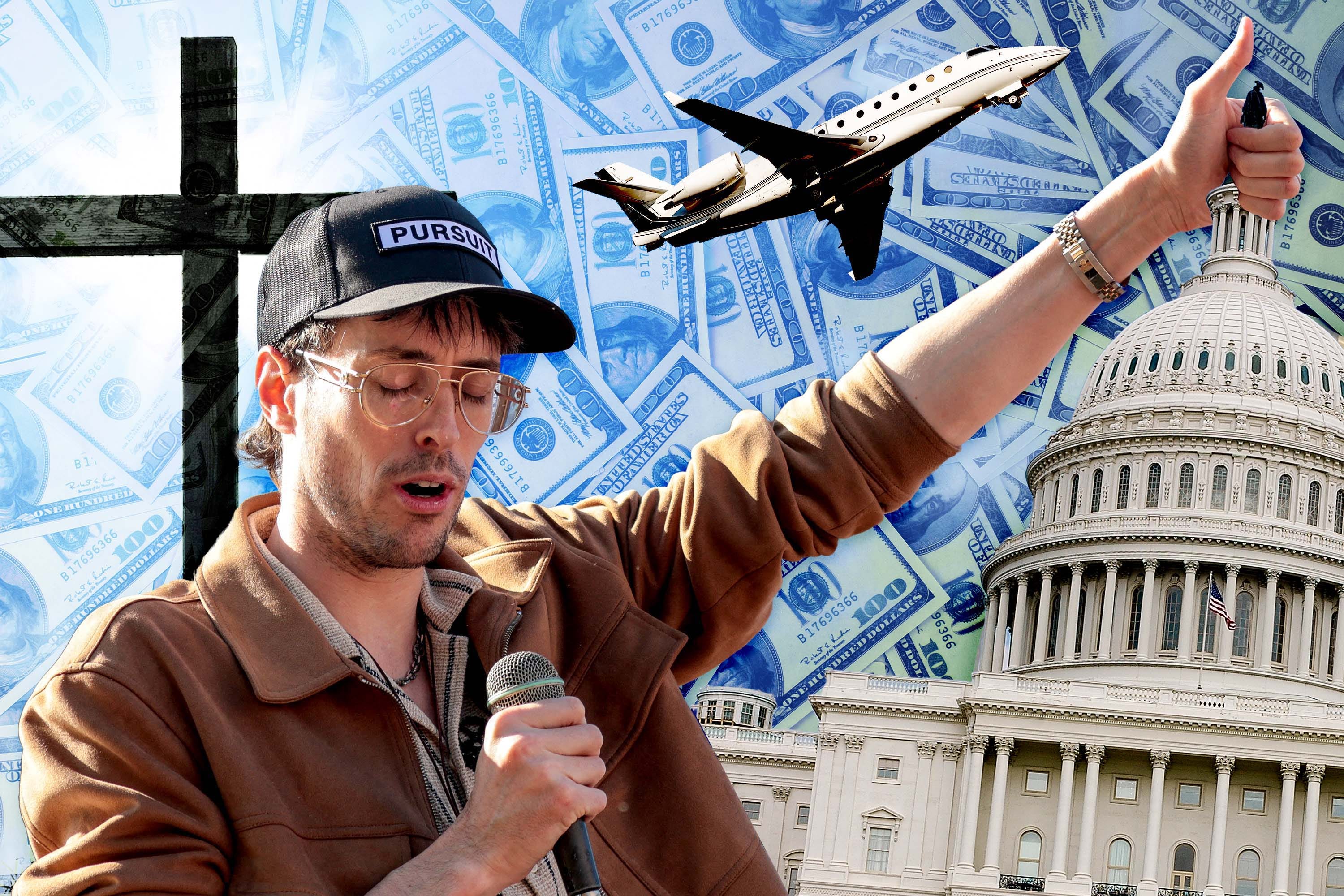
HELL, IN MOST POPULAR ACCOUNTS, is a rather timeless place. But according to Donald Trump’s spiritual adviser Paula White-Cain, it’s not entirely beyond the reach of time.
In fact, when a particular young minister wakes up in the morning, she recently said, an alarm goes off in the underworld. That’s how the devils know it’s time for Satan to get tormented.
Based in the Pacific Northwest, the minister White-Cain was admiring is a former Republican campaign operative and lobbyist-turned-pastor/influencer who has been developing a novel approach to Christian ministry that brings together right-wing politics, belligerence towards the press, digital-native media savvy, and revivalist evangelism. Though you have probably never heard of him, Pastor Russell B. Johnson and the independent charismatic church he founded, the Pursuit NW, have over the past decade built a religious fiefdom in Washington state that today features a growing network of church campuses and alternative educational institutions.
And alongside the tax-exempt church institutions he has been building, the 40-year-old pastor has been creating an explicitly political operation: A PAC based at the church issued a voting guide in 2024 that endorsed Trump for president, and following some legal complications, Johnson’s church recently launched yet another new political organization. As he more openly aligns himself with the MAGA right, it may be that he will play a greater political and cultural role in the latter half of the second Trump administration.
But questions surround Johnson’s synthesizing approach to ministry. As his influence has risen, so have his wealth and his personal fame. And as Trump’s IRS continues to signal its intent to further relax enforcement against churches whose political activities might otherwise threaten their tax-exempt status, Johnson’s ministry could offer a preview of an even more politically aggressive evangelicalism that could emerge in the years ahead.
NOT THAT JOHNSON LOOKS the part, exactly. Johnson can come across like a lanky skater punk from Seattle; over the last few years, he has sported a bleached mullet and favored ripped jeans with a vintage hoodie. But when the edgily attired man opens his mouth to speak, you start to understand why his peers call him “Antifa Spurgeon.”
Charles Spurgeon was a nineteenth-century Baptist preacher in England who became famous for his charismatic oratory. The antifa part comes from Johnson’s fashion sense, not ideology. And the slightly nonsensical nickname that brought those two elements together was inspired by slain MAGA activist and TPUSA founder Charlie Kirk.
“I met Charlie for the first time in Nashville, Tennessee. I was invited to speak at a Turning Point pastors’ summit that he was hosting. After I got done speaking he invited me to be on his podcast,” Johnson has said. “He told me, ‘You know, Russell, you have my wife to thank for how I even know about you. She started sending me preaching clips of this fiery young guy from Seattle who dresses like Antifa but preaches like Spurgeon.’”
Brash and combative, flamboyant and engaging, Johnson is a rising star among right-wing influencers. His growing online profile has led to multiple trips to Washington, D.C. as a member of Paula White-Cain’s National Faith Advisory Board; he was part of a group that visited with Trump at Mar-a-Lago before the 2024 election. His local political activism has grown in tandem with his ministry: In addition to heading his church’s PAC in the run-up to the 2024 election, he helped lead a rally in Seattle last May that resulted in chaotic confrontations with protesters, dozens of arrests, and a lawsuit Johnson filed against the city’s then-mayor.
Charlie Kirk apparently saw the aggro minister as a man for this moment, and he could be taken to be an avatar of just the sort of politics Kirk advocated: Johnson was a political operative before he turned to preaching, and in his ministry, the boundaries between the two categories start to dissolve.
THE SON OF PARENTS WHO worked in ministry and Christian education, Johnson came of age believing he was headed for a career in politics. After graduating from college, he became a lobbyist in Olympia and also supported several Republican campaigns, and he made plans to move to Washington, D.C. to advance his political career. His turn toward ministry began in the mid-2010s. He transitioned out of the professional political world by taking up a youth ministry role at a Pentecostal megachurch before eventually opening his own church in 2014. The Pursuit NW is charismatic, meaning that it welcomes the classic expressions of the gifts of the Holy Spirit, including speaking in tongues, and incorporates them into its worship.
While an MDiv—that is, a Master of Divinity, a labor-intensive degree that typically involves formal theological training and takes three or four years to complete—is the customary qualification for senior church leadership in many denominations, Johnson has taken a different educational path. He holds a bachelor’s degree in biblical studies from a local Bible college and an M.A. in “leadership studies” from a Christian university in California. He is pursuing a Ph.D. at Northwest University, a local Assemblies of God–affiliated school; the only academic program that institution offers at that level of study is in “organizational leadership.” Because the church he founded and leads is independent, he is not ordained within a denomination or subject to denominational oversight, and the Pursuit NW makes little known publicly about its leadership structure and the oversight it provides Johnson beyond having a board of elders and campus pastors.
But all this has done nothing to slow the growth of Johnson’s personal celebrity and influence or the growth of his church. In fact, he has parlayed his hybrid political-theological rhetoric and rousing preaching into a kind of success many other Christian leaders only dream about. Earlier this year, he estimated the Pursuit NW’s membership to number around 5,000 across its four campuses; in connection with the church, he has opened a multi-campus private school serving students through grade 7 and an unaccredited college that offers ministry classes. Further expansion is underway. Recently, Johnson announced the hiring of two new pastors, Ross Johnston and Jay Koopman, who have known and worked with Johnson for years. Religion reporter Kate Burns describes them as “two of the most active street-level operatives in the New Apostolic Reformation (NAR), an enormous and highly influential evangelical movement led by self-appointed Apostles and Prophets who claim to receive fresh, divine revelation directly from God.”
Johnson also has tens of thousands of followers across numerous social media platforms, where he or his team put up post-ironic jokes and memes, clips from his sermons, and glimpses of a dazzling personal life. He has chatted about the Rolexes he’s owned with a watch blogger,1 and the campuses of his church are now spread out widely enough that he charters helicopters and private jets every weekend to preach at each one, including Pursuit’s newest campus in Spokane. He sometimes posts pics and short clips of his Sunday commutes for the enjoyment of his followers on social media. (According to the Spokesman-Review, Johnson has told his congregation that his private air travel is being paid for by “friends of the church.”)

Because the church owns the $2.3 million property that includes his home—he has claimed he bought it himself and donated it to the Pursuit NW so the church could leverage the asset to continue its pace of expansion—he pays no property taxes. It’s a nice bill to miss out on: According to the Snohomish County Assessor’s Office, the last owners of the land Johnson and the church acquired in 2022 were paying the county roughly $16,000 to cover that tax bill each year, but since the property’s designation was changed in 2023 from a private to a religious residence, Johnson and his wife have been on the hook for only around $300 in annual fees to the city to cover water access and fire-department services.
Further, while Johnson claims that his home was a “multi-million dollar gift I made to the church,” a property account summary document provided by the county assessor’s office tells a slightly different story: He and his wife are still named as co-owners of the property alongside The Pursuit Corp.
The Pursuit NW’s website encourages members to give “faithfully and sacrificially.” Tithing is “a baseline of obedience and generosity.” As Johnson recently put it on Instagram, generosity “is measured by how much you have left after you get done giving,” and it “tells God . . . I’m ready for my upgrade and I’m trusting you that you’re gonna provide.” The church’s latest giving campaign has pulled in more than $35 million so far.
The hope of prosperity in this life is both part of the American dream and a quieter theme of Johnson’s preaching, although he has expressly rejected belief in what critics call the “prosperity gospel,” which associates material wealth and success with faithfulness to God. But asked in an email how he reconciles his luxury lifestyle with Christ’s teachings about the spiritual hazards of wealth, he rejected the question as an example of journalists “cosplaying as theologians.” The Bible, he wrote in an email, “doesn’t teach that holiness requires performative poverty, nor does it require pastors to live according to the aesthetic preferences of hostile journalists.” Whether a person is wealthy doesn’t matter, morally or spiritually; their personal attitude toward their wealth—“whether wealth owns the person,” as Johnson puts it—is what’s important.
“I make no apology for enjoying life,” he continued.
Johnson was similarly exercised about other questions I emailed him about his ministry and politics, including some that touched on recent political stories. For instance, asked how he squares a Christian ethic with Trump’s mass deportations–focused immigration policy, which has broken up families across the country and caused untold harms to communities targeted for enforcement, Johnson claimed the question was “morally unserious.” “Scripture commands compassion for the stranger. It doesn’t command national suicide or the erasure of borders,” he wrote.
Does he differ with President Trump on any significant political matters? The former Republican campaign operative insisted on his ideological independence. “There are always policies, appointments, rhetoric, and other decisions I would evaluate critically. I am a pastor, not a campaign surrogate,” he wrote. He did not provide specific examples.
“If any of my answers come across as dismissive or dripping with disdain, that is intentional. I have deep contempt for what your profession has become,” he added before ending on a version of a classic Trump line: “The media truly has become the enemy of the American people.” Johnson then posted the full set of questions and his responses (with hostile commentary about The Bulwark) to his Instagram story.
The aggressive engagement with journalists is part of a larger strategy the pastor has used to grow his reach online as he has worked to expand his church’s presence in Washington state. It isn’t something he turns off when addressing himself to his fellow right-wingers, either.
“Candace Owens is retarded,” Johnson told me in an interview earlier this spring. (“So if you’re looking for a quote, feel free to use that one,” he added.) He expressed disgust with Christians who buy into the right-wing influencer’s “garbage,” particularly her conspiracy theories about Kirk’s death, her rank antisemitism, and her hatred of the state of Israel. (In addition to his pastoring duties, Johnson serves as the Washington state director for Christians United for Israel, the largest Christian Zionist organization in America.) To Johnson, following Owens is a sure sign of “spiritual dysfunction” resulting from spending more time on social media than reading the Bible.
Johnson will be doing his part to combat this dysfunction when he joins other pastors and literal ex-commandos at the Gorge, Washington state’s famous natural amphitheater overlooking the Columbia River, for a Father’s Day weekend men’s conference this month. The two-day event features talks from many core leaders of the modern MAGA evangelical movement—including Mark Driscoll, Eric Metaxas, and Josh Howerton—alongside Christian manosphere podcasters and veterans like Graham Allen, John Lovell, and Chad Robichaux, who will explain what Christian men today need to do to change the culture and achieve their movement’s concrete political goals. Tickets to “Freedom Con: Rise of the Statesman” will put you back around $200—if you’re a man. Women from the church hosting the event can pay $55 for the privilege of taking tickets, distributing food, and even serving on the “tidy team,” which is responsible for cleaning up after the boys.
JOHNSON’S RISE AS A JET-SETTING political pastor with deep connections to MAGA world started before Trump won his second term. Apparently around the time that he visited Mar-a-Lago in 2024, Johnson was invited to join the National Faith Advisory Board (NFAB), an organization led by Trump’s personal pastor, the charismatic televangelist Paula White-Cain, who reportedly has a basement office in the West Wing.2
White-Cain traveled to Johnson’s church in August of last year and extolled his virtues during a service.
“You are so blessed because God has given you one of his choice servants,” she told the congregation of the Pursuit NW. “He’s given you a man that has boldness, courage—[who] is anointed.” She reached for a vivid illustration: Johnson “torments the devil,” and when he wakes up in the morning, she said, “an alarm goes off in hell.”3
Johnson now regularly travels to D.C. to participate in NFAB activities; these sometimes include photo shoots in the Oval Office with the president, who is always game to let pastors pray over him in front of a bank of clicking cameras.
Johnson told me his political activities are the fruit of “a sense of spiritual obligation to be involved in the direction of the country.” He claims his goal is not “theocracy,” narrowly considered: “I don’t want to ban other religions. I don’t want to get rid of the First Amendment. I don’t want to forcibly convert people,” he says, adding that he doesn’t know anyone else in his line of work who would advocate those things.4 Instead, he sees himself as an advocate for the beliefs of people who “have an IQ above room temperature” by opposing things like unchecked crime in the cities.
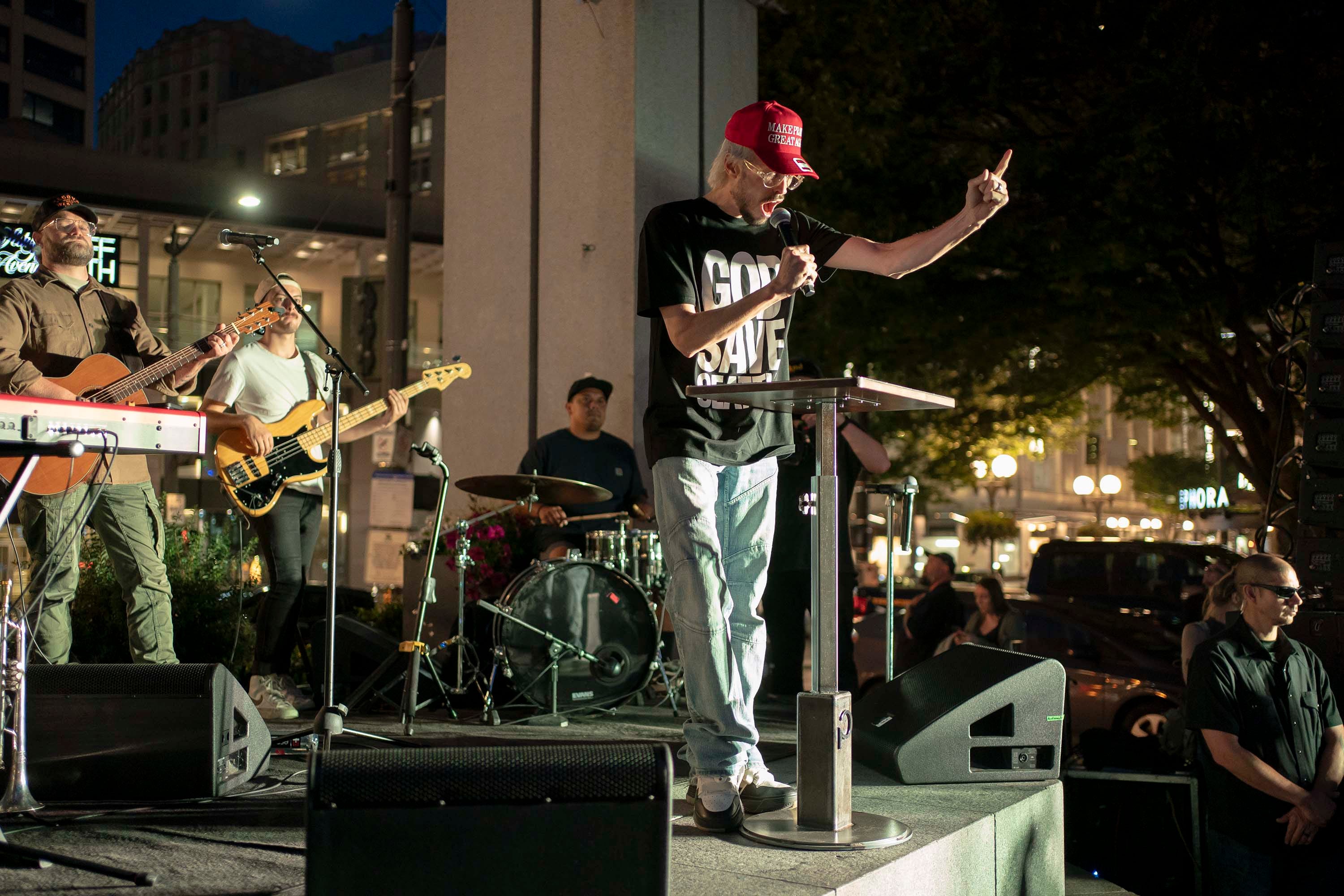
When asked if liberal Christians, people of other religions, sexual minorities, or others who might feel threatened by his religious-political advocacy would flourish if the United States were to fully embrace a confessional Christian identity, Johnson rejected the terms of the question and the idea that these communities would have anything to worry about—even if the government were to uphold its “obligation” to enact laws that reflect the “moral vision” of its “Christian formation.” As he wrote in an email,
Of course, people who are not Christians should be protected (and allowed to flourish) under the law, regardless of who sits in the White House. No serious person is arguing otherwise. But that does not mean America has to pretend it has no moral inheritance, no Christian formation, and no obligation to make laws that reflect a moral vision. Every legal system has a moral bias built into it. The question is not whether public law will reflect morality. It always does. The question is whose morality it will reflect.
Besides, he argued, what about the biases of secularism? “The issue you are avoiding is whether Christians, and conservative Christian conviction [sic], are allowed to flourish in the kind of society you seem to want,” he wrote. “Given how you framed this question, I suspect the answer is obvious.”
Just as many evangelicals and other conservative Christians tend to see secular American society, the Seattle pastor regards his city as hostile territory. Johnson has claimed a campus in the University of Washington district that belongs to his church has been vandalized before, and his congregation has been protested and picketed; unflattering stories about them have made the rounds in local media. In his view, encountering this sort of ambient resistance from the surrounding culture is all just proof that he and his church are on the right track.
The Pursuit NW’s expansion to Spokane has created challenges for local residents, as the Spokesman-Review has reported: Neighbors claim that after moving into the Spokane neighborhood known as Browne’s Addition, the church tore out a community garden, started beaming floodlights into nearby homes, and played music loudly enough on Sunday mornings to rattle walls. The church even defied a city order to cease meeting in the building until it acquired an operational permit, a demand Johnson made light of in his sermon on Easter Sunday.
Then there was the “Mayday USA” event Johnson helped lead in Seattle’s Cal Anderson Park last May. Upset that a Christian anti-LGBTQ+ rally was moving ahead in a famous gay neighborhood in the city—part of the event was dedicated to sharing detransitioning stories—protesters showed up en masse with noisemaking devices of all kinds to disrupt the proceedings. The police intervened, roughing up and arresting many protesters; the then-mayor made a statement criticizing both sides; and Johnson and other rally leaders sued him and the city for discrimination and First Amendment violations. The pastor claimed on Fox that the rally had been “swarmed by hundreds of antifa militants” who had thrown urine-filled water balloons at rallygoers. An extensive report later released by the state’s Office of the Inspector General about the “Mayday USA” episode found that police aggression was primarily to blame for the day’s unrest rather than any specific actions on the part of protesters. It also did not mention any pee-based projectiles. (I was there covering the event, and for what it’s worth, I didn’t see—or smell—anything of the sort, either.)
In all this, Johnson keeps pushing and provoking, claiming any unhappy reactions to his activities attest to the soundness of his strategy. “In that region, if you’re not catching flak, if they’re not trying to cancel you, if they’re not trying to throw you into the fiery furnace, you know, you’re probably not doing much of anything worthwhile,” he said on a podcast with fellow aggro pastor Mark Driscoll. Triggering the libs, you might say, here becomes the mandate of heaven.
THE PURSUIT NW OFFICIALLY obtained 501(c)(3) tax-exempt status in 2017. While the IRS treats all churches as having the status without requiring them to file an application for it, officially applying for the designation makes certain processes easier administratively, including filing for property-tax exemptions. But doing so also imposes limitations on the church’s political activities. In July 2025, the IRS stated that it would permit churches to endorse political candidates directly to their own congregations, considering the act of endorsement as more akin to a “family discussion” than the public political activity the relevant law is intended to prohibit. A judge rejected the agency’s new hands-off approach this past March, and a few days later, the Treasury Department announced that new guidance outlining “clear, administrable standards for houses of worship, including how the law applies to certain communications made within the context of religious services” will be released later this year.
Churches are free to lobby on specific issues without threatening their 501(c)(3) status, which gives pastors like Johnson plenty of room to declaim on social issues—as he does on abortion, LGBT+ issues generally, trans issues in particular, liberalism writ large, and other culture war themes, sometimes directly from his pulpit. But the larger prohibition on tax-exempt church organizations campaigning for or against candidates, made part of the tax code with the Johnson Amendment in 1954 (named for Lyndon B. Johnson), remains in effect, notwithstanding the many times since 2016 that Trump has called for it to be repealed.
From 2023 until earlier this year, Johnson’s church was affiliated with its own political action committee (PAC). According to public information, Johnson was listed as Pursuit PAC’s president; the organization’s last treasurer was Amy Wuerch, who is also listed as the “executive pastor and business officer” of the Pursuit NW’s unaccredited college. Its address was the same as that of the church’s Snohomish campus, and the listed email address was the church’s generic contact address. In the 2024 election, Pursuit PAC endorsed Trump for president and a straight Republican ticket (with the exception of one independent).
The PAC ran on a volunteer basis and its only recorded donations came in 2024; that year, it received a warning from Washington state’s Public Disclosure Commission for minor infractions related to state law, including a failure to disclose its sponsorship of its voting guide. The FEC administratively closed the PAC in March after a period of inactivity, and the PAC’s website URL now bounces visitors to the site of a new organization called “Pursuit United,” which appears to be carrying forward the mission and goals of Pursuit PAC. The new organization’s address is the same as the Pursuit NW’s Kirkland church campus.
Johnson himself has not been shy about telling members of his church and his followers online exactly how he thinks they should vote. He has occasionally shared election guides to his social media feeds. He posted his most recent “Pastor’s Picks” (subheading: “Getting Conservative Leaders Elected”) during the lead-up to last year’s elections, making recommendations for almost all races and proposals that would appear on ballots in Western Washington counties and cities. Most of Johnson’s lists came from a man named Joe Fuiten, the “pastor emeritus” of the church where Johnson got his start in youth ministry. Fuiten has written about his approach to voting guides and endorsements: “I personally almost always align with Republicans since they tend to align with me and my Biblical values. Even when I have endorsed Republicans who are liberal I have almost always done so because even a liberal Republican strengthens the political influence of Republican majorities who tend toward my views.”
Johnson and his PAC’s endorsements and other activities raise complicated questions about what the tax code allows for churches that wish to retain their 501(c)(3) status. It’s not likely to be a pressing concern for the pastor, however: For years, the IRS has been relaxing enforcement in this area, as a joint investigation by ProPublica and the Texas Tribune found in 2022, and this in turn has emboldened more and more churches to push the boundaries of tax law relating to political speech. Ultimately, if Trump were to get his longstanding wish for the Johnson Amendment to be repealed outright, conservative pastors across the country who wish to incorporate a more overt political strategy into their ministries will look for models among those who have spent years pushing the line. Johnson’s approach with the Pursuit NW gives a sense for what could be ahead for American churches if we do cross the threshold into a post–Johnson Amendment era.
For now, Seattle’s Antifa Spurgeon is preparing for his moment at Freedom Con on a stage usually reserved for rock stars. He also still enjoys the TPUSA imprimatur; the Kirkland campus of Russell’s church is the only location in Washington state that will receive a visit from Erika Kirk during her nationwide “Make Heaven Crowded” tour this summer. She’ll be stopping by on July 24.
If you think that the National Faith Advisory Board to which Russell belongs is an entity within the Trump administration, you would be (forgivably) mistaken. That’s the White House Faith Office. Though both entities have White-Cain at the head, the faith office is technically a government organization with precedents in prior administrations that Trump established by executive order in February 2025, whereas the advisory board is a private nonprofit incorporated in Florida.
White-Cain was one of several high-profile evangelists investigated by Sen. Chuck Grassley from 2008 to 2011 over concerns about lavish spending and possible financial impropriety; she did not cooperate with the investigation, and some staffers from her ministry backed out of offering comments out of fear of being sued by her church. An advocate of what critics call the “prosperity gospel,” she has often connected giving financially to her ministry to receiving gifts in return of a supernatural kind. White-Cain is not the only person to appear at Johnson’s church who was a subject in Grassley’s investigation: So was Benny Hinn, the faith-healing evangelist, who hosted an Easter “miracle crusade” with Johnson’s church in 2023.
Johnson would not need to look far to find high-profile Christian leaders who advocate some of these positions. One example is Doug Wilson, a pastor who recently spoke at the Pentagon at Secretary of Defense Pete Hegseth’s invitation. In Wilson’s ideal Christian society, Catholics would be banned from certain public displays of devotion, and Muslims would be prohibited from broadcasting calls to prayer; nonbelievers would be stripped of the franchise.
 | A guest post by
|