

‘Michael’ Review
Or, How I Learned to Stop Worrying and Love Saint MJ.

FEW TOOLS IN HUMAN HISTORY have held more power to sway perceptions of reality than the motion picture. We are creatures that have evolved to accept what we see and what we hear as the truth; it is why, in Nineteen Eighty-Four, the most damning evidence of the Party’s totalitarianism is the demand “you reject the evidence of your eyes and ears.” As historian Thomas Doherty notes in his new book on documentaries drawn from newsreels, How Film Became History, cinema, at least until the rise of algorithmic social media, was the ultimate propagandist’s tool. In early Soviet Russia, for instance, “footage from the recent past was collected to teach Revolutionary doctrine, to deify Lenin (and later Stalin), and to tell, and retell, the Bolshevik origin story. The archival instinct merged with the totalitarian impulse to rewrite and recast the past to suit the ideological needs of the present.”
Understanding the ability of present filmmakers to rewrite (or erase) sins of the past is paramount to understanding why Michael exists in the form audiences will see it in. As Puck’s Matthew Belloni has chronicled over the last couple of years, this biopic, which was made with the blessing of the Jackson estate, underwent massive reshoots when someone somewhere realized that the Jackson estate is, legally, not allowed to dramatize the sexual assault accusations leveled against the King of Pop by then-13-year-old Jordan Chandler. And how, pray tell, did the script initially read? Here’s Belloni in January 2025:
The script begins and ends during the 1993 investigation into statements about Jackson’s anatomy made by Jordan Chandler, the then-13-year-old boy whose molestation claim led to worldwide headlines and an eventual $20 million settlement. The script depicts Jackson as the naïve victim of the money-grubbing Chandlers, whose unfounded claims force Jackson to endure ridicule and persecution until he ultimately settles, his resolve and reputation forever in tatters.
Whoops.
I have no special knowledge of or insight into the accusations leveled against Jackson by multiple young men over the years. (They seem relatively compelling, but what do I know?) I do know a little something about the power of film, however, as did whoever worked out that deal for Chandler. Because they knew that the power of film, if left unchecked, would allow the Jacksons to rewrite the story in the public imagination forever.
Confronted with an unreleasable nine-figure investment, producers Graham King (Bohemian Rhapsody) and John Branca (MJ’s real-life lawyer1), along with director Antoine Fuqua (Training Day), scrambled to salvage the movie, and the resulting picture is . . . odd. What we’re left with is a biopic that has been stripped of nearly all dramatic tension, a chronicle of a, perhaps the, pop star’s rise . . . and rise . . . and rise. One that is rinsed in a beatific glow of childlike wonder, angel-voiced innocence. One that undeniably makes you want to dance in your seat because whatever Michael Jackson’s sins, he was a magnetic performer with an almost-unmatched back catalogue. One that almost feels as if it’s trolling those who hope a picture like this might honestly examine some of the thornier sides of Jackson’s life.
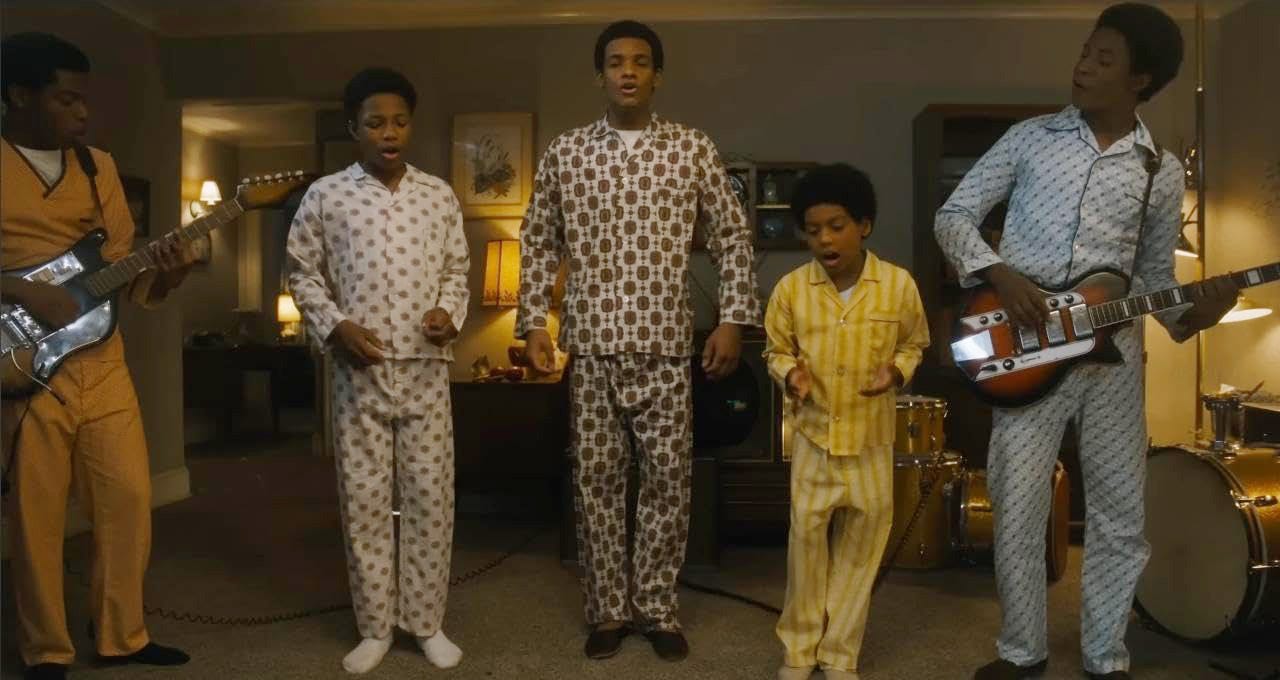
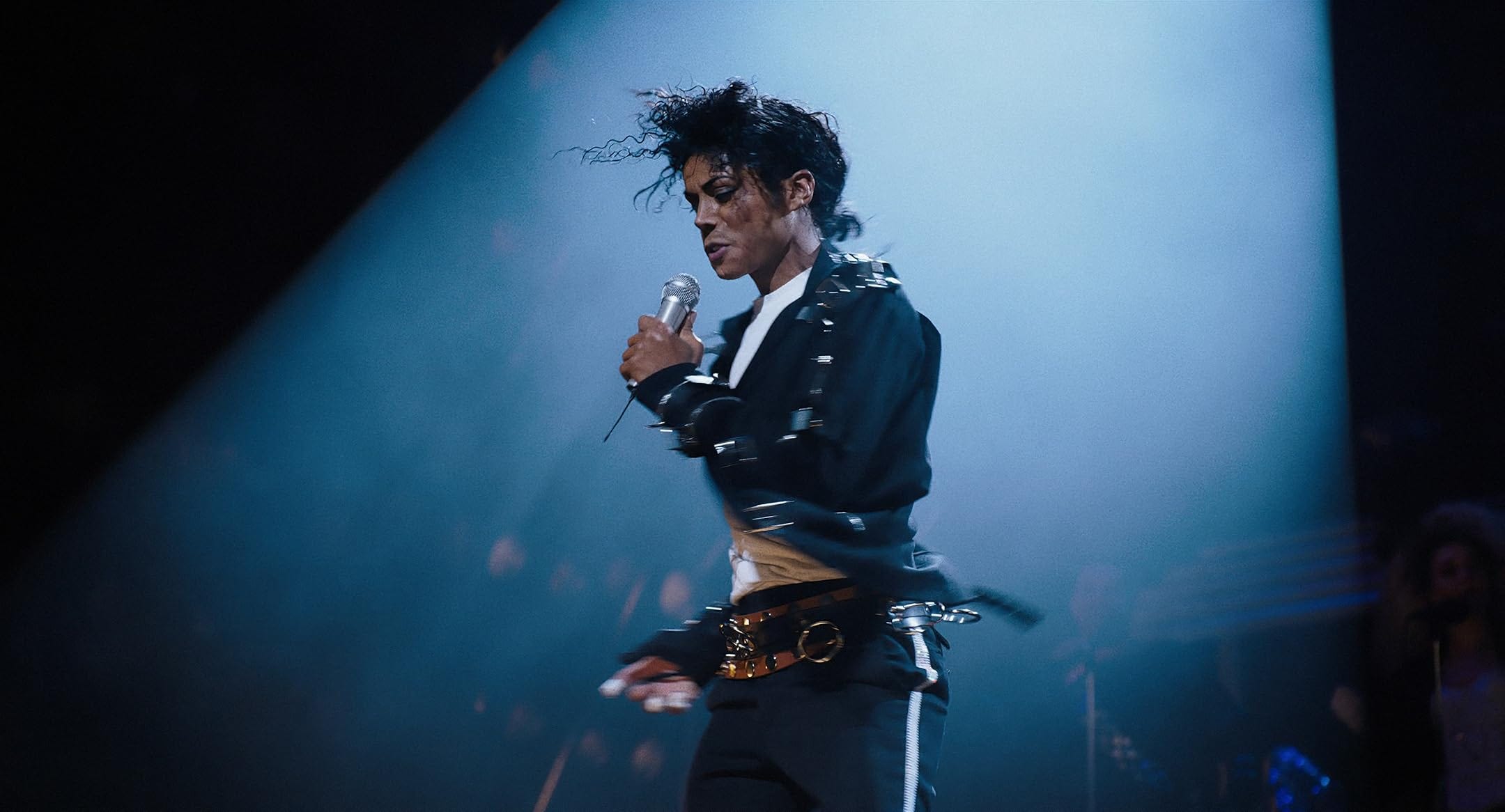
Rather than the sexual abuse investigation, Michael is now bookended by a performance of “Bad” in London. In between, we see the aforementioned endless rise. As the youngest member of the Jackson 5, Michael (played as a child by Juliano Valdi) is both obviously the best singer and the best dancer. And yet, he is treated horribly by his father, Joseph (Colman Domingo), constantly beaten with belts and made to sing long past the point of exhaustion. The hard work pays off and soon the boys are at Motown, where Berry Gordy (Larenz Tate) is a sort of surrogate father figure for Michael, indulging his questions about production and mixing, telling him he has the best voice he’s ever heard.
The Jackson 5 surge to the top of the charts and we see and hear them play a bunch of of their best numbers, like “ABC.” The songs, the hits: This is the part of the movie that’s easy as 123, do-re-mi. It’s why, frankly, producer King needed the help of Branca and the Jackson family: Without the hits, there’s no movie. What’s the point of a Michael Jackson biopic if you’re not going to have an older Michael (played as an adult by Jaafar Jackson, MJ’s nephew via his brother, Jermaine) singing “Don’t Stop ’Til You Get Enough” and “Beat It” and “Thriller” and “Billie Jean”?
This is why, for most filmgoers, it will not matter that the film is completely lacking in dramatic tension, that the only thing we are left wondering is why anyone, anywhere, denies Michael a single thing. Fuqua, an accomplished action director who has made, among other films, the Equalizer series, Olympus Has Fallen, and Tears of the Sun, leans on his music-video roots here, shooting Jaafar with an eye for the kineticism that was key to MJ’s success. Michael’s movements were like a magic trick: Even if you’re not a student of dance (and Lord knows, I am not), you can’t help but gawk. MJ’s nephew does a more-than-serviceable job of mimicking his fluidity, and whatever studio magic they’ve used to recreate Jackson’s vocal stylings works.
Domingo’s Joseph is borderline camp, a hunched, sneering villain who plots with, among others, Don King (Deon Cole) to exploit his most talented offspring to the full extent of the law. He seems intent on crushing the saintly Michael, whom we see buying toys for children, and visiting children in hospitals, and signing autographs for children whenever asked. That’s it, though; he never did anything else with children. Don’t even suggest it!
Again, from a dramatic viewpoint, this is a very strange film. There’s simply no conflict within Jackson himself, and nothing for him to overcome, period, aside from his father. There’s no internal struggle at all, no self-doubt. Say what you will about the potentially evil version of Michael that existed before the lawyers got ahold of it: That at least sounded like it had something approaching a dramatic arc.
What wound up in theaters does not: It is a rather straightforward celebration of Michael Jackson’s music, one designed to get people dancing in the aisles and singing along with the script. I have no doubt it will be an enormous hit: The paying audience I saw it with loved it from start to finish. If all you’re looking for is a two-hour montage of MJ classics, you’re in for a treat. If, on the other hand, you want something like insight into the man behind the music, well, you’re out of luck.
Branca is played in the film with impeccable cool by Top Gun: Maverick’s Miles Teller, a world-class piece of vanity casting.
So, really, I can just save a lot of effort and money by going online and watching a bunch of real Jackson 5 and MJ videos.
An interesting movie would be one about his dad. Or Colonel Tom Parker. Or Don Robey. Or any of the notorious bastards of pop music history.