NATO’s Been Talking About Greenland for Years
The island matters a lot—not as territory to acquire but as a linchpin of deterrence.

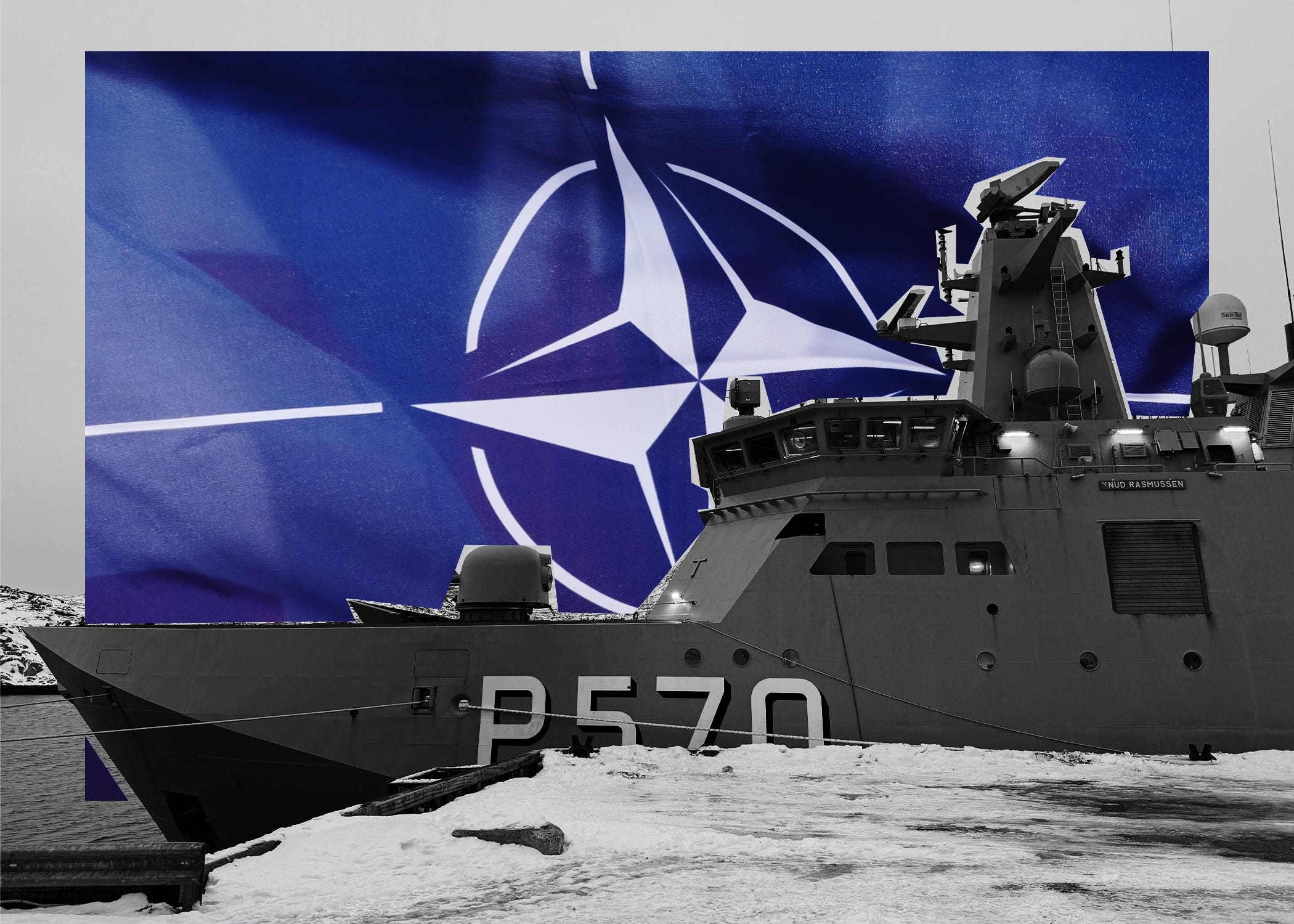
DONALD TRUMP’S FIXATION ON GREENLAND has had a strange and probably unintended effect: It has pulled a long-running NATO conversation into the American political spotlight.
Trump’s interest may reflect any number of impulses—regional hegemonic instinct, a desire to expand U.S. territory, or a familiar tendency to redirect attention away from domestic turbulence, whether the Epstein files or the state of the American economy. But whatever the motive, he is late to the strategic discussion. Long before Greenland became a political talking point in Washington, issues concerning the island—though not who had sovereignty over it—had been debated inside NATO. The United States has been part of those discussions from the start—and often at the center of them.
Greenland’s importance does not come from presidential rhetoric or acquisition fantasies. It comes from geography, threat, and climate—and from an alliance that has spent the past two decades rediscovering something many Americans filed away after the Cold War.
For NATO, the problem is simple: You cannot defend Europe if you cannot protect the Atlantic. And you cannot protect the Atlantic—its sea lanes, undersea infrastructure, and reinforcement routes—without taking the High North seriously.
That is why Greenland matters to all of Europe, Canada, and the United States. Not as a trophy. Not as a bargaining chip. And certainly not as an acquisition target. Greenland matters because it sits astride the strategic geography that connects North America to Europe and shapes access to the North Atlantic.
Greenland has always been critical in the Greenland–Iceland–UK (GIUK) gap—the maritime bottleneck that connects the Arctic and Atlantic Oceans, funneling ships and submarines from open sea into relatively narrow lanes. In the Cold War, these were the only passages whereby Russian nuclear missile submarines could leave their home waters in the Barents Sea to find hiding spots in the broader Atlantic—a concern that’s returning thanks to Russia’s aggression and nuclear saber-rattling.
Greenland has also long mattered for ballistic missile warning and airspace control across the polar approaches. These are not new discoveries. They are enduring facts of geography.
The point, then, is not that Washington has suddenly “discovered” the Arctic. The point is that NATO—with the United States fully engaged—has been forced over the past two decades to refocus on the Arctic as a key element of the alliance’s strategy. Russia never stopped thinking about it. China has begun investing in Arctic access and influence. And climate change is turning geography into opportunity, vulnerability, and competition all at once.
FIRST, THE THREAT ENVIRONMENT: Russia’s Northern Fleet remains one of its most capable military formations, explicitly designed to project power into the North Atlantic. For all NATO nations, this is not abstract. In a crisis, Russia’s ability to contest sea lanes, threaten undersea infrastructure, or disrupt reinforcement flows from North America to Europe goes directly to the credibility of collective defense.
To get an idea of why the Russian Northern Fleet breaking out into the North Atlantic would be a problem, just look at a live tracker of shipping or air traffic between North America and Europe, or a map of undersea cables between the two continents. The Atlantic is more than water; it is the connective tissue of the alliance. In peacetime, goods, services, and information—everything from financial transactions to Netflix series—crosses thousands of miles undisturbed. In a crisis, military reinforcements—especially maritime forces—depend on those same routes that are increasingly contested. The Arctic and the North Sea are no longer distant flanks. Together, they form part of all of NATO’s main defensive belt.
And thanks to climate change, this theater of competition and potential military activity is, in a sense, physically growing. The Arctic is warming much faster than the global average, a phenomenon known as “Arctic amplification.” The Intergovernmental Panel on Climate Change assesses Arctic warming at two times the global average; other studies put that number at four times.
Climate change does not just create environmental problems; it changes military reality. Civilians often fail to appreciate these implications of a changing world, but they’re why the Department of Defense has studied climate risk for years across administrations. A changing climate alters access, basing assumptions, infrastructure durability, and patterns of competition. Less predictable ice conditions, seasonally navigable waters, eroding ice exposing greater shorelines, increased demands on search and rescue, stress on undersea infrastructure, and intensified competition over sea routes and seabed resources all mean the High North is no longer peripheral. It is a live theater of deterrence and resilience.
America’s European allies have understood this for some time. While I was serving as commander of U.S. Army Europe in 2012, I was surprised during a visit to Sweden and Norway to hear that their army chiefs were already integrating climate considerations into long-term operational planning, and the Arctic routes of advance were one of their primary concerns. For Northern European nations, the Arctic is not a niche mission. It is a set of interlocking requirements: deter Russia, protect reinforcement routes, defend critical infrastructure, and ensure that allied territory does not become a vulnerability an adversary can exploit.
AS BOTH A FORMER COMMANDER in Europe and later a national security analyst, I have spent years studying NATO ministerial agendas. NATO does not make this easy: There is no searchable archive tagged by topic (and many of the topics are NATO secrets anyway), and official communiqués often fold Arctic issues into broader regional or “360-degree defense” language. All these most consequential discussions are classified, though whispers and rumors of what topics are addressed spreads among the community of professionals who deal with European security issues.
Even so, the public record tells a clear story.
In the last several years alone, Arctic and High North security has been a constant theme at NATO ministerial meetings and in the speeches of NATO’s leaders. In June 2023, defense ministers framed NATO’s posture in the High North as a core issue and a “strategic challenge to the alliance.” In October 2024, a Brussels defense ministerial launched new capability initiatives, with NATO’s Military Committee leadership tying them directly to Arctic requirements, including the multinational satellite communications initiative NORTHLINK, developed specifically for the Arctic region. In April 2025, foreign ministers focused on the high north as an urgent, alliance-wide responsibility. NATO Secretary General Mark Rutte returned to the topic in June 2025, just before the NATO summit. NATO Deputy Secretary General Radmila Shekerinska highlighted Arctic issues several times to her remarks last month at Harvard. And this month, NATO publicly highlighted Greenland’s collective-security requirements within classified discussions of reinforcement planning. Arctic security has moved from niche interest in the 1990s to recurring ministerial business today—with the United States consistently engaged with our allies, not alone, throughout.
This matters because Greenland’s defense is not a problem any one nation can solve alone—not even the United States.
NATO is uniquely suited to defend the High North because the challenge itself is multinational. The alliance brings together the geography, the forces, the sensors, the infrastructure, and—critically—the ability to train and exercise together at scale. Arctic defense requires maritime forces, air and missile defense, undersea surveillance, space-based capabilities, logistics, and reinforcement planning across thousands of miles in some of the harshest conditions in the world. No bilateral arrangement can replicate that. We are, as our European Command mantra suggests, much stronger together.
The Nordic-Baltic Eight—Denmark, Estonia, Finland, Iceland, Latvia, Lithuania, Norway, and Sweden—has been a powerful amplifier inside NATO and the EU on northern security; that is why all of those nations have been so incredibly vocal in countering Trump’s proposals requiring Greenland. These countries share something Washington sometimes lacks: an instinctive understanding that geography does not care about politics.
For years, the Nordic-Baltic Eight have warned that the High North is not empty space. It is an avenue of approach, a vulnerability in reinforcement, and a testing ground for hybrid pressure. Their argument has been consistent: Arctic security is not a boutique Scandinavian concern. It must be of interest to the whole alliance. Even amid political turbulence around Greenland, Baltic leaders have proposed joint Arctic–North Atlantic security arrangements—explicitly framing Greenland as part of collective defense, not a bilateral U.S. obsession.
That is the Nordic-Baltic Eight’s contribution in a sentence: They keep pulling the conversation away from personalities and back toward geography, deterrence, and alliances.
Greenland’s military value is not hypothetical. It is already embedded in NATO’s security architecture.
The U.S. Space Force installation at Pituffik Space Base—formerly Thule Air Base—is a critical node for missile warning, tracking, and Arctic–North Atlantic awareness. Greenland also figures centrally in NATO’s thinking about undersea infrastructure, anti-submarine warfare, and reinforcement routes, particularly as Russia’s Northern Fleet remains a threat.
When NATO treats the High North as a strategic challenge, this is what it means. The contest is not just about who “owns” the land. It is over access, sensors, communications, and the ability to move multinational forces across the Atlantic under pressure.
The focus on the Arctic is not a Trump invention, and it will not end with Trump. It is, rather, a reflection of decades of alliance planning—shaped by geography, threat, and climate—with the United States deeply involved throughout.
That is the lesson of two decades of Arctic discussion inside NATO: Greenland is not a bargaining chip. It is a responsibility. And it is one the alliance is far better equipped to shoulder together than any nation could alone.