Threatening Nigeria? Leaving Romania? The Chaos of Trump’s Foreign Policy
Meandering on the world stage isn’t leadership, it’s dangerous.

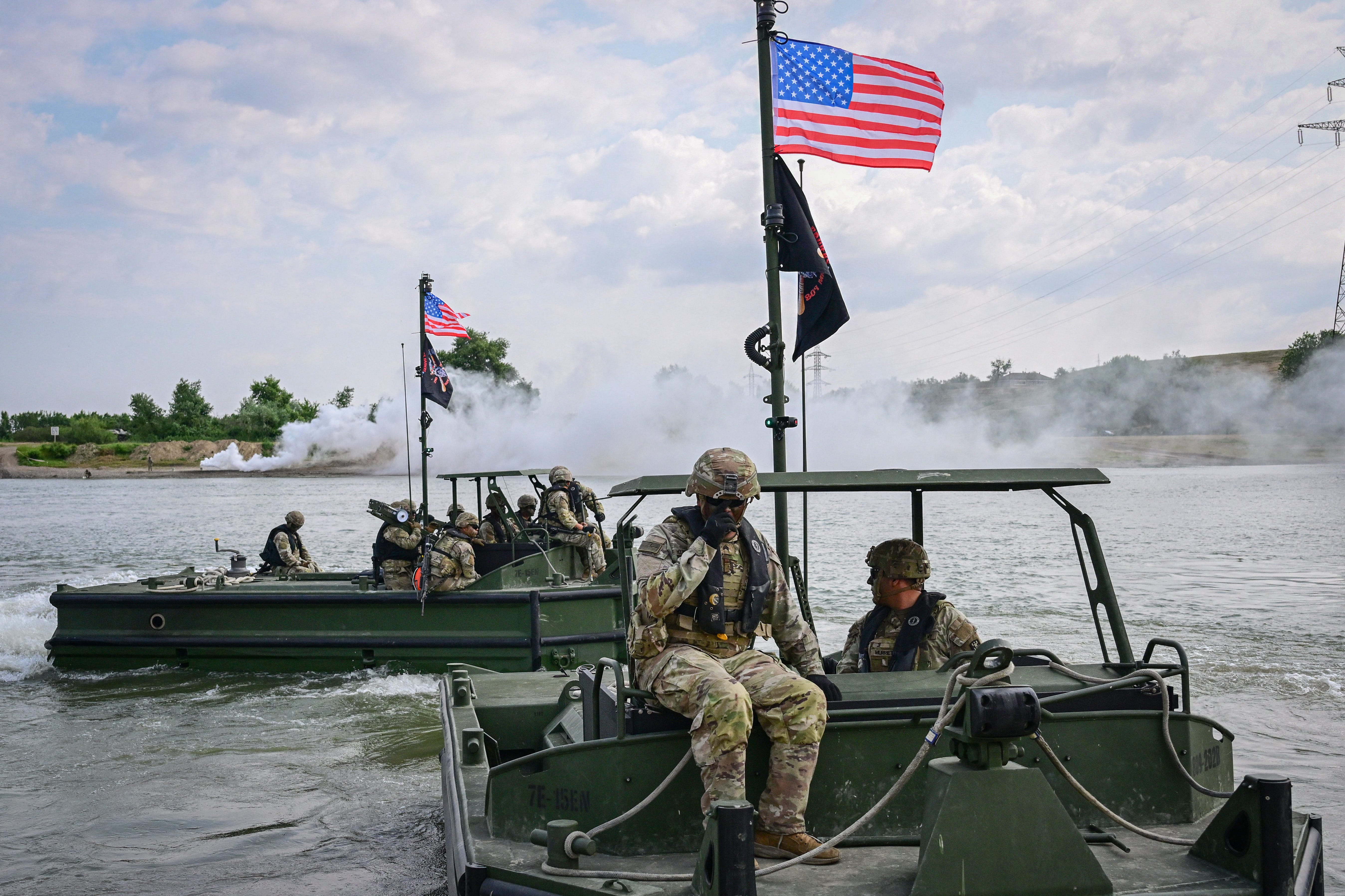
LAST WEEK, THE TRUMP ADMINISTRATION made two major national-security announcements that, taken together, capture just a bit of its incoherence. First came word from the Secretary of Defense that U.S. forces would be withdrawn from bases in Romania—bases that anchor NATO’s southeastern flank and project stability into the Black Sea region—because, as Pentagon officials put it, America must “refocus on defending the homeland” and “prepare for a future confrontation with China.” Then, only hours later, the president mused on social media that he might need to send American forces into Nigeria—Nigeria?—to “protect Christians” from persecution.
As confounding and shocking as those statements were individually, together they imply something far more dangerous: a scattershot national-security process that lurches from one impulse to the next, untethered to strategy, alliance, or reality. You don’t strengthen the homeland by pulling back from Europe’s frontline. You don’t deter China by announcing a religiously defined military intervention in Africa. And you certainly don’t project global leadership by letting strategic whiplash substitute for deliberate planning.
The withdrawal from Romania is not simply a geographic adjustment; it reverses a strategic arc that took years to build. I was part of the development of what became Joint Task Force–East, a planned rotational presence at bases “Turzii” (Câmpia Turzii) and “MK” (Mihail Kogălniceanu)—bases that were deliberately designed for that location and reconstructed to meet the demands of a contingency footprint as part of a decade-long effort to reinforce U.S. and NATO posture along Europe’s eastern flank. How do I know this? These actions were long-planned strategic sites that were conceived as part of the transformation of U.S. forces in Europe from 2004 to 2011, built to complement permanently stationed forces in Germany and Italy with rotational capacity in Romania.
Some administration voices suggested after the announcement that withdrawing forces from Romania merely returns U.S. posture in Europe to where it stood before Russia’s full-scale invasion of Ukraine. But that framing is misleading. Those forces were never “permanently stationed”; they were rotational by design, enabling rapid adaptation to emerging threats. After Russia’s invasion of Ukraine, that flexibility proved vital, as it allowed the United States and NATO to surge eastward, reassure allies, and respond to Russian aggression without renegotiating basing or improvising logistics in crisis. Removing that capability now is not a neutral reset—it dismantles one of the quiet success stories of allied deterrence just as its value has been proven.
MEANWHILE, AS THE TRUMP ADMINISTRATION undermines American credibility in Europe, it toys with a new military adventure in West Africa. The president’s seemingly offhand suggestion to send troops to Nigeria to “protect Christians” may play well to certain domestic evangelical audiences, but to anyone who has studied, served, or spent time in this region, it is strategically unsound and operationally unworkable.
I’ve been to Nigeria both as a military officer and more recently as a civilian with a U.S. health care organization that was partnering with a medical facility in Abuja, Nigeria’s capital. This is a dynamic, deeply religious country of more than 230 million people, divided roughly evenly between Muslims and Christians. Additionally, Nigerians are overwhelmingly pro-American, proud of their democracy, and fiercely protective of their sovereignty. The violence that scars parts of the nation—terrorism by Boko Haram and ISIS-West Africa in the northeast, criminal banditry in the northwest, farmer-herder clashes in the Middle Belt—are all driven by complex social, economic, and environmental forces. Faith often overlaps those conflicts, but it rarely defines them. To describe this as a campaign of religious persecution is to mistake the symptom for the disease.
Which leads me to believe that any U.S. military intervention framed around “protecting Christians” would not only misread the problem—it would inflame it. Nigeria’s constitution—much like ours—forbids establishing a state religion. For America to arrive proclaiming a religious mandate would offend both Nigerian Muslims and Christians, energize extremist propaganda about “crusader invaders,” and undermine the very communities we claim to defend.
Usually, the first thing a commander does when there is an indication their forces may be deployed somewhere is to look at a map. The operational realities of Nigeria are daunting. This is a country bigger than Texas, with vast ungoverned spaces, extremely dense cities, and few clear front lines. Following the 2023 coup in Niger (Nigeria’s neighbor to the north), U.S. forces were forced to withdraw from their key drone base at Agadez, leaving the United States with limited intelligence and basing options across West Africa. Launching a new expeditionary operation without host-nation consent would be illegal and strategically self-defeating. Even a small, invited presence would be a magnet for violence and a lightning rod for nationalist anger. “Protecting Christians” in a nation that large and complex is an impossible task—and pretending otherwise is policy malpractice.
Beyond the tactical and operational dynamics lies a deeper contradiction. After the announcement of the troop departure from Romania, the administration signaled that its National Defense Strategy will pivot toward homeland security and then toward addressing the issues related to China. Part of this pivot reportedly includes considering the dissolution of U.S. Africa Command (AFRICOM)—the headquarters stationed in Germany that is charged with building partnerships and managing operations on the African continent. The thought of eliminating AFRICOM while simultaneously hinting at a Nigeria deployment isn’t strategy; it’s chaotic improvisation. It shows a government reacting to headlines, not shaping national security.
When I wore the uniform, no commander promised “we can do that” before conducting mission analysis—the disciplined process of defining objectives, identifying means, assessing risk, and determining feasibility. A secretary of defense’s duty is to insist on that process, not to shortcut it. Secretary Hegseth’s “Yes sir” response to Trump’s social media post regarding a mission in Nigeria may sound loyal, but it’s the opposite of leadership. It replaces reason with deference and turns the world’s most capable military into an instrument of whim. And it puts America’s sons and daughters in harm’s way.
Proper analysis would reveal what common sense already knows: “Protecting Christians” is not a military objective. It’s a humanitarian aspiration requiring diplomacy, collaboration with host nation forces, policing, and governance. Troops can fight enemies, but they cannot reconcile communities or resolve religious conflicts. Using force for a moral symbol rather than a strategic end risks both American lives and American credibility.
Nigeria deserves partnership, not paternalism. A better path may be to help its government strengthen internal security, reduce corruption, and improve human rights performance; to support programs that mitigate civilian harm and manage farmer-herder disputes; and to bolster regional intelligence cooperation. The very things AFRICOM was designed to do.
When I was in Abuja a few years ago as a civilian, I met Nigerian doctors, teachers, and civic leaders who spoke warmly of the United States. They admired our reliability and professionalism. They didn’t want American soldiers patrolling their neighborhoods, but they did want American partnership to help build a safer, fairer country.
A foreign policy that withdraws from Romania while threatening to deploy to Nigeria is not a grand strategy; it’s meandering on the world stage. It weakens NATO, confuses allies on other continents, emboldens adversaries, and cheapens the seriousness of both diplomats and military forces. The United States remains the indispensable nation, but indispensability demands discipline and coordinated strength.
This isn’t discipline strategy or military strength—it’s drift. And drift, when it comes to matters of war and peace, is the most dangerous course of all.
 | A guest post by
|