It’s Not Yet Too Late to Save Our Democracy
The window is closing fast—but a handful of senators and Supreme Court justices could check Trump’s autocratic ambitions.

The only thing necessary for the triumph of evil is that good men do nothing.
ALTHOUGH THE ORIGINS OF THIS OBSERVATION are unknown, its wisdom should now weigh heavily on Republican members of Congress and conservative justices of the Supreme Court. For if they continue to do nothing—indeed, if they don’t move decisively in the coming months—to thwart President Donald Trump’s relentless drive to overturn the constitutional order, it will be game over: The window for saving American democracy will have been slammed shut.
Trump’s autocratic ambitions are now in plain view. Through executive actions, court filings, and public statements, Trump has repeatedly asserted, as he reminded his sycophantic cabinet last week, that as president “I have the right to do anything I want to do.”
The scope of powers he claims is breathtaking:
Ignoring unfavorable orders of lower courts.
Shutting down entire agencies created and funded by Congress.
Overriding congressional appropriations.
Firing, without cause, appointees to independent agencies serving unexpired terms.
Firing federal employees for following policies of previous presidents, for their political views, or for no reason at all.
Abolishing federal employee unions and abrogating their contracts.
Imposing any level of tariff on any good imported from any country at any time.
Nationalizing the national guard of any state for any purpose.
Imposing new voting or election rules on states.
Detaining and deporting any noncitizen, naturalized citizen, or citizen born to noncitizens.
Canceling, without cause, previously approved government contracts or grants.
Dictating speech and conduct codes, hiring policy, and curriculum in public schools and private universities.
Barring law firms from appearing before government agencies because of the lawyers they hire or the clients they represent.
Using the military to wage war on suspected drug traffickers.
Renaming cabinet departments established and named by statute.
And, lest we forget, fomenting an armed insurrection to overturn an unfavorable election.
Republican legislators and Republican-appointed justices have spun any number of rationalizations for their acquiescence to this march toward authoritarianism.
There’s the shopworn “elections have consequences” excuse, that presidents deserve deference and wide latitude in implementing policies promised to voters.
There’s the predictable blame-the-other-party rationale—that under Democrats the pendulum swung so far to the left that there is a need for an equally dramatic swing in the other direction.
But the most dangerous rationalization is also the most delusional: We can always stop Trump later if he tries to cross the line into outright dictatorship. Of course, that’s what the “good men” said about Caesar, Mussolini, and Hitler.
SO WHO, EXACTLY, ARE THESE REPUBLICANS who have the opportunity to halt the slide toward presidential omnipotence? Let us call them out by name.
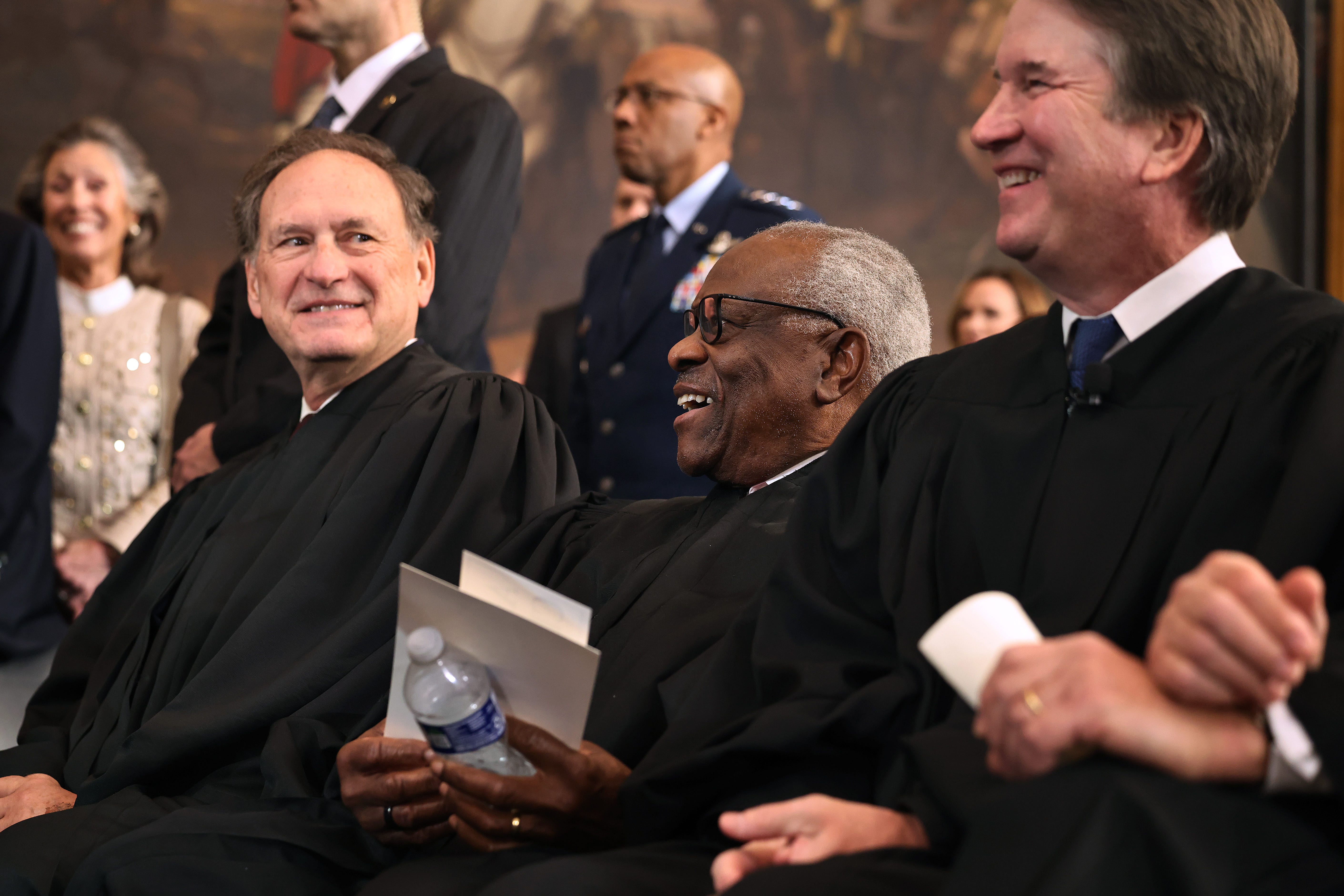
At the Supreme Court, Justices Clarence Thomas and Samuel Alito decided long ago to discard any pretense of impartiality or intellectual honesty to become warriors for the Republican cause. They now sit reliably in Trump’s corner.
Chief Justice John Roberts and Justice Amy Barrett, by contrast, have shown a willingness at times to join with the Court’s three liberals to say no to Trump’s overly expansive view of presidential power. But so far they have had little help from Trump appointees Brett Kavanaugh and Neil Gorsuch. In the coming months, in what should be slam-dunk cases on tariffs, the Federal Reserve, the national guard, and shutting down programs funded by Congress, Kavanaugh and Gorsuch will have to decide whether to continue to stick with their legal hair-splitting or finally make good on their long-professed devotion to the separation of powers, historical precedent, and the plain language of the Constitution. Anything less than an unambiguous 7–2 rebuke in these high-profile cases involving executive power will only embolden Trump to continue playing legal rope-a-dope with the courts.
In Congress, meanwhile, it falls to a gaggle of Republican senators to mount a last line of defense of the power and prerogatives of the legislative branch. Most Republicans in Congress are now so marinated in partisan grievance and wacko conspiracy theories that they will blindly follow Trump down the path toward one-man rule. But in the Senate, there are maybe a dozen Republicans who, albeit only rarely, have shown an instinct to resist the MAGA bullying: Shelley Moore Capito (West Virginia), Bill Cassidy (Louisiana), Susan Collins (Maine), John Curtis (Utah), James Lankford (Oklahoma), Lisa Murkowski (Alaska), Rand Paul (Kentucky), Roger Wicker (Mississippi), Todd Young (Indiana), along with lame ducks Thom Tillis (North Carolina), Joni Ernst (Iowa), and Mitch McConnell (Kentucky).
For these senators, the test will come later this month when the fiscal year draws to a close and new funding is required to keep the government open. Democrats, with good reason, will insist that any new funding contain explicit language requiring agencies to spend what Congress has directed. If enough of these Republicans are willing to stick together and join in those demands, they would have the votes to stop the Trump steamroller.
And what if those senators and those justices fail to meet this profile-in-courage moment? Well, one thing we know about Donald Trump is that he will respond to any show of weakness or lack of resolve by grabbing for even more power. And by year’s end he will have garnered all he needs to rig or steal the next election, dispatch the military to take control of Democratic-run cities, neutralize the business community, and weaponize every department of government against anyone or any institution that stands in his way. At that point, it won’t matter what Congress or the courts do. He’ll be in a position to simply ignore them.
Democracy, it turns out, doesn’t die in darkness. It dies in broad daylight when otherwise good but cowardly people fail to act until it’s too late.
 | A guest post by
|