‘One Battle After Another’ Review
Paul Thomas Anderson’s latest alternates between laughs, thrills, and pandering sogginess.


One Battle After Another is simultaneously thrilling on a moment-to-moment basis and kind of a slog: fast-paced yet repetitive, a movie with pretense to daring subversion that nevertheless hews neatly to nearly every political instinct of writer-director Paul Thomas Anderson’s intended audience, ensuring there’s never an uncomfortable moment.
The best sequence in the film is the opening forty minutes or so, in which the French 75—a Weathermen-style group led by the revolutionary Perfidia Beverly Hills (Teyana Taylor) and explosives expert Ghetto Pat (Leonardo DiCaprio)—free a group of illegal immigrants from a detention center. During the operation, Perfidia sexually humiliates Col. Steven Lockjaw (Sean Penn), who becomes infatuated with her; as the random bombings and other actions pile up, he has his eyes on her, allowing her to continue to work in exchange for sexual favors.
Anderson moves us with deftness and dexterity through this early action, guiding us from bombing to bombing with skill and highlighting the solipsistically sexual nature of Perfidia’s actions. She’s a self-styled revolutionary, but she’s really doing this because she gets off on it. She gets off on the danger, she gets off on Pat’s bombmaking, she gets off on dominating Lockjaw. It’s revolution as kink, more peccadillo than persuasive politics. (Turns out the key text to comprehending One Battle After Another isn’t Thomas Pynchon’s Vineland, on which it is loosely based, but Bryan Burrough’s Days of Rage: America’s Radical Underground, the FBI, and the Forgotten Age of Revolutionary Violence.) She is, ultimately, a self-centered narcissist, unwilling to be a proper mother to her daughter, professing jealousy that Pat pays more attention to her baby than her. That she couches her narcissism in the language of social consciousness only deepens her shame; it’s the one real political complication Anderson throws into the film, this recognition that people like Perfidia are more committed to themselves than any cause.
Perfidia, narcissistic to the end, betrays her comrades and goes on the lam, running to Mexico. Pat takes the baby and goes underground, where the two of them assume the names Bob and Willa Ferguson (played by Chase Infiniti as a teenager). The bulk of the film, some two hours, revolves around Bob and Willa being confronted by Lockjaw’s need to divine Willa’s lineage in order to obtain membership in a sort of Klan-adjacent secret society dedicated to maintaining white power in America or some such. Can the French 75 save Willa from Lockjaw’s clutches and revive the revolution? Or will the forces of naked reaction win the day via dirty tricks like initiating a false-flag Molotov cocktail attack on the police during a protest to allow cover for a crackdown?
Again: This is not a subtle film, precisely.
It’s in the back and forth over Willa where One Battle After Another really gets stuck in the muck. It’s not that nothing happens or that what happens is particularly confusing—if anything, the film is almost too straightforward for its own good—more that it’s all incredibly repetitive and every sequence takes twice as long as the action warrants. This repetitiveness occasionally pays off, particularly in a pair of sequences—one on a roof, the other on a stretch of hilly highway terrain—where a repeated action (namely, a character losing sight of something directly in front of them) results in a fairly humorous visual punchline. But even in these sequences, the punchlines are so clearly telegraphed because the setup is so long that it loses some of its oomph. It’s like Anderson doesn’t quite trust the audience if he doesn’t spend multiple shots repeating the same information so we’ll get what happens when it happens.
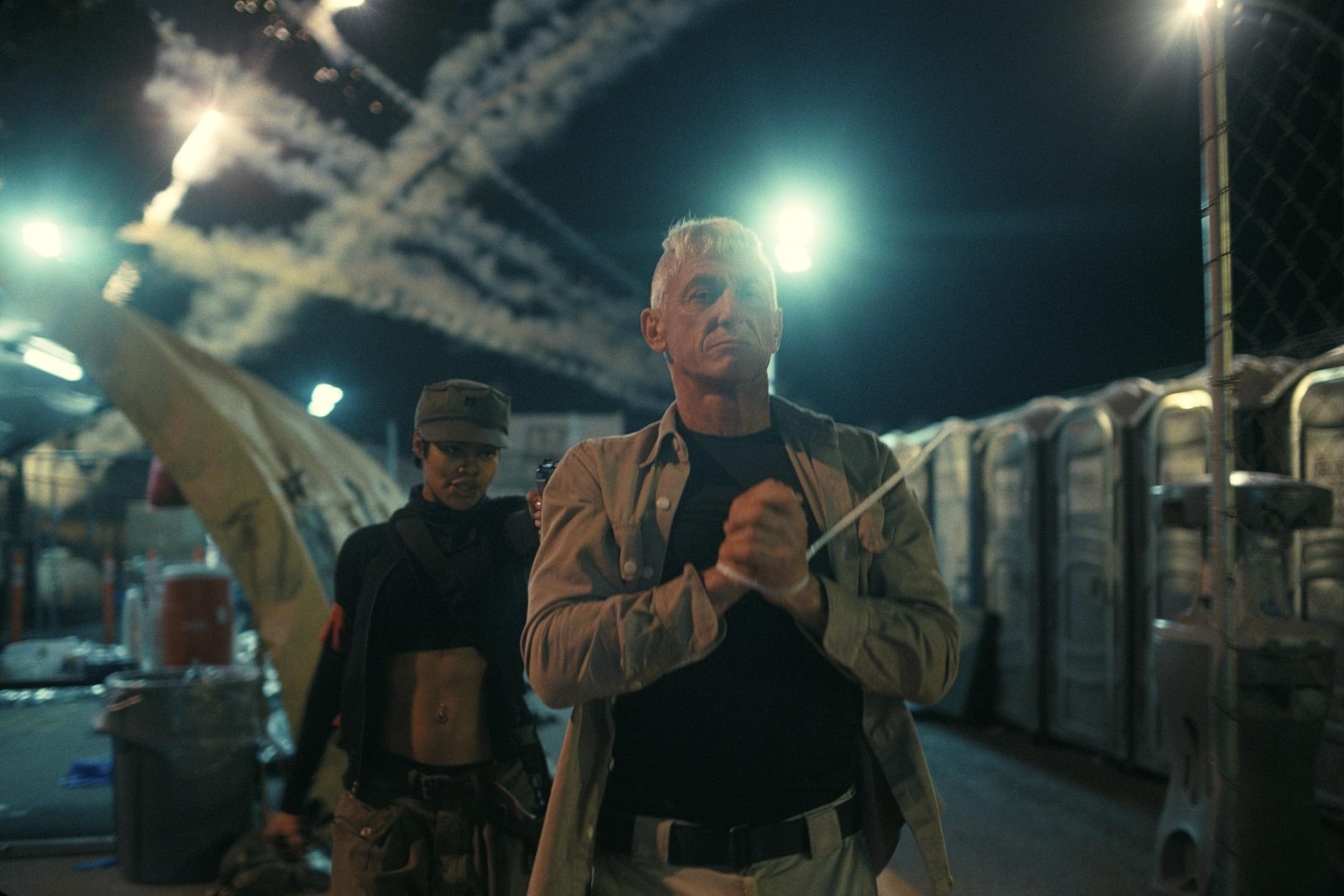
DiCaprio is occasionally very funny as Pat/Bob, the consummate burnout revolutionary unable to remember the passwords thanks to decades of drug and alcohol abuse, and Penn earned laughs every time he appeared onscreen, his stick-up-the-ass posture perfectly conveying his character’s mien in case you couldn’t quite grok it from his name (which, again, is “Lockjaw”). Tony Goldwyn is deeply amusing as the suave, smiling face of WASPy power in America, and there’s something absurdly charming about the naïve idea of a secret society having to quietly maneuver Americans into a crackdown on illegal immigration, as if migration hasn’t served as the flashpoint for reaction in virtually every Western nation over the last decade or so.
One Battle After Another is frequently very charming despite being overlong and didactic; it’s simply too pat to serve as anything like the referendum on our time it clearly aspires to be. Eddington covered similar ground earlier this year, but in a way that’s thornier, and thus funnier and more revelatory.
Penn's outstanding performance deserves mention, as does Willa's layered significance. Though the Christmas Adventurers are explicitly identified with the Klan—Lockjaw receives the “Bedford Forest” award!—it is also implicitly illustrated to be a not-so-cryptic American fascist cabal. Their final solution for a "clean" murder involves gassing and incinerating their victim. Lockjaw's office is in Suite 55 == “SS”. I cannot help but to associate American SS villain Lockjaw's relationship with his mixed-race daughter whom he wants shot with the actual story of the most famous Nazi SS film villain Amon Göth (portrayed by Ralph Fiennes in Schindler's List) whose own real-life granddaughter is half black and wrote the book “My Grandfather Would Have Shot Me.”
This is the history that struck me watching Willa's character: it's Anderson's representation of how real-life American fascists in power will deal with the complexities of an immigrant and mixed-race society, the same way that German fascists dealt with their own mixed society.
This is an important film with many dark subtleties about our current moment. It deserves its own Bulwark Film Club treatment. And watch it in VistaVision if you have the chance.
Wait. For a minute I thought Rick Dalton was back in a sequel.