A Milestone Pediatric Cancer Bill Fails at the Hands of Bernie
The Vermont senator is holding out for a bigger health care package. Advocates are asking: Is the price worth it?

FOR YEARS, THE PEDIATRIC CANCER COMMUNITY has tried to pass a single piece of legislation that would allow for more comprehensive drug treatments to be given to young patients.
The process has involved agonizing setbacks, intense private negotiations, and a sudden, unexpected change in fortune thanks to the advocacy of a dying child.
On Wednesday night, this long, laborious journey appeared close to ending with what advocates anticipated would be a triumph. The Mikaela Naylon Give Kids a Chance Act (named after that dying child) was heading to the Senate floor, where it was expected to be passed by unanimous consent. Having already passed the House, it would then head to Donald Trump’s desk. And there was no doubt in anyone’s mind that the president would sign the measure and—as is his wont—take personal credit for it.
Pediatric cancer advocates scrambled to get to the Senate to watch the moment. Reporters who had covered the issue, including this one, were given the heads-up about its imminent passage. At least three kids who are bereaved siblings of cancer victims and one pediatric cancer survivor sat in the Senate gallery.
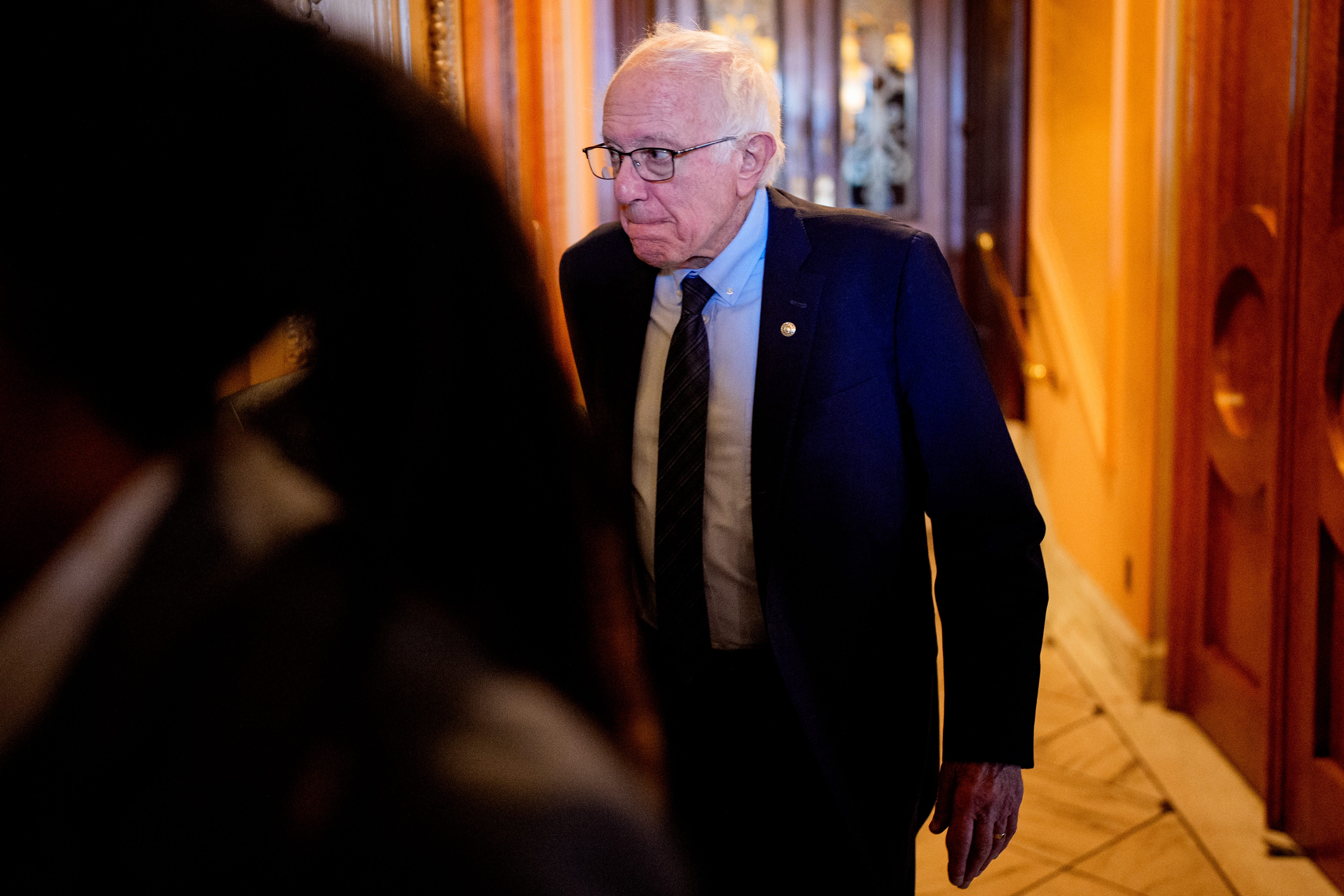
And then, it failed. A single senator stood in the way. It was Bernie Sanders.
In a dramatic, heated exchange on the Senate floor—caught by the C-SPAN cameras but largely missed by the news-consuming public—Sanders announced his opposition to quick passage for the bill. He did so not because he disagreed with its objective—which is to give the FDA the authority to push pharmaceutical companies to study combination drug therapies—but because he worried that extraneous provisions attached to it would make it harder to achieve other priorities. He argued that the Senate ought to be passing similarly important, bipartisan-supported health care measures along with it. His staff insisted to me that they would revisit the bill soon, and they seemed confident it would all get done in the new year.
But that’s not at all clear to the pediatric cancer community, which was left stunned by the vote.
“Everyone was just so exhausted and deflated and sad when we exited the gallery,” one member of the community told me. “It was a feeling of abandonment and confusion.”
The entire episode has raised a larger question about the motivations of lawmakers: What are their political and moral obligations in moments like these? Put another way: When is incremental legislative progress worth more than the continued pursuit of a bigger goal?
TO UNDERSTAND SANDERS’S OBJECTION, you need to go back to exactly one year ago. It’s December 2024, Donald Trump has been elected but is not president yet, and the U.S. Congress is trying to pass a year-end funding bill before heading out of town for holiday break. The funding bill that they were considering was meticulously crafted over the course of months. It included a slate of health care–related policies that Sanders, then the chair of the Senate Health committee, had helped negotiate with his Republican counterparts.
The bill was on the doorstep of passage through the Republican-controlled House when Elon Musk suddenly decided to take it upon himself to kill it. In a series of caustic tweets, he called for GOP lawmakers to scrap every element of the legislation that wasn’t a simple continuation of the current government policy. The health care components that had been negotiated were scrapped.
And then, for a brief moment, they looked like they might be revived.
In the hours after Congress passed that pared-down December 2024 funding bill, lawmakers revisited three pediatric cancer provisions. One of them, which would provide money for pediatric cancer research, passed the Senate with unanimous consent. The Give Kids a Chance Act failed. This time it was Sen. Rand Paul (R-Ky.) who objected.
Over the subsequent ten months, advocates tried to find avenues to bring the bill back up for reconsideration by Congress. It had more than enough support from both parties and in both houses to pass. But the procedural hurdles and the sheer amount of time it would take for it to get to the floors of the respective chambers virtually guaranteed it wouldn’t move. Then, in September, the logjam started to break up.
The pediatric cancer community held its annual lobbying days on the Hill, in which cancer-stricken kids go around to offices to push for legislative priorities. Among those who traveled to D.C. this year was Mikaela Naylon. Diagnosed with osteosarcoma—a form of bone cancer—in 2020, Mikaela had had, among other procedures, a below-knee amputation, multiple lung surgeries, radiation, and radioactive treatments. She relapsed four times.
Prior to heading to the Hill, her doctors had told her she had only a few weeks to live. Her parents told me that their daughter insisted that she spend that time advocating for the Give Kids a Chance Act.
Mikaela met with multiple lawmakers. And when she went back to Colorado, she continued meeting with them by Zoom. Eventually, she grew so weak that her parents had to do the talking for her while she listened. On October 29, Sen. John Hickenlooper reached out. Three hours later, Mikaela died. She was 16.
At that point, it was clear there was new momentum for getting the bill done. Rep. Mike McCaul, one of the legislation’s most impassioned champions, renamed it after Mikaela. Early this month, the House passed it unanimously.
But as the attention turned back to the Senate, it became clearer that this wasn’t going to be some sort of Aaron Sorkin script in which good intentions, sound reasoning, and warm feelings prevail. It was the brute process of legislating, which often involves a fraught balance of individual priorities, personal slights, and competing provincial interests.
For example, Rand Paul had come around to support a unanimous consent request on the Give Kids a Chance Act in part because lawmakers had added to it a provision he wanted: one that would give the FDA authority to share information about innovator (i.e., brand-name) drugs to prospective applicants. That specific provision is projected to save roughly $1.2 billion over the ten-year budgetary window (according to Hill aides), which would go into a Medicare account. Why does that matter, you ask? Because Sanders wanted the savings to be used to fund community health centers instead. And once money goes into Medicare, it’s hard to take it out for use elsewhere. No politician wants to be attacked for raiding a social safety net program.
That was just one problem that Sanders had with the bill. He also wanted all of the provisions that Musk scrapped back in December 2024 to be passed as well, not just the Give Kids a Chance Act. Among them: mandatory funding for the national health service corps and mandatory funding for the teaching health center program. Were they not important, too, he asked on the Senate floor.
“We must revive that bipartisan agreement that was worked on month after month after month by Democrats and Republicans,” Sanders said.
Efforts were made to try and push through. Sen. Bill Cassidy, who took over the chairmanship of the Senate Health, Education, Labor, and Pensions Committee from Sanders in 2025, tried holding out carrots, making what appeared to be a commitment to his colleague to help get community health care funding passed. Sen. Markwayne Mullin, a major proponent of the Give Kids a Chance Act, tried wielding a stick instead.
“He is literally killing kids in front of us because of his political movement,” he said of Sanders on the Senate floor. “It is ridiculous.”

Where this leaves the process is, frankly, in a sadly familiar state: shrouded in uncertainty. In a statement to me on Thursday, Sanders fired back at Mullin for objecting to reviving the bipartisan agreement that had seemed so close to passage back in December 2024. If the goal, Sanders asked, was to promote the health of children, then he could not understand why Mullin “would kill a proposal that brings more primary health care doctors, nurses and dentists to rural America. I hope Sen. Mullin rethinks his reckless decision, which endangers many lives. I strongly support the Give Kids a Chance Act. Primary care in America is in a state of crisis, we need to act NOW.”
Mullin’s office then passed along a statement from the Oklahoma senator noting that he is fine with funding community health centers but not as part of a “hostage situation.” For good measure, he called Sanders “The Grinch.”
“Bernie Sanders has been in Congress since I was 13 years old,” the statement read. He knows good and well the only reason the Mikaela Naylon Give Kids a Chance Act didn’t pass is because he’s the only person who objected to it. If it weren’t for The Grinch, our bipartisan bill would have passed by unanimous consent and become law before Christmas Day.”
The tit-for-tat may eventually resolve itself. The primal impulse to leverage these moments for bigger wins may end up exhausting itself. Or a compromise may be reached.
But it won’t come this year since the Senate left on Thursday evening for an extended holiday break.
Perhaps it will come at the end of January when Congress will need to pass another government funding fight. Or, perhaps, we may find ourselves back in this exact place yet again, one year from now, asking the least fortunate among us to continue to wait patiently for Congress to act when the one thing they do not have is time.
A heart-breaking example of sacrificing the good for the perfect.
People look at me like I am crazy when I say how much Bernie irritates me…and then some time passes and I soften a bit, and he pulls something like this again and I am right back where I started and I don’t care what anyone says. He has let the perfect be the enemy of the good so many times it has had real consequences for our country.