Pediatric Cancer Bill Torpedoed by Elon, Rand, and Bernie Finally Passes
It had broad bipartisan support but passage still required years of heartbreaking lobbying by extraordinarily dedicated children.

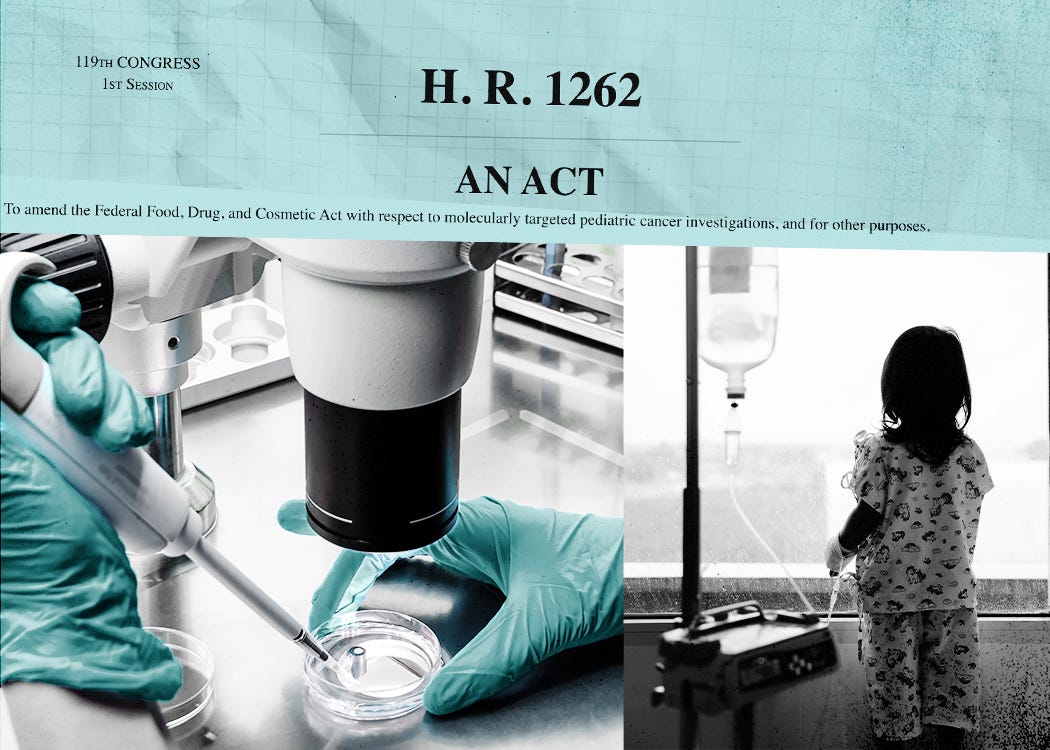
AMID ALL THE SQUABBLING, the name-calling, the steady drip of horrifying news and the seemingly complete rupture of our national politics, it can be tough to recognize, let alone acknowledge, positive developments when they occur.
But on Tuesday, something unambiguously positive did happen—and it happened in the most unexpected of ways: the normal order of congressional business.
The House of Representatives passed a handful of appropriations bills. In doing so, it sent those bills, which had previously passed the Senate, to the president’s desk, whereupon they were signed into law. Tucked inside one of those bills was the Mikaela Naylon Give Kids a Chance Act, a groundbreaking piece of legislation for kids suffering from cancer.
The bill will make pediatric drug research a bigger part of the pharmaceutical R&D process in addition to pushing pharmaceutical companies to study combination therapies. It’s also not the only pediatric cancer bill signed into law on Tuesday. The funding legislation included the Accelerating Kids’ Access to Care Act, which reduces paperwork requirements for children receiving out-of-state treatments; and fully funds several other initiatives designed to promote pediatric cancer research and data infrastructure.
All told, it was a monumental achievement for those who work in the field—not to mention a triumph for science. But it also offered a depressing portrait of the damage our coarse politics can wreak. It took five years for the Give Kids a Chance Act to make it into law. Some of the main advocates for these bills were cancer-stricken children working with the group Kids v Cancer. Nine of those children died while fighting for the very legislation that could eventually save the lives of children like them—or maybe even their own.
Bringing the bill to final passage proved a Sisyphean process. It was originally included as a rider on the Prescription Drug User Fee Act back in September 2022 before being removed at the last minute for reasons that remain somewhat unclear even to those who advocated for its passage. Then, in late December 2024, it was part of a major government funding deal that was suddenly scuttled after Elon Musk threw a tantrum over the inclusion of any new spending provisions. Hours later, Senate Democrats moved to consider it as a standalone measure, but Rand Paul (R-Ky.) objected.
During the summer of 2025, the bill secured more than enough votes in both the Senate and the House for it to comfortably become law. But Congress works in mysterious, byzantine ways and it never got consideration; it was left dangling in the legislative ether, waiting for another moment.
That moment arrived in December, when the bill passed the House and found its way to the Senate. But an effort to move it through unanimous consent—which requires that no senator voice an objection to the measure—failed once more. This time it was Sen. Bernie Sanders (I-Vt.) who objected. He wanted all the provisions that Musk insisted on removing in 2024 to be brought back. When he pushed for a bigger package, Senate Republicans pushed right back.
There was something particularly cruel about that last failure. In the leadup to it, a number of kids with cancer had gone to the Hill and lobbied congressional offices to pass the bill. Among them was Mikaela Naylon, who had been diagnosed in 2020 with osteosarcoma, a form of bone cancer. Mikaela had spent her final weeks talking with lawmakers over Zoom. Eventually she grew too weak to speak, and listened in as her parents did the talking. On October 29, her home state senator, John Hickenlooper, reached out to check in with Mikaela and update her once more about legislative progress. Three hours later, she was dead at just 16.
The bill was subsequently renamed after Mikaela. Her fellow advocates, themselves stricken with cancer, were in the Senate chamber to watch the vote in December. They had ventured there under the belief the measure would make it into law. And then, Sanders offered his objection.
The scene was wrenching. But they kept at it. They were back in the House gallery in late January when members passed an earlier version of the appropriations package they passed again on Tuesday. They would have been there again today, if not for school. All told, there were five House votes, four Senate votes—several of which involved painful, inexplicable, defeats—before there was success.
“These kids didn’t want their life and their death to mean nothing. They wanted to contribute,” Nancy Goodman, the founder and executive director of Kids v Cancer, told me. “Two of them specifically talked about that in the last days and weeks of their lives, that this is how they wanted to make a difference on earth, by getting this bill passed. This gave them a feeling of purpose.”
POLITICAL PROGRESS IS RARELY LINEAR. Often, lawmakers are more motivated to bicker, or to demand something bigger, or to feel comfortable with the status quo.
In the days before Tuesday’s vote, there was a lot of anger among Democrats, for example, at the prospect of passing the appropriations package. As they saw it, these votes are one of the few opportunities that the party has to extract concessions from the Trump administration. In particular, they wanted major, substantive reforms to the president’s approach to immigration enforcement and detention. They believed it was incumbent upon congressional Democrats to stop any funding bill—even ones that didn’t deal with the Department of Homeland Security—unless those reforms were made.
But last week, Senate Democrats instead decided to pursue a dual-tracked approach. They shortened debate on the DHS-specific funding bill to two weeks while simultaneously passing the others in a single tranche. And while 193 House Democrats voted against final passage, 21 of them supported it—providing the margin needed for it to make it through the chamber, 217–214.
In doing so, they secured some major wins, one that would have seemed virtually unthinkable in the early days of the second Trump administration, when Musk was running DOGE and the Office of Management and Budget was wantonly slashing programs near and dear to progressives’ hearts.
The funding bill for the Departments of Labor, Health and Human Services, and Education, for example, includes an increase of $400 million for the National Institutes of Health. It will fund Alzheimer’s and ALS research. It will boost support for women’s health. It includes $20 million for State Opioid Response Grants. It includes $1.1 billion for domestic and global HIV programs. It maintains federal investments in K-12 elementary schools. It even included funding for community health centers—which Musk had gotten cut—that Sanders had demanded back in December.
It does this all as the Trump administration continues to call for major cuts into all of these same initiatives (and in the case of the Education Department, its total elimination). Democratic officials also argue that the language is written in a way—codified to precise levels—that it will protect against future efforts by the Trump administration to try and claw that money back.
Of course, like any negotiated funding bill, these ones include GOP priorities. In this case, those involve cuts to several federal agencies that Democrats have prioritized, like $24 million from the Department of Education, $62 million from the Department of Labor, $5 million from the National Labor Relations Board, and the continued zeroing out of funds for National Public Radio.
It would also be naïve to imagine that the administration won’t still try to cut even further. But because these bills have now passed, the grounds of the future debates have shifted. And on a host of very significant fronts, real progress has been made.
IT WAS HOURS AFTER THE HOUSE had voted when I reached Goodman, the head of Kids v Cancer, on the phone. She was at a local restaurant in D.C., celebrating with five other moms, three of whom had lost children to cancer.
Goodman lost her son Jacob at the age of 10 to medulloblastoma, an aggressive form of brain cancer. And following his death, she devoted her life to this field of advocacy. She’s been working on the Give Kids a Chance Act since 2021. She believes the legislation will, in her words, “create the infrastructure where scientists can actually find cures.”
And yet, as we spoke, Goodman sounded more exhausted than elated. She wasn’t dispassionate so much as in a state of disbelief. The world of politics had always offered her disappointments. She wasn’t aware of how to respond when it produced a breakthrough.
“It turns out after eleven times you come to Congress to see if it will pass you start to feel like it is just your work,” she told me. “I’m still operating under the assumption that there must be another vote, and the week after that, and the week after that.”
Thirty minutes after we hung up, Trump signed the bill into law.
"Then, in late December 2024, it was part of a major government funding deal that was suddenly scuttled after Elon Musk threw a tantrum over the inclusion of any new spending provisions."
This sentence is an absolute indictment of our politics. At least Rand Paul and Bernie Sanders are senators. They are accountable to their voters for their decisions, who have empowered them with the ability to object to legislation. But Elon Musk is not an elected official. He is a white supremacist, pedophile-curious, ketamine-addicted man-child with a reputation for genius that is utterly undeserved (the geniuses behind his companies are the engineers and scientists) and enormous delusions of grandeur. He is not accountable to anyone, it seems. And in December 2024, Joe Biden was president. Musk had absolutely no official powers whatsoever.
I'm on the verge of saying we should set aside 1776, despite this year being what it is, and start partying like it's 1793.
Thank you for writing this, Sam. It's well written and presented the reality of how hard it can be to get something through our political system at any time, not just during Trump years. But I've been feeling recently like the only possible news until Trump leaves office is going to be horrible news, and it's hard to hang onto the kind of hope that we need to keep joy in our lives. And joy, as a lot of people are noticing lately, is a type of medicine, and a weapon against the dark. So reading this gave me something I really needed today. (Along with watching Rocky Kanaka of Sitting with Dogs save a terrified dog from life and death in a shelter. Two forms of inspiration in one day. Wow.)