Pete Hegseth Said Military Chaplains Are ‘Degraded.’ He’s Wrong.
Military chaplains exist to help service members, not indoctrinate them.

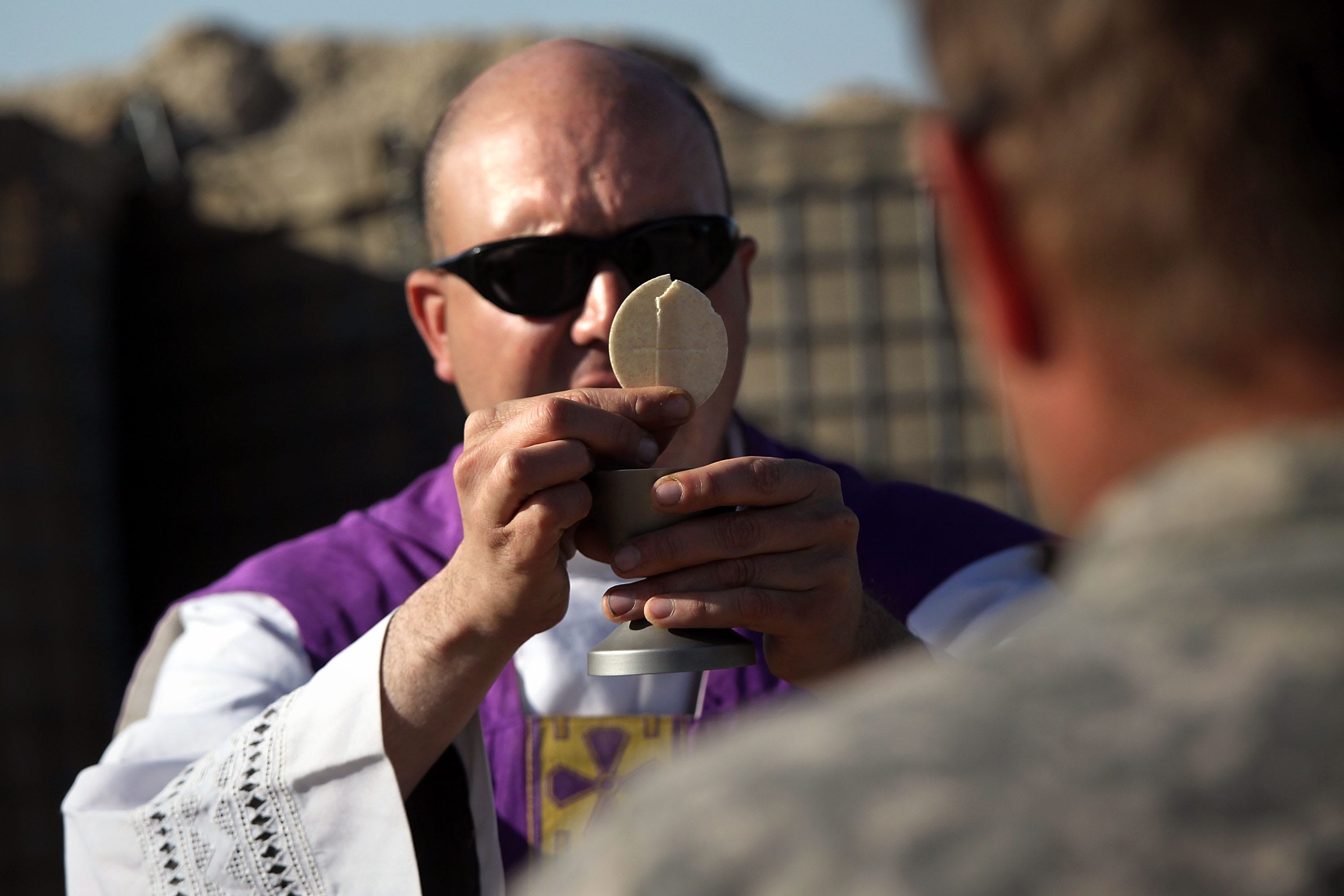
LAST WEEK, SECRETARY OF DEFENSE Pete Hegseth released a video on social media asserting that “a real problem facing our nation’s military” is “the weakening of our chaplain corps.” In the clip, he cited parts of the Army’s newly published Spiritual Fitness Guide—the online version of which has since been unpublished—as evidence of the decline, arguing that the religious role of chaplains had “degraded” into what he characterized as “self-help and self-care” with too much attention toward “feelings.” In doing so, he made two fundamental mistakes: one about the chaplain corps and the Army document he attacked, and the other about the composition and needs of the force he is tasked with leading.
The Spiritual Fitness Guide was not doctrinal guidance for chaplains, nor did it reflect or define their professional responsibilities, training, or standards. Those are governed by Army regulations and doctrine that have remained remarkably consistent for generations. The role of military chaplains has never been ambiguous, nor has it been “degraded.” As Hegseth correctly pointed out, military chaplains are the conscience of the force, and I expect that many of them—all clergy—would take offense at the suggestion that any Army publication could shake their religious and moral foundations.
From the formal establishment Chaplain Corps in July 1775, chaplains have carried a critical dual mission according to Army regulations: “to provide religious support according to the faith of the soldier, and to advise commanders on moral, ethical, and spiritual matters affecting the force.” Chaplains are commissioned officers and members of what is called the commander’s “special” staff (alongside judge advocates and medical officers). Chaplains bring unique perspectives to their commanders: assessments of the spiritual and moral climate of their assigned units, early indicators of moral injury of the soldiers in the command, insight into family stress issues, and counsel to their commanders during moments when decisions carry profound human cost.
I know this, as I have been blessed to serve with phenomenal chaplains during war and peace.
As a young major in a cavalry squadron during Desert Storm, I watched as our chaplain, Capt. Steve Thornton, demanded to be allowed to remain with our unit despite a serious injury that doctors warned could permanently disable him. He offered a calming presence and counsel, despite his debilitating pain, as soldiers prepared for and then entered combat. Later, when I commanded a large training unit at Fort Knox, my squadron chaplain, Lt. Col. Tony Torrer, a Catholic priest, used his ministry to strengthen morale and cohesion in a unit that had a complex and thankless mission. As a Brigade Commander at Fort Lewis, my Protestant brigade chaplain, Maj. Wesley Smith, professionally guided his six subordinate battalion chaplains representing multiple faiths, while also quietly preserving marriages strained by repeated deployments; his actions directly affected our unit’s readiness and retention.
When I commanded the 1st Armored Division during the surge in Iraq, one of our Muslim chaplains—whose name I’ll withhold to respect his privacy—organized combined Ramadan observances for our few American Muslim soldiers and many of our Iraqi counterparts. At the same time, our Jewish chaplains—rabbis—helped Christian commanders understand as their Jewish soldiers celebrated Shabbat and Hanukkah, reinforcing dignity and inclusion within diverse formations.
One of my most memorable moments came when our senior division chaplain, Lt. Col. Terry Meek, and his deputy, Maj. Lou Del Tufo, exemplified their ministerial and military profession at its best: mentoring junior chaplains, advising commanders, and providing quiet counsel when the moral weight of injured and lost soldiers was the heaviest. They were always present when commanders wrestled privately with decisions that carried life-and-death consequences.
Watching Hegseth’s video, one could easily get the impression that the Army’s Spiritual Fitness Guide was a manual for chaplains, encouraging them to downplay religious counseling in favor of psycho-emotional therapy. In reality, the manual—subtitled “Purpose Leads, Strength Follows”—was a soldier-readiness resource developed to help soldiers and leaders think about spiritual readiness as one component of overall fitness. As part of the Army’s Holistic Health and Fitness program, it was a companion to other documents addressing physical, mental, nutritional, and sleep readiness. This spiritual guide was intentionally broad and inclusive, structured much like a physical fitness or leader-development guide. It offered concepts and practices to help soldiers develop purpose, resilience, and meaning—regardless of religious belief. While chaplains contributed to its development, it was never intended to define chaplain doctrine or replace existing regulations or practices.
Presenting this guide as evidence of a “degraded” Chaplain Corps is exceptionally misleading. Reform and critique are legitimate leadership responsibilities. But accuracy and method matter. Publicly denigrating a Corps that has served faithfully for 250 years undermines the trust commanders depend upon. If senior civilian leaders believe chaplain doctrine requires revision, there is a professional way to do it: provide guidance in private, task revisions through the service staffs, and engage the different services’ Chiefs of Chaplains. A public video that misrepresents current practice does none of those things. Instead, it undermines trust.
If Hegseth’s objective is to strengthen moral grounding and spiritual resilience in the Army, the answer is not to misread guidance documents or narrow a role that has never been narrow. The answer is to understand the Chaplain Corps as it exists—and as it has always existed. Chaplains are servants, ministers, facilitators, and partners with commanders. They provide religious support in accordance with their faith and advise leaders with honesty, discretion, and courage. They carry no weapons. They accept absolute confidentiality. They walk toward grief, doubt, and moral injury when others cannot. In doing all this, chaplains remain what they have always been—the moral anchor of our fighting force.
At one point in the video, Hegseth compares the number of times God is mentioned in the document—once—to the number of times other terms are mentioned. But about one in five Americans doesn’t believe in God. Less than two thirds are sure God exists. The purpose of a chaplain isn’t to preach a particular faith to the force, but to look after their spiritual needs at the extreme of human stress and experience, up to and including death. That goes as much for the atheists or the soldiers who believe in many gods as for those who share the secretary’s religion.
Secretary Hegseth closed his video with “Merry Christmas,” which I have no doubt was sincere. But in a force where chaplains minister daily to Christians, Jews, Muslims, Buddhists, Hindus, and those with no religious preference, leaders learn that inclusion is often conveyed as much by what is acknowledged as by what is omitted. Chaplains understand this instinctively. It is part of their professional discipline. That is how they are most faithful—to the profession of arms, to the Constitution, and to the Army the Founders envisioned, free from religious persecution.